Mount Everest entered a defining new phase in 2025, as the climbing season produced an unusually dense cluster of world records that reshaped how high-altitude achievement is understood. The mountain became a testing ground for extremes of human endurance, speed, and adaptation, with milestones ranging from record-breaking multiple summits by Sherpa climbers to unprecedented sea-level-to-summit ascents completed in just a few days. Alongside these performance breakthroughs, 2025 also highlighted deeper structural changes in Everest climbing, including advances in acclimatization technology, more sophisticated expedition systems, and a growing shift toward Nepali climbers as central figures in global mountaineering records.
This article examines the full scope of those 2025 Everest achievements, breaking down the most significant world records across endurance climbing, speed ascents, age-based milestones, inclusion-first achievements, and technical descents. It also places these records within the broader evolution of Himalayan mountaineering, showing how changing training methods, verification systems, and international participation are redefining what is possible on the world’s highest peak.
Which Mount Everest Records Drew the Most Attention in 2025?
The 2025 spring climbing season opened to extraordinary momentum. Nepal's Department of Tourism issued approximately 468 climbing permits for the south (Nepal) side alone, and by the end of May, an estimated 846 climbers had summited across both sides of the mountain. But beyond raw volume, what captured global headlines were records that weren't just milestones of endurance, they were rewritings of what the human body and spirit can accomplish at 8,848.86 metres.
A short list of the season's most buzzworthy achievements includes a Sherpa's 31st summit, a 29-year-old completing four ascents in 15 days, a 40-year-old engineer reaching the summit from sea level in under four days, and a blind Indian woman standing atop the world for the first time in history as a visually impaired female climber. Add to that the first-ever ski descent without supplemental oxygen in September 2025, and you begin to understand just how pivotal this year was.
What most people overlook is that records on Everest rarely occur in isolation. They reflect advances in preparation science, evolving expedition technologies like biometric monitoring and hypoxic tent training, and the growing role of Nepali high-altitude professionals in driving the frontier of what's possible.
Which Overall Achievements Became New World Records?
Here's a concise overview of the records confirmed by Guinness World Records (GWR) and Nepal's Department of Tourism during the 2025 season:
Most Everest summits (male): Kami Rita Sherpa, 31st ascent (May 27, 2025)
Most Everest summits in a single season: Tashi Gyalzen Sherpa, 4 summits in 15 days (May 9–23, 2025)
Fastest sea-level to Everest summit: Andrew Ushakov, 3 days, 23 hours, 7 minutes (May 15–19, 2025)
First visually impaired woman to summit Everest: Chhonzin Angmo (India), May 19, 2025
Youngest American woman to summit Everest and complete the Seven Summits: Emma Schwerin, age 17 years, 2 months, 24 days (May 15, 2025)
Most Everest summits by a non-Nepali climber: Kenton Cool (UK), 19th ascent (May 17–18, 2025)
First complete ski descent of Everest without supplemental oxygen: Andrzej Bargiel (Poland), September 22–23, 2025
Each of these records represents a category of achievement that redefines the art of the possible, whether through raw speed, extraordinary endurance, or the power of inclusion.
Kami Rita Sherpa remains the undisputed centrepiece of Everest's record landscape: he summited for the 31st time on May 27, 2025, and Kami Rita Sherpa's Guinness-recognized 32nd summit in the Department of Tourism's 2026 register confirms he extended that mark again in May 2026.
Why Did These Records Gain Global Recognition?
Global recognition came not just because records were broken, but because of who broke them and how. Kami Rita Sherpa's 31st summit drew attention because the previous record was his own. Tashi Gyalzen's four summits in 15 days challenged the biological assumption that human bodies need prolonged recovery between high-altitude pushes. Andrew Ushakov's sub-four-day climb upended the traditional 50-day acclimatization model for a general audience.
Perhaps most importantly, Chhonzin Angmo's summit as the first visually impaired woman to climb Everest struck a universal chord. Her story went beyond mountaineering, it became a message about disability, determination, and redefining boundaries for millions of people who don't climb mountains at all.
Who Set New World Records on Mount Everest in 2025?
The 2025 Everest season brought together an unusually diverse cast of record-breakers, from a 55-year-old Sherpa guide extending a three-decade legacy to a 40-year-old New York engineer with no professional athletic background. What united them was not a shared profile but a shared refusal to accept the conventional ceiling of what Everest allows. Nepali climbers dominated the endurance and multi-summit categories, while international climbers pushed boundaries in speed, youth, and technical firsts. Understanding who they are, and how they prepared, reveals as much about the evolving science of high-altitude performance as it does about individual will.
Which Climbers Reached Historic Milestones?
Kami Rita Sherpa remains the undisputed centrepiece of Everest's record landscape. At 55 years old, he stood on the summit for the 31st time on May 27, 2025, at around 4:00 a.m., guiding a team from the Indian Army Adventure Wing while working with Seven Summit Treks. What makes this achievement quietly staggering is that his nearest competitor, fellow Nepali Sherpa Pasang Dawa, has managed 29 ascents. Kami Rita leads by two full summits and has been climbing the mountain nearly every year since 1994, sometimes twice in a single season.
Tashi Gyalzen Sherpa pushed the absolute limits of seasonal endurance by executing an unprecedented multi-summit campaign, leveraging advanced recovery protocols to achieve multiple ascents in a single, grueling spring window. His first ascent came as part of the rope-fixing team that opened the 2025 route. He then returned solo, guided a client, and went again solo, all within the same spring window. Working with 8K Expeditions, Tashi used oxygen tents, strategic rest periods at lower camps, and satellite weather monitoring between pushes. Guinness World Records officially certified this as the most Everest ascents in a single season.
Andrew Ushakov, a 40-year-old Ukrainian-American engineer from New York, became the fastest person to reach Everest's summit from sea level. He departed New York and, utilizing specialized pre-acclimatization, achieved an extraordinarily fast door-to-summit time, drastically compressing the traditional 50-day timeline and reaching the peak just days after arriving at Base Camp. He'd spent over 400 hours in a hypoxic tent to simulate altitude acclimatization, bypassing the traditional six-week rotation schedule that governs standard trek acclimatization entirely. He did this with a recently injured hand, and without any professional athletic background.
Andrzej Bargiel, a 37-year-old Polish ski mountaineer, summited Everest on September 22, 2025, after nearly 16 hours in the death zone above 8,000 metres, without supplemental oxygen. He then clipped into his skis at the summit and descended the treacherous South Col route, navigating as far as the terrain safely allowed before the impassable Khumbu Icefall, completing the first-ever oxygen-free ski descent of the mountain's upper faces. Bargiel had attempted this in 2019 and 2022 before conditions finally cooperated.
Which Sherpas and Support Teams Made Record History?
.avif)
Kenton Cool of the United Kingdom set the record for the most Everest summits by a non-Nepali climber, reaching the top for the 19th time on May 17–18, 2025. He was accompanied by Nepali climber Dorji Gyaljen Sherpa, who logged his 23rd summit on the same climb. Cool first summited in 2004 and has returned nearly every year since.
Pasang Dawa Sherpa reached 29 summits in 2025, making him the second-most prolific Everest summiteer in history, trailing only Kami Rita. The growing number of Sherpa climbers with 20+ summits underscores the professional depth within Nepal's high-altitude community.
It's worth noting that the 2025 season saw a striking shift: Nepalese support staff on the mountain now outnumber foreign clients. It's worth noting that the 2025 season saw a striking shift: Nepal's official country-by-country 2025 summiteer register shows Nepali climbers made up 464 of the season's 748 confirmed summiteers, with China, India and the United States rounding out the largest foreign contingents.
What Speed Records Were Achieved on Mount Everest in 2025?
Speed climbing on Everest entered a new era in 2025, moving beyond the traditional base-camp-to-summit model into something far more ambitious: sea-level-to-summit timing that captures the full journey from departure to the top of the world. The shift matters because it changes the baseline of comparison and demands a completely different preparation strategy, one built around pre-adaptation rather than on-mountain acclimatization rotations. Andrew Ushakov's sub-four-day achievement demonstrated that hypoxic tent training, if applied rigorously enough, can compress what once took 50 days into under four. For trekkers and aspiring climbers, these records signal that the frontiers of Everest speed will increasingly be won in training environments long before anyone boards a flight to Kathmandu.
Which Ascents Established New Timing Benchmarks?
The most headline-grabbing speed record of 2025 belonged to Andrew Ushakov's sea-level-to-summit achievement. What most coverage missed was how his method contrasted with conventional speed climbing. Traditional speed records measure base camp to summit; Ushakov measured from sea level, a far more demanding standard that accounts for the full logistical and physiological journey.
The four British former Special Forces soldiers, Garth Miller, Alastair Carns, Anthony Stazicker, and Kev Godlington, summited Everest in under a week from departing London as part of a Furtenbach Adventures speed expedition. They utilized rigorous hypoxic tent training and advanced, WADA-compliant pre-acclimatization protocols for preparation. While their record was not certified separately in the same category as Ushakov's, their achievement further demonstrated that rapid-ascent methodology was having a genuine moment in 2025.
Tashi Gyalzen's record of four summits in 15 days also represents an extraordinary speed benchmark, not for a single push, but for recovery and repeat performance at extreme altitude. Each ascent from Camp IV to the summit typically takes 8–12 hours. Completing this cycle four times within a fortnight, while maintaining the physical capacity to guide clients, is a testament to a level of altitude acclimatization that science is still trying to fully explain.
How Were These Speed Records Verified?
Speed records on Everest are not verified on the mountain, they're verified after. For sea-level-to-summit attempts, timestamps are recorded using GPS devices, flight manifests, and biometric trackers. Ushakov's expedition company, Elite Exped (founded by renowned climber Nimsdai Purja), submitted detailed documentation including departure timestamps, satellite tracking logs, and summit photographs with timestamped GPS data.
For records seeking Guinness World Records certification, applicants must submit a formal application supported by independent witness statements, photographic and video evidence, expedition company records, and in many cases, Nepal's Department of Tourism summit certificate. The GWR team reviews these submissions independently before issuing an official certificate.
Nepal's Department of Tourism also maintains its own summit registry, which forms the backbone of official verification. Climbers must submit summit certificates with photographs and evidence within three months of their climb.
What Age-Related Records Were Broken on Mount Everest in 2025?
Age records on Everest occupy a unique space in mountaineering history because they reflect not just individual achievement but the evolving policies and ethics that govern who is permitted to attempt the mountain at all. Nepal's minimum age regulations mean that the youngest-ever records are effectively frozen in time, no future climber can legally replicate certain historic ascents from the Nepali side, making existing youth records structurally permanent. In 2025, the most significant age milestone came not from a teenage prodigy but from a 17-year-old American who turned Everest into the final chapter of an 18-month multi-continent mission. On the other end of the spectrum, climbers in their 50s continued to set endurance benchmarks that quietly challenge the assumption that high-altitude performance peaks in early adulthood.
Which Climbers Became the Youngest Record Holders?
Emma Schwerin, a 17-year-old from Bozeman, Montana, summited Everest on May 15, 2025, at the age of 17 years, 2 months, and 24 days. In doing so, she became the youngest American woman to reach the summit and, having previously climbed the highest peaks on every other continent, the youngest woman in the world to complete the Seven Summits challenge. She was guided by Tendi Sherpa, an 18-time Everest summiteer, and climbed alongside her father, Sam, making them the first father-daughter duo to jointly complete the Seven Summits.
Emma trained intensively while attending school at Choate Rosemary Hall in Connecticut, incorporating 4-hour Stairmaster sessions and mountaineering courses in Bolivia. Her summit of Everest came after completing Kosciuszko, Kilimanjaro, Denali, Mont Blanc, Aconcagua, and Vinson, all within 18 months.
It's worth understanding an important nuance here: age records on Everest are subject to regulatory constraints. Age records on Everest are also shaped by the Sixth Amendment to Nepal's Mountaineering Expedition Regulation, published in the Nepal Gazette in February 2025, which ended solo expeditions above 8,000 metres and tightened guide requirements ahead of the 2025 season. Because these records are governed by national regulations, any future competitor would need to meet permit requirements, making some of the youngest-ever records difficult or impossible to repeat on the Nepali south side. Emma's achievement as the youngest American female at her age is therefore more structurally significant than it might first appear.
Which Climbers Became the Oldest Record Holders?
No new overall oldest-summiteer record was set in 2025, the existing record still stands with Yuichiro Miura of Japan, who summited at 80 in 2013. However, Kami Rita Sherpa's continued summit streak at age 55 while setting new multi-summit milestones represents a different kind of age-related significance: the longevity of elite high-altitude performance. Climbing Everest at 55, as a guide responsible for client safety, while managing the physiological demands of a 31st ascent over three decades, speaks to extraordinary long-term conditioning.
The 2025 season also saw continued participation from climbers in their 60s and 70s, reinforcing an Everest trend where experience increasingly offsets the presumed advantages of youth.
Which Nationality-Based Records Were Established in 2025?
The 2025 season reinforced a clear pattern: record-breaking on Everest is no longer the exclusive domain of Western expedition teams, and the diversity of nations represented on the podium of achievement has never been broader. Nepal led in every endurance and multi-summit category, while India, the United States, the United Kingdom, and Poland each claimed distinct milestones that reflect their own mountaineering cultures and ambitions. India delivered two of the most emotionally powerful records of the year, and the Department of Tourism's verified 2025 summiteer counts by nationality confirm India led all foreign nations with 61 confirmed summits, ahead of the United States' 47. What these nationality-based records collectively reveal is that Everest has become a genuinely global competition, with different countries excelling in different record categories rather than competing in the same lane.
Which Countries Produced New Everest Record Holders?
Nepal dominated the 2025 record landscape. Kami Rita Sherpa (31 summits), Tashi Gyalzen Sherpa (4 summits in a season), and Pasang Dawa Sherpa (29 total summits) all extended Nepal's position as the unrivalled home of Everest's most extraordinary climbers. These aren't outliers, they reflect a systemic excellence built across generations in Solukhumbu's Sherpa communities.
India delivered two of the most emotionally powerful records of the year. Chhonzin Angmo became the first visually impaired woman to summit Everest on May 19, 2025. India also led in permit holdings in 2025 with 87 permits, the highest of any single foreign nation, reflecting growing institutional investment in Himalayan mountaineering.
The United States added a significant milestone through Emma Schwerin's record as the youngest American woman to summit Everest and complete the Seven Summits. The US held 83 permits in 2025, the second-highest of any foreign country.
The United Kingdom's Kenton Cool extended his record for the most Everest summits by a non-Nepali climber, reaching the top for the 19th time. Cool has been a fixture of Everest seasons for over two decades.
Poland achieved one of the most technically complex records of the year through Andrzej Bargiel's oxygen-free ski descent from the summit to Base Camp in September 2025, a feat that had eluded multiple previous attempts across three years.
How Did International Participation Influence Record Trends?
The 2025 season revealed a fascinating dynamic: while foreign permit counts remained relatively consistent (468 on the south side), the nature of record-breaking increasingly reflected specialization. Countries like Nepal dominated repeat-summit and endurance categories. Western nations contributed speed, youth, and inclusion milestones. Poland claimed a technical extreme-sport record. India brought disability and representation records into the conversation.
This diversification of record categories reflects a broader global awareness of Everest as a platform for human stories beyond summiting alone. What's changing is who the world watches, and for what reason.
What Women's Records Were Broken on Mount Everest in 2025?
Women's climbing on Everest has been on a trajectory of rapid advancement, and 2025 added a dimension that no previous season had delivered, the inclusion of a visually impaired summiteer whose achievement expanded the definition of who the mountain belongs to. Beyond the headline records, the 2025 season saw women contribute meaningfully to speed, youth, and exploration categories that have historically been male-dominated. What most coverage misses is that female Everest records in 2025 weren't just athletic benchmarks, they were cultural statements about accessibility, representation, and the broadening narrative of adventure. For anyone following women's mountaineering, 2025 stands as a turning point rather than simply another milestone.
Which Female Climbers Achieved Historic Feats?
Chhonzin Angmo stands as the defining female achievement of the 2025 Everest season. Born in Kinnaur, Himachal Pradesh, she lost her sight at age eight due to a medication reaction. Rather than letting blindness define her horizon, she trained across years, completing a basic mountaineering course, summiting peaks in Ladakh including a 15,632-foot Siachen Kumar Post and an unnamed 19,717-foot peak, and receiving India's National Award for Empowerment of Persons with Disabilities in 2024. On May 19, 2025, she reached the summit of Everest at 8:34 a.m., guided by Dandu Sherpa and Om Gurung. She became the world's first visually impaired woman to summit the highest mountain on Earth.
Her preparation strategy is worth understanding in detail. Without the visual cues that most climbers depend on for route reading and hazard assessment, Angmo built extreme trust with her guiding team, trained her proprioception and auditory awareness, and mentally mapped each section of the climb using sound and tactile feedback. Common mistakes in understanding her record: people often assume guides essentially "carry" visually impaired climbers up the mountain. In reality, high-altitude climbing requires the physical output, breathing discipline, and mental endurance of every climber regardless of support. Angmo generated every step herself.
Emma Schwerin (discussed in the age section above) added her voice to women's Everest achievement through the youngest American female summit and Seven Summits completion in a single year, both records documented and recognized by climbing organizations.
How Did Women Contribute to Everest Record History?
Women's climbing on Everest has accelerated noticeably since Kristin Harila and Phunjo Jhangmu Lama set female speed records in 2023 and 2024 respectively. The 2025 season added a new dimension: inclusion. Chhonzin Angmo's summit expanded what the word "possible" means in women's high-altitude climbing beyond the metrics of speed or age. Her achievement demonstrates that the most meaningful records aren't always the fastest, sometimes they're the ones that open doors for entirely new populations of climbers to imagine themselves on the mountain.
What Multiple-Summit Records Were Achieved in 2025?
Multiple-summit records represent a category of Everest achievement that demands something fundamentally different from a single summit attempt: the ability to recover at extreme altitude and repeat a physiologically brutal process without allowing cumulative fatigue to become catastrophic. In 2025, two Nepali climbers redefined what "multiple summits" can mean, one by extending a career total that now stands unchallenged in history, the other by compressing four complete ascent cycles into a single 15-day window. These records share a common thread: both required a level of altitude adaptation that sits at the outer edge of what exercise science currently understands. They also reflect a growing recognition that the most extraordinary Everest achievements of the modern era are increasingly Nepali stories, not just Nepali support stories.
Which Climbers Reached Everest the Most Times?
Kami Rita Sherpa's 31st summit stands apart from everything else in this category. To put it in perspective: the next closest competitor, Pasang Dawa Sherpa, has completed 29 summits. Third place sits considerably below both. Kami Rita's career spans more than three decades of nearly uninterrupted Everest climbing, beginning as a porter in 1994 and evolving into the most accomplished high-altitude guide on Earth. He has also summited other 8,000-metre peaks including K2, Cho Oyu, Manaslu, and Lhotse, bringing his career total to at least 44 ascents of 8,000-metre peaks, a figure continuously tracked and recognized by Guinness World Records.
Kenton Cool reached the 19th summit mark for non-Nepali climbers, cementing a legacy built since 2004. His record stands in a category that separates professional guides from Nepali high-altitude workers, a useful distinction for understanding how records are sometimes siloed by nationality designation.
Which Repeat Ascents Became New Records?
Tashi Gyalzen Sherpa's four ascents in a single spring season redefined what a "repeat ascent record" looks like. Before 2025, the highest number of summits in a single season had been three. Tashi's four pushed the absolute ceiling. What made his record distinct from Kami Rita's cumulative achievement is the time compression: four summit pushes within 15 days, requiring constant monitoring of oxygen levels, weather windows, and physical recovery.
The practical reality of repeat ascents at this frequency is physiologically brutal. Each descent to lower camps is not rest, it is active recovery in an oxygen-thin environment. Muscle repair, hydration, and sleep quality are all compromised above 5,000 metres. The fact that Tashi could perform four full summit-push cycles within a single fortnight suggests a level of altitude adaptation that is genuinely outside the normal distribution of human performance.
How Were New Mount Everest Records Confirmed in 2025?
Setting a record on Everest and having it officially confirmed are two separate events that can be months apart, a distinction that most media coverage glosses over in the rush to publish summit announcements. The verification process involves multiple layers, Nepal's Department of Tourism summit certificates, GPS-logged data, independent witness statements, and for Guinness World Records certification, a formal submission review that can take considerable time after the season ends. What this means practically is that climbers often return home to ordinary life while the paperwork that defines their place in history is still being reviewed. Understanding how records are confirmed also helps explain why some achievements are universally accepted within days while others take until the following year to carry an official certificate.
Which Organizations Verified the Achievements?
Two primary bodies carry official weight in Everest record verification.
Guinness World Records is the most globally recognized certification authority. GWR officially recognized Kami Rita Sherpa's 31st summit and Tashi Gyalzen Sherpa's four-in-a-season record in 2025, issuing formal certificates following independent review of submitted evidence. GWR's review process is rigorous: it requires multiple independent witness statements, GPS-logged data, and official documentation from expedition operators and government bodies.
Nepal's Department of Tourism serves as the national register of all Everest summits from the south side. Every permitted climber who summits must submit a certificate with photographic and GPS evidence within three months. This registry is the foundational data source that all other verification bodies, including GWR and the Himalayan Database, draw from.
Expedition companies also play a critical supporting role. Organizations like Seven Summit Treks (Kami Rita's operator), 8K Expeditions (Tashi Gyalzen's operator), Elite Exped (Ushakov's operator), and Pioneer Adventure (Chhonzin Angmo's operator) maintain internal records, provide witness documentation, and serve as the first point of public communication when records are achieved.
What Evidence Was Used to Validate New Records?
For standard summit records, evidence packages typically include timestamped GPS coordinates at the summit, high-resolution photographs at the peak showing identifiable features, independent witness statements from fellow climbers and Sherpas, expedition company records, and Nepal Department of Tourism summit certificates.
For speed records like Ushakov's sea-level-to-summit time, flight manifests, hotel check-in timestamps, helicopter departure logs, and biometric tracking data (Ushakov used smart pill and biometric monitoring technology throughout his climb) were submitted. His summit time of 9:22 a.m. on May 19 was GPS-logged to the second.
For unprecedented firsts like Chhonzin Angmo's visually impaired summit, verification required medical documentation of her condition, guide testimony, and independent corroboration from expedition organizer Pioneer Adventure. This created a new documentary template for disability-related records on Everest, one that will likely inform how future such records are assessed.
One thing most climbers and spectators don't fully appreciate: achieving a record and having it officially certified are two distinct events. Many records are announced by expedition companies immediately after the summit, but GWR certification can take months of back-and-forth documentation review. Tashi Gyalzen's Guinness certificate, for example, was formally issued in early 2026, months after the summit.
How Did the 2025 Records Compare With Previous Everest Milestones?
Every record set in 2025 existed in dialogue with what came before it, and in most cases the gap between the old mark and the new one tells you something important about the pace of progress. Kami Rita's 31st summit was an incremental extension of his own record; Andrew Ushakov's speed achievement was a categorical leap that reduced the previous benchmark by a factor of three. Some 2025 records built on decades of gradual improvement, while others, like Andrzej Bargiel's oxygen-free ski descent, created entirely new record categories that had no predecessor to measure against. Taken together, the comparison reveals a two-speed dynamic in Everest history: slow, cumulative progress in endurance categories, and sudden, technology-enabled breakthroughs in speed and technical performance.
Which Earlier Records Were Surpassed?
Kami Rita's own 30-summit record (set in 2024) was the immediate predecessor to his 31st. His annual progression, adding one or two summits each season, has been a consistent feature of Everest history since 2019.
The previous "most summits in a single season" record stood at three ascents before Tashi Gyalzen pushed it to four. The three-summit mark had been considered by many seasoned mountaineers to be a practical ceiling given the recovery demands involved.
The sea-level-to-summit speed record was previously held by Roxanne Vogel, who completed the journey in 12 days in 2019. Ushakov's 3-day-23-hour time demolished that benchmark by a factor of three, representing a categorically different kind of achievement rather than an incremental improvement.
Kenton Cool's own record of 18 summits (his previous mark) was extended to 19 in 2025, consistent with his established pattern of summiting nearly every year since 2004.
While Hans Kammerlander completed a partial ski descent from 300 metres below the summit without oxygen in 1996, and Davo Karničar completed the first full descent with oxygen in 2000, Bargiel's achievement aimed to establish a new milestone for a complete, oxygen-free descent.. Andrzej Bargiel's feat was not a broken record in the traditional sense, it was a first, creating a new record category entirely.
What Trends Emerged From Recent Record Progress?
Several clear trends define the direction of Everest record-making as of 2025.
Speed and non-traditional preparation are increasingly central. The sea-level-to-summit concept, hypoxic tent training, and pharmaceutical-adjacent preparations like xenon gas suggest that the frontier of Everest speed records will be technical and scientific, not just athletic.
Sherpa excellence is being globally recognized in its own right. Historically, the contribution of Nepali guides was framed as support for foreign climbers. The 2025 season, with Kami Rita's 31st summit, Tashi Gyalzen's four-in-season record, and Pasang Dawa's 29th, reframed Nepali climbers as the primary protagonists of Everest history.
Inclusion records are gaining mainstream legitimacy. Chhonzin Angmo's achievement suggests that future Everest records will increasingly emerge from communities historically excluded from high-altitude mountaineering. This signals a maturing in how mountaineering defines ambition and achievement.
The Everest death toll is declining relative to traffic. With 846 estimated summits in 2025 and only five reported deaths, the safety ratio has markedly improved compared to previous high-volume years. Better weather forecasting, improved commercial infrastructure, and more professional support ratios have contributed to this.
How Should You Explore Mount Everest Achievements With Guided Treks?
You don't need to summit Everest to connect with its records, culture, and history. The Everest Base Camp trek, which traces the paths walked by Kami Rita, Tashi Gyalzen, and virtually every climber who has set foot on the mountain, offers trekkers a direct window into what makes this mountain extraordinary.
Walking through Namche Bazaar, visiting the villages of Solukhumbu, and reaching Base Camp at 5,364 metres gives you a visceral understanding of what climbers face before they even begin their summit push. Following the same Everest Base Camp trek route, you see the Khumbu Icefall that Tashi Gyalzen navigated four times in a fortnight. You pass the teahouses where Kami Rita grew up in a Sherpa family steeped in mountaineering tradition. You breathe the same thinning air that Chhonzin Angmo moved through without the benefit of sight.
Guided treks add depth that self-guided routes simply cannot provide. For a full breakdown of the route, teahouses, and daily itinerary, our complete EBC trek guide contextualizes the records you've read about with firsthand knowledge, which expeditions passed through, what the mountain looked like during the 2025 season, and what it takes in terms of physical preparation and cultural respect to explore this region responsibly.
If you're considering the trek, the best season for the trek falls in the pre-monsoon (March–May) and post-monsoon (September–November) windows. Both coincide with the climbing seasons that produced the 2025 records discussed throughout this article.
Can Nepal Intrepid Treks Help Travelers Experience Everest Culture?
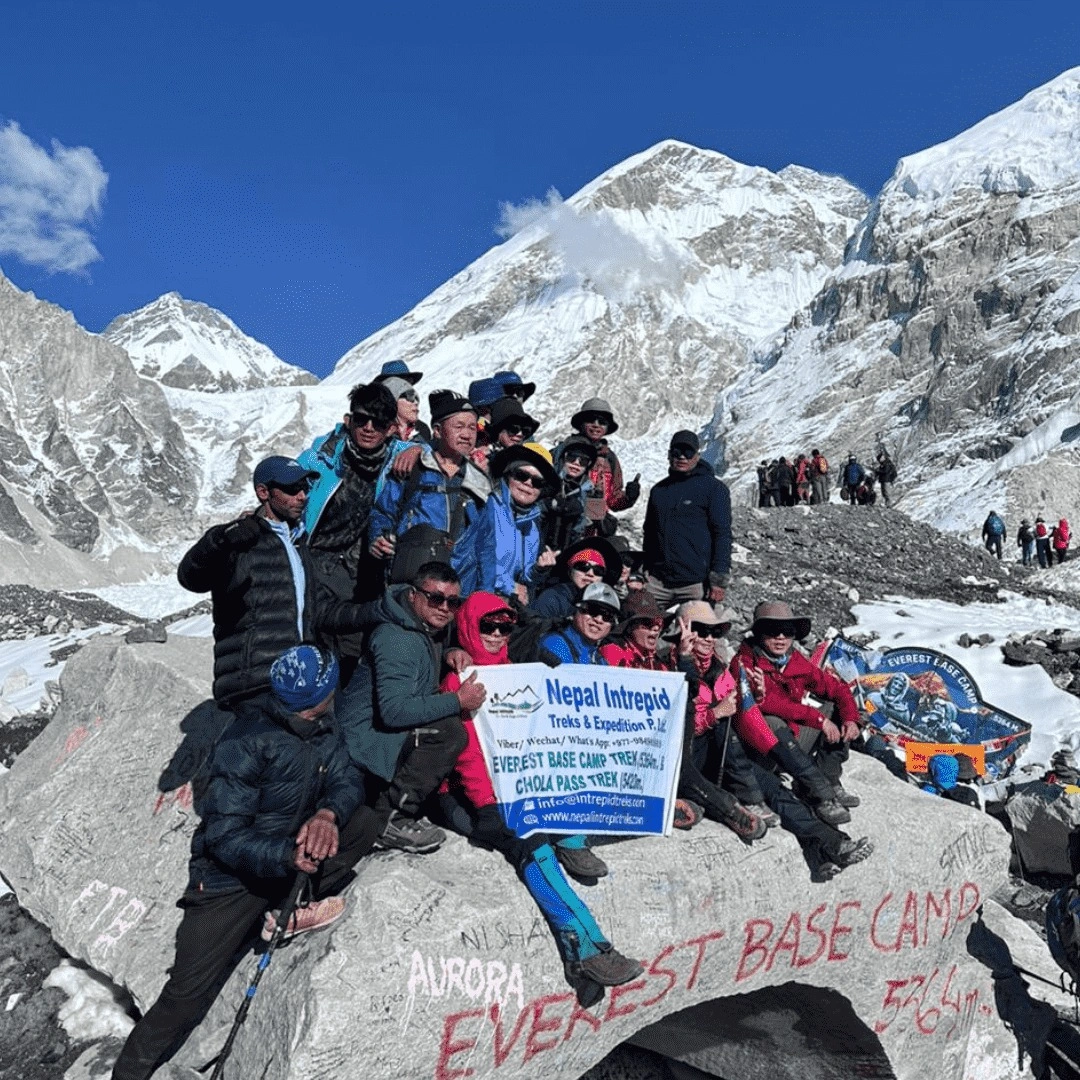
Nepal Intrepid Treks offers guided Everest region experiences designed to connect trekkers with the cultural, geographical, and mountaineering heritage of the Khumbu Valley. Their itineraries are built around local knowledge, responsible tourism practices, and an understanding of what makes this region singular in the world.
For travelers inspired by the 2025 records, whether by Kami Rita's perseverance, Chhonzin Angmo's courage, or the raw speed of Andrew Ushakov's ascent, our Everest Base Camp Trek package provides a guided pathway to experience the same landscape that produced these historic achievements. Getting the most out of a trek in this region means more than following a trail; it means understanding the Sherpa community, the mountain's ecology, and the long story of ambition that runs through every step from Lukla to Base Camp.
What Are the Key Takeaways About New World Records on Mount Everest in 2025?
The 2025 Everest season did not just produce records, it produced a new framework for thinking about what Everest records mean. Here's what you should carry forward:
Kami Rita Sherpa's 31 summits represent the single most dominant individual achievement in Everest history. No one else is close, and he shows no indication of stopping. His story is not just about endurance, it's about a Sherpa family tradition becoming a global legacy.
Tashi Gyalzen Sherpa's four summits in 15 days permanently moved the ceiling on seasonal endurance. This is a record that breaks the mental model most people have about high-altitude acclimatization and recovery. Expect this record to define a new aspiration category for elite Nepali climbers.
Andrew Ushakov's 3-day-23-hour sea-level-to-summit time shows that non-traditional preparation methods, centred around pre-adaptation rather than mountain rotation, can compress the Everest timeline dramatically. This has implications for future speed records and the accessibility of rapid ascents.
Chhonzin Angmo's visually impaired summit is arguably the most symbolically important achievement of the year. It expands who can aspire to Everest beyond the world of professional athletics and changes the conversation around disability and adventure permanently.
Emma Schwerin's youth record and Seven Summits completion at 17 demonstrates the role of structured, family-supported preparation in achieving world-class mountaineering results, and underscores that the youngest-ever records, governed by age restrictions, belong to a protected window of history.
Andrzej Bargiel's oxygen-free ski descent opened an entirely new record category that didn't exist before September 22, 2025. It also confirmed that autumn Everest expeditions, historically overshadowed by the spring season, can produce world-first achievements.
The 2025 season, viewed in full, tells you something important about where Everest is going: records are becoming more diverse in category, more inclusive in who breaks them, and more technically sophisticated in how they're achieved. If you're a trekker, a mountain lover, or simply someone captivated by the outer edge of human potential, 2025 was the year Everest reminded the world that its story is far from finished.