Mount Everest, the highest mountain on Earth at 8,848.86 meters, represents the most analyzed case study in high-altitude mortality and expedition risk. As of 2026, 339 confirmed deaths have been recorded since 1921, according to the Himalayan Database, covering all climbing routes, causes, and expedition types. This total includes both paying climbers and high-altitude support workers, primarily Sherpa guides, whose repeated exposure to hazardous zones like the Khumbu Icefall significantly increases their risk. While Everest holds the highest absolute death toll of any 8,000-meter peak, its overall fatality rate per summit attempt remains relatively low compared to mountains like K2 and Annapurna, making it a uniquely data-rich environment for understanding how people die at extreme altitude.
Everest fatalities are not random events but the result of identifiable patterns involving avalanches, falls, altitude illness such as HACE and HAPE, and decision-making failures in the Death Zone above 8,000 meters. Over the past century, the mountain’s risk profile has shifted dramatically due to advances in weather forecasting, fixed-rope infrastructure, supplemental oxygen systems, and commercial guiding standards, reducing mortality rates by more than 60% since 2000. Modern data reveals that survival depends less on physical fitness and more on expedition quality, acclimatization strategy, oxygen use, and adherence to turnaround protocols. Understanding how many people have died on Mount Everest requires more than a single number, it requires analyzing where, why, and under what conditions those deaths occur.
How Many People Have Died on Mount Everest in Total?
As of 2026, 339 people have died on Mount Everest, according to the Himalayan Database compiled through December 2025. The breakdown by route is 229 deaths on the Nepal (South) side and 110 deaths on the Tibet (North) side. Together they represent every fatality from avalanche, fall, altitude illness, disappearance, and other causes across more than a century of climbing history.
The total reflects climbers who died both on the mountain and at Base Camp. It does not include a small number of missing persons presumed dead but never confirmed.
What Is the Exact Death Rate on Mount Everest Per Summit Attempt?
Across all 13,737 recorded summits (through December 2025), the overall death rate stands at 1.06 deaths per 100 summits. Broken down by route:
Nepal (South) Side: 9,887 summits, 229 deaths, 1.07 deaths per 100 summits
Tibet (North) Side: 3,850 summits, 110 deaths, 1.05 deaths per 100 summits
Those rates are strikingly close, which surprises most people. The Nepal side dominates in absolute numbers because it carries approximately 69% of all Everest traffic. The Tibet side's slightly higher raw percentage reflects fewer climbers overall, not a more dangerous route by design.
The overall 43% summit success rate, summits divided by all attempts above Base Camp, means that for every 100 climbers who leave Base Camp intending to summit, 43 reach the top and roughly 1 dies.
How Has the Everest Death Rate Changed Over Time?
The death rate has declined dramatically across three distinct eras:
1921–1999 (expedition era): Normalized death rate of approximately 1.81 per 100 climbers. Climbers pioneered new routes with limited weather forecasting, basic oxygen systems, and no fixed-rope infrastructure. The period produced 170 deaths over 79 years.
2000–2014 (early commercial era): Death rates fell sharply as guiding companies standardized routes, introduced structured acclimatization protocols, and expanded supplemental oxygen use.
2015–2025 (modern commercial era): Normalized death rate declined to approximately 0.69 per 100 climbers, the lowest in Everest's climbing history. From 2010 to 2025, the mountain averaged roughly 7 deaths per year.
The decline reflects specific advances in weather forecasting, oxygen delivery systems, fixed-rope infrastructure, and organized guiding models, all covered below.
How Many People Have Died on Everest by Year? (Recent Seasons)
The most critical recent seasons:
2023: 17 deaths, the deadliest modern season, driven partly by a record 479 permits issued by Nepal
2024: 8 deaths
2025: 5 deaths, one of the lowest totals in decades, attributed to more stable weather and improved expedition preparation
The 5 confirmed deaths in 2025 were: Filipino climber Phillip II Santiago (died at Camp IV, exhaustion); Indian climber Subrata Ghosh (died near the Hillary Step, altitude illness and exhaustion); Peniri Sherpa (heart attack at Camp I); Lanima Sherpa (altitude sickness at Base Camp); and Gimma Dorji Sherpa (brain hemorrhage). All 5 occurred on the South (Nepal) side.
The all-time deadliest years on record:
2015: 22+ deaths, the April 25 earthquake triggered a devastating avalanche through Base Camp
2023: 17 deaths, a modern-era record
2014: 16 deaths, a single serac collapse in the Khumbu Icefall killed 16 Sherpa guides on April 18
1996: 15 deaths, including the May 10 storm events documented in Into Thin Air
What Are the Most Common Causes of Death on Mount Everest?
The 4 leading documented causes of death on Everest are avalanche (79 deaths), falls (78 deaths), Acute Mountain Sickness including HACE and HAPE (48 deaths), and exhaustion (32 deaths). These 4 causes account for 237 of the 339 total fatalities, approximately 70% of all deaths recorded through December 2025.
The full cause breakdown by route from the Himalayan Database:
Cause | Northeast Ridge | Southeast Ridge | Other South | Other North | Total |
Avalanche | 9 | 41 | 13 | 14 | 79 |
Fall | 18 | 34 | 18 | 8 | 78 |
AMS (HACE/HAPE) | 12 | 31 | 0 | 5 | 48 |
Exhaustion | 12 | 19 | 0 | 1 | 32 |
Illness (non-AMS) | 5 | 20 | 1 | 1 | 27 |
Exposure/Frostbite | 11 | 10 | 2 | 3 | 26 |
Icefall Collapse | 0 | 17 | 2 | 0 | 19 |
Disappearance | 4 | 6 | 0 | 3 | 13 |
Crevasse | 0 | 10 | 0 | 0 | 10 |
Falling Rock/Ice | 0 | 5 | 0 | 0 | 5 |
Other/Unknown | 3 | 2 | 1 | 1 | 7 |
Total | 74 | 195 | 34 | 36 | 339 |
The Southeast Ridge (South Col route) accounts for 195 deaths, 57% of all Everest fatalities, driven by its traffic volume, not inherent danger relative to other routes.
Why Do Avalanches Kill More Climbers Than Any Other Single Cause?
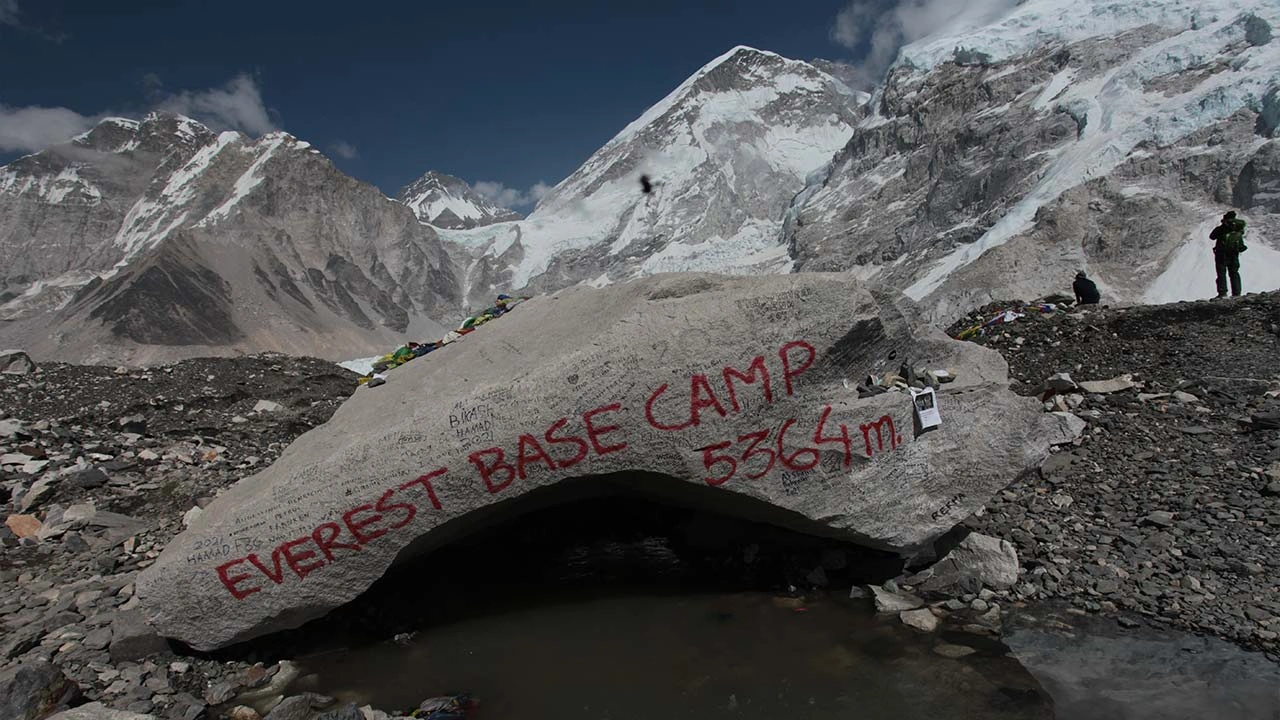
Avalanches have claimed 79 lives, the highest death toll of any single cause on Everest. The primary hazard zone is the Khumbu Icefall on the South Col route, a 700-meter section of shifting glacial ice between Base Camp (5,364 m) and Camp I (6,065 m).
The April 2014 disaster illustrates the risk precisely. A serac, a column of glacial ice estimated at several thousand tons, collapsed at approximately 6:45 AM on April 18, falling directly onto a group of Sherpa guides preparing to ferry equipment. All 16 died. It remains the deadliest single-event accident in Everest history.
What most accounts omit: Sherpa guides cross the Khumbu Icefall 30 to 40 times per season while fixing ropes, breaking trail, and ferrying loads for clients. A paying client might cross it 4 to 6 times total. The exposure asymmetry is extreme, which directly explains why Sherpa deaths are disproportionately caused by avalanche and icefall collapse.
How Do Falls Kill Climbers on Everest?
Falls account for 78 deaths, nearly equal to avalanches. The distribution pattern reveals a critical behavioral driver: the majority of fatal falls occur on the descent, not the ascent.
Summit fever, the cognitive bias that compels climbers to continue past established safety turnaround times, is the primary contributing behavior. Climbers who summit after 2:00 PM face dramatically increased exposure to deteriorating light, falling temperatures, and physical depletion on the descent. Most professional guides enforce a hard 2:00 PM turnaround regardless of proximity to the summit.
The 2 highest-risk fall zones on standard routes are the Hillary Step (a near-vertical 12-meter rock face just below the summit on the Southeast Ridge) and the Northeast Ridge cornices on the North Col route. Fixed ropes reduce but do not eliminate fall risk, rope failure, unclipped harnesses, and hypoxia-induced loss of motor coordination remain contributing factors.
What Is Altitude Illness and How Does It Kill Above 8,000 Meters?
Altitude illness, encompassing Acute Mountain Sickness (AMS), High Altitude Cerebral Edema (HACE), and High Altitude Pulmonary Edema (HAPE), accounts for 48 confirmed deaths and likely contributes to many exhaustion and disappearance fatalities where the root cause is hypoxia.
At altitudes above 8,000 meters, oxygen partial pressure is approximately one-third of sea-level values. The human body cannot acclimatize at this altitude, it only deteriorates. Blood oxygen saturation without supplemental oxygen typically falls to 60–70% (sea-level normal: 98–99%), producing measurable cognitive impairment within 10 to 15 minutes.
HACE causes progressive confusion, loss of coordination, ataxia, and hallucinations before unconsciousness. HAPE fills the alveoli with fluid, producing breathlessness and asphyxiation. Both conditions are reversible in early stages, but only with immediate descent of at least 300 to 1,000 meters. A climber experiencing HACE or HAPE may lack the physical and cognitive capacity to initiate or sustain descent without assistance.
What Is the Role of Supplemental Oxygen in Everest Survival?
Supplemental oxygen is the single strongest predictor of survival on Mount Everest. Of the 339 total fatalities through December 2025, 180 deaths (53%) involved climbers not using supplemental oxygen. Among summit-attempt climbers specifically (excluding Sherpas working lower on the mountain where oxygen is not standard), the contrast is decisive:
Category | Total Attempted | Total Summited | Success Rate | Deaths | Death Rate |
With supplemental oxygen | ~7,246 | ~5,769 | 80% | 75 | 1.03% |
Without supplemental oxygen | ~2,369 | 99 | 4% | 28 | 1.18% |
Only 232 climbers, approximately 1.7% of all summiters, have reached the top of Everest without bottled oxygen since 1953. The success rate without oxygen is 20 times lower than with it.
An important nuance: at least 128 of the 180 non-oxygen deaths occurred during route preparation, primarily Sherpas working below Camp I in the Khumbu Icefall, where supplemental oxygen is not standard practice. The 2014 and 2015 disasters account for the majority of those deaths. Adjusting for this, the mortality gap between oxygen-assisted and non-oxygen summit attempts narrows but remains meaningful.
Tibet-side climbers use non-oxygen approaches at lower rates than Nepal-side climbers, likely reflecting the higher average experience level required. China's requirement that climbers demonstrate prior high-altitude experience (a completed ascent of a 7,000-meter peak) filters out the least-prepared applicants before they reach the mountain.
Which Zones on Everest Are the Most Deadly?
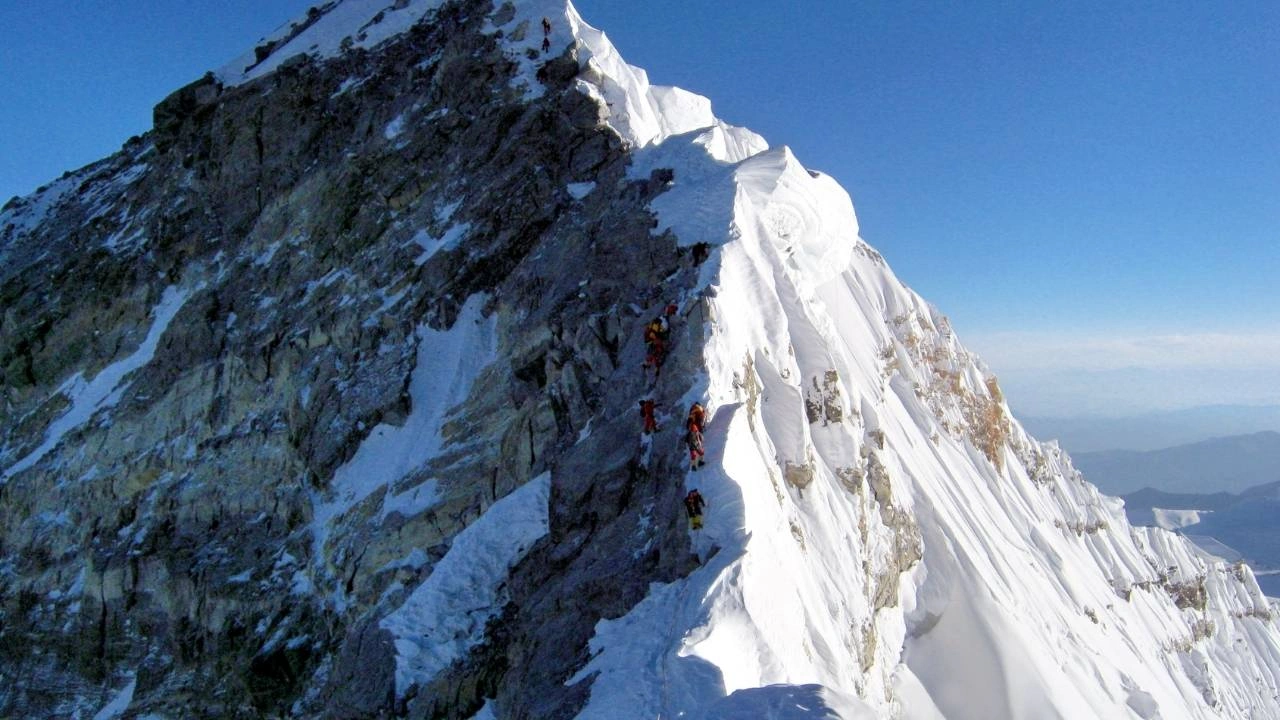
The Death Zone above 8,000 meters accounts for the majority of summit-day fatalities, but the Khumbu Icefall remains the most lethal single zone by total deaths when Sherpa exposure is included. Non-standard routes account for only 2% of all Everest ascents but 21% of all deaths, a death rate more than 10 times higher than standard routes.
What Is the Death Zone and Why Is It Lethal?
The Death Zone is any altitude above 8,000 meters (26,247 feet). Mount Everest's summit stands at 8,848.86 meters (29,031.7 feet), as remeasured by the 2020 Chinese-Nepalese survey. The Death Zone on Everest spans the final 848 vertical meters.
Physiological deterioration in the Death Zone is predictable and unrelenting:
Blood oxygen saturation without supplemental oxygen drops to 60–70% (healthy sea-level baseline: 98–99%)
Cognitive impairment begins within 10–15 minutes without supplemental oxygen
Muscle tissue breakdown accelerates; the body consumes itself for energy
Core temperature regulation degrades; hypothermia risk elevates sharply after sunset
Supplemental oxygen at 2 to 4 liters per minute raises blood saturation to approximately 85–95%, sustaining effective cognitive and motor function. High-flow systems delivering 6 to 8 lpm, increasingly common among premium operators, provide closer approximation to lower-altitude physiological function.
Why Do Non-Standard Routes Carry a Dramatically Higher Death Risk?
Non-standard routes, every line other than the Southeast Ridge (Nepal) and Northeast Ridge (Tibet), account for only 187 ascents out of 13,737 total summits: 1.4% of all summits.
Those 187 ascents produced 70 deaths, representing 21% of all Everest fatalities despite involving only 2% of all attempts. The death rate on non-standard routes is approximately 2.0 to 2.3 per 100 climbers, compared to 0.89 to 0.98 on standard routes.
The disparity reflects the absence of fixed-rope infrastructure, commercial rescue networks, pre-established camp supplies, and the significantly higher technical difficulty of non-standard lines. The last successful new route on Everest was completed in 2009, when a Korean team climbed the Southwest Face. Every attempt since has ended in retreat or death.
South Col Route vs. North Col Route: Updated 2026 Comparison
Metric | Nepal (South Col) | Tibet (North Col) |
Total Summits (all time) | 9,887 | 3,850 |
Total Deaths (all time) | 229 | 110 |
Death Rate (per 100 summits) | 1.07 | 1.05 |
% of all Everest traffic | 69% | 31% |
Non-oxygen deaths (% of side total) | 51% (116 deaths) | 37% (41 deaths) |
Commercial permit cap | None formal | ~300 per season |
The death rates per 100 summits are effectively identical, 1.07 versus 1.05. The Nepal side's higher absolute death count reflects its 69% traffic share, not inherently greater lethality on the standard route.
Who Has Died on Mount Everest? Deaths by Category and Nationality
Hired support climbers (Sherpas and equivalent workers) account for 132 of the 339 total deaths, 39% of all fatalities. Among non-Sherpa members, India, South Korea, and the United States record the highest national death tolls among foreign climbers.
What Were the First Recorded Deaths on Mount Everest?
The first confirmed deaths on Everest occurred during the 1922 British expedition, when 7 Sherpa porters were killed by an avalanche on June 7. The mountain's very first fatalities fell on the guides carrying the loads, a pattern that has repeated across the century.
The disappearance of George Mallory and Andrew Irvine on June 8, 1924 remains the mountain's most historically contested deaths. Last observed near the First Step at approximately 8,500 meters, they may or may not have reached the summit 29 years before Hillary and Tenzing Norgay. Mallory's preserved body was found in 1999 on the North Face at 8,155 meters. Irvine's remains have never been recovered.
How Many Sherpa Guides Have Died on Everest as of 2026?
132 hired support climbers, primarily Sherpa guides, have died on Everest through December 2025, per the Himalayan Database. That represents 39% of all confirmed Everest deaths.
Sherpa guides do not experience Everest at the same frequency as clients. A Sherpa guiding 3 seasons per year crosses the Khumbu Icefall approximately 90 to 120 times across a guiding career. A client crosses it 4 to 6 times per expedition. The exposure differential is 20-to-1 or greater.
Nepal's government requires expedition operators to carry insurance providing a minimum of $15,000 USD per Sherpa per expedition, a regulation formalized after the 2014 disaster. Beginning with the 2026 season, the permit fee itself rose from $11,000 to $15,000, an increase partly framed as funding better mountain safety infrastructure.
A decisive data point from recent seasons: 23 of the 26 deaths across 2023 and 2024 occurred on expeditions operating at or below the median price point. Expedition cost correlates directly with logistical depth, more Sherpas per client, more supplemental oxygen, better weather subscription services, and stricter turnaround enforcement. Budget expeditions that strip these elements carry measurably higher mortality risk than the overall death rate suggests.
Who Are the Most Influential Deaths in Everest History?
Several deaths changed how the mountain is climbed:
Rob Hall and Scott Fischer (1996): The two most prominent guided expedition leaders of their generation died within hours of each other on May 10, 1996, caught in a storm above the South Summit. Their deaths triggered the adoption of strict turnaround times, mandatory weather subscriptions, and improved client screening across the entire guided expedition industry.
David Sharp (2006): Found alive but unresponsive in the Green Boots cave at 8,500 meters on the Northeast Ridge, Sharp died while numerous summit teams passed. His death generated sustained international debate about whether continuing a summit bid is ethically defensible when passing a dying climber. No formalized protocol has since emerged.
The 16 Sherpa guides of 2014: Their deaths in the Khumbu Icefall serac collapse forced a season-ending Sherpa work stoppage and compelled Nepal to increase death benefits, reevaluate route infrastructure, and acknowledge the labor inequities embedded in commercial guiding. The event is considered the defining turning point in how the Himalayan guiding industry is publicly understood.
Is Mount Everest Getting More or Less Dangerous Over Time?
Mount Everest's normalized death rate has declined from approximately 1.81 per 100 climbers in the pre-2000 era to approximately 0.69 per 100 climbers from 2015 to 2025, a reduction of more than 60%. The mountain is statistically safer per attempt than at any point in its documented climbing history.
What Specific Advances Have Reduced the Everest Death Rate?
4 measurable advances drive the decline in mortality:
Weather forecasting accuracy. Satellite-based meteorological modeling and commercial forecasting services now deliver 5 to 7 day summit windows with accuracy unavailable before the late 1990s. The 1996 storm that killed 8 climbers was not foreseeable with the technology of its time. Modern forecasting is not infallible, but the probability of being caught in an unanticipated storm on a planned summit day has declined significantly.
Fixed-rope infrastructure. The Icefall Doctors, a team of Sherpa professionals operating under the Sagarmatha Pollution Control Committee, install a continuous fixed line from Base Camp through the Khumbu Icefall to the South Col each season. Rope-fixing teams on the Northeast Ridge do equivalent work on the Tibet side. These systems allow climbers to navigate crevasse fields and technical terrain without independent route-finding under full load.
Supplemental oxygen improvements. Modern Poisk and TopOut systems deliver regulated flow at significantly reduced weight compared to 1970s equipment. High-flow delivery at 6 to 8 lpm, previously impractical due to canister weight, is now increasingly used in the Death Zone by premium expeditions.
Structured commercial guiding. Professional guide services enforce staged acclimatization schedules, typically 3 rotations between Base Camp and Camp III before summit attempts, and strict turnaround protocols. Self-guided and under-supported climbers in earlier decades frequently under-acclimatized, a pattern that directly increased altitude illness mortality.
What Does the 2023 Spike in Deaths Reveal About Modern Risk?
The 2023 season recorded 17 deaths, the highest in the modern commercial era, despite no single catastrophic event comparable to 2014 or 2015. Nearly all deaths were isolated incidents spread across the season.
Two patterns dominated post-season analysis: Nepal issued a record 479 climbing permits, and 23 of the 26 deaths across 2023 and 2024 combined occurred on low-cost expeditions. The data strongly suggests that Everest's overall death rate reduction has benefited primarily climbers using well-resourced, professionally guided operators, and that underfunded expeditions with lower Sherpa ratios, thinner oxygen supplies, and less robust turnaround discipline retain fatality rates closer to the pre-commercial era.
Nepal responded with regulatory changes: mandatory guide-to-climber ratios, tightened permit requirements for inexperienced climbers, and the 2025–2026 permit fee increase to $15,000. Growing calls from within the Sherpa community advocate requiring proof of prior high-altitude experience (a 6,000 or 7,000-meter completed ascent) before issuing Nepal-side Everest permits, a standard the Tibet side already enforces.
What Happens to Bodies Left on Mount Everest?
Approximately 200 bodies remain on Mount Everest, most at or above 8,000 meters, where recovery is logistically and physiologically near-impossible. Extreme cold preserves remains for decades, making Everest effectively a permanent record of its fatalities.
Why Are Bodies Not Recovered from Everest?
Recovering a body from above 8,000 meters requires a minimum of 4 to 6 additional climbers operating at their own physiological limits, supplemental oxygen for the entire recovery team, specialized rigging equipment, and favorable conditions rarely available for multi-day efforts.
A body weighing 70 kg becomes effectively immovable on steep technical terrain without mechanical assistance that cannot be brought to altitude. Financial cost estimates for a Death Zone recovery range from $30,000 to $80,000 USD. The human risk to the recovery team is considered disproportionate to the recovery effort in most circumstances.
The Himalayan Rescue Association has proposed a dedicated body recovery fund financed through expedition permit fees. No such system was operational as of April 2026.
Which Bodies on Everest Are the Most Recognized?
Several fatalities have become de facto landmarks, frozen markers visible to passing teams for years or decades:
"Green Boots", widely believed to be Indian climber Tsewang Paljor, who died in 1996 on the Northeast Ridge. His body, sheltered in a limestone cave at approximately 8,500 meters and identifiable by vivid green mountaineering boots, served as a navigational reference on the North Col route for over two decades before reportedly being moved out of the primary path.
David Sharp, found alive but unrescuable in the Green Boots cave in 2006. His death location overlaps with Green Boots' known position, a detail that generated considerable media confusion and intensified the ethical debate about summit-versus-rescue decisions.
George Mallory, found by Conrad Anker in 1999 on the North Face at 8,155 meters after disappearing in 1924. His remains were interred in a stone cairn at the discovery site. Irvine's camera, which could theoretically contain photographic evidence of whether they reached the summit, has never been found.
How Does Everest's Death Toll Compare to Other 8,000-Meter Peaks?
Everest does not have the highest death rate among 8,000-meter peaks. It has the highest absolute death toll. The distinction is critical.
Mountain | Height | Total Confirmed Deaths | Death Rate (approx. per summit attempt) |
K2 | 8,611 m | ~91 | ~25% |
Annapurna I | 8,091 m | ~72 | ~23% |
Nanga Parbat | 8,126 m | ~90 | ~22% |
Kangchenjunga | 8,586 m | ~47 | ~20% |
Everest (standard routes) | 8,848.86 m | 339 | ~1.06% |
Everest's dramatically lower death rate on standard routes reflects commercial guiding infrastructure, fixed ropes, weather forecasting subscriptions, and the sheer volume of climbers, which justifies and funds safety systems no other 8,000-meter peak has at comparable scale.
Everest on non-standard routes reverts toward death rates approaching other Himalayan giants: approximately 2.28 per 100 climbers on non-standard southern lines and 1.83 per 100 on non-standard northern lines. The safety of Everest is route-specific and infrastructure-dependent.
What Do Most People Get Wrong About Dying on Everest?
3 persistent misconceptions distort public understanding of Everest fatalities.
Misconception 1: The summit push is where most deaths occur. Deaths are distributed across the entire mountain and entire season. The 2015 earthquake killed 22 people at Base Camp. The 2014 disaster killed 16 in the Khumbu Icefall. Camp II, Camp III, and Base Camp all record fatalities in most seasons, not just the Death Zone on summit day. Summit-push deaths represent a significant but not exclusive portion of the total.
Misconception 2: Overcrowding is the primary modern killer. The 2019 viral photo of a queue at the Hillary Step generated global headlines. That season recorded 11 deaths. Post-season Himalayan Database analysis found no direct evidence that queuing caused deaths from oxygen depletion alone. Most fatalities involved late summiting times, ignored turnaround protocols, or pre-existing altitude illness. The 2023–2024 data is more diagnostic: deaths correlated with expedition budget, not climber density.
Misconception 3: Physical fitness eliminates the risk. The Death Zone degrades every human body regardless of sea-level fitness. What separates survivors from victims is not aerobic capacity, it is acclimatization discipline, turnaround adherence, and experience recognizing altitude illness early enough to act. In 2023 and 2024, the majority of deaths involved climbers with limited prior high-altitude experience on underfunded expeditions.
How many people have died on Everest in 2025?
5 people died on Mount Everest during the 2025 spring season, one of the lowest seasonal death tolls in years. The 2024 season recorded 8 deaths. The 2023 season recorded 17. All 5 deaths in 2025 occurred on the Nepal side: 3 on the mountain itself and 2 at Base Camp.
What percentage of Everest climbers die?
The overall death rate across all routes and all history is 1.06 deaths per 100 summits (Himalayan Database, through December 2025). From 2015 to 2025, the normalized rate declined to approximately 0.69 per 100 climbers, the lowest decade on record.
Has anyone ever died on Everest and been recovered?
Yes. Sherpa communities have led multiple recovery operations motivated by religious burial customs. Post-season cleanup expeditions recovered 4 bodies from the Death Zone in 2019. Nepal and Chinese authorities have each conducted isolated recoveries in recent seasons. The majority of the approximately 200 bodies remaining on the mountain, particularly above 8,000 meters, have not been recovered.
Which country has the most Everest deaths?
Nepal records the highest total when Sherpa deaths are included. Among foreign nationals, India, South Korea, and the United States record the most climber deaths. India's figures reflect both expedition volume and a higher proportion of underfunded independent expeditions. South Korea's reflect a strong national mountaineering culture that historically emphasized summit achievement over conservative turnaround decisions.
Is it safe to climb Everest today?
Climbing Everest on a well-resourced guided expedition via the South Col or North Col route in a stable weather year carries approximately a 1-in-100 to 1-in-145 chance of death based on current normalized death rates. That risk concentrates in the Death Zone above 8,000 meters, in the Khumbu Icefall, in summit-day decision-making, and, as the 2023–2024 data demonstrates, in underfunded expeditions with thin Sherpa ratios and inadequate oxygen supplies.
What does the 2026 Everest season look like for safety?
The 2026 spring season (April–May 2026) is currently underway. Nepal's new $15,000 permit fee is in effect, and growing calls for stricter climber selection, requiring proof of prior 6,000 or 7,000-meter ascent experience, are under active discussion with Himalayan authorities. The Tibet side already formally requires a documented 7,000-meter ascent before issuing Everest permits, with Aconcagua and Ama Dablam now accepted. Whether Nepal adopts a comparable experience threshold remains the defining regulatory question of the 2026 season.
Key Takeaways: Mount Everest Death Statistics 2026
The verified 2026 data presents a nuanced picture. Everest's death toll, 339 confirmed fatalities through December 2025, continues to grow, but the normalized death rate has fallen to its lowest point in a century of climbing.
What the Himalayan Database data consistently shows:
Avalanche and falls are the 2 leading causes, claiming 79 and 78 lives respectively, nearly equal
53% of all fatalities involved climbers not using supplemental oxygen
Hired support climbers (Sherpas) account for 39% of all deaths, despite their superior skill and acclimatization
The Southeast Ridge (South Col route) accounts for 57% of all deaths, proportional to its traffic share
Non-standard routes carry death rates 2 to 10 times higher than standard routes despite representing only 2% of ascents
Expedition cost correlates with survival: 23 of 26 deaths in 2023–2024 occurred on below-median-priced expeditions
The 2025 season recorded only 5 deaths, among the lowest in modern climbing history
The mountain has not become safe. It has become better managed. And the gap between a well-managed and a poorly managed Everest expedition, in terms of survival probability, has never been wider than it is in 2026.
Understanding that gap is the most actionable insight the death toll data has to offer.