Everest Base Camp Trek acclimatization is the physiological process through which the body adapts to progressively lower oxygen availability during the ascent to 5,364 meters at Everest Base Camp. The EBC route rises from Lukla at 2,860 meters through Namche Bazaar at 3,440 meters and Dingboche at 4,410 meters before entering the 5,000-meter zone around Lobuche and Gorak Shep. At these elevations, acclimatization becomes the central factor in managing altitude stress, maintaining trekking performance, and reducing the risk of acute mountain sickness (AMS), high altitude cerebral edema (HACE), and high altitude pulmonary edema (HAPE).
Safe acclimatization on the Everest Base Camp trek depends on gradual ascent, scheduled rest days, higher-elevation acclimatization hikes, lower sleeping elevations, adequate hydration and nutrition, quality sleep, and regular monitoring of altitude-related symptoms and blood oxygen saturation (SpO2). Namche Bazaar and Dingboche provide the two principal acclimatization stages before the route reaches extreme altitude, while early recognition of AMS and immediate descent for HACE or HAPE can determine whether a trek continues safely or becomes a medical emergency. This guide explains the EBC acclimatization process from Lukla to Base Camp, including the elevation profile, physiological changes, acclimatization hikes, preparation before the trek, warning signs of altitude sickness, and practical strategies for reaching Everest Base Camp safely.
Why Is Acclimatization Essential for the Everest Base Camp Trek?
Acclimatization is essential because the Everest Base Camp route gains over 2,500 meters of altitude from Lukla to base camp, and the human body requires 2–3 days to physiologically adapt to each significant elevation change before safely ascending further.
Without this adaptation window, three altitude-related conditions develop: acute mountain sickness (AMS), high altitude cerebral edema (HACE), and high altitude pulmonary edema (HAPE). AMS is uncomfortable and treatable at altitude. HACE and HAPE are medical emergencies that require immediate descent and, in many cases, helicopter evacuation.
The Khumbu region sees several hundred altitude-related evacuations every trekking season. The majority involve trekkers who either pushed through early AMS symptoms or followed itineraries with insufficient rest days. Acclimatization is not a personal choice made on the trail. It is the factor that determines whether you reach Everest Base Camp or get carried off the mountain in a helicopter.
How Does Altitude Affect the Body During the Trek?
Altitude reduces atmospheric pressure, which lowers the partial pressure of oxygen in each breath. The body responds with 4 primary physiological changes: increased breathing rate, increased heart rate, reduced plasma volume, and disrupted sleep patterns from periodic breathing.
These changes begin at around 2,500 meters and intensify above 3,500 meters, which is precisely where the EBC route operates for the majority of its duration.
The mechanism works like this: as elevation increases, atmospheric pressure drops. At 5,364 meters, atmospheric pressure is approximately 53 kPa, compared to 101 kPa at sea level. Every breath contains the same proportion of oxygen (21%), but far fewer oxygen molecules are available with each inhale. The body compensates by breathing faster and increasing heart rate. Blood thickens as plasma volume drops during early acclimatization, raising clot risk.
Blood oxygen saturation (SpO2) is the most practical field measure of acclimatization progress. A healthy SpO2 reading at sea level is 95–100%. At Namche Bazaar (3,440m), trekkers typically measure 85–92% after 2 days. At Dingboche (4,410m), the expected range is 78–88%. At Everest Base Camp (5,364m), readings of 70–82% are normal after full acclimatization. A reading below 70% combined with symptoms is a medical red flag.
A pulse oximeter, a small device that clips to your fingertip, measures SpO2 in seconds. At USD 15–30, it is the highest-value piece of safety equipment on the EBC trek after trekking poles.
One detail most trekking content overlooks: Cheyne-Stokes breathing affects nearly all trekkers above 3,500 meters. This is a sleep pattern where breathing briefly stops before restarting with rapid, deeper breaths. It is alarming to experience but not inherently dangerous. It does, however, significantly reduce sleep quality at altitude: which directly slows acclimatization, since the body's physiological repair and adaptation happen during sleep.
How Quickly Does Altitude Increase on the Everest Base Camp Route?
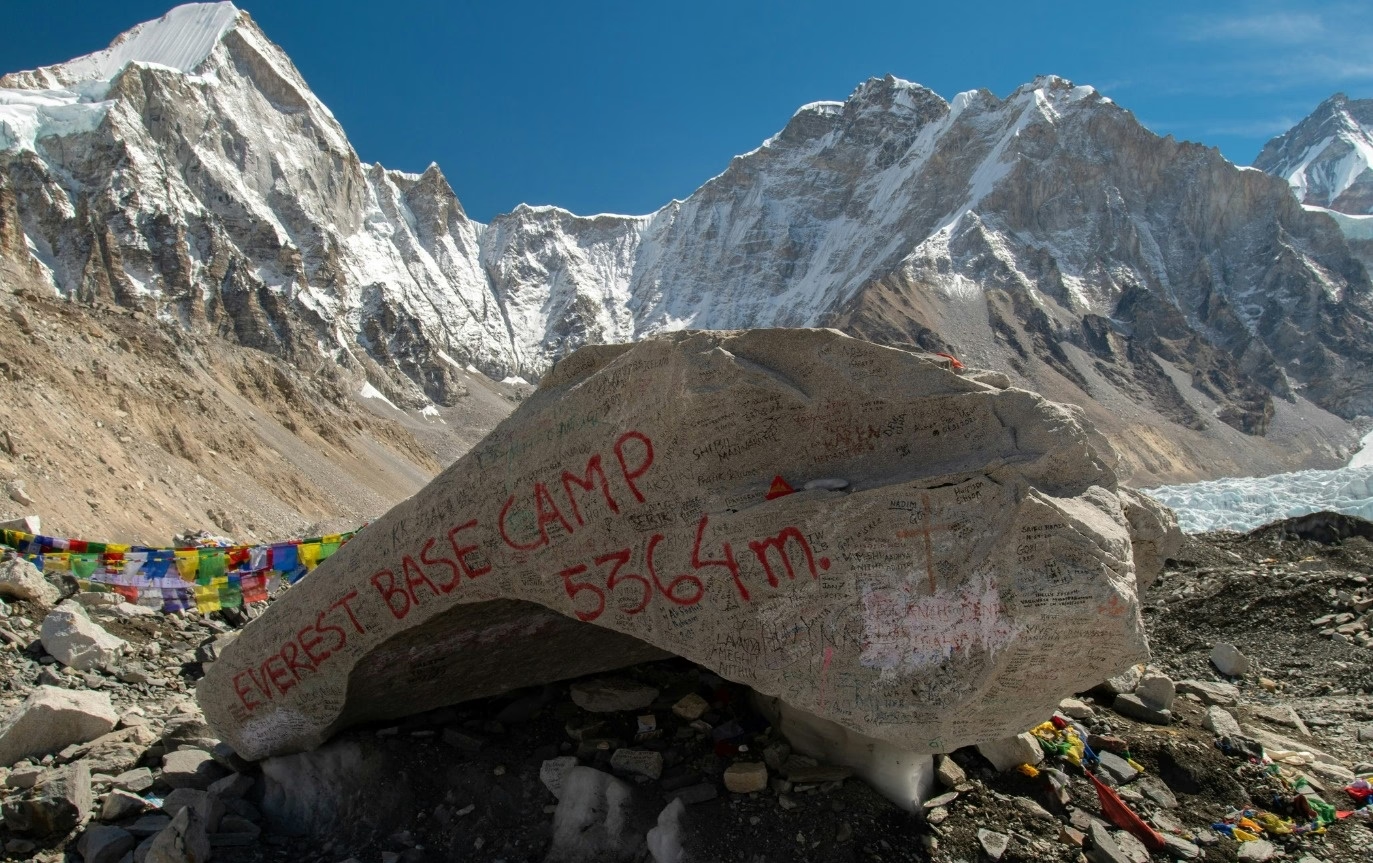
The EBC route gains 2,504 meters of net elevation from Lukla (2,860m) to Everest Base Camp (5,364m) across 11–12 trekking days, with the most abrupt single-day gains occurring on the Lukla-to-Namche and Namche-to-Tengboche segments.
The table below shows the actual elevation profile of the standard 14-day EBC itinerary:
Location | Elevation | Approximate Day |
Kathmandu | 1,400m | Day 1–2 |
Lukla | 2,860m | Day 3 |
Phakding | 2,610m | Day 3 |
Namche Bazaar | 3,440m | Day 4–5 (2 nights) |
Tengboche | 3,867m | Day 6 |
Dingboche | 4,410m | Day 7–8 (2 nights) |
Lobuche | 4,940m | Day 9 |
Gorak Shep | 5,164m | Day 10 |
Everest Base Camp | 5,364m | Day 11 |
Kala Patthar | 5,545m | Day 11 |
The Wilderness Medical Society's high-altitude acclimatization guideline is clear: do not ascend more than 500 meters per day above 3,000 meters, and take one full rest day for every 1,000 meters gained above that threshold.
The most dangerous segment on this profile is the Lukla-to-Namche section. Trekkers fly from Kathmandu (1,400m) to Lukla (2,860m), a 1,460-meter gain in a 35-minute flight, then trek to Namche Bazaar (3,440m) the following day. That is a massive 2,040-meter total altitude gain from your Kathmandu baseline in under 48 hours. The body does not have time to adapt to Lukla before it faces Namche.
This is why the 2-night minimum at Namche Bazaar is non-negotiable, not negotiable based on how you feel.
Where Are the Main Acclimatization Stops on the Everest Base Camp Trek?
The 2 primary acclimatization stops on the Everest Base Camp trek are Namche Bazaar at 3,440 meters and Dingboche at 4,410 meters. Each stop includes a mandatory full rest day with a higher-elevation acclimatization hike before sleeping at the original camp elevation.
Why Is Namche Bazaar Important for Acclimatization?
Namche Bazaar is the first major acclimatization checkpoint on the EBC route. At 3,440 meters, it sits at the exact threshold where altitude sickness starts affecting unacclimatized trekkers consistently. According to the Himalayan Rescue Association (HRA), more than 70% of AMS cases on the Everest route develop between Lukla and Namche Bazaar during this initial rapid ascent.
Namche is also the most medically resourced stop on the route below base camp. The HRA operates a staffed medical clinic in Namche offering free altitude illness consultations and SpO2 checks. This is the right place to verify your baseline reading before climbing further.
From a physiological standpoint, the extra day in Namche triggers erythropoietin (EPO) production: the hormone that stimulates the bone marrow to produce additional red blood cells. This process begins within 24 hours of altitude exposure but takes 5–7 days to produce a meaningful increase in oxygen-carrying capacity. Starting this process early at Namche directly reduces cumulative altitude stress at Dingboche, Lobuche, and Gorak Shep.
How Does the Acclimatization Day in Namche Bazaar Help?
The acclimatization day in Namche Bazaar applies the "climb high, sleep low" principle directly. Trekkers hike to Everest View Hotel (3,880m) or the Syangboche airstrip (3,748m), gaining 300–440 meters above Namche, before returning to sleep at 3,440 meters.
This day trip produces two benefits simultaneously. First, the higher-elevation hike stimulates altitude adaptation above the sleeping elevation. Second, the hike opens views of Everest (8,849m), Lhotse (8,516m), and Ama Dablam (6,812m), giving trekkers early visual context for the scale of terrain ahead.
The most common mistake we observe on the EBC route: trekkers leave Namche after one night instead of two, citing that they "feel fine." Feeling fine after 24 hours at Namche does not indicate full acclimatization. It indicates that AMS has not yet developed. The body's EPO response, red blood cell adjustment, and respiratory alkalosis correction all require the second night. Trekkers who skip it consistently report stronger AMS symptoms at Tengboche and Dingboche.
Why Is Dingboche a Key Acclimatization Stop?
Dingboche at 4,410 meters functions as the second and final major acclimatization checkpoint before the trek pushes into 5,000-meter terrain. Above 5,000 meters, the human body no longer fully acclimatizes, it only deteriorates more slowly. Reaching Lobuche (4,940m) and Gorak Shep (5,164m) without a proper acclimatization day at Dingboche exposes trekkers to greatly elevated HAPE and HACE risk.
The Himalayan Rescue Association also operates a clinic at Pheriche (4,371m), just 3 kilometers from Dingboche. This is the last staffed medical resource before Everest Base Camp. Trekkers who experience early AMS symptoms at Dingboche can access HRA medical staff without retracing significant ground.
Beyond medical infrastructure, Dingboche marks the transition into the high-altitude zone where rescue helicopter performance degrades. Above 5,500 meters, standard helicopters operate near their service ceiling and cannot always hover or land reliably. Getting acclimatization right at Dingboche is the last real insurance against a forced evacuation from above.
How Does the Acclimatization Day in Dingboche Help?
The acclimatization hike from Dingboche targets either Nangkartshang Peak (5,083m) or Chhukung Ri (5,550m). Both ascents cross the 5,000-meter threshold, giving the body its first exposure to true high-altitude conditions before the main route requires sustained trekking at that level.
This matters because the physiological impact of crossing 5,000 meters for the first time, even briefly, significantly accelerates the body's altitude adaptation rate. The body responds to peak altitude during the day's hike, not the sleeping altitude. By hiking to 5,083m and sleeping at 4,410m, trekkers arrive at Lobuche (4,940m) already partially adapted to above-5,000-meter oxygen conditions, rather than encountering them for the first time during a full trekking day while carrying a pack.
The Chhukung Ri hike additionally serves as preparation for Kala Patthar (5,545m), the trek's highest point and one of its most demanding days, often started before dawn in sub-zero temperatures.
What Should You Do on Everest Base Camp Acclimatization Days?
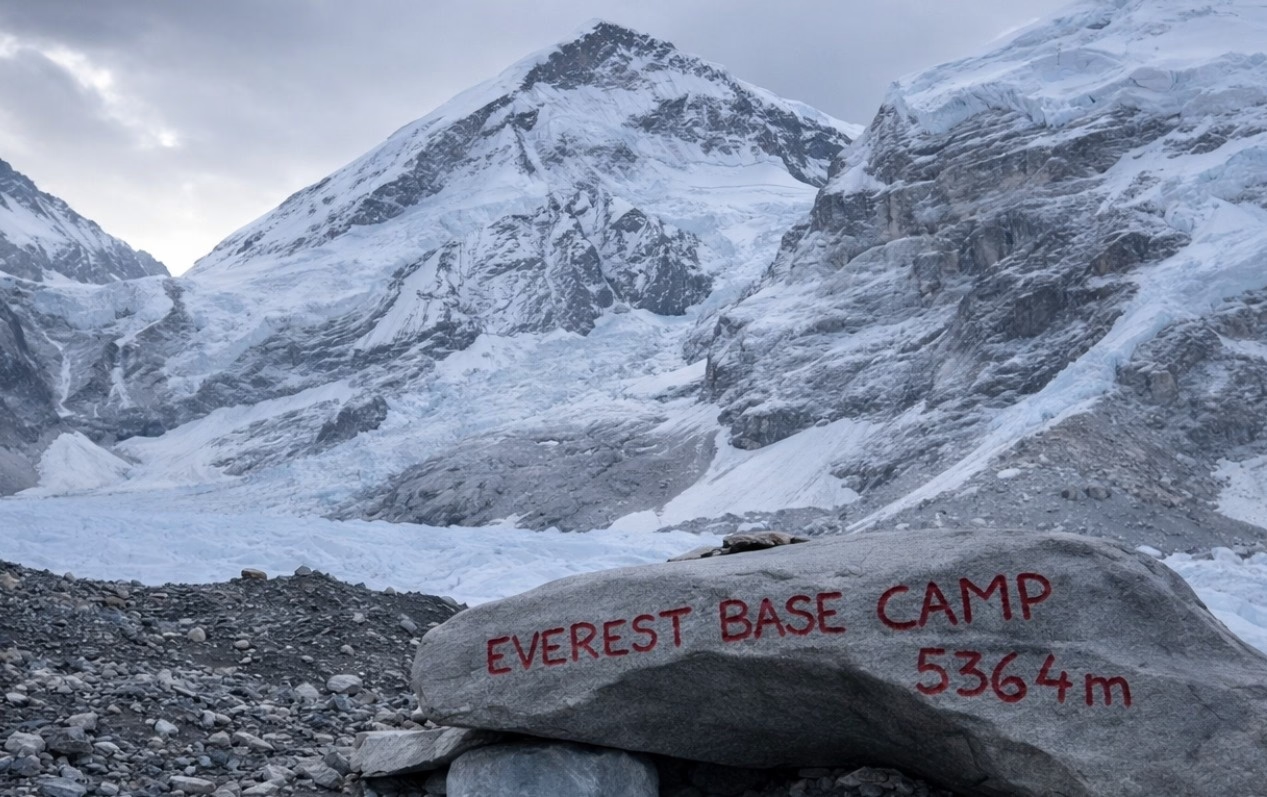
On acclimatization days, trekkers complete 4 essential activities: a morning acclimatization hike to a higher elevation, sustained hydration throughout the day, light carbohydrate-rich nutrition, and early sleep. The goal is maximum altitude stimulus with minimum physical depletion.
How Do Acclimatization Hikes Support Altitude Adaptation?
Acclimatization hikes work by exposing the body to higher atmospheric pressure reduction than the sleeping elevation provides. The body measures altitude based on oxygen partial pressure, not terrain type or distance traveled. A 3-hour hike gaining 400–500 meters above camp produces a stronger altitude adaptation stimulus than a flat walk at camp elevation lasting twice as long.
The hike also maintains cardiovascular conditioning without accumulating the total-body fatigue of a full trekking day. Rest days are not training days, they are adaptation days. The goal of the hike is altitude exposure and physiological stimulus, not fitness improvement.
One aspect most trekking guides omit: the pace of acclimatization hikes matters as much as the destination. Trekking above 4,000 meters at fast pace spikes heart rate and oxygen demand simultaneously, which can push borderline-acclimatized trekkers into AMS symptoms. The correct intensity is conversational pace, slow enough to speak comfortably without breathlessness. At that intensity, the altitude stimulus is present, but the physiological cost stays manageable.
Why Is the "Climb High, Sleep Low" Approach Used?
The "climb high, sleep low" principle is grounded in research from the American Alpine Club and Wilderness Medical Society. According to this research, altitude adaptation is governed primarily by sleeping altitude, not by maximum altitude reached during the day.
The body's EPO response, red blood cell production increase, and respiratory alkalosis correction all stabilize and lock in during sleep. A trekker who sleeps at 4,410 meters but hiked to 5,083 meters during the day adapts toward the 4,410-meter sleeping altitude overnight, while the 5,083-meter exposure earlier in the day provides the physiological stimulus for faster adaptation.
In practice, this is why trekkers who complete the Nangkartshang acclimatization hike from Dingboche feel measurably more comfortable at Lobuche than those who spent a full rest day at camp. The altitude exposure during the hike shortens the adjustment window at the next sleeping altitude.
How Much Rest Should You Get During Acclimatization?
On acclimatization days, 8–9 hours in the sleeping bag is the target. Sleep quality at altitude is poor regardless of fitness or experience, Cheyne-Stokes breathing disrupts sleep cycles above 3,500 meters consistently, but the body's adaptation processes require extended recovery time when operating under altitude stress.
3 practical tools improve sleep quality at altitude:
Sleep position: sleeping on your side reduces Cheyne-Stokes events compared to sleeping on your back
Sleeping bag warmth: cold-induced waking further fragments already disrupted sleep; a bag rated to at least -10°C is appropriate for Dingboche and above
Diamox (acetazolamide): a low half-dose (62.5mg) taken at bedtime directly stimulates breathing rate, reducing Cheyne-Stokes frequency and improving overnight SpO2
Diamox is prescription-only. Trekkers who want to use it obtain a prescription from a travel medicine doctor before departure, along with guidance on dosing and known side effects (finger tingling, increased urination, rare sulfa allergy risk).
How Much Water Should You Drink at High Altitude?
At elevations above 3,500 meters, trekkers require 3–4 liters of water per day, roughly double the standard 2-liter sea-level recommendation. Three mechanisms drive this increased fluid requirement.
First, accelerated breathing rate at altitude expels significantly more water vapor with each exhaled breath. Respiratory water loss at 4,000–5,000 meters increases by 100–300ml per day compared to sea level. Second, the kidneys increase urine output during the first 24–48 hours at new altitude as they compensate for blood alkalinity changes from faster breathing. Third, dry mountain air in the Khumbu region reduces the sensation of thirst even while accelerating dehydration.
The simplest monitoring tool: urine color. Clear to pale yellow indicates adequate hydration. Dark yellow or amber indicates dehydration. On acclimatization days, checking urine color twice, mid-morning and mid-afternoon, takes 10 seconds and provides reliable hydration feedback.
Two drinks to minimize on acclimatization days: alcohol and large-quantity caffeine. Alcohol depresses breathing rate during sleep, which directly worsens Cheyne-Stokes events and reduces overnight SpO2. A single beer at 4,000 meters produces the sedative effect of 2–3 beers at sea level. The Khumbu teahouses serve good hot lemon drinks and ginger tea, these are far better choices during acclimatization.
What Should You Eat During Acclimatization Days?
On acclimatization days, carbohydrate-rich foods improve altitude adaptation through a direct biochemical mechanism: carbohydrates produce more carbon dioxide per oxygen molecule consumed than fats or proteins, and carbon dioxide is the primary driver of the body's breathing rate at altitude.
Higher CO2 production from carbohydrate metabolism stimulates more frequent breathing. More frequent breathing increases oxygen uptake. This is why experienced high-altitude climbers and mountaineers deliberately increase carbohydrate intake above 4,000 meters.
4 readily available foods on the EBC route support this approach:
Dal bhat: Nepal's staple dish of lentil soup and rice, available at every teahouse from Lukla to Gorak Shep, delivers complex carbohydrates and legume protein in a single meal
Garlic soup: traditionally used in the Khumbu; some trekkers report reduced AMS discomfort after garlic soup, though controlled clinical evidence remains limited
Tsampa porridge: roasted barley flour, a Sherpa staple with high carbohydrate density and easy digestibility
Potato dishes: widely available above Namche and provide low-fiber complex carbohydrates that digest easily when appetite is suppressed
Appetite decreases significantly above 4,000 meters in most trekkers. The correct response is eating small meals every 3–4 hours rather than forcing large meals. Skipping meals at altitude impairs recovery and acclimatization more than most trekkers anticipate, the body's altitude adaptation processes are metabolically expensive.
What Are the Signs of Altitude Sickness on the Everest Base Camp Trek?
Altitude sickness on the EBC trek presents across 3 severity levels: acute mountain sickness (AMS), high altitude cerebral edema (HACE), and high altitude pulmonary edema (HAPE). AMS is manageable at altitude with rest and medication. HACE and HAPE are evacuation emergencies.
What Are the Early Symptoms of Acute Mountain Sickness?
The 4 core symptoms of acute mountain sickness are headache, gastrointestinal symptoms (nausea/vomiting), fatigue, and dizziness. These symptoms typically develop 6–12 hours after reaching a new altitude and are regularly mistaken for dehydration or trail exhaustion.
The Lake Louise AMS Score is the standard clinical assessment tool used by HRA physicians and trained wilderness guides on the EBC route:
Symptom | Severity | Score |
Headache | Mild | 1 |
Headache | Severe | 2 |
GI disturbance | Mild | 1 |
Fatigue / weakness | Mild | 1 |
Dizziness | Mild | 1 |
A total score of 3 or higher, with headache as a required component, indicates AMS. A score of 5 or higher signals severe AMS requiring cessation of ascent and immediate medical assessment.
Headache location provides useful diagnostic information. Altitude headaches typically present at the front of the head or behind the eyes. Dehydration headaches more commonly present at the temples. Trekkers who cannot distinguish between the two treat both causes simultaneously: rest, rehydrate with 1 liter of water, and reassess after 2–3 hours. If the headache persists after hydration, altitude is the primary driver.
When Should Altitude Sickness Become a Serious Concern?
Altitude sickness becomes a medical emergency when any of the 3 warning signs of HACE or HAPE appear: ataxia (loss of coordination), altered consciousness, or severe breathlessness at rest.
The heel-to-toe walking test identifies ataxia in field conditions. The test requires walking in a straight line with each step placing the heel directly in front of the toes of the other foot. Any stumbling, staggering, or inability to maintain the line indicates neurological impairment from HACE. HACE develops rapidly, within hours of early neurological symptoms, and descent is required immediately.
HAPE warning signs follow a specific progression: breathlessness at rest that worsens over hours, a dry cough that transitions to a productive wet cough, pink or frothy sputum in advanced cases, and SpO2 below 70%. According to data from the HRA Pheriche and Namche clinics, HAPE is the leading cause of altitude-related death among trekkers in the Khumbu region, more so than HACE.
The distinction that most trekking content underemphasizes: AMS can be managed at altitude with rest, hydration, ibuprofen, and Diamox. HACE and HAPE cannot. No medication, supplemental oxygen supply, or additional rest reverses HACE or HAPE as effectively as descent. The treatment for both conditions is descending, and descending before the trekker loses the ability to walk down independently.
What Should You Do If Altitude Sickness Symptoms Appear?
When AMS symptoms appear, the correct response sequence is:
Stop ascending immediately: do not continue to the next teahouse thinking it will pass
Rest at current altitude for a full 24 hours before reassessing
Hydrate aggressively: 1 liter of water in the first 2 hours, then 3–4 liters across the day
Take ibuprofen 400mg for headache: ibuprofen outperforms paracetamol (acetaminophen) for altitude headache in clinical comparisons
Reassess after 24 hours: symptom improvement means the body is coping; symptom plateau or worsening means descent is required
Diamox (acetazolamide) 125–250mg twice daily accelerates acclimatization and reduces AMS symptom severity by stimulating the kidneys to excrete bicarbonate, which acidifies the blood and triggers faster breathing. It is a physiological support tool, not a cure. Trekkers who take Diamox still acclimatize through the same biological processes, Diamox reduces the discomfort and speeds the timeline. Trekkers obtain a prescription and dosing guidance from a travel medicine doctor before departure.
When Should You Descend During the Trek?
Descend without delay when any of these 4 conditions are present:
Ataxia: any loss of coordination, stumbling, or failure of the heel-to-toe test
Altered mental status: confusion, unusual behavior, slurred speech, or impaired reasoning
Breathlessness at rest: SpO2 below 70% with rapid, labored breathing at rest
AMS symptoms worsening across 24 hours of rest: if the Lake Louise score increases despite stopping, the body is not coping
Descent of 500–1,000 meters typically reverses AMS symptoms within 1–3 hours. HACE symptoms reverse within 4–8 hours of descent. The guiding principle on the EBC route: descend early enough to descend on foot. Helicopter evacuation above 5,000 meters depends on weather windows, rotor performance at altitude, and available aircraft. None of these are guaranteed.
Helicopter evacuation from the Khumbu region carries a cost of USD 4,000–8,000 per flight. Travel insurance covering high-altitude trekking (explicitly above 5,000 meters) is a logistical necessity, not optional coverage. Confirm the coverage ceiling in your policy before departure.
How Can You Prepare for Better Acclimatization Before the Everest Base Camp Trek?
Acclimatization preparation begins 8–12 weeks before the trek and focuses on 3 factors: cardiovascular fitness, pre-trek altitude exposure where possible, and informed logistical decisions made before reaching Lukla.
How Does Physical Fitness Affect High-Altitude Trekking?
Physical fitness does not prevent altitude sickness. Altitude sickness is a physiological response to reduced oxygen availability that operates independently of cardiovascular fitness, elite marathoners and mountaineers develop AMS. However, cardiovascular fitness significantly affects trekking performance and resilience under altitude stress.
A trekker with a higher VO2 max (maximum oxygen consumption rate) extracts more usable oxygen per breath than a less-fit trekker at the same altitude. At 5,364 meters, where available oxygen per breath is 53% of sea-level levels, this extraction efficiency translates directly to better endurance, faster recovery from exertion, and greater capacity to manage the physical demands of 14+ consecutive trekking days.
The 3 most effective pre-trek training approaches:
Aerobic base building: 4–5 sessions per week of sustained aerobic exercise (running, cycling, swimming) at 60–75% of maximum heart rate for 45–90 minutes per session, maintained for 8–12 weeks before departure
Weighted hiking: progressive load-bearing hikes building from 5kg to 12–15kg over 3–5 months, targeting 5–8-hour hiking days on varied terrain
Stair climbing with a pack: the most time-efficient simulation of the EBC route's ascent profile for trekkers without access to mountain terrain
Can Previous High-Altitude Experience Improve Acclimatization?
Previous high-altitude experience provides 2 measurable benefits. First, experienced high-altitude trekkers recognize their own personal AMS early warning pattern, they know what altitude fatigue feels like in their body before it becomes dangerous. This early recognition enables faster, better-calibrated responses. Second, trekkers who spent time above 4,000 meters within the previous 4–6 weeks retain some residual acclimatization advantages from elevated red blood cell counts, though these diminish by the 8-week mark.
One risk factor specific to experienced trekkers: overconfidence. Trekkers who "never had problems before" on previous EBC attempts or other high-altitude treks sometimes underestimate symptoms that are developing differently during a current trek. Altitude response varies across treks due to differences in fitness, hydration, sleep, respiratory health, and seasonal conditions. Past performance is not a predictor of current response.
For Nepali trekkers from Kathmandu (1,400m): the acclimatization advantage over international trekkers from lower altitudes is moderate, not absolute. The step from 1,400 meters to 3,440 meters at Namche is a significant physiological challenge regardless of origin.
What Should You Know About Acclimatization Before Flying to Lukla?
Before the flight to Lukla, 4 pre-departure decisions directly improve trek safety:
Spend 2 nights in Kathmandu before flying: at 1,400 meters, Kathmandu provides mild altitude priming and breaks jet lag before altitude stress begins; trekkers who spend only one night in Kathmandu start the trek compounding jet lag fatigue with altitude adaptation
Consult a travel medicine doctor: obtain a Diamox prescription and understand the dosing protocol; experimenting with Diamox for the first time at 4,000 meters without prior medical guidance introduces unnecessary variables
Purchase a pulse oximeter: a fingertip oximeter costing USD 15–30 provides objective SpO2 data every morning and evening, removing the guesswork from acclimatization assessment throughout the trek
Verify the itinerary ascent rate: any itinerary promising Everest Base Camp in fewer than 12 days does not allow adequate acclimatization time; the safe, standard range is 14–16 days from Lukla
How Can Nepal Intrepid Treks Support Everest Base Camp Trek Acclimatization?
Nepal Intrepid Treks structures every Everest Base Camp itinerary around the Wilderness Medical Society's high-altitude acclimatization guidelines, with mandatory 2-night stops at Namche Bazaar and Dingboche, daily SpO2 monitoring, and guides trained in high-altitude emergency protocols.
How Can Nepal Intrepid Treks Plan Acclimatization Safely?
Nepal Intrepid Treks applies 5 specific acclimatization safety measures across every EBC itinerary:
2-night minimum at Namche Bazaar (3,440m): no early departures based on subjective trekker comfort, regardless of fitness level
Guided acclimatization day at Dingboche: the Nangkartshang Peak (5,083m) hike is included as a structured element, not optional
Daily pulse oximeter checks: every trekker's SpO2 is recorded each morning; readings trending downward trigger immediate protocol review
Sherpa guides with Wilderness First Responder training: all lead guides carry dexamethasone (HACE emergency medication) and nifedipine (HAPE emergency medication) in their medical kits
Itinerary flexibility by guide discretion: acclimatization stops extend by 24 hours at guide judgment; this is built into itinerary scheduling, not treated as a deviation that disrupts logistics
Our guides have collectively led more than 200 Everest Base Camp treks. The most consistent pressure on any EBC trek comes from trekkers mid-route asking to push faster. The answer is no, and trekkers who accept that answer reach base camp at a higher completion rate than those who don't.
Planning your Everest Base Camp trek? Contact Nepal Intrepid Treks to discuss your itinerary, acclimatization profile, and the right preparation timeline for your trek dates.
What Are the Key Acclimatization Takeaways for the Everest Base Camp Trek?
Acclimatization on the Everest Base Camp trek resolves into 6 principles that separate completions from evacuations:
Ascend at a controlled rate: do not gain more than 500 meters per day above 3,000 meters
Complete both full stops: 2 nights at Namche Bazaar (3,440m) and 2 nights at Dingboche (4,410m) are not suggestions; they are structural requirements of safe EBC itineraries
Apply climb-high-sleep-low actively: treat acclimatization day hikes as altitude work, not leisure walks; the physiological response depends on reaching meaningful elevation above camp
Monitor SpO2 daily: carry a pulse oximeter and track morning and evening readings; a declining trend across 2–3 consecutive readings signals developing problems before symptoms become severe
Respond to AMS early: headache combined with nausea and fatigue at any stage of the trek requires stopping ascent, resting for 24 hours, and reassessing with objective SpO2 data
Descend without negotiation at HACE or HAPE signs: ataxia, altered consciousness, or breathlessness at rest are non-negotiable descent triggers; delay makes descent physically harder and medically riskier
Everest Base Camp is not a technical mountaineering objective. It is an altitude challenge on a well-established trail. The trekkers who reach it are not necessarily the fittest or the most experienced: they are the ones who took rest days seriously, drank water consistently, ate enough carbohydrates, and resisted the urge to rush.
Acclimatization is not time wasted on the mountain. It is the work that gets you there.