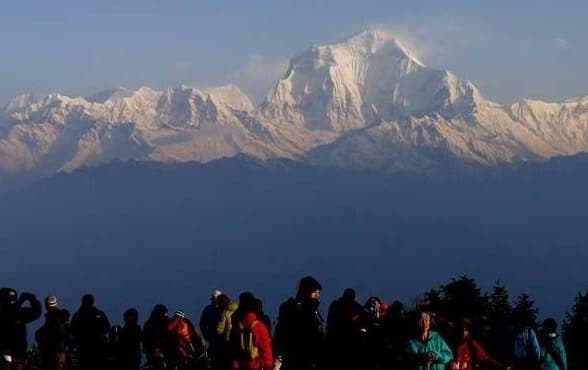
Short tours to Nepal provide an efficient way to experience the country's Himalayan landscapes, UNESCO World Heritage Sites, wildlife reserves, adventure activities, and vibrant cultural destinations without committing to long trekking expeditions or extended holidays. Available from 5-hour helicopter flights to 12-day multi-region itineraries, these tours accommodate every travel schedule while showcasing Nepal's diverse geography, including the Everest and Annapurna Himalayas, Kathmandu Valley, Pokhara Valley, and the Terai lowlands. Whether your priority is mountain scenery, wildlife encounters, heritage exploration, or outdoor adventure, choosing the right itinerary depends on the time available, preferred activities, and level of physical involvement.
This guide explores the top 9 short tours to Nepal, comparing each itinerary by duration, destinations, major attractions, activity type, physical demand, and the travelers it suits best. From Everest and Annapurna helicopter tours to Pokhara sightseeing, Kathmandu heritage exploration, Chitwan jungle safaris, Trishuli River rafting, sunrise viewpoints, and complete Nepal adventure packages, every tour is explained with practical travel information, route highlights, and planning insights. By comparing these experiences in one place, travelers can confidently select the Nepal short tour that delivers the greatest value for their schedule, interests, and travel goals.
1. Everest Heli Tour
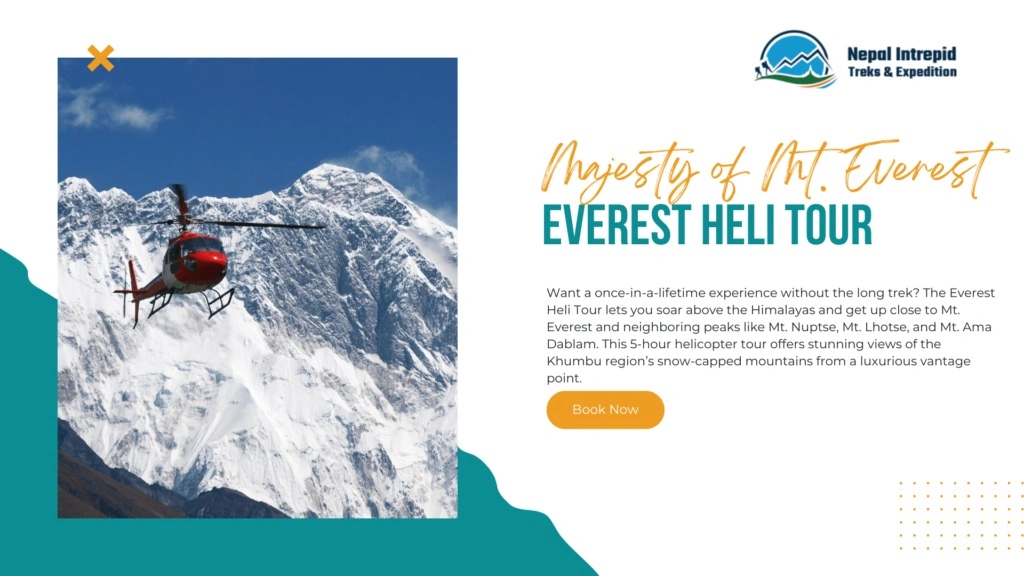
The Everest Heli Tour is a 5-hour helicopter sightseeing experience that gives travelers a direct aerial view of Mount Everest (8,849 m), a breakfast stop at the world's highest-altitude hotel, and a landing near Everest Base Camp, all without requiring a single day of trekking.
What Can You Expect During the Everest Heli Tour?
The Everest Heli Tour includes a private helicopter flight from Kathmandu over Mount Everest, a landing at Kala Patthar (5,644 m), close-up views of 6 surrounding peaks, and a hot breakfast at Hotel Everest View (3,962 m). The full aerial distance covered is approximately 350 km within a single day.
The 6 peaks visible during the flight are Mount Nuptse (7,861 m), Mount Lhotse (8,516 m), Mount Ama Dablam (6,812 m), Mount Thamserku (6,608 m), Mount Pumori (7,161 m), and Mount Cho Oyu (8,188 m). Each peak is visible within a 25 km radius of the Everest summit corridor.
Most departures leave from Kathmandu's Tribhuvan International Airport at 6:30 AM and return by noon. Each flight accommodates 5 passengers. The tour operates during Nepal's 2 prime aviation seasons: October–November and March–May, when high-altitude visibility exceeds 30 km.
Hotel Everest View (3,880 m), the breakfast stop, holds the Guinness World Record as the highest-placed hotel in the world. This detail distinguishes the Everest Heli Tour from standard mountain flightseeing and adds a genuine ground-level encounter with the Khumbu region, which is otherwise only accessible by days of trekking. This detail distinguishes the Everest Heli Tour from standard mountain flightseeing and adds a genuine ground-level encounter with the Khumbu region.
Why Do Travelers Choose a Helicopter Tour Over Trekking to Everest?
Travelers choose the Everest Heli Tour over the Everest Base Camp trek because it eliminates 14 days of walking, reduces altitude acclimatization risk, and delivers the same panoramic Himalayan view within 5 hours. The standard EBC trek covers 130 km over 14 days, requiring an average fitness level and a minimum of 12 nights on-trail.
The helicopter tour costs approximately USD 1,200–1,700 per person depending on group size, versus USD 1,500–2,500 for a fully guided EBC trek including permits, teahouse accommodations, and agency fees.
Travelers who consistently choose the helicopter tour over trekking fall into 4 distinct groups: travelers over 60, those with knee or joint conditions, business travelers with 1–3 days in Nepal, and families with children (minimum age 4). The tour requires no fitness preparation, no altitude medication, and no special equipment.
What most travelers overlook: the Khumbu Icefall reflects the strongest morning light between 7:00–9:00 AM. Nepal Intrepid Treks schedules all Everest Heli Tour departures within this window, ensuring the clearest and most visually dramatic aerial conditions.
2. Annapurna Heli Tour
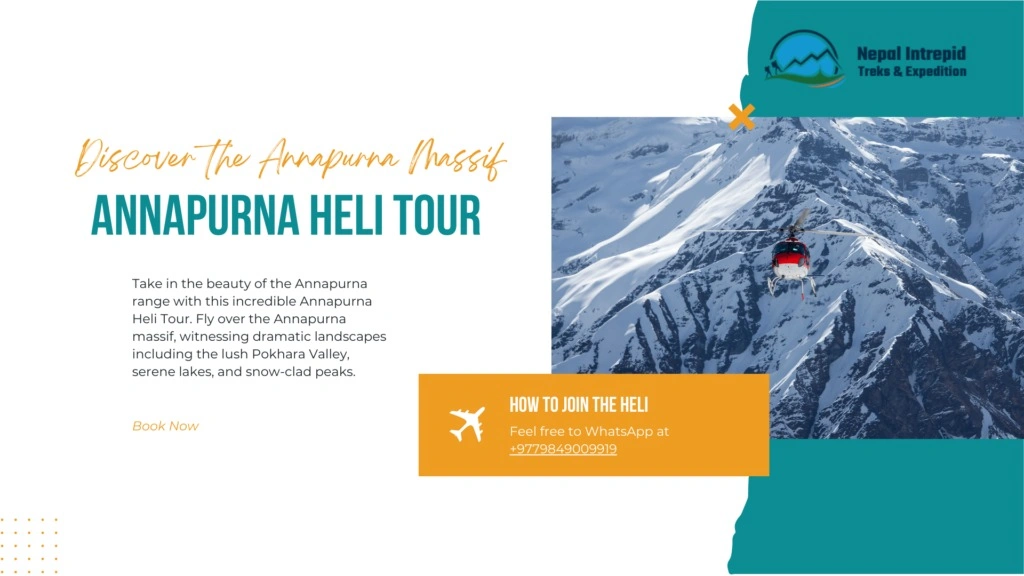
The Annapurna Heli Tour is a 3-to-5-hour helicopter sightseeing tour covering the Annapurna range, Annapurna Base Camp sanctuary (4,130 m), Pokhara Valley, Phewa Lake, and the Modi Khola River gorge, Nepal's second most-visited Himalayan region after Everest.
Which Landmarks Can You See During the Annapurna Heli Tour?
The Annapurna Heli Tour covers 8 primary landmarks: Annapurna Base Camp (4,130 m), the Annapurna Sanctuary, Machhapuchhre (6,993 m), Dhaulagiri (8,167 m), Phewa Lake (4.43 km²), Pokhara Valley, the Modi Khola gorge, and Ghorepani Poon Hill (3,210 m). The helicopter reaches Annapurna Base Camp, a destination that trekkers normally access after 7 walking days from Pokhara.
The Annapurna range contains 14 peaks above 7,000 m, with Annapurna I (8,091 m) standing as the 10th highest mountain on Earth. From the helicopter, the Annapurna Sanctuary reveals itself as a natural amphitheater of glaciers, ice walls, and cirque basins visible from a 360-degree aerial angle.
The flight path over Pokhara city gives travelers a rare aerial view of Phewa Lake directly below Annapurna II (7,937 m) and Machhapuchhre, a lake-mountain visual alignment that photographers specifically travel to Nepal to capture. This perspective is only possible from the air.
What Makes the Annapurna Region So Popular With Visitors?
The Annapurna region attracts over 72,000 trekking permits annually, according to Nepal Tourism Board 2024 data, making it Nepal's most visited trekking area. Its 5 established trekking routes, accessible trailheads within 30 minutes of Pokhara, and terrain diversity from subtropical forest to glacial terrain account for its dominance.
The 5 main trekking routes in the Annapurna circuit are the Annapurna Circuit (160–230 km), Annapurna Base Camp Trek (110 km), Ghorepani Poon Hill Trek (65 km), Mardi Himal Trek (55 km), and the Khopra Ridge Trek (80 km). Each route visits different altitude bands and offers distinct peak perspectives.
For helicopter tour travelers, the Annapurna region presents 2 practical advantages over the Everest circuit: shorter flight time from Pokhara (45 minutes vs. 90 minutes from Kathmandu to Lukla), and the option to combine the helicopter tour with a Pokhara city tour or Fewa Lake activity on the same day.
3. Pokhara Day Tour
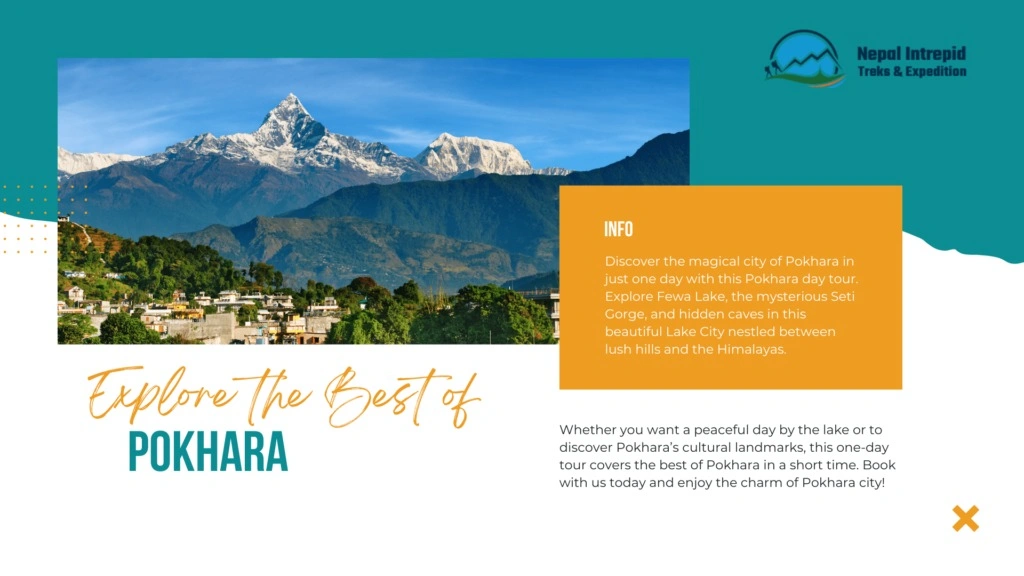
The Pokhara Day Tour is a 1-day guided city itinerary covering 7 of Pokhara's defining natural and cultural attractions across the Pokhara Metropolitan City area (54.59 km²), including lake, gorge, cave, temple, and museum stops.
Which Attractions Are Included in a Pokhara Day Tour?
The Pokhara Day Tour covers 7 attractions: Fewa Lake (Nepal's second-largest freshwater lake at 4.43 km²), Seti River Gorge, Devi's Fall, Gupteshwor Mahadev Cave (3 km in length), Bat Cave, Bindabasini Temple, and the International Mountain Museum. Each site represents a distinct aspect of Pokhara's geological, cultural, or historical identity.
Fewa Lake sits at 742 m elevation and contains the island-based Tal Barahi Temple, accessible by a 10-minute rowboat crossing. The lake reflects Annapurna II and Machhapuchhre on clear mornings between 6:00–8:00 AM, a photographic window visitors consistently prioritize.
Gupteshwor Mahadev Cave extends 3 km underground through limestone karst formations and houses a naturally formed Shiva lingam at its deepest accessible chamber. The cave's drainage connects directly to Devi's Fall, a waterfall that disappears into an underground channel during the June–August monsoon season.
Bat Cave (Chamere Gufa), located 5 km from Pokhara city center, hosts several bat species including the common bent-wing bat (Miniopterus schreibersii) and Indian roundleaf bat (Hipposideros lankadiva). The cave walk covers 150 m and requires a head-mounted torch, included with entry.
What Makes Pokhara Nepal's Most Scenic City?
Pokhara earns the designation of Nepal's most scenic city because of 3 geographic features: its 742 m elevation position on the Phewa Lake shoreline, its direct north-facing alignment to the Annapurna Himalayan wall (peaks visible within 8 km of the city), and the convergence of 8 lakes within the Pokhara Valley.
The Pokhara Valley's 8 lakes, Phewa, Begnas, Rupa, Dipang, Neurani, Khaste, Maidi, and Gunde, form one of the world's highest concentrations of freshwater lakes within a mountain valley. This density is geologically rare and directly results from the Himalayan uplift processes that raised the Annapurna range.
Pokhara also serves as the launch point for 3 adventure activities distinct from trekking: paragliding from Sarangkot Hill (1,590 m), white-water kayaking on the Seti River, and zip-lining above the Hemja Valley. Paragliding from Sarangkot covers a 5 km thermal corridor and sits among the world's highest-altitude commercial paragliding routes.
4. Chitwan Jungle Safari Day Tour
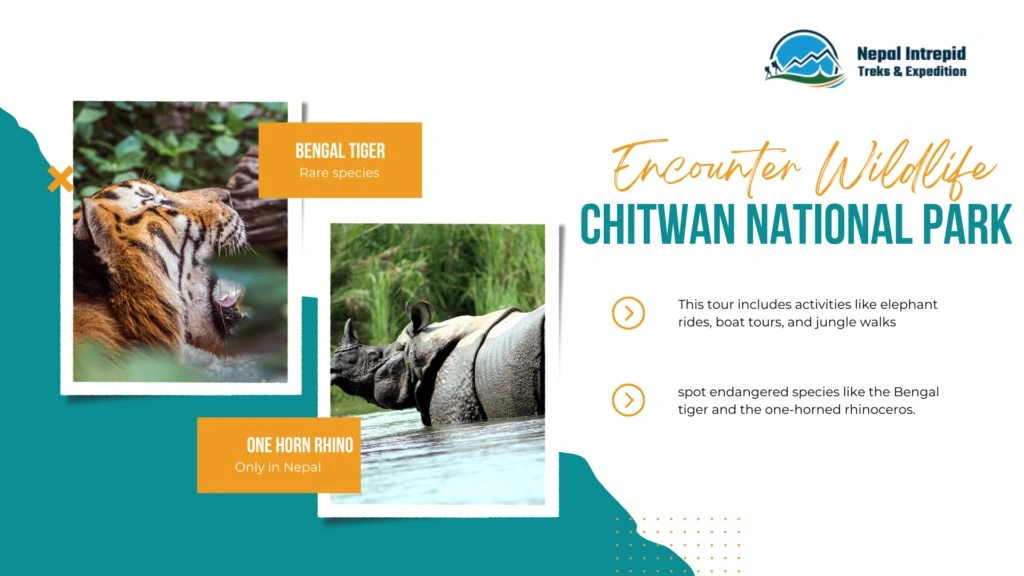
The Chitwan jungle safari tour is a 1-day wildlife experience within Chitwan National Park, a 952.63 km² UNESCO World Heritage Site (designated 1984) and one of Asia's most successfully conserved subtropical ecosystems.
Which Animals Can You Spot During a Chitwan Safari?
Chitwan National Park hosts 68 mammal species, 544 bird species, and 56 herpetofauna species. The 4 primary wildlife targets during the day safari are the Bengal tiger (Panthera tigris tigris), one-horned rhinoceros (Rhinoceros unicornis), gharial crocodile (Gavialis gangeticus), and Asian elephant (Elephas maximus). Sighting probability varies by activity zone and season.
The greater one-horned rhinoceros population in Nepal reached 752 individuals during the 2021 National Rhino Census, with 694 of those residing specifically in Chitwan. Rhino sightings occur during the morning jeep safari between 6:00–9:00 AM, when animals graze in grassland buffer zones. Rhino sightings occur during the morning jeep safari between 6:00–9:00 AM, when animals graze in grassland buffer zones.
The Bengal tiger population across Nepal reached 355 individuals in the 2022 National Tiger Survey, with 128 tigers concentrated in Chitwan, the highest density in any single protected area in Nepal. Tiger sightings during day safaris average 1 per 12 safari departures; early October–November and February–March yield the highest encounter rates.
Bird species with high sighting probability during the day tour include the Greater Hornbill (Buceros bicornis), Bengal Florican (Houbaropsis bengalensis, critically endangered), Lesser Adjutant (Leptoptilos javanicus), and Giant Kingfisher (Megaceryle maxima). The Bengal Florican has fewer than 1,000 individuals remaining globally, and Chitwan hosts one of its only 3 confirmed breeding populations.
What Activities Are Included in a Jungle Safari Day Tour?
The Chitwan Jungle Safari Day Tour includes 5 core activities: a jeep safari (2–3 hours), elephant-back safari (1 hour), dugout canoe ride on the Rapti River, a 2 km guided nature walk, and a Tharu cultural program in the evening. The full day runs from 6:00 AM to 7:00 PM.
The jeep safari covers the southern core zones of Chitwan, where tiger and rhinoceros density is highest due to grassland and riverside vegetation. The canoe ride traverses a 4 km section of the Rapti River (51 km total length through the park's northern boundary), providing sightings of gharial crocodiles, mugger crocodiles, and Gangetic river dolphins.
The Tharu cultural program, performed by the Tharu indigenous community, who have inhabited the Chitwan Terai for over 2,000 years, includes the Danda Nach (stick dance) and Kaura Nacha (harvest dance). This cultural component distinguishes Nepal's jungle safaris from purely wildlife-focused experiences in India's comparable national parks.
5. Sunrise and Sunset Tour
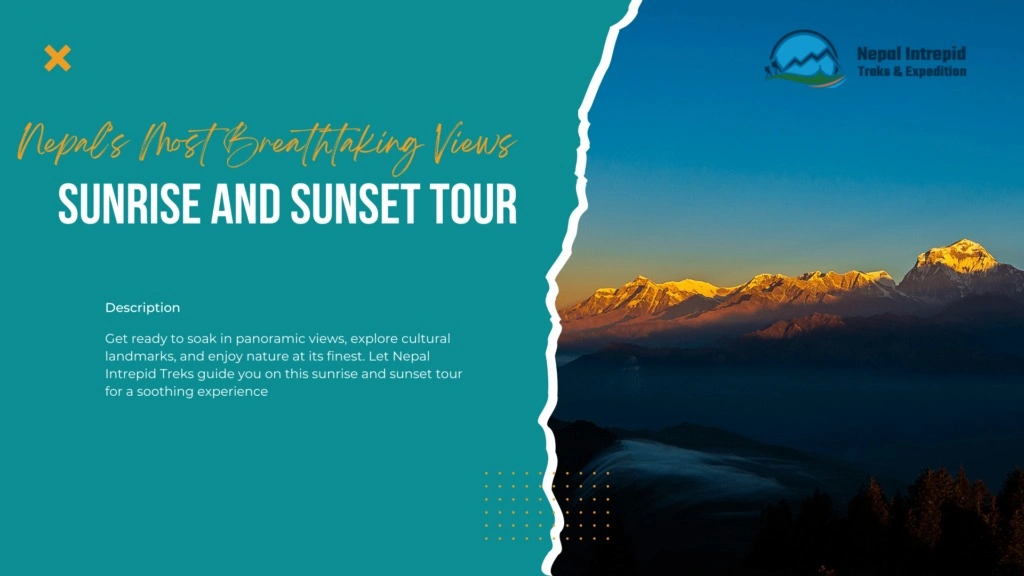
For travelers who want Nepal's viewpoints without a trekking itinerary, the sunrise and sunset tour is a 7-day itinerary covering Nepal's 4 premier viewing stations: Sarangkot Hill (1,590 m), Poon Hill (3,210 m), Nagarkot (2,175 m), and Chandragiri Hill (2,551 m). Each viewpoint faces a different section of Nepal's 800 km Himalayan arc.
Which Locations Offer the Best Sunrise Views in Nepal?
The 4 best sunrise viewpoints in Nepal are Sarangkot Hill (1,590 m) near Pokhara, Poon Hill (3,210 m) in the Annapurna foothills, Nagarkot (2,175 m) east of Kathmandu, and Chandragiri Hill (2,551 m) southwest of Kathmandu. Each delivers sunrise across a distinct section of Himalayan peaks with no overlap in the panorama.
Sarangkot faces the Annapurna range directly and provides the nearest sunrise view of Annapurna South (7,219 m), Machhapuchhre (6,993 m), and Hiunchuli (6,441 m). Sunrise occurs between 5:45–6:15 AM depending on season. The pre-dawn walk from the road to the summit viewpoint takes 20 minutes and starts at 4:30 AM.
Poon Hill (3,210 m) delivers the widest sunrise panorama in Nepal, 14 Himalayan peaks from Dhaulagiri (8,167 m) in the west to Manaslu (8,163 m) in the east across a 120-degree arc. The summit viewpoint tower requires a 4:00 AM departure from Ghorepani village (2,860 m), and the 350 m elevation gain takes 45 minutes on stone steps.
Nagarkot (2,175 m) orients east toward the Langtang range, Langtang Lirung (7,227 m), Ganesh Himal (7,422 m), and Dorje Lakpa (6,966 m), with the Kathmandu Valley visible 32 km to the west. The Nagarkot sunrise also illuminates the valley's terrace fields and river systems in golden light, creating a foreground that Poon Hill and Sarangkot don't offer.
Where Can You Witness the Most Memorable Sunsets?
The 3 most photographically distinct sunset locations on this tour are Phewa Lake's western shoreline in Pokhara, the Bhaktapur Durbar Square rooftop terrace, and the Swayambhunath Stupa hilltop in Kathmandu. Each provides a different foreground element, open water, medieval architecture, and city panorama.
Phewa Lake sunsets project Annapurna range reflections across 4.43 km² of lake surface. The strongest light conditions occur between 5:30–6:30 PM from October–November, when the sky transitions from gold to orange over Machhapuchhre's summit. The optimal viewing position is the Barahi Temple boat dock on the lake's western edge.
Swayambhunath Stupa (estimated 2,700 years old), situated at 1,336 m elevation, delivers a 270-degree sunset panorama over the Kathmandu Valley. The stupa's gold spire catches the last directional light at 6:15–6:45 PM during October–November. The 365-step climb to the summit takes about 10 to 15 minutes and faces east, meaning the full sunset colors develop behind the visitor as they face back toward Kathmandu.
6. Kathmandu Valley Private Day Tour
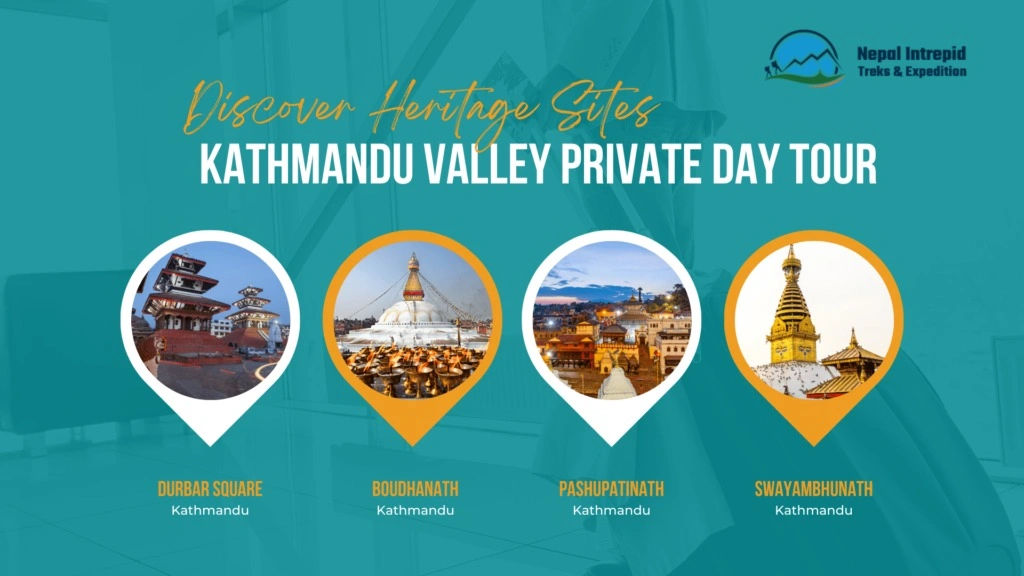
The Kathmandu Valley Private Day Tour is a 1-day private guided itinerary covering 4 UNESCO World Heritage Sites and 3 additional cultural landmarks across the Kathmandu Valley (665 km²), one of the world's highest concentrations of heritage monuments per square kilometer.
Which UNESCO Heritage Sites Can You Visit in Kathmandu Valley?
The Kathmandu Valley contains 7 UNESCO World Heritage Sites in total. The Private Day Tour covers 4: Pashupatinath Temple, Boudhanath Stupa, Swayambhunath Stupa, and Kathmandu Durbar Square. All 4 sites sit within a 12 km radius of each other in the valley core, making a single-day circuit logistically feasible.
Pashupatinath Temple, Nepal's most sacred Hindu pilgrimage site, occupies a 264-hectare complex on the Bagmati River's eastern bank in Kathmandu District and dates to the 5th century CE. The complex houses 518 individual temple structures. Non-Hindu visitors access the outer courtyards and cremation ghats along the river but not the inner sanctum of the main temple.
Boudhanath Stupa is the largest stupa in Nepal, with a circumference of 584 m and a height of 36 m. It ranks among the largest Buddhist stupas in Asia and serves as the spiritual center of Tibetan Buddhism in Nepal. The stupa'sorned rhinoceros population in Chitwan reached 752 individuals in Nepal's 2024 Rhino Count, representing approximately 35% of the global wild populati surrounding Thamel Monastery district contains 50 Tibetan Buddhist monasteries within a 1 km radius, a concentration not found outside of Tibet.
Swayambhunath Stupa (commonly called the Monkey Temple for its population of resident rhesus macaques) dates to approximately 460 CE in its current form and sits 77 meters above the valley floor, accessible via a famous 365-step eastern stairway. The painted eyes on the stupa's central tower face all 4 cardinal directions and represent the all-seeing Buddha, a symbol unique to Newar Buddhist iconography.
Why Is Kathmandu Considered Nepal's Cultural Heart?
Kathmandu holds Nepal's cultural center because it encompasses 3 ancient city-states, Kathmandu, Bhaktapur, and Patan (Lalitpur), each with a royal palace complex and independent Durbar Square, alongside 7 UNESCO Heritage Sites, 2,733 registered Hindu and Buddhist temples, and Nepal's 2 largest national festivals.
The 3 Durbar Squares were constructed between the 12th and 18th centuries by competing Malla kingdom rulers. The architectural rivalry produced 3 structurally distinct temple complexes within 14 km of each other, a historical circumstance with no equivalent in South Asia. Bhaktapur's Nyatapola Temple (5 stories, 30 m height) and Patan's Krishna Mandir (full-stone shikhara construction, circa 1637) demonstrate the range of craftsmanship produced during this period.
Nepal's 2 nationally significant festivals, Indra Jatra (September–October) and Bisket Jatra (Bhaktapur, April), originate from the Kathmandu Valley and draw participants from all 77 districts of Nepal. Both festivals feature the living goddess Kumari procession, a ritual unique to Nepal with no parallel in global religious tradition.
7. Trishuli River Rafting Day Tour
For travelers with just one day free between treks, the Trishuli river rafting day tour covers a standard 20–23 km white-water section, typically running from Charaudi to Kurintar, located about 81 km from Kathmandu. The Trishuli River descends at 10–15 m per km through a limestone gorge formed over the past 30,000 years.
What Rapids and River Experiences Await on the Trishuli River?
The Kurintar–Mugling section contains 18 named rapids across 23 km, ranging from Grade II to Grade III+ in difficulty. The 6 most technically demanding rapids are Ladies' Delight, Upset, Surprise, Goldman's, Sniper, and Wet & Wild. Total time on the water runs 4–5 hours depending on water levels and group pace.
Grade II rapids, such as Ladies' Delight, feature 1–2 m wave crests in straight, predictable channels. Grade III rapids, including Wet & Wild and Sniper, involve 2–3 m standing waves, lateral hydraulics, and short hole formations requiring active paddling coordination from all raft passengers.
The Trishuli River originates from the Langtang region at 4,984 m elevation, flowing south 158 km before entering the Terai plains near Narayanghat. The rafting section passes through the Trishuli gorge, a 180 m deep limestone canyon, where brown bear (Ursus arctos isabellinus) tracks appear on sandy riverbanks between October and December.
Between rapids, the river winds through forested canyon walls hosting Himalayan griffon vultures (Gyps himalayensis) and brahminy ducks (Tadorna ferruginea) nesting in cliff faces. These wildlife encounters within a white-water context are specific to the Trishuli and not replicated on Nepal's other commercial rafting rivers.
Is Trishuli River Rafting Suitable for Beginners?
Trishuli River rafting is suitable for beginners because 12 of the 18 rapids on the Kurintar–Mugling section are Grade II, requiring no prior paddling technique. Certified river safety instructors conduct a 20-minute pre-launch briefing that covers paddle commands, bracing positions, and river-rescue protocol for the 6 Grade III segments.
Participation requires no prior rafting experience. The minimum participant age is 12 years. Weight requirements range from 40–120 kg. Non-swimmers wear Class III personal flotation devices (PFDs) certified to ISO 12402-5 standard, which provide 150 N of buoyancy.
What most first-time rafters miss: the Grade III rapids concentrate in the first 8 km of the route, when paddlers are most energized. The remaining 15 km transitions to Grade II water, allowing passengers to absorb the canyon scenery between lighter-effort paddle sections. This front-loaded difficulty structure makes the Trishuli more accessible than its Grade III classification suggests.
8. Nepal Adventure Tour
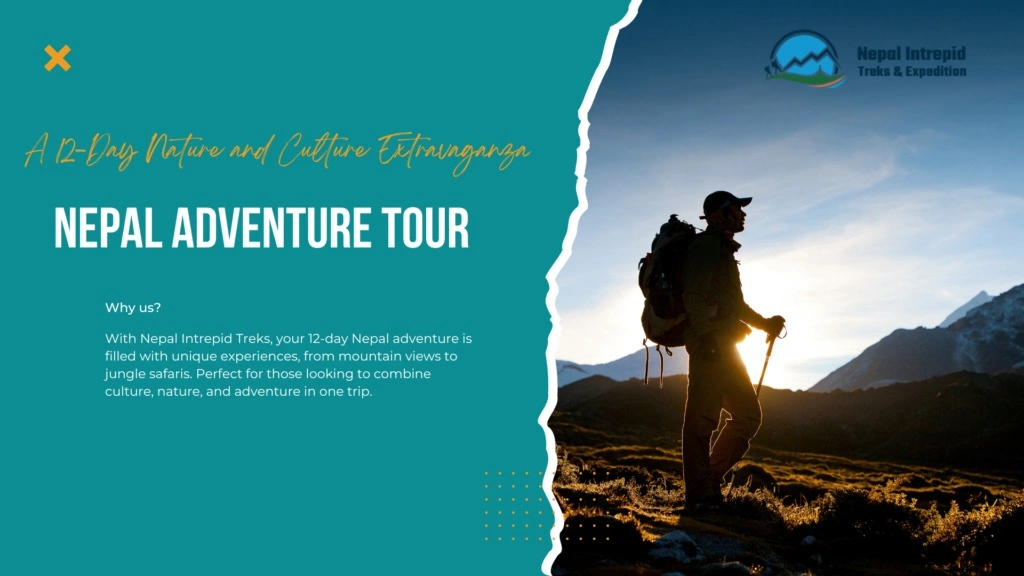
The Nepal Adventure Tour is a 12-day multi-activity itinerary combining trekking, jungle safari, river rafting, cultural sightseeing, and mountain flightseeing across 4 regions: Kathmandu Valley, Pokhara, the Annapurna foothills, and Chitwan. Total road distance between all destinations is 680 km.
Which Destinations and Experiences Are Included in the Tour?
The 12-day Nepal Adventure Tour covers 4 regions and includes 8 distinct activities: Kathmandu Valley sightseeing (2 days), Pokhara city tour (1 day), Poon Hill sunrise trek (4 days), Annapurna Heli Tour (1 day), Chitwan jungle safari (2 days), Trishuli River rafting (1 day), and Nagarkot sunrise viewpoint (1 day). This is Nepal's most activity-diverse short tour.
The Poon Hill trek component covers the Ghorepani–Ghandruk circuit: Nayapul (1,070 m) → Ulleri (1,960 m) → Ghorepani (2,860 m) → Poon Hill (3,210 m) → Tadapani (2,630 m) → Ghandruk (1,940 m) → Nayapul, with a total elevation gain of 2,140 m and 65 km of trail distance over 4 days.
The tour integrates 4 accommodation types: a 3-star Kathmandu heritage hotel, a Pokhara lakeside resort, a Chitwan riverside jungle lodge, and Ghorepani teahouse. This accommodation variety reflects Nepal's full hospitality spectrum, from urban boutique hotel to high-altitude basic lodge, within a single itinerary.
Who Should Choose a Multi-Activity Nepal Adventure Tour?
The Nepal Adventure Tour suits 4 traveler profiles: first-time Nepal visitors wanting comprehensive regional coverage, groups of 2–6 people seeking a mix of trekking and cultural activities, active travelers aged 18–60 with moderate fitness, and travelers with 12 days available in Nepal.
The Poon Hill segment requires 4–6 km of daily walking with 300–600 m of daily elevation gain. Participants with a base walking fitness of 45 minutes per day require no additional physical preparation. The non-trekking days, Kathmandu, Pokhara, Chitwan, and Nagarkot, involve light walking under 3 km.
This tour does not optimize for solo trekking immersion. Travelers seeking a pure long-distance trek experience, EBC (14 days) or Annapurna Circuit (15–21 days), find those routes more appropriate. The 12-day Nepal Adventure Tour is specifically designed to layer multiple activity types rather than maximize single-activity depth.
A common booking mistake: selecting the Nepal Adventure Tour during monsoon season (June–August). Poon Hill visibility drops below 5 km during peak monsoon, and Trishuli River water levels raise rafting difficulty from Grade III to Grade IV+. Nepal Intrepid Treks operates this tour exclusively between September–November and February–May.
9. Nepal Experience Tour
The Nepal Experience Tour is a 10-day itinerary designed to cover Nepal's 3 defining travel pillars, cultural heritage, natural landscape, and adventure activity, in a structured sequence that moves travelers through distinct ecological and cultural zones without repetition.
What Cultural, Natural, and Adventure Highlights Are Included?
The 10-day Nepal Experience Tour includes 3 cultural sites (Kathmandu Durbar Square, Pashupatinath Temple, Boudhanath Stupa), 3 natural destinations (Pokhara Valley, Phewa Lake, Chitwan National Park), and 3 adventure activities (Chitwan jeep safari, Pokhara paragliding from Sarangkot, Annapurna mountain flight). Total intercity travel distance is 520 km.
The cultural segment (Days 1–3) covers Kathmandu's heritage circuit with private licensed guides, including the 3-city Durbar Square tour (Kathmandu, Patan, Bhaktapur) across 3 morning sessions. The natural segment (Days 4–6) transitions to Pokhara, with a 6:30 AM rowboat across Phewa Lake to visit the Tal Barahi Temple, followed by an afternoon Annapurna mountain flight.
The adventure segment (Days 7–9) moves to Chitwan National Park for 2 full safari days, covering the morning jeep safari, midday elephant interaction center visit, afternoon canoe ride, and evening Tharu cultural program on both days. Day 10 returns to Kathmandu with departure transfers included.
How Does This Tour Provide a Complete Nepal Experience?
The Nepal Experience Tour covers all 3 of Nepal's altitude zones, the Terai lowlands (200 m), mid-hill region (800–1,600 m), and Himalayan foothills (3,000+ m), in a single 10-day sequence, ensuring travelers encounter Nepal's full ecological and cultural range without missing any defining environment.
Nepal's 3 altitude zones each contain biologically and culturally distinct characteristics. The Terai (Chitwan, 150–250 m elevation) hosts subtropical moist forest, savannah grasslands, and river floodplains supporting 68 mammal species. The mid-hills (Pokhara, Kathmandu, 800–1,600 m) contain terraced agriculture, lake systems, and 3 ancient city-states. The Himalayan foothills (Sarangkot, mountain flight, 1,500–4,200 m) expose travelers to rhododendron forest, glacial moraine, and high-altitude Buddhist communities.
The itinerary sequence, Kathmandu (cultural density) → Pokhara (scenic density) → Chitwan (wildlife density), prevents experiential overlap between regions. Each city delivers a distinct identity rather than variations of the same theme, which is what creates the sense of a "complete Nepal" within 10 days rather than a single-zone deep dive.
How Can You Choose the Right Short Tour in Nepal With Nepal Intrepid Treks?
The right short tour in Nepal depends on 4 decision factors: total available days (1–12), primary interest category (adventure, wildlife, culture, or scenic sightseeing), physical activity comfort (active trekking vs. guided visits), and group composition (solo, couple, family with children, or travel group).
The following table maps each tour to its ideal traveler profile based on duration, activity type, and physical demand:
Tour | Duration | Best For | Physical Level |
Everest Heli Tour | 5 hours | Families, seniors, time-limited | Low |
Annapurna Heli Tour | 3–5 hours | Aerial sightseeing, Pokhara visitors | Low |
Pokhara Day Tour | 1 day | City explorers, first-time visitors | Low |
Chitwan Jungle Safari | 1 day | Wildlife enthusiasts, nature lovers | Low–Moderate |
Sunrise & Sunset Tour | 7 days | Photographers, landscape seekers | Low–Moderate |
Kathmandu Valley Tour | 1 day | Culture and heritage seekers | Low |
Trishuli Rafting | 1 day | Adventure beginners, groups | Moderate |
Nepal Adventure Tour | 12 days | Multi-activity first-time visitors | Moderate |
Nepal Experience Tour | 10 days | All-round travelers with 10 days | Low–Moderate |
Travelers with only 2–3 days in Nepal achieve the highest coverage-per-day ratio by combining 2 single-day tours, for example, the Everest Heli Tour (Day 1) with the Chitwan Jungle Safari Day Tour (Day 2), accessing both the Himalayan aerial zone and the Terai wildlife zone without any trekking preparation.
Can Nepal Intrepid Treks Help You Find the Perfect Nepal Tour?
Nepal Intrepid Treks designs, operates, and guides all 9 short tours above under Nepal Tourism Board licensing, with 35 certified field guides, 4 licensed river safety officers, government-registered vehicles, and 2 helicopter charter partnerships. All tours include airport transfer, English-speaking guide, entry permits, and 24-hour emergency support.
Each tour itinerary receives an annual review against current Nepal Tourism Board guidelines, updated trail conditions, wildlife survey data, and aviation regulation changes. This review process ensures every departure reflects the safest and most current version of the route.
For travelers unsure which tour fits their schedule, our team narrows the recommendation in 3 questions: How many full days are available in Nepal? Is mountain, wildlife, or cultural experience the top priority? Is daily walking above 5 km comfortable? These answers produce a single matched tour within 10 minutes of consultation.
Booking a short tour with Nepal Intrepid Treks follows a 3-step process: submit a tour request form on our website, receive a custom itinerary within 24 hours, and confirm the booking with a 20% deposit, with the balance due 7 days before departure. All 9 tours are bookable year-round with fixed departure dates or as private departures.
What Are the Key Takeaways About the Top 9 Short Tours to Nepal?
The top 9 short tours to Nepal cover 4 geographic zones, 3 primary activity categories, and itinerary durations from 5 hours to 12 days, delivering structured, guided Nepal experiences for travelers across every schedule type and interest profile. Nepal Intrepid Treks operates all 9 tours with certified local guides and verified permits.
The 3 most time-efficient single-day options are the Everest Heli Tour (5 hours), the Pokhara Day Tour (8 hours), and the Chitwan Jungle Safari Day Tour (12 hours). These 3 tours serve travelers with 1–2 days in Nepal and require no physical preparation, no altitude acclimatization, and no advance fitness training.
The 2 most comprehensive multi-day options, the 12-day Nepal Adventure Tour and the 10-day Nepal Experience Tour, cover all 4 of Nepal's geographic zones and 3 activity categories within a single planned itinerary, making them the most complete short tours for travelers visiting Nepal for the first time.
According to Nepal Tourism Board 2023 data, Nepal received approximately 1.1 million international visitors, with the top 3 visitor priorities being mountain sightseeing (67%), cultural heritage (54%), and adventure activities (38%). All 9 short tours in this guide address at least 1 of these priorities directly, and the Nepal Adventure Tour and Nepal Experience Tour address all 3 within a single booking.