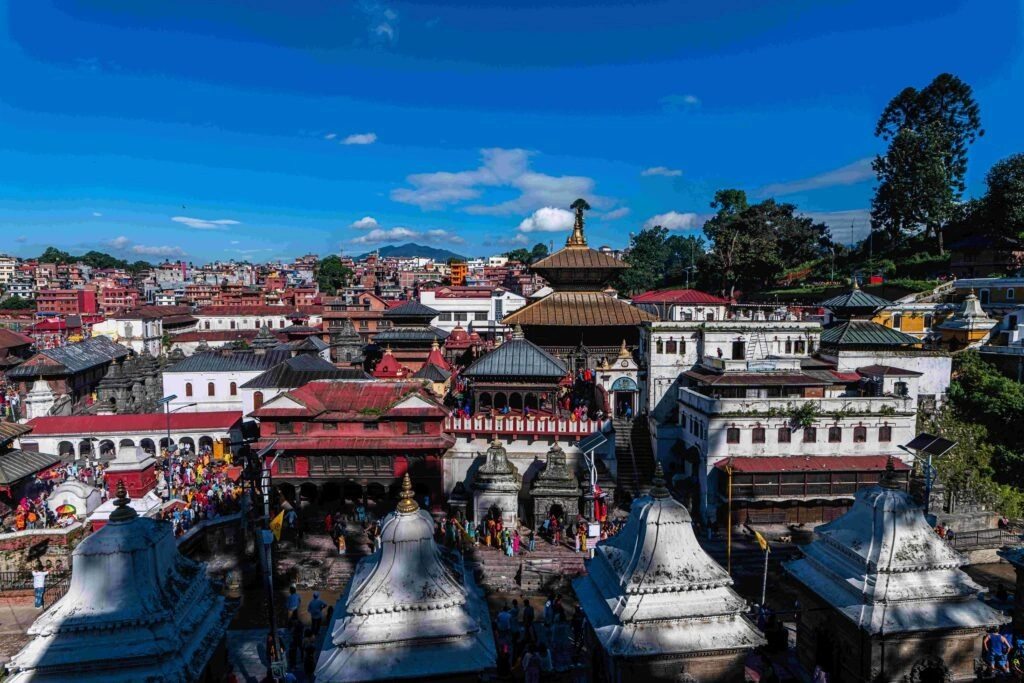
Pashupatinath Temple is a UNESCO World Heritage Hindu pilgrimage site in Kathmandu, located along the sacred Bagmati River and dedicated to Lord Shiva. As one of Nepal’s most visited religious landmarks, reaching Pashupatinath Temple efficiently depends on choosing the right transport mode, entry point, and timing. The temple lies within 2 to 6 km of major hubs such as Tribhuvan International Airport, Thamel, and Boudhanath Stupa, making it accessible in 15 to 30 minutes by taxi, ride-hailing apps like Pathao, local microbuses, or short walking routes.
Reaching Pashupatinath Temple easily requires understanding route options, fare ranges, and entry logistics before arrival. Taxi services offer direct access with predictable travel times, while budget travelers can use microbus routes via Gaushala followed by a short walk. Walking from Boudhanath provides a practical 2 km pedestrian route connecting two UNESCO heritage sites. Travel time, cost (NPR 20 to 800), peak-hour traffic, and gate access all influence the overall experience, especially during major festivals like Maha Shivaratri when visitor numbers surge significantly.
Where Is Pashupatinath Temple Located?
Pashupatinath Temple is located in Deopatan, a historic district in northeastern Kathmandu, Nepal, at coordinates 27.7104° N, 85.3487° E. The temple stands on the western bank of the Bagmati River, approximately 5 km northeast of central Kathmandu. It is one of the seven Monument Zones in the Kathmandu Valley UNESCO World Heritage property.
Pashupatinath Temple is a sacred Hindu temple complex dedicated to Pashupati, the lord of all living beings and a form of the deity Shiva. The temple's pagoda-style shikhara (spire) rises 23.6 meters above the main sanctum. The UNESCO World Heritage Site designation, granted in 1979, covers a core property of 83.55 hectares plus an 11.55-hectare buffer zone, 95.1 hectares in total, according to UNESCO's official Kathmandu Valley Monument Zone records.
The Bagmati River, which flows east to west through the temple complex, holds ritual significance as a holy waterway in Hindu and Buddhist traditions. The river's ghats (stone steps) directly in front of the temple serve as active cremation sites known as Aryaghat and Bhasmeshwar Ghat.
How Far Is It From Tribhuvan International Airport?
Tribhuvan International Airport (TIA) lies 5.5 km southwest of Pashupatinath Temple. The direct road distance via Araniko Highway and Gaushala takes 15 to 20 minutes by taxi under normal traffic conditions. During peak hours, 8 AM to 10 AM and 5 PM to 7 PM, travel time extends to 30 minutes.
Tribhuvan International Airport is Nepal's only international airport, located in Sinamangal ward, Kathmandu. Its proximity to Pashupatinath Temple makes it possible to visit the temple directly from the airport before checking into a hotel, particularly for pilgrims with limited layover time.
Which Gate Is Easiest for First-Time Visitors?
The western main gate of Pashupatinath Temple, facing Gaushala Road, is the primary entrance for first-time visitors. This gate leads directly to the ticket counter where foreigners purchase entry passes for NPR 1,000 (approximately USD 7.50). The eastern gate, accessible from the Boudhanath side, serves pilgrims arriving on foot from that direction.
The western gate opens at 4:00 AM and closes at 9:00 PM daily. The ticket booth at the western gate operates from 6:00 AM to 7:00 PM. Three additional smaller gates, northern, southern, and the Guhyeshwari access path, serve local worshippers and are not the primary access points for visitors unfamiliar with the complex layout.
What Are the Best Ways to Reach Pashupatinath Temple?
The 3 primary transport options to reach Pashupatinath Temple from Kathmandu are taxi, local microbus, and walking. Taxis offer direct door-to-door service in 15 to 30 minutes at NPR 300 to 800 depending on origin. Microbuses cost NPR 20 to 30 but require a short walk from the nearest stop. Walking is practical only from Boudhanath, which is 2 km away.
Is a Taxi the Easiest Option?
Taxis are the fastest, most direct transport option for reaching Pashupatinath Temple from any Kathmandu location. App-based taxis via Pathao or inDrive give fixed fares before departure, eliminating fare negotiation. Metered taxis from hotel zones cost NPR 300 to 800 depending on origin point.
Pathao, Nepal's dominant ride-hailing platform, connects to Pashupatinath Temple through its GPS-mapped destination feature. Fares from Thamel via Pathao range from NPR 280 to 350 for a car and NPR 180 to 220 for a motorcycle ride. Taxis hired from the temple's parking area for the return journey typically cost NPR 100 more than the inbound fare due to negotiated pricing at tourist sites.
3 taxi hiring points near the western gate are: the formal taxi stand on Gaushala Road (marked by yellow signs), the informal waiting area near the Seti Gandaki footbridge, and the hotel taxi stands along Budhanilkantha Marg.
Can You Take a Local Bus or Microbus?
Local microbuses reach Pashupatinath Temple via the Gaushala stop on Koteshwor–Ratnapark Route 23, costing NPR 20 to 30 per ride. The Gaushala stop is a 600-meter walk from the temple's western gate. Microbuses depart every 8 to 12 minutes between 6:00 AM and 8:30 PM.
Microbuses are minivans seating 12 passengers, operated by private contractors on fixed Kathmandu Valley routes. Route 23 connects Ratnapark (central Kathmandu) to Koteshwor via Gaushala. Passengers board at any roadside point and pay the conductor directly in NPR cash. No digital payment is accepted on local microbuses.
City Bus Route 12 also passes Gaushala, with a fare of NPR 25. Bus frequency on Route 12 is every 20 to 25 minutes. During Maha Shivaratri, the temple's largest annual festival, temporary shuttle buses operate from Ratnapark to the temple gates at NPR 30 flat fare.
Is Walking to the Temple Practical?
Walking to Pashupatinath Temple is practical only from Boudhanath Stupa, which is 2 km east along a paved pedestrian path. The walk from Boudhanath takes 20 to 25 minutes on flat terrain. Walking from Thamel (6 km) or TIA (5.5 km) is impractical due to high-traffic roads with no dedicated footpaths.
The 2-km Boudhanath-to-Pashupatinath walking path passes through Deopatan village, where local vendors sell flower offerings (puja items) and clay lamps for NPR 20 to 50. For a deeper look at the temple's spiritual and historical significance, our guide on the reasons to visit Pashupatinath covers the top attractions inside the complex. The route is marked with green directional signs in Nepali and English at 5 key intersections. The path is fully paved and accessible without a guide.
How Do You Reach Pashupatinath Temple From Popular Areas?
Pashupatinath Temple is reachable from 3 major visitor hubs in Kathmandu: Tribhuvan International Airport (5.5 km), Thamel (6 km), and Boudhanath (2 km). Each starting point has a distinct transport combination. Patan, located 7 km south, requires crossing the Ring Road via taxi or microbus.
How Do You Go From Tribhuvan International Airport?
From Tribhuvan International Airport, take a pre-paid taxi from the airport taxi counter to Pashupatinath Temple for NPR 600 to 700 fixed fare. The journey covers 5.5 km via Araniko Highway, turning north at Gaushala Chowk. Travel time is 15 to 20 minutes outside peak hours.
The airport pre-paid taxi counter is located at the arrival terminal exit, 30 meters left of the main gate. Pre-paid taxis operate under Tribhuvan International Airport Authority regulation. The fixed fare eliminates post-ride negotiation. Alternatively, Pathao and inDrive apps are operational inside TIA's arrival zone via mobile data or airport Wi-Fi and deliver fares NPR 150 to 200 lower than pre-paid counters.
The 4-step route from TIA to Pashupatinath:
Exit TIA arrival terminal and proceed to the pre-paid taxi counter (30 meters left of the exit)
Request Pashupatinath Temple western gate as destination and pay NPR 600 to 700
Travel via Araniko Highway northward to Gaushala Chowk (4.2 km)
Turn left at Gaushala Chowk and proceed 1.3 km to the temple gate
How Do You Go From Thamel?
From Thamel, the 6 km journey to Pashupatinath Temple takes 20 to 35 minutes by taxi at a fare of NPR 350 to 500. The standard route travels east on Lazimpat Road, turns onto Maharajgunj Road, and continues to Gaushala Chowk before reaching the temple gate.
Thamel is Kathmandu's primary tourist accommodation district, located in ward 16, 6 km west of Pashupatinath Temple. Hotel concierge taxis from Thamel charge NPR 450 to 500 for this route. Pathao motorcycle rides from Thamel to the temple cost NPR 200 to 250 and avoid traffic congestion on two-wheelers.
The alternative microbus route from Thamel requires boarding Route 23 at Ratnapark (2 km south of Thamel on foot or NPR 100 by rickshaw), riding to Gaushala stop, then walking 600 meters to the gate, total cost NPR 120 to 130, total time 50 to 70 minutes.
How Do You Go From Boudhanath or Patan?
From Boudhanath Stupa, walk the 2 km eastward path to Pashupatinath Temple in 20 to 25 minutes at zero transport cost. From Patan Durbar Square, take a taxi 7 km north via Ring Road for NPR 400 to 550, covering the distance in 25 to 40 minutes.
Boudhanath Stupa is the largest Buddhist stupa in Nepal, located 2 km east of Pashupatinath Temple in Boudha ward. The walking path between the two sites creates a natural dual-heritage visitor itinerary covering both Hinduism and Buddhism within a 3-hour window, part of a broader network of UNESCO World Heritage Sites in Nepal that spans Kathmandu Valley and beyond.
Patan, officially Lalitpur Metropolitan City, sits 7 km south of Pashupatinath Temple across the Bagmati River. The Ring Road connects Patan to Gaushala via Koteshwor intersection. Local microbuses from Patan's Lagankhel Bus Park reach Gaushala on Route 18 for NPR 25 to 30, requiring a 600-meter walk to the temple gate from the stop.
How Much Time and Money Should You Budget?
Budget NPR 600 to 1,800 total for transport to and from Pashupatinath Temple depending on origin and transport mode, plus NPR 1,000 for the foreigner entry fee. Total visit time, travel, entry, and temple exploration, ranges from 2 hours (quick visit) to 5 hours (full complex + Guhyeshwari Temple + Bagmati riverfront).
How Long Does Each Transport Option Take?
The following table shows travel times to Pashupatinath Temple by departure point and transport mode. Times reflect non-peak hours (10 AM to 4 PM). Add 10 to 15 minutes during morning peak (8 to 10 AM) and evening peak (5 to 7 PM).
Departure Point | Taxi Time | Microbus Time | Walking Time |
Tribhuvan Airport | 15–20 min | Not applicable | Not applicable |
Thamel | 20–35 min | 50–70 min | Not practical |
Boudhanath | 10–12 min | Not applicable | 20–25 min |
Patan (Lagankhel) | 25–40 min | 45–60 min | Not practical |
Taxi travel time is the most consistent across all departure points due to direct routing. Microbus time includes waiting time at boarding stops, averaging 8 to 12 minutes per stop during standard operating hours.
How Much Does a Taxi, Bus, or Local Ride Cost?
Taxi fares to Pashupatinath Temple range from NPR 300 to 800, microbus fares cost NPR 20 to 30, and Pathao motorcycle rides range from NPR 180 to 350 depending on departure point. All fares are one-way. Return fares from the temple's taxi stand typically add NPR 50 to 100 due to tourist zone pricing.
The following table shows one-way transport costs from each departure point in Nepali Rupees (NPR). Exchange rate as of 2025: 1 USD = approximately NPR 133.
Departure Point | Taxi (NPR) | Pathao Car (NPR) | Pathao Bike (NPR) | Microbus (NPR) |
Tribhuvan Airport | 600–700 | 420–500 | 250–300 | Not direct |
Thamel | 350–500 | 280–350 | 180–220 | 120–130 total |
Boudhanath | 200–300 | 150–200 | 100–130 | Not applicable |
Patan (Lagankhel) | 400–550 | 320–420 | 200–260 | 25–30 |
Foreigner entry to Pashupatinath Temple complex costs NPR 1,000, as confirmed on PADT's official visitor information page, which also lists free entry for Indian nationals and daily complex hours of 4:00 AM to 9:00 PM. The entry fee covers access to all open areas of the 264-hectare complex excluding restricted inner shrines.
When Is the Best Time to Travel to the Temple?
The 2 optimal times to visit Pashupatinath Temple are early morning (5:00 AM to 7:00 AM) for the morning Aarati ceremony and early evening (5:30 PM to 7:00 PM) for the Sandhya Aarati. Midday hours (11 AM to 3 PM) bring peak tourist crowds with waits of 15 to 30 minutes at the ticket counter.
Should You Go Early Morning or Before Evening Aarati?
Morning Aarati at Pashupatinath Temple begins at 5:00 AM and lasts 45 minutes. Arriving by 4:45 AM secures a viewing position near the Bagmati riverbank. Evening Sandhya Aarati begins at 6:00 PM and lasts 60 minutes, drawing larger crowds of 500 to 1,500 worshippers.
Aarati is a Hindu ritual worship ceremony involving fire lamps, incense, and mantras offered to the presiding deity. At Pashupatinath, morning Aarati is conducted by 4 priests simultaneously at the 4 cardinal-direction shrines surrounding the main Pashupatinath sanctum. Evening Aarati occurs on the Bagmati river ghats and is visible to non-Hindu visitors from the eastern bank without temple entry.
Morning visits offer 3 practical advantages over afternoon visits: cooler temperatures, fewer visitors at the ticket counter, and active puja (prayer) rituals creating authentic atmosphere throughout the complex. For a complete seasonal breakdown of weather, crowd levels, and festival timing, see our guide on the best time to visit Kathmandu.
How Do Festivals and Peak Days Affect Your Trip?
Maha Shivaratri, observed annually in February or March, drew an estimated 800,000 devotees and around 4,000 sadhus to Pashupatinath Temple in 2026, according to PADT's official festival estimate, extending travel time to the temple by 60 to 120 minutes. Regular Mondays (considered sacred to Shiva) bring 3 to 4 times the standard daily visitor count.
Maha Shivaratri is the great night of Shiva, a Hindu festival marking the marriage of Shiva and Parvati and observed on the 14th night of the dark fortnight in the Hindu month of Phalguna. During Maha Shivaratri, Kathmandu Metropolitan City deploys 200 to 300 additional traffic police officers around the temple zone. Temporary bus shuttles operate from 8 major city points at NPR 30 flat fare.
Teej festival (August or September), Bala Chaturdashi (November or December), and Kartik Purnima (October or November) are 3 additional high-attendance festivals that extend entry queues by 20 to 45 minutes. Travel to the temple on these days benefits from departing before 6:30 AM to clear the area before peak crowd arrival at 9 AM.
What Should You Know Before Entering the Temple Area?
Pashupatinath Temple enforces 3 primary entry rules: Hindu-only access to the main sanctum, mandatory footwear removal at designated areas, and a conservative dress code for all visitors. Non-Hindu visitors access 80% of the outer complex including ghats, subsidiary shrines, and forest areas. The inner sanctum housing the Pashupatinath Shivalinga is restricted to Hindu worshippers.
Who Can Enter the Main Temple?
Only practicing Hindus are permitted inside the main Pashupatinath Temple sanctum, enforced by temple priests (Bhattas) stationed at the inner gate. Non-Hindu visitors, including tourists of all nationalities, enter the outer complex covering approximately 200 hectares but are stopped at the inner sanctum gate by temple staff.
The Pashupatinath Shivalinga is the central sacred object inside the main temple, a 1-meter stone phallus representing Shiva's cosmic energy, installed in a 5-faced (Panchamukha) golden form. Hindu identity verification at the gate relies on declaration by the visitor; no documents are checked. Foreign nationals of Hindu faith are admitted upon verbal declaration.
This restriction has been upheld by the Pashupatinath Area Development Trust (PADT), the government body administering the temple complex, under the statutory authority granted by the Pashupati Area Development Trust Act, 2044 (1987).
What Dress Code and Etiquette Should Visitors Follow?
All visitors to Pashupatinath Temple follow 4 dress and conduct rules: covered shoulders, covered knees, no footwear in designated zones, and no leather items near inner shrines. Clothing rentals are not available at the temple; visitors prepare before arrival.
The 4 dress and etiquette requirements are:
Covered shoulders and upper arms: sleeveless tops and tank tops are not permitted inside the complex boundary
Knees covered: shorts above the knee require a sarong or wrap, available from vendors outside the gate for NPR 50 to 100
Footwear removed: shoes are removed before entering any roofed shrine pavilion and at the ghat steps; sandals are recommended over lace-up shoes for ease
No leather items near inner shrines: leather belts and bags are removed at the inner temple threshold as leather is considered impure in the shrine context
Photography inside the main temple courtyard is restricted. Exterior and ghat photography is permitted. Drone photography requires advance written permission from PADT.
What Should Non-Hindu Visitors Expect?
Non-Hindu visitors experience Pashupatinath Temple's outer complex, ghats, forest paths, subsidiary shrines, and the Bagmati riverbank, covering 80% of the 264-hectare site. The Bagmati eastern bank viewing area provides full visual access to the main temple, cremation ghats, and Aarati ceremonies without entry restrictions.
The 5 areas open to non-Hindu visitors within the complex are:
Outer temple courtyard: stone-paved ground surrounding the main pagoda accessible from the western gate
Aryaghat and Bhasmeshwar Ghat: active cremation platforms on the Bagmati riverbanks, open for respectful observation
Mrigasthali forest: a 50-hectare forested area north of the temple inhabited by rhesus macaques and deer, considered sacred
Subsidiary shrines: 492 smaller temples and shrines within the complex, most of which non-Hindus enter freely
Eastern bank viewing terraces: stone terraces on the opposite side of the Bagmati River providing unobstructed views of the main temple facade and ghat ceremonies
What Nearby Places Can You Combine With Your Visit?
3 nearby sites combine efficiently with a Pashupatinath Temple visit: Guhyeshwari Temple (500 meters), Boudhanath Stupa (2 km), and the Mrigasthali forest deer park (within the temple complex). Combining all 3 sites creates a 4 to 5 hour itinerary covering Hindu and Buddhist heritage in northeastern Kathmandu.
Can You Add Guhyeshwari Temple to Your Route?
Guhyeshwari Temple is located 500 meters northeast of Pashupatinath Temple's eastern bank, reachable on foot in 7 to 10 minutes via the Bagmati riverside path. The route from Pashupatinath to Guhyeshwari follows the northern bank of the Bagmati River along a stone-paved pilgrim trail with no vehicular traffic.
Guhyeshwari Temple is a sacred Hindu and Tantric shrine dedicated to Guhyeshwari, a form of the goddess Sati and a Shakti Peetha (seat of divine feminine power). Shakti Peethas are 51 sacred sites across South Asia marking spots where body parts of the goddess Sati fell to earth according to Hindu Puranas. Guhyeshwari marks the location where Sati's knees are believed to have fallen.
Entry to Guhyeshwari Temple carries the same Hindu-only restriction for the inner sanctum as Pashupatinath Temple. Non-Hindu visitors access the outer courtyard and sacred pond. The combined Pashupatinath–Guhyeshwari visit covers 2 major Kathmandu heritage sites within a 600-meter walking radius.
What Can You See Around the Bagmati Riverfront?
The Bagmati riverfront at Pashupatinath extends 400 meters and contains 7 active features: Aryaghat cremation ghat, Bhasmeshwar Ghat, Ram Ghat, the Ram Temple, sadhus' ashrams, stone viewing terraces, and the Seti Gandaki bridge. All 7 are accessible to non-Hindu visitors from the eastern bank walkway.
Sadhus, Hindu ascetics who renounce worldly life to pursue spiritual liberation, reside in permanent ashrams at the northern section of the Bagmati bank within the Pashupatinath complex. Approximately 50 to 100 sadhus are present at the temple at any given time. They are identifiable by their orange or white robes, ash-covered bodies, and tridents (Shiva's weapon symbol). Sadhus accept voluntary donations (NPR 50 to 200) in exchange for photographs or blessings.
The Bagmati River itself, originating in the Shivapuri hills 25 km north, holds status as a sacred Hindu river equivalent in religious importance to the Ganges for Nepali Hindus. Cremation at Aryaghat followed by ash immersion in the Bagmati is a common funeral practice for Kathmandu Valley Hindus seeking moksha (spiritual liberation).
How Should You Plan the Visit With Local Travel Help?
Hiring a licensed Kathmandu tour guide for a Pashupatinath Temple visit costs NPR 1,500 to 3,000 for a 3 to 4 hour tour, covering transport, entry, temple history, and Aarati ceremony explanation. A pre-arranged taxi with a knowledgeable driver costs NPR 1,500 to 2,000 for a half-day including round-trip transport and 2 to 3 hours of waiting time.
Can a Taxi or Guided Tour Make the Trip Easier?
A guided tour of Pashupatinath Temple provides 3 specific advantages over self-navigation: pre-arranged transport, ritual context explanation during Aarati ceremonies, and access to less-visited subsidiary shrines not marked in English. Licensed guides are registered with the Nepal Tourism Board (NTB) and carry photo ID cards. Travelers who want a seamless, driver-and-guide-inclusive option can book a Kathmandu Valley private day tour that covers Pashupatinath alongside other key heritage sites in a single day.
Nepal Tourism Board-licensed guides are required to complete a 6-month certification program covering Kathmandu Valley heritage sites, English language proficiency, and first aid. NTB guide registration can be verified at the NTB office on Bhrikutimandap Road, Kathmandu.
Tour operators in Thamel offering Pashupatinath half-day tours include the guided walking route from Boudhanath through Deopatan village to the temple, covering 2 km of the historic pilgrim path used by devotees since the Licchavi period (400–750 CE). Tour packages including Boudhanath + Pashupatinath start from NPR 2,500 per person excluding entry fees.
Alternatively, many Kathmandu taxi drivers who regularly serve tourist routes possess practical knowledge of temple timings, entry protocols, and nearby sites. Requesting a driver with Pashupatinath experience from your hotel concierge, rather than flagging a street taxi, improves the quality of informal guidance during transit.
What Are the Key Takeaways About Reaching Pashupatinath Temple?
Pashupatinath Temple in Deopatan, Kathmandu, is reachable from Tribhuvan International Airport in 15 to 20 minutes by taxi for NPR 600 to 700, from Thamel in 20 to 35 minutes for NPR 350 to 500, and from Boudhanath on foot in 20 to 25 minutes at no transport cost. The western gate is the standard visitor entry point, with a foreigner entry fee of NPR 1,000.
The 4 practical decisions for any Pashupatinath visit are:
Transport mode: taxi via Pathao for speed and fixed fares, microbus on Route 23 for budget travel, walking from Boudhanath for cost-free access
Arrival timing: morning Aarati at 5:00 AM or evening Sandhya Aarati at 6:00 PM for ceremony access; midday for fewer queues at subsidiary shrines
Entry access: Hindu visitors access the main sanctum; non-Hindu visitors access the outer complex, ghats, forest, and viewing terraces
Itinerary scope: adding Guhyeshwari Temple (500 meters) and Boudhanath Stupa (2 km) completes a 4 to 5 hour northeastern Kathmandu heritage circuit
Pashupatinath Temple remains Kathmandu's most significant religious site and one of South Asia's 4 most sacred Shiva temples alongside Kedarnath (India), Kashi Vishwanath (India), and Trimbakeshwar (India). Planning transport, timing, and entry type before arrival reduces on-site delays and maximizes the quality of the visit. Visitors who want to combine Pashupatinath with Boudhanath, Swayambhunath, and Kathmandu Durbar Square in a single day can explore our Kathmandu city tour for a fully guided heritage itinerary.