The Tilicho Lake trek in winter is a challenging high-altitude adventure in the Annapurna region of Nepal, reaching Tilicho Lake at 4,919 m (16,138 ft) in the Annapurna Conservation Area. The route passes through Dharapani, Chame, Pisang, Manang, Khangsar and Tilicho Base Camp before reaching one of the world's highest large glacial lakes, surrounded by snow-covered Himalayan peaks. Winter trekking offers frozen landscapes, quieter trails and spectacular mountain views, but heavy snowfall, icy trails, extreme temperatures and avalanche exposure make the journey significantly more demanding than trekking in autumn or spring.
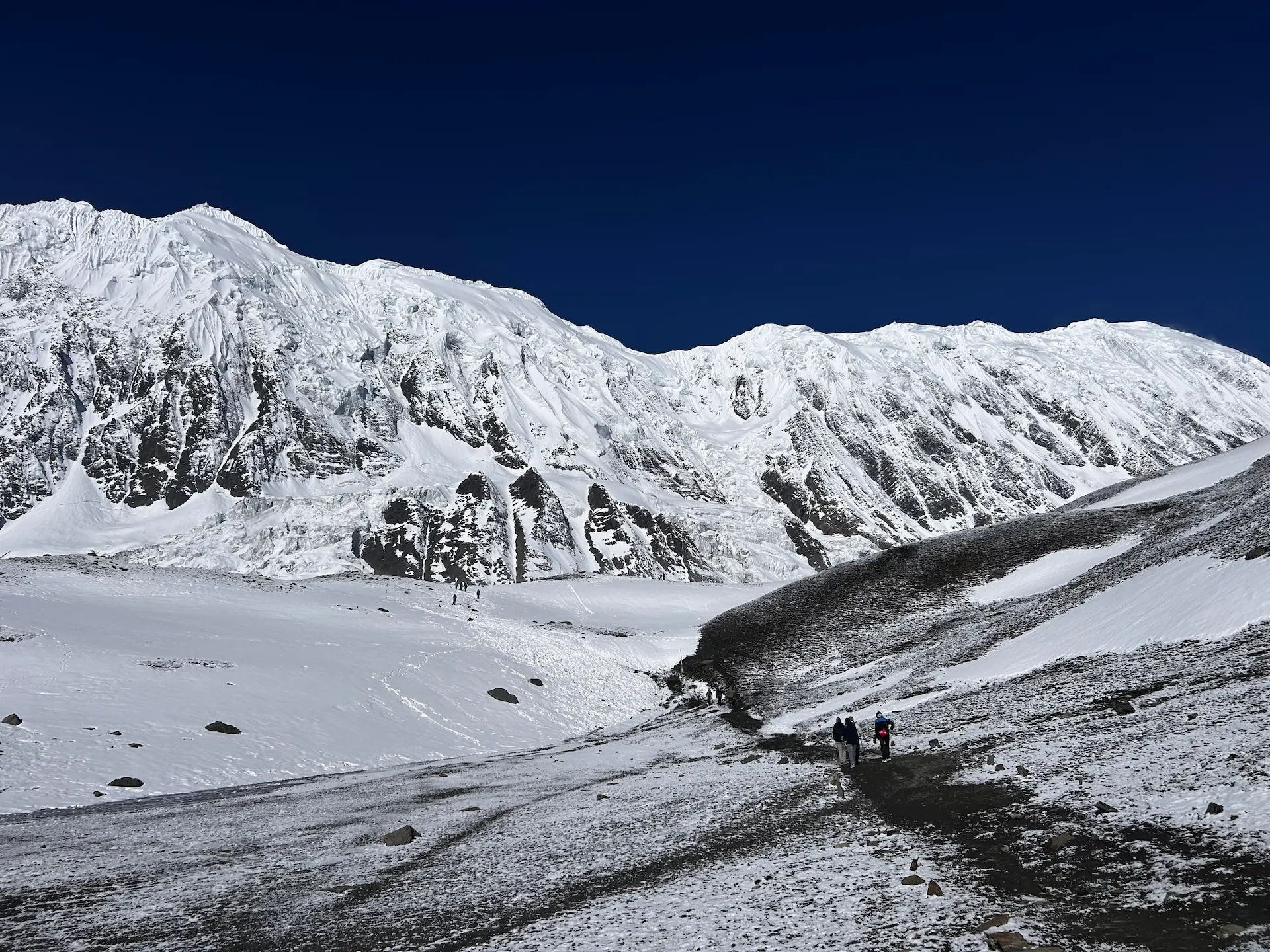
The best time for a Tilicho Lake winter trek is late November to early December, with late February and early March offering limited alternatives depending on snow conditions. A successful winter journey requires a licensed trekking guide, proper acclimatization, cold-weather equipment and a flexible itinerary with weather reserve days. This guide covers the best winter trekking season, monthly weather conditions, temperatures, route difficulty, a 14-day itinerary, altitude sickness prevention, avalanche safety, required ACAP and TIMS permits, accommodation, food, essential gear and estimated trekking costs in USD and NPR for 2026/27.
What Makes Tilicho Lake Trek in Winter Unique?
The Tilicho Lake trek in winter is unique because a frozen glacial lake at 4,919 m, near-empty trails and snow-covered peaks replace the autumn crowds. The same conditions that create the silence also close lodges, bury trail markers and raise the risk on every exposed section.
Autumn is the opposite experience. Nepal Intrepid Treks guides count 75 to 90 trekkers a day at Tilicho Base Camp in peak October weeks, with all 3 base camp lodges full. Winter traffic is a small fraction of that, and a group in early December can have the upper valley to itself.
Why Is Tilicho Lake Considered One of the World's Highest Lakes?
Tilicho Lake sits at 4,919 m (16,138 ft), which makes it one of the highest large lakes on Earth. According to published survey data, the lake is 4 km long and 1.2 km wide, with a surface area of 4.8 km² and an average depth of 85 m. A 1987 survey by Aizaki and colleagues, cited in a Nepal Journals Online paper, recorded a maximum depth of about 95 m, with most of the basin deeper than 60 m.
The label "highest lake in the world" is shorthand. Imja Tsho in the Everest region lies at 5,010 m, and a small crater lake near the summit of Ojos del Salado in the Andes sits near 6,390 m. Tilicho earns its reputation through scale: few lakes pair 4 km of length with an elevation close to 5,000 m.
Meltwater from the glaciers of Tilicho Peak (7,134 m) feeds the basin, which makes Tilicho a glacial lake: a body of water held in a hollow shaped by ice. Hindus identify the lake with Kak Bhusundi, the lake in the Ramayana where the sage Kak Bhusundi told the epic to Garuda, king of birds. The 1950 French Annapurna expedition under Maurice Herzog reached the Tilicho area while searching for a route to Annapurna I and found the frozen lake blocking its way.
What Makes the Winter Landscape of Tilicho Lake Special?
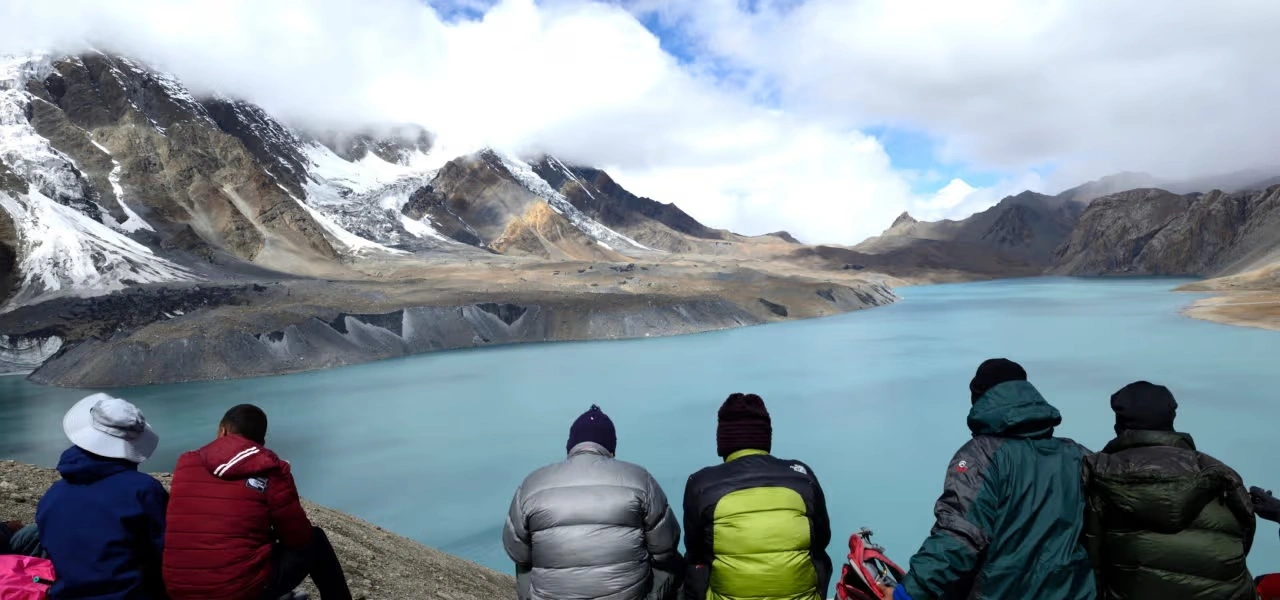
Winter turns Tilicho Lake into a white basin beneath Tilicho Peak, with ice covering the surface from late December and snow walls lining the shore. Trail reports from the Manang valley put full freeze-over around December 20 in an average year, with ice 20 to 40 cm thick by late January.
The summer turquoise disappears. Grey-white ice, blue shadows and low sun take its place, with Tilicho Peak, Nilgiri (7,061 m) and Khangsar Kang (7,485 m) standing over the shore. Between snowfalls the early-morning air is dry and still, and visibility is excellent.
The silence is the main reward. Ice thickness varies across the basin, especially near inflows, so guides keep groups on the shore.
How Does Winter Tilicho Lake Trekking Differ From Other Seasons?
Winter differs from autumn, spring and monsoon in 5 ways: less daylight, snow and ice on the trail, closed lodges, avalanche exposure and night temperatures near -20°C. The table compares the 4 seasons at Tilicho Base Camp (4,150 m).
Season | Conditions | Base camp lodges | Main hazard |
Autumn (Oct to Nov) | Dry, clear, 75 to 90 trekkers a day at peak | Open, full capacity until mid-November | Crowds, cold nights |
Spring (Mar to May) | Snow patches in March, stable by mid-April | Open from April | Afternoon wind, residual snow |
Monsoon (Jun to Aug) | 70 to 90% cloud at the lake, heavy rain | Open, quiet | Landslides on the lower trail |
Winter (Dec to Feb) | Snow, ice, night lows to -25°C | Mostly closed from early December | Avalanches, cold injury, delayed rescue |
Daylight is the least obvious difference. At 28.7°N the day shrinks from about 14 hours in June to about 10 hours in mid-December, so every stage starts at first light and ends by 4:00 PM. The lower valley stays mild, and the cold arrives above Manang.
What Is the Best Time to Do Tilicho Lake Trek in Winter?
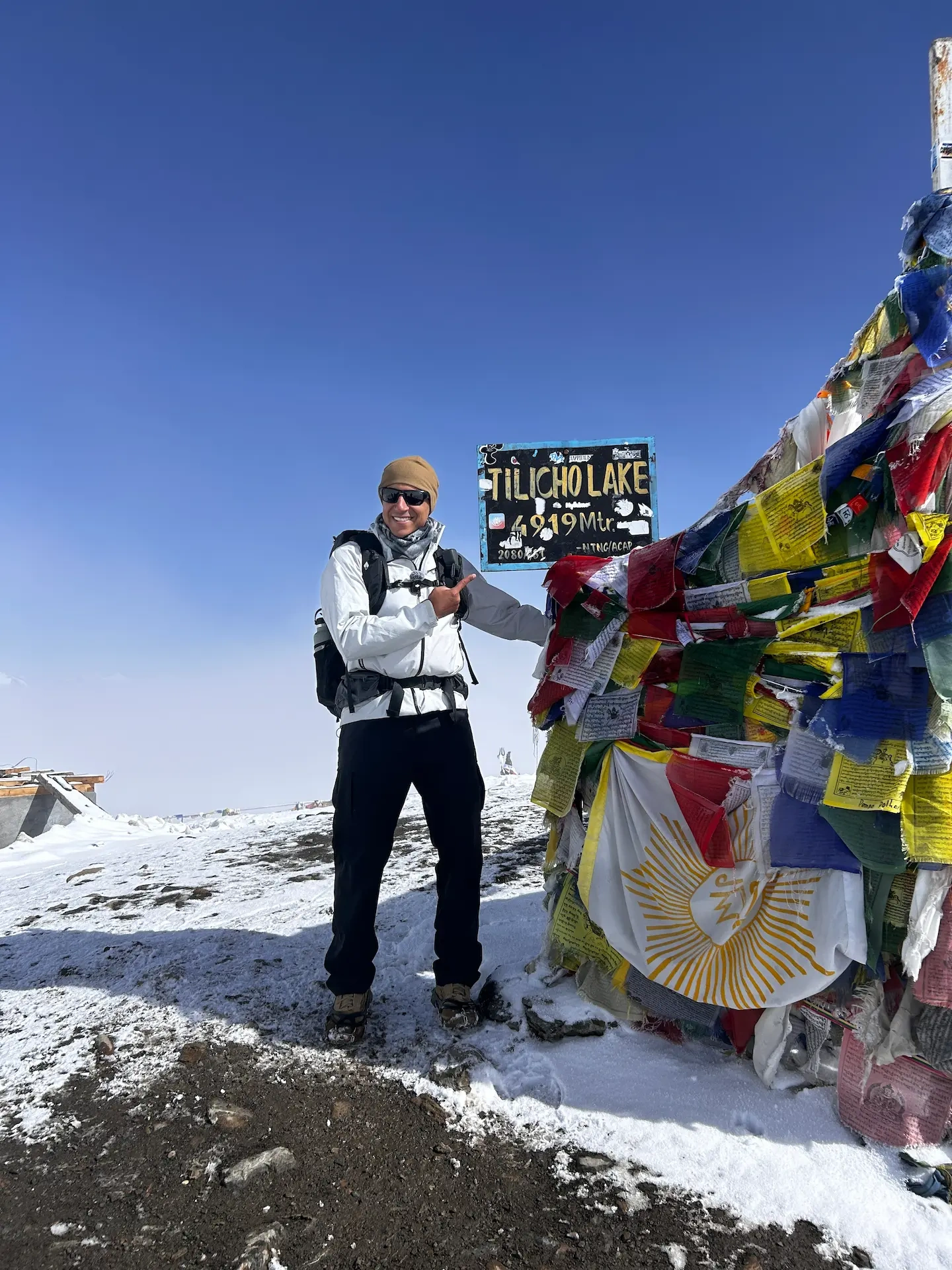
The best time for a winter Tilicho Lake trek is November 20 to December 10, with early March as the second choice. Both windows pair stable skies with trails a guided group can still cross, while January closes the final approach for most trekkers.
Conditions at 4,000 m change by the week, so treat these windows as planning anchors and confirm each departure against the forecast. Trekkers comparing other regions find the wider calendar in Best Time to Trek in Nepal.
Which Winter Months Are Suitable for Tilicho Lake Trek?
Late November and the first half of December are suitable, late February and early March are conditional, and January is unsuitable for most trekkers. The table lists daytime temperature at the lake base area, average monthly precipitation and a verdict for each period, using Nepal Intrepid Treks monthly weather data.
Period | Daytime temperature | Precipitation | Trail status | Verdict |
Late November | 3°C to 10°C | 15 mm | Dry, lodges closing | Go |
December 1 to 15 | -5°C to 3°C | 20 mm | Snow builds | Go, with reserve day |
December 16 to 31 | -5°C to 3°C | 20 mm | Avalanche season begins | Avoid |
January | -10°C to 0°C | 20 mm | Closed for most trekkers | No-go |
February 1 to 20 | -8°C to 2°C | 20 mm | Deep snow | No-go for most |
February 21 to 28 | -8°C to 2°C | 20 mm | Transitional | Conditional |
March 1 to 10 | 5°C to 10°C | 35 mm | Snow patches, avalanche risk | Conditional |
The table shows 2 go periods, 2 conditional periods and 3 avoid or no-go periods. Precipitation stays low in every month because Manang sits in the rain shadow of the Annapurna range.
Is December a Good Time to Visit Tilicho Lake?
December is a good time for Tilicho Lake in its first half and a poor time in its second. Daytime temperatures at the lake base area range from -5°C to 3°C, the lake freezes around December 20, and avalanche exposure on the upper trail begins near December 15 according to Nepal-based trekking operators.
Arrive in Kathmandu between November 24 and December 1 so that the lake day falls between December 2 and December 9, with December 10 as the reserve day.
Lodge availability is the second factor. Tilicho Base Camp lodges close between December 1 and mid-December in most years, so December itineraries carry camping gear as a fallback.
Can You Trek to Tilicho Lake in January and February?
Trekking to Tilicho Lake in January is not recommended, and February is possible only in its final week. New snow of 20 to 50 cm a week above 4,000 m, night lows to -25°C and closed lodges shut the final approach for most trekkers.
Rescue is the deciding constraint. Helicopters do not fly in winds above 25 km/h or visibility under 1 km, and operators in the Manang valley report those conditions on 40 to 60% of winter days above 4,000 m.
The exceptions are private, expedition-style trips for trekkers with winter mountaineering experience and avalanche training. Late February is the best of the bad options, because the days lengthen and the snowpack starts to settle.
Is Late November or Early March Better for Winter Tilicho Lake Trekking?
Late November is better than early March for most trekkers because trails are dry, the snowpack is thin and Manang lodges are fully open. Early March adds 1 hour of daylight but carries the deepest snowpack of the year and avalanche exposure until mid-March.
Factor | Late November | Early March |
Daytime temperature | 3°C to 10°C | 5°C to 10°C |
Snowpack on the upper trail | Thin | Deepest of the year |
Daylight | About 10.5 hours | About 11.5 hours |
Base camp lodges | Closing around December 1 | Not yet open (April start) |
Avalanche exposure | Low | Present until mid-March |
Choose late November for a first winter attempt. Choose early March only when the calendar leaves no alternative, and book 2 reserve days instead of 1.
What Is the Weather and Temperature Like During Tilicho Lake Trek in Winter?
Winter weather at Tilicho Lake combines clear, dry mornings with afternoon wind, daytime highs between -10°C and 3°C and night lows from -15°C to -25°C. Snow arrives in short pulses from western weather systems, not from the monsoon.
A western disturbance is a low-pressure system that travels east from the Mediterranean region and brings winter snow to the western and central Himalaya. Each pulse lasts 1 to 3 days and is followed by 3 to 5 clear days. Guides time the push to the lake for the clear days after a pulse, once the new snow has settled and the trail is packed.
How Cold Does It Get at Tilicho Lake in Winter?
Tilicho Lake reaches daytime highs of -10°C to 3°C and night lows of -15°C to -25°C between December and February. Temperature falls about 6.5°C for every 1,000 m of ascent under the standard atmospheric lapse rate, so the lake at 4,919 m is roughly 9°C colder than Manang at 3,519 m.
That gradient makes the trek feel like 3 climates. Manang is cold but livable, base camp is harsh, and the lake is brutal in shade. North-facing sections above 4,200 m miss the December sun and hold ice all day.
How Much Snowfall Can You Expect Along the Tilicho Lake Trail?
Snowfall ranges from a dusting at Manang to 20 to 50 cm a week above 4,000 m in January and February, with total snowpack of 1 m or more in heavy winters. Totals vary sharply from year to year, because a dry winter leaves bare ground while a wet western pattern buries the trail markers.
Snow timing matters more than snow depth. Avalanche forecasters commonly treat 30 cm of new snow in 24 hours as a critical loading threshold, and danger stays high for 24 to 72 hours afterward. Knee-deep snow above Shree Kharka (4,050 m) doubles the walking time.
How Do Wind Chill and Altitude Affect Winter Trekkers?
Wind chill lowers the effective temperature by 7°C to 12°C at wind speeds of 20 to 40 km/h, and altitude cuts air pressure at 4,919 m to about 54% of the sea-level value. Wind chill is the cooling effect of moving air on exposed skin, calculated from air temperature and wind speed with the standard formula used by the US National Weather Service and Environment Canada.
Air temperature | Wind speed | Wind chill |
-5°C | 20 km/h | -12°C |
-12°C | 30 km/h | -22°C |
-15°C | 40 km/h | -27°C |
Afternoon wind builds along the exposed ridge above Shree Kharka, so the lake push starts before dawn. Altitude adds a second cost: cold air is dry, each breath above 4,000 m loses more water, and the resulting dehydration imitates an altitude headache.
What Are the Daytime and Nighttime Temperatures at High Altitudes?
Daytime temperatures at Tilicho Base Camp range from -5°C to 3°C in December and -10°C to 0°C in January, while night temperatures fall to between -15°C and -25°C. The table gives approximate monthly ranges for the base camp area.
Month | Daytime range | Night range |
November | 3°C to 10°C | -8°C to -15°C |
December | -5°C to 3°C | -12°C to -20°C |
January | -10°C to 0°C | -15°C to -25°C |
February | -8°C to 2°C | -15°C to -22°C |
Night values drive the equipment list. A sleeping bag with a comfort rating of -20°C and a down jacket with 700 fill or higher are the baseline, and Tilicho Base Camp rooms have no heating.
What Is the Tilicho Lake Trek in Winter Route and Itinerary?
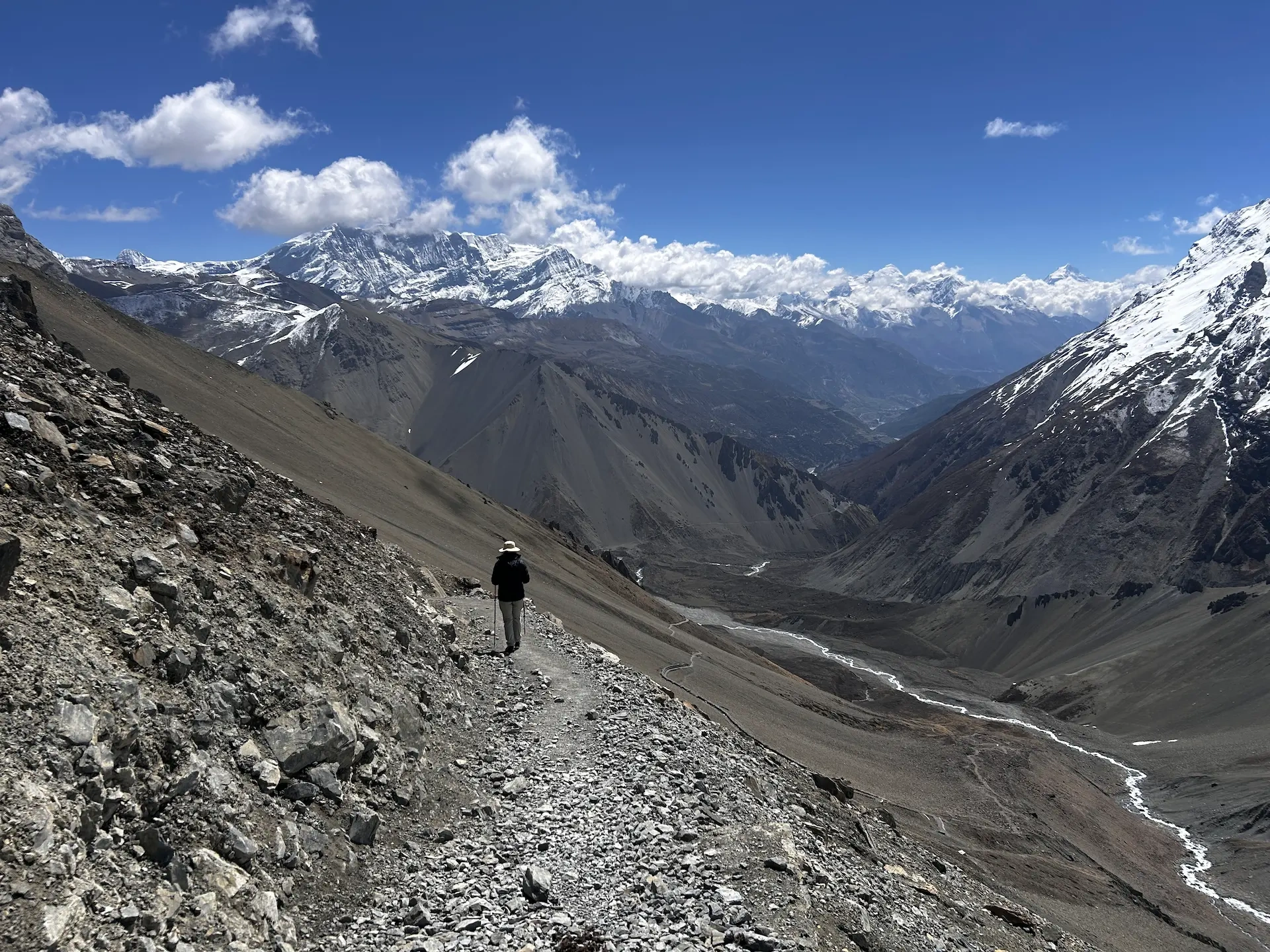
The winter route follows the Marsyangdi Valley from Besisahar through Dharapani, Chame, Pisang and Manang, branches through Khangsar to Tilicho Base Camp and the lake, and returns the same way in 12 to 14 days from Kathmandu. The out-and-back format keeps every night in a place with a known exit.
The only alternative is to continue from the lake over Mesokanto La (about 5,100 m) to Jomsom, and snow closes that pass from December to March.
Where Does the Tilicho Lake Winter Trek Begin?
The trek begins at Besisahar (823 m), the district headquarters of Lamjung, 174 km from Kathmandu, and continues by jeep to Dharapani (1,960 m), where walking starts. The Kathmandu to Besisahar leg takes 5 to 6 hours by tourist bus or about 4 hours by private jeep.
Walking from Dharapani instead of driving to Manang is a deliberate winter choice. The 4 walking days through Chame and Pisang build acclimatization that a 1-day drive removes.
What Are the Major Villages and Attractions Along the Tilicho Lake Route?
The route passes 7 main stops between the road head and the lake: Dharapani, Chame, Pisang, Manang, Khangsar, Shree Kharka and Tilicho Base Camp. The list gives the elevation and the main feature of each stop.
Dharapani (1,960 m): the start of the walk and the last warm night
Chame (2,710 m): the district headquarters of Manang, with hot springs nearby
Pisang (3,300 m for Upper Pisang): a stone village below Pisang Peak
Manang (3,519 m): the acclimatization base, with Praken Gompa, Gangapurna Lake and a seasonal Himalayan Rescue Association post
Khangsar (3,734 m): a small village with a monastery, the last settlement before the exposed section
Shree Kharka (4,050 m): the junction on the upper trail, with a seasonal lodge
Tilicho Base Camp (4,150 m): the staging point for the lake, with 3 lodges in season
How Many Days Are Needed to Complete the Winter Tilicho Lake Trek?
A winter Tilicho Lake trek requires 12 to 14 days from Kathmandu: the standard season uses 11 days, and winter adds 1 weather reserve day and 1 to 2 acclimatization nights. The 14-day plan below is the one most winter groups follow.
The reserve day is not optional. A single snow pulse can close the trail for 24 to 48 hours. The extra acclimatization night comes from splitting the Manang to Tilicho Base Camp stage, which would otherwise raise the sleeping altitude by 631 m in 1 day, while Himalayan Rescue Association guidance limits the gain to about 500 m a day above 3,000 m.
What Is the Recommended Day-by-Day Winter Tilicho Lake Trek Itinerary?
The recommended winter itinerary runs 14 days from Kathmandu to Kathmandu, with 1 acclimatization day in Manang, a split ascent through Khangsar and 1 reserve day at Tilicho Base Camp. The table defines each day by route, sleeping altitude and approximate walking time.
Day | Route | Sleeping altitude | Time |
1 | Arrive in Kathmandu, gear check, briefing | 1,355 m | Rest |
2 | Drive to Dharapani via Besisahar | 1,960 m | 9 to 10 h drive |
3 | Dharapani to Chame | 2,710 m | 6 h |
4 | Chame to Upper Pisang | 3,300 m | 6 h |
5 | Upper Pisang to Manang | 3,519 m | 6 to 6.5 h |
6 | Acclimatization day, hike to Gangapurna Lake or Praken Gompa | 3,519 m | 3 to 4 h |
7 | Manang to Khangsar | 3,734 m | 3 to 4 h |
8 | Khangsar to Tilicho Base Camp via Shree Kharka | 4,150 m | 4 to 5 h |
9 | Tilicho Lake and return to base camp | 4,150 m | 7 to 9 h |
10 | Weather reserve day (or rest day) | 4,150 m | Flexible |
11 | Tilicho Base Camp to Manang | 3,519 m | 7 to 8 h |
12 | Jeep from Manang to Besisahar | 823 m | 7 to 9 h |
13 | Besisahar to Kathmandu | 1,355 m | 5 to 6 h |
14 | Departure | 1,355 m | Flexible |
The table shows 3 decision points: the guide makes a go or no-go call at Manang on Day 6, at Khangsar on Day 7 and at base camp before dawn on Day 9. Lodge availability at Khangsar and base camp changes from year to year, so the guide phones the lodge owners 5 days before Manang, and the agency carries camping equipment as the fallback. Trekkers who want the Thorong La crossing in a milder season can compare this plan with the Annapurna Circuit Trek with Tilicho Lake.
How Difficult Is the Tilicho Base Camp to Tilicho Lake Trail?
The 5 km trail from Tilicho Base Camp (4,150 m) to the lake (4,919 m) climbs about 770 m in 3 to 5 hours and is the hardest day of the trek, because of loose scree, exposed slopes and thin air. In winter the ascent takes 4 to 6 hours and the descent 2 to 3 hours.
Start at first light, about 6:00 AM in December, with headlamps on. The common guide rule is a turnaround at 11:00 AM: a group that has not reached the lake by then descends, however close the shore looks. Microspikes handle packed snow, and crampons are the safer choice on the glazed north-facing sections above 4,200 m.
There is no lodge at the shore, so every lake day is a round trip from base camp, with 20 to 40 minutes at the water for photographs and tea from a flask.
How Difficult and Safe Is Tilicho Lake Trek in Winter?
The Tilicho Lake trek in winter is strenuous and safe only with a licensed guide, a weather reserve day, avalanche awareness and the discipline to turn back. Winter grading sits one level above the same route in autumn.
The difficulty is not technical climbing. It is altitude, cold and exposure over 4 consecutive nights above 3,700 m, with no easy exit once the group passes Khangsar.
What Makes the Winter Tilicho Lake Trek More Challenging Than Other Seasons?
Winter adds 4 challenges to the standard route: night temperatures to -25°C, snow and ice on the trail, closed lodges and slower rescue. The day length cut of 3 to 4 hours compared with June compresses every stage, and the cold shortens the margin for error on every long day.
Cold drains energy and fingertip dexterity, which makes small tasks such as zipping a jacket slow. Closed lodges remove the fallback of a warm room at 4,150 m, and slower rescue completes the picture, because ground evacuation from the upper trail takes 6 to 10 hours.
Are Snowstorms and Avalanches Risks Along the Tilicho Lake Trail?
Yes. Snowstorms and avalanches are real risks on the upper Tilicho Lake trail from mid-December to mid-March, especially on the slopes between Shree Kharka and Tilicho Base Camp. An avalanche is a mass of snow sliding down a slope, and a slab avalanche releases when a cohesive snow layer fractures over a weaker layer beneath.
Most avalanches release on slopes of 30° to 45°, and the highest danger follows a snowfall of 30 cm or more. Guides reduce exposure with 4 practices:
Cross suspect slopes one trekker at a time, with 30 m between people
Carry a transceiver, a probe and a shovel
Delay the push for 24 to 72 hours after heavy snow
Retreat when the avalanche danger rises above the group's skill
Whiteout is the second storm hazard. Three sections above 4,200 m have no physical markers, so the guide navigates by GPS waypoints, and visibility under 50 m ends the day.
Is the Tilicho Lake Trail Prone to Landslides and Icy Slopes?
The trail is prone to both: the rockfall traverse between Khangsar and Tilicho Base Camp, about 4 km long, stays active in winter, and north-facing sections above 4,200 m hold ice from December to March. Monsoon rain causes the worst landslides, but winter freeze and thaw cycles loosen the same slopes.
Rockfall peaks when afternoon sun warms the slope after a cold night, so groups cross the traverse before 10:00 AM with a gap between trekkers. Icy slopes need crampons, poles and a slow, flat-footed step, and a guide who insists on crampons is protecting the group, not slowing it.
Can Beginners Complete the Tilicho Lake Winter Trek?
Beginners are advised against the Tilicho Lake winter trek. The route demands prior experience at altitude, strong fitness and comfort with cold, and first-time trekkers meet none of those requirements together.
A realistic entry standard has 3 parts: 1 completed multi-day trek above 4,000 m such as Annapurna Base Camp (4,130 m), 8 weeks of training with 3 cardio sessions a week, and the ability to hike 6 to 8 hours with an 8 to 10 kg pack. Beginners get a better result from the same lake in October or April, and Ghorepani Poon Hill (3,210 m) is the sensible winter first step on the Annapurna Region page.
What Altitude Sickness Risks Should Trekkers Understand?
Altitude sickness risk rises above 2,500 m and becomes serious above 4,000 m, where acute mountain sickness (AMS) can progress to high altitude cerebral edema (HACE) or high altitude pulmonary edema (HAPE). AMS causes headache, nausea, fatigue and dizziness within 6 to 12 hours of rapid ascent, and descent is the only reliable treatment for worsening symptoms.
HACE is swelling of the brain and shows as confusion, loss of balance and drowsiness. HAPE is fluid in the lungs and shows as breathlessness at rest and a wet cough. Both require immediate descent.
Four rules lower the risk: limit sleeping altitude gain to about 500 m a day above 3,000 m, rest every 3 to 4 days, drink 3 to 4 liters of fluid daily and report symptoms at once. The Wilderness Medical Society lists acetazolamide at 125 mg twice daily as the preventive dose, started the day before ascent, and a physician confirms suitability. Resting oxygen saturation at 4,150 m commonly reads 80% to 90%, and a lower reading with symptoms prompts descent.
Winter adds one complication: the Himalayan Rescue Association runs its Manang post in the main trekking seasons, so winter trekkers rely on the guide's kit and the local health post.
What Permits and Documents Are Required for Tilicho Lake Trek in Winter?
Winter Tilicho Lake trekkers need 3 items: the Annapurna Conservation Area Permit (NPR 3,000), a TIMS card (NPR 2,000) issued through a registered agency, and a licensed guide. A valid passport and a Nepal visa are required, and no separate Tilicho permit exists.
Tilicho is not a restricted area. The Restricted Area Permit applies only to neighboring valleys such as Nar Phu. Carry paper copies of every permit, because phone images are not accepted at every checkpoint.
Is the Annapurna Conservation Area Permit Required for Tilicho Lake Trek?
Yes. The Annapurna Conservation Area Permit (ACAP) is mandatory because the whole route lies inside the 7,629 km² Annapurna Conservation Area, and the fee is NPR 3,000 (about USD 22) for foreigners and NPR 1,000 for SAARC nationals. The National Trust for Nature Conservation (NTNC) manages the area and issues the permit.
Permits are bought in Kathmandu or Pokhara, or through the NTNC e-permit portal, and paid in rupees. The documents and photo requirements are in How to Buy an ACAP Permit in Nepal.
Is a TIMS Card Required for the Tilicho Lake Trek?
Yes. A TIMS card costs NPR 2,000 (about USD 15) for most nationalities and NPR 1,000 for SAARC nationals, and the Nepal Tourism Board requires it to be issued through a licensed trekking agency. TIMS stands for Trekkers' Information Management System, a registration scheme run jointly by the Nepal Tourism Board and the Trekking Agencies' Association of Nepal since 2008.
According to the Nepal Tourism Board, the revised procedure took effect in 2023 and ended the independent green card. The Nepal Tourism Board rules state that a trekking company found operating without a TIMS card for a client faces a fine of NPR 12,000 per trekker. Checkpoint enforcement on Annapurna routes varies in 2026, but the card remains part of the legal paperwork, and the agency arranges it with the ACAP.
Can You Trek to Tilicho Lake Independently in Winter?
No. Foreign trekkers cannot trek independently to Tilicho Lake in winter, because Nepal Tourism Board rules since 2023 require a licensed guide and an agency-issued TIMS card on regulated routes, and winter conditions make solo travel unsafe regardless of the rules.
"Independent" in practice means a private trek: 1 traveler, 1 guide and fully flexible dates. A private departure is the closest legal match to independent travel, and it is also the best fit for winter, because the group leaves only when the forecast allows. Regulations in Nepal change often, so confirm current requirements with the agency before booking.
What Should You Pack for Tilicho Lake Trek in Winter?
Pack a 5-layer clothing system, insulated waterproof boots, microspikes or crampons, a sleeping bag with a -20°C comfort rating and a first-aid kit that includes altitude medication.
What Winter Clothing Is Essential for Extreme Cold?
Five layers cover the winter range: a merino base layer, a fleece mid layer, a down jacket with 700 fill or higher, a waterproof shell and insulated trousers for camp. Cotton is banned from the list, because wet cotton loses all insulation.
Extremities fail first. Pack liner gloves, insulated mittens rated to -20°C, a balaclava, a wool hat, a neck gaiter, 3 pairs of mid-weight merino socks and category 4 sunglasses or goggles, because snow reflects up to 80% of ultraviolet light.
Which Trekking Boots and Snow Gear Should You Bring?
Bring insulated, waterproof boots with a stiff sole, half a size larger than normal, plus microspikes, 10-point or 12-point crampons, gaiters and trekking poles with snow baskets. The larger size leaves room for thick socks and circulation, which keeps toes warm.
Microspikes handle packed snow on the lower trail, and crampons handle the glazed north-facing sections above 4,200 m. The guide decides which tool to use at each point and carries the avalanche kit of transceiver, probe and shovel.
What Sleeping Bags and Cold-Weather Accessories Are Necessary?
A sleeping bag with a -20°C comfort rating, a liner, an insulated sleeping mat and a hot water bottle are necessary, because teahouse rooms have no heating and night lows reach -25°C. Nepal Intrepid Treks includes a sleeping bag and a down jacket on its guided packages, and the comfort rating deserves a check before a winter departure.
Small accessories decide comfort:
Liner: adds 3°C to 5°C to the sleeping bag
Mat: a pad with an R-value of 4 or higher
Bottle: a wide-mouth 1 L bottle of hot water as a bed warmer
Batteries: lithium cells for the headlamp, because alkaline cells fail in the cold
Power bank: kept inside the jacket, because phones shut down below -10°C
What Emergency and First-Aid Supplies Should You Carry?
Carry acetazolamide, painkillers, rehydration salts, anti-nausea tablets, blister dressings, an elastic bandage, a thermal blanket and hand warmers, plus insurance that covers helicopter evacuation to 5,000 m. The guide's kit adds an oximeter and a first-aid kit, and higher-risk itineraries typically add dexamethasone, nifedipine and a portable hyperbaric bag.
Cold injury needs its own plan. Frostnip turns skin pale and numb and reverses on rewarming. Frostbite turns skin waxy and hard and needs medical care. Never rub the skin, never rewarm if the area may refreeze, and never drink alcohol to warm up. A helicopter evacuation from Manang costs several thousand US dollars when paid out of pocket, so the insurance policy matters as much as any piece of gear.
What Are Accommodation and Food Options During Tilicho Lake Trek in Winter?
Winter accommodation is available in Dharapani, Chame, Pisang and Manang, limited at Khangsar and mostly closed at Shree Kharka and Tilicho Base Camp from early December, so guides arrange a timed stay or supported camping. Food follows the lodges: full menus in the lower villages and a short list higher up.
Are Teahouses Open Along the Tilicho Lake Route in Winter?
Teahouses stay open in Manang and the lower villages through winter, while lodges at Tilicho Base Camp close around December 1 in most years and Khangsar lodges run from March to November. Reports vary by year, with some base camp lodges closing as late as mid-December.
Heating is minimal even where lodges are open. A stove burning wood or dried dung warms the dining room, the bedrooms stay unheated, and the inside of the windows can ice over. Sleep in the full winter kit and move to the dining room for the evening.
Supported camping is the fallback when lodges close. The crew adds a cook, a kitchen helper, porters and tents, which raises the cost but keeps the itinerary open.
Where Can Tilicho Lake Trekkers Find Food and Drinking Water?
Food comes from teahouse kitchens in the open villages, and drinking water comes from boiled or treated supplies, because streams above 3,500 m freeze in winter. Menus in Manang run to dal bhat, noodle soup, Tibetan bread, momos, eggs and pasta, while the menu above Khangsar shrinks to dal bhat and noodles.
Treat all water. Chlorine dioxide tablets work in the cold, but ultraviolet pens fail when their batteries chill. Store bottles upside down so the cap end does not freeze first, and ask the kitchen for boiled water to fill the night bottle. Aim for 3 to 4 liters a day, because cold suppresses thirst and dehydration speeds up altitude symptoms.
Should You Carry Extra Food and Emergency Supplies?
Yes. Carry at least 1 day of emergency food, about 1,500 kcal, plus a thermal blanket, because closed kitchens and weather delays leave gaps of 8 to 10 hours. The guide team carries its own reserve for the weather day.
A practical reserve has 5 items: energy bars, mixed nuts, chocolate, dried fruit and instant soup sachets. Pack 2 to 3 bars for every trekking day as a snack baseline. Calorie-dense food matters because cold weather raises energy use, and appetite drops with altitude.
How Much Does Tilicho Lake Trek in Winter Cost?
A winter Tilicho Lake trek costs USD 1,800 to 2,600 per person on a private 14-day departure for 2 trekkers, compared with USD 1,300 to 1,800 for a standard-season guided package. These are planning ranges, not quotes, and the final price depends on group size, dates and camping needs.
Published 2026 packages for the standard route span a wide range, from about USD 650 for basic group packages to USD 1,800 for private full-service ones. Winter adds a reserve day, a longer itinerary, heavier gear and sometimes camping.
What Is the Estimated Winter Trekking Budget for Tilicho Lake Trek?
The direct cost of a 14-day winter Tilicho Lake trek is USD 1,400 to 2,450 per trekker for 2 people sharing a guide and porter. The table breaks the budget into 10 lines, with NPR figures where local prices apply.
Item | Estimated cost per trekker |
ACAP (NPR 3,000) and TIMS (NPR 2,000) | USD 37 |
Licensed guide, 14 days at NPR 2,500 to 4,000 a day | USD 252 to 420 |
Porter shared by 2, 14 days | USD 140 to 196 |
Transport: bus or shared jeep Kathmandu to Dharapani and Manang to Besisahar | USD 90 to 180 |
Lodging and meals, 12 trek nights at USD 30 to 45 | USD 360 to 540 |
Staff meals and lodging | USD 195 to 325 |
Kathmandu hotel, 3 nights | USD 60 to 150 |
Gear rental: sleeping bag, down jacket, crampons | USD 30 to 80 |
Weather reserve day | USD 70 to 120 |
Travel insurance with helicopter cover | USD 80 to 200 |
Tips for guide and porter | USD 100 to 200 |
The lines add up to the stated range. Agency packages bundle most of them, and the bundle prices at USD 1,800 to 2,600 for a private winter departure once overhead and winter staffing are included.
Which Factors Affect the Overall Trekking Cost of Tilicho Lake Trek in Winter?
Six factors drive the cost of the Tilicho Lake trek in winter: group size, trek length, reserve days, camping versus teahouse stays, gear rental and insurance level. Each factor moves the total by a measurable amount.
Group size matters most. A solo traveler carries the full cost of a guide and a porter, while 4 trekkers split it 4 ways. Each extra reserve day adds roughly USD 70 to 120, and camping adds several hundred US dollars for the cook, kitchen staff, porters and tents.
Is a Guided Winter Tilicho Lake Trek More Expensive Than Independent Trekking?
No. Independent trekking is not available to foreign trekkers on this route, so the guided trek is the legal minimum, and a guide costs USD 18 to 30 a day against a rescue bill of several thousand dollars. The real comparison is between service levels, not between guided and unguided.
A service-only package covers guide, permits and logistics while the trekker pays for lodging and meals on the trail. An all-inclusive package covers everything from airport pickup to the final meal. A private departure costs more per person than a group, and it is the only format that lets the group wait for a weather window. For a winter attempt, the extra cost of flexibility is also the cost of safety.
How Can Nepal Intrepid Treks Help You Experience Tilicho Lake Trek in Winter?
Nepal Intrepid Treks arranges licensed guides, porters, ACAP and TIMS permits, transport and private-date departures from 1 traveler for the Tilicho Lake route, with winter plans built around daylight, reserve days and daily go or no-go decisions.
Plan your winter Tilicho Lake trek with Nepal Intrepid Treks. Share your preferred dates and experience level, and the team checks the date against the winter windows in this guide. Contact Nepal Intrepid Treks or message +977 9849009919 on WhatsApp.
The agency is based at Nayabazar-16, Kathmandu, and lists the Nepal Tourism Board, the Trekking Agencies' Association of Nepal and the Nepal Mountaineering Association among its affiliations. Its guided packages include an English-speaking guide, 1 porter for every 2 guests, permit arrangements, a sleeping bag, a down jacket, a first-aid kit and an oximeter.
Can Nepal Intrepid Treks Organize a Safe and Guided Winter Trek to Tilicho Lake?
Yes. Nepal Intrepid Treks organizes guided Tilicho Lake treks on private dates, and a winter plan adds a reserve day, a split ascent and conditions-based decisions at Manang, Khangsar and base camp. Safety in winter comes from planning and the willingness to wait, not from speed.
Three steps start the process: pick a date inside the November 20 to December 10 window, send an enquiry with trekking experience and insurance details, and review the itinerary and gear list with the team. Trekkers who want the Thorong La crossing can ask about the Annapurna Circuit Trek, which runs best in autumn and spring.
What Are the Key Things to Know Before Planning Tilicho Lake Trek in Winter?
Before planning the Tilicho Lake trek in winter, confirm 7 points: the travel window, a 14-day itinerary with a reserve day, ACAP and TIMS permits, a licensed guide, a -20°C sleeping system, insurance that covers helicopter evacuation and a plan for closed lodges. The checklist below turns those points into actions.
Choose a departure between November 20 and December 10, or in the last week of February
Book a 14-day itinerary with 1 reserve day, or 2 for early March
Secure the ACAP (NPR 3,000) and the TIMS card (NPR 2,000) through the agency
Hire a licensed guide with winter and avalanche experience
Prepare a sleeping bag rated -20°C, insulated boots and crampons
Buy insurance that covers trekking to 5,000 m and helicopter evacuation
Confirm lodge status at Khangsar and Tilicho Base Camp, and carry camping gear as a fallback
Altitude rules do not bend for winter: sleep no more than about 500 m higher each night above 3,000 m, rest in Manang, and descend at the first sign of AMS that worsens.
The Tilicho Lake trek in winter rewards the trekker who respects the calendar, the cold and the guide's decision to wait. Autumn and spring offer the easier alternatives, and the winter window from late November to mid-December offers a frozen 4,919 m lake with almost no one else on the trail.

