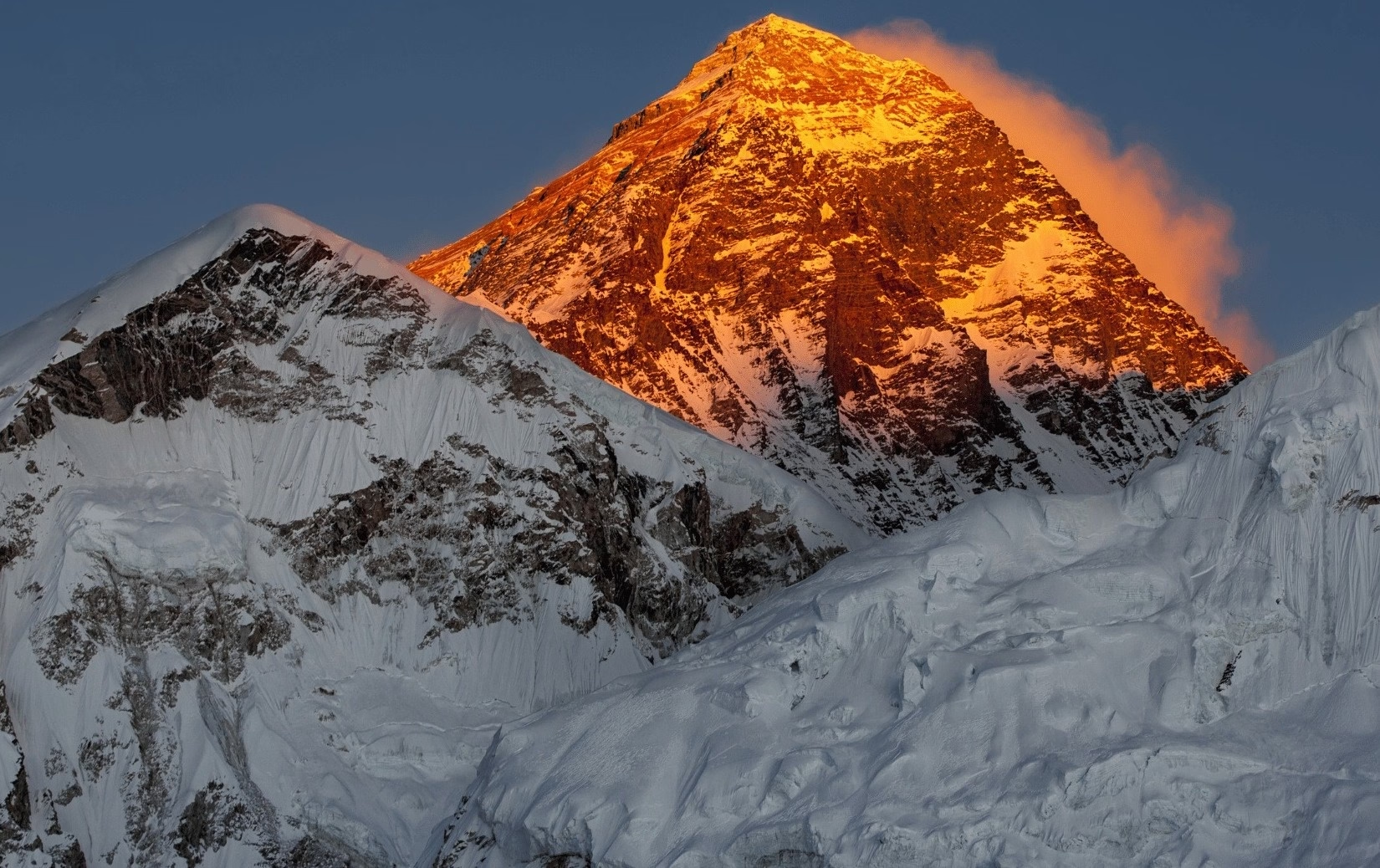
Annapurna Base Camp trek permit cost in 2026 is NPR 5,000 for most foreign trekkers, covering the 2 mandatory documents required to enter the Annapurna Conservation Area: the Annapurna Conservation Area Permit (ACAP) and the Trekkers' Information Management System (TIMS) card. SAARC nationals pay NPR 2,000 in total, while children under 10 are exempt from both fees. These permits apply to the standard ABC trek route to 4,130 metres and are checked at official trail entry and control points such as Birethanti and Chhomrong before and during the trek.
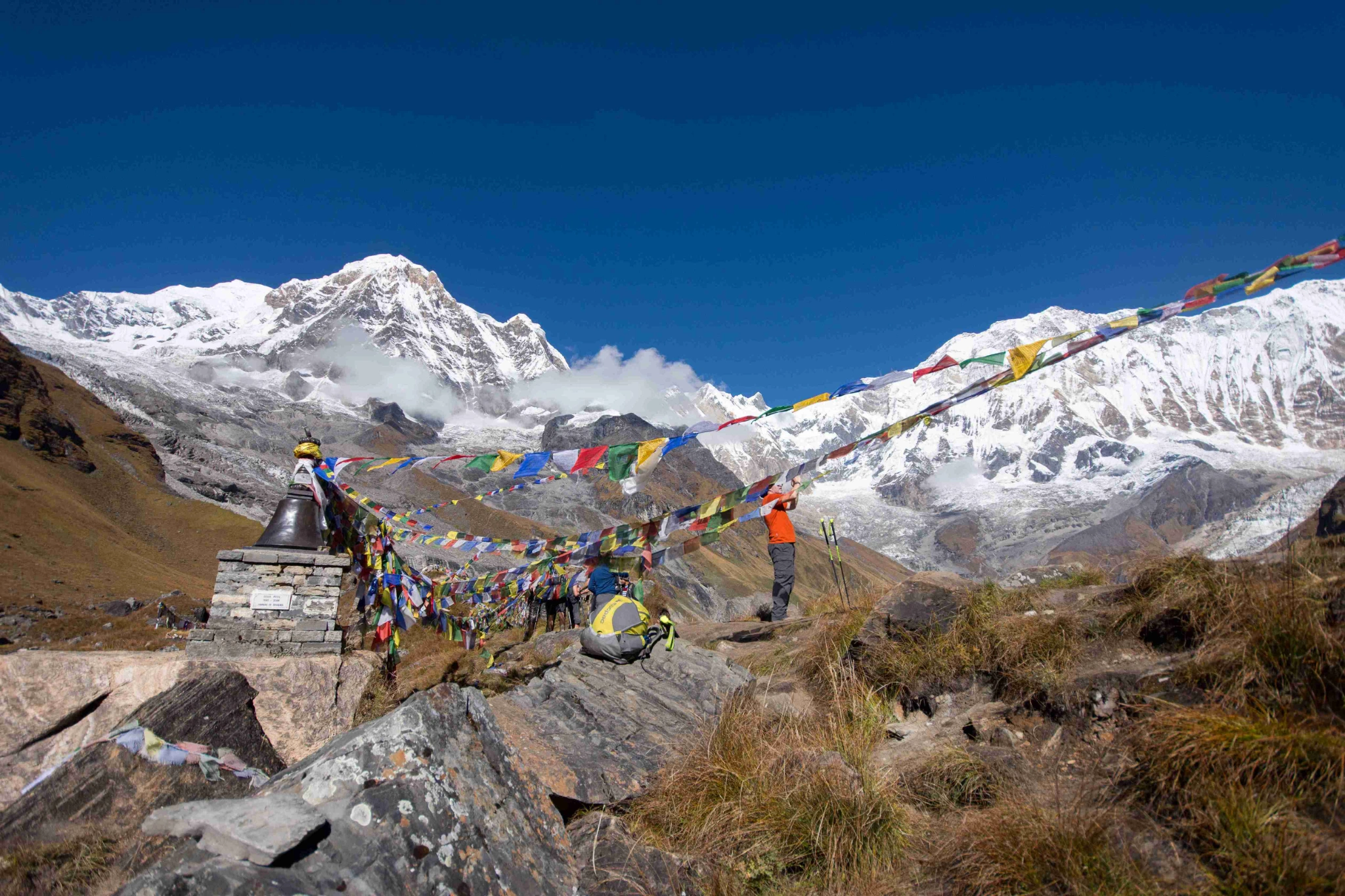
The full Annapurna Base Camp (ABC) permit budget depends on more than the headline fee. Trekkers also need to understand who must buy Annapurna Conservation Area Permit (ACAP) and the Trekkers' Information Management System (TIMS), where permits are issued in Kathmandu or Pokhara, whether ACAP can be obtained online, what documents are required, what fines apply for missing permits, and how the licensed guide rule affects total trekking costs for foreign nationals. A complete permit guide for Annapurna Base Camp in 2026 therefore includes permit prices, enforcement rules, checkpoint procedures, agency processing options, and the extra regulated costs that can raise the total beyond the base NPR 5,000.
Which Permits Do You Need for Annapurna Base Camp?
Trekkers need 2 permits for Annapurna Base Camp in 2026: the ACAP (Annapurna Conservation Area Permit) and the TIMS card (Trekkers' Information Management System card). The ACAP is issued by the National Trust for Nature Conservation (NTNC). The TIMS card is issued by the Nepal Tourism Board (NTB) and the Trekking Agencies' Association of Nepal (TAAN).
Each permit serves a distinct regulatory function. The ACAP authorises entry into the Annapurna Conservation Area, a protected zone established under Nepal's National Parks and Wildlife Conservation Act. The TIMS card registers trekker identity, route, and emergency contact details in a national database managed by the Nepal Tourism Board.
The Annapurna Conservation Area Permit (ACAP) is issued by the National Trust for Nature Conservation (NTNC), which launched the Annapurna Conservation Area Project in 1986 as Nepal's first and largest protected area (NTNC Annual Report 2024). ACAP revenue funds trail maintenance, wildlife protection, and community development programs across the 7,629 sq km conservation area.
Is the ACAP Permit Mandatory for the ABC Trek?
The ACAP permit is strictly mandatory for the ABC trek in 2026. Conservation authorities scan ACAP permit QR codes at official checkpoints, including Birethanti, Ghorepani, and Chhomrong. Trekkers without a valid ACAP permit face denied entry at the first checkpoint or a double-charge fine issued on the trail.
The ACAP permit became the primary legal requirement for the Annapurna region in 1986 when the National Trust for Nature Conservation (NTNC) established the Annapurna Conservation Area Project. The permit fee directly funds 4 operational areas: trail maintenance, wildlife conservation, community development, and waste management across the 7,629 sq km conservation zone.
No exemptions exist for ACAP in 2026. Individual trekkers, agency trekkers, returning visitors, and trekkers on short itineraries all pay the same fee. The permit is non-transferable and validated against passport details at each checkpoint.
Do You Still Need a TIMS Card for Annapurna Base Camp?
The TIMS card is an official requirement for the ABC trek as per the Nepal Tourism Board. The NTB reinstated TIMS enforcement across popular Annapurna routes, including the ABC trail via Poon Hill–Ghorepani, after a post-COVID suspension period.
Ground-level enforcement on Annapurna trails varies in 2026. The ACAP permit is checked consistently at all 7 major checkpoints. TIMS card checks occur primarily at the Birethanti entry point and at Chhomrong. Some trail segments between checkpoints do not verify TIMS separately.
Trekkers booking through licensed trekking agencies in 2026 receive both ACAP and TIMS as part of standard permit packages. The TIMS card carries a practical safety function beyond regulation: it records the trekker's passport number, emergency contacts, guide details, and planned route in a central NTB database accessible to rescue coordination teams.
How Much Is the ACAP Permit for Each ABC Trekker Type?
The ACAP permit costs NPR 3,000 for foreign trekkers and NPR 1,000 for SAARC nationals in 2026. Nepali citizens pay a separate, reduced rate managed by the National Trust for Nature Conservation. The fee structure is tiered across 3 trekker categories and has remained unchanged from 2023 levels.
The ACAP fee is fixed regardless of trek duration. A trekker completing the 7-day short ABC itinerary and a trekker completing the 14-day full ABC itinerary pay the same NPR 3,000. The permit covers the entire Annapurna Conservation Area, not a single route.
What Do Foreign Trekkers Pay for an ACAP Permit?
Foreign trekkers pay NPR 3,000 (approximately USD 22–25) for an ACAP permit in 2026. This fee applies to nationals of all countries outside the SAARC bloc and Nepal. Payment is accepted in Nepali Rupees (NPR) only at NTB offices and NTNC counters.
SAARC member nations include 8 countries: Afghanistan, Bangladesh, Bhutan, India, Maldives, Nepal, Pakistan, and Sri Lanka. Passport holders from these 8 nations qualify for the SAARC rate. All other nationalities pay the NPR 3,000 foreign rate.
The foreign ACAP fee of NPR 3,000 was set in 2023, increasing from the previous NPR 2,000 rate in place since 2016. The 50% increase reflected higher trail maintenance costs, expanded waste management operations, and ranger patrol expansion across the conservation area.
What Do SAARC Trekkers Pay for an ACAP Permit?
SAARC nationals pay NPR 1,000 for an ACAP permit in 2026. This rate applies to passport holders from Bangladesh, Bhutan, India, Maldives, Pakistan, and Sri Lanka. Afghan nationals holding valid travel documentation also qualify at NPR 1,000 under the SAARC rate.
The NPR 1,000 SAARC rate represents a 67% discount from the foreign rate of NPR 3,000. Indian nationals form the largest SAARC trekking group on the ABC trail. SAARC trekkers present the same documentation as foreign trekkers, passport copy, passport photos, and completed application form, but pay the lower fee.
Do Children Need to Pay for an ACAP Permit?
Children under 10 years old are exempt from the ACAP permit fee in 2026. Children aged 10 and above pay the full rate applicable to their nationality, NPR 3,000 for foreign nationals or NPR 1,000 for SAARC nationals. The age exemption applies at all NTB and NTNC permit offices.
Children between 10 and 17 years of age do not receive a reduced rate under the current ACAP fee structure. The fee is the same as the adult rate for their nationality category. Permit applications for minors require a parent or guardian's signature on the application form alongside a copy of the child's passport.
How Much Would the ABC Permits Cost in Total?
The total ABC permit cost for a foreign individual trekker is NPR 5,000 (approximately USD 42) in 2026. This combines the NPR 3,000 ACAP permit and the NPR 2,000 TIMS card. For SAARC individual trekkers, the total is NPR 2,000.
The following table summarises the 2026 ABC permit costs across trekker categories.
Trekker Category | ACAP Fee | TIMS Fee (Individual) | TIMS Fee (Agency) | Total (Individual) |
Foreign national | NPR 3,000 | NPR 2,000 | NPR 1,000 | NPR 5,000 |
SAARC national | NPR 1,000 | NPR 1,000 | NPR 500 | NPR 2,000 |
Nepali citizen | Nominal | Exempt | Exempt | Nominal |
Child under 10 | Exempt | Exempt | Exempt | NPR 0 |
The table above reflects standard 2026 permit fees at NTB offices. Agency TIMS rates apply to trekkers registered under a licensed Nepali trekking agency.
What Is the Total ABC Permit Cost for Foreign Trekkers?
Foreign trekkers pay a total of NPR 5,000 (USD 42) for ABC permits in 2026 when trekking solo. Foreign trekkers booking through a registered trekking agency pay NPR 4,000 total, NPR 3,000 (ACAP) plus NPR 1,000 (Agency TIMS rate). The Agency TIMS rate of NPR 1,000 replaces the NPR 2,000 solo rate when 2 or more trekkers travel under a licensed agency booking. Trekkers deciding between the two iconic routes can compare ABC vs EBC permit costs alongside altitude, duration, and total trek price differences in a side-by-side guide.
At the April 2026 NPR–USD exchange rate of approximately 134 NPR per USD, NPR 5,000 converts to approximately USD 37. Travel guides quoting USD 42 use a slightly conservative rate. Trekkers exchanging currency at Pokhara's money exchange offices before purchasing permits save on currency conversion fees applied by hotel exchange counters.
What Is the Total ABC Permit Cost for SAARC Trekkers?
SAARC nationals pay a total of NPR 2,000 for ABC permits in 2026 when trekking solo. This combines the NPR 1,000 ACAP fee and the NPR 1,000 TIMS fee. SAARC nationals trekking through a registered agency pay NPR 1,500 total, the NPR 1,000 ACAP fee plus the NPR 500 agency TIMS rate.
Indian nationals constitute the majority of SAARC trekkers on the ABC trail. Indian citizens do not need a separate Nepal visa, but do require a valid Indian passport or voter ID card. The NPR 2,000 total permit cost for Indian nationals makes the ABC trek among the most cost-accessible high-altitude Himalayan treks in the region.
What Extra Card or Gateway Fees Can Raise the Total ABC Permit Cost?
3 additional fees can raise the total ABC permit cost above NPR 5,000: the Pokhara Tourist Service Centre gateway fee, the Nayapul checkpoint gateway card, and a licensed guide mandatory fee.
The gateway fees break down as follows:
Pokhara Tourist Service Centre fee: Some trekking operators include a NPR 200–500 facilitation fee for permit processing assistance. This is not a government-mandated fee.
Nayapul entry card: Some ABC route entry points collect a NPR 100–200 local municipality fee at trail access points. Rates vary by entry point.
Mandatory licensed guide cost: Since April 1, 2023, Nepal's Department of Tourism requires all foreign trekkers to hire a licensed guide on routes requiring a TIMS card. A licensed trekking guide for ABC charges NPR 2,500–4,000 (USD 20–30) per day. A standard 10-day ABC itinerary with a guide adds NPR 25,000–40,000 to the total budget.
The mandatory guide regulation, enforced under the Nepal Tourism Board circular of March 2023, applies to all foreign nationals. SAARC nationals and Nepali citizens are not required to hire a guide. For a complete breakdown of every spending category beyond permits - accommodation, meals, flights, porter fees, and gear. See the full Annapurna Base Camp trek cost guide.
However, Nepal's Department of Tourism and Tourist Police recorded 488 tourist-related incidents nationwide in FY 2023/24, including 9 missing-person cases (Nepal Tourism Statistics 2024). A licensed guide provides immediate decision-making support in weather deteriorations and medical incidents.
Where Can You Buy ABC Permits Before the Annapurna Base Camp Trek?
ABC permits are purchased at 3 main locations before the trek: NTB offices in Kathmandu, NTB offices in Pokhara, and licensed trekking agency offices in either city. The ACAP permit is also available through the online NTNC portal. Purchasing permits before reaching the trailhead avoids checkpoint delays and penalty charges.
Both the ACAP and TIMS permits require the same documentation set, and processing at NTB offices takes 30–60 minutes when all documents are presented together. Offices operate Monday to Friday, 09:00–16:00 Nepal Standard Time (NST). Offices close on Saturdays, Sundays, and all 22 public holidays in Nepal's annual holiday calendar.
Can You Get the ACAP Permit Online?
The ACAP permit is available online through NTNC's official e-permit system at epermit.ntnc.org.np, the portal covering the 7,629 sq km Annapurna Conservation Area that NTNC's 2024 Annual Report confirms was established in 1986 and is home to more than 100,000 residents. Trekkers who prefer a detailed walkthrough of every purchase option, online portal, NTB office counter, and checkpoint, can follow the complete guide on how to buy an ACAP permit in Nepal before deciding which method suits their arrival timeline. The online process requires a passport scan upload, a digital passport photo, and payment by international credit or debit card. The permit is issued as a printable PDF after payment confirmation, typically within 24 hours.
The TIMS card is not available through an online portal in 2026. TIMS must be obtained in person at NTB offices in Kathmandu or Pokhara, or through a registered trekking agency. The online ACAP system allows trekkers arriving directly to Pokhara from international flights to complete the ACAP process before departure.
Trekkers using the online ACAP portal must print the permit. Digital copies stored on smartphones are not consistently accepted at Annapurna trail checkpoints due to limited mobile network connectivity between 2,000m and 4,130m altitude.
Where Can You Get ACAP and TIMS Permits in Kathmandu or Pokhara?
In Kathmandu, ACAP and TIMS permits are issued at the Nepal Tourism Board office on Pradarshani Marg in Kathmandu's city centre, open Monday to Friday 09:00–16:00 NST. In Pokhara, both permits are issued at the Nepal Tourism Board Pokhara office in the Damside (Pame Bazaar) area, located 1.2 kilometres from Phewa Lake.
The NTNC (National Trust for Nature Conservation) also issues ACAP permits from its Kathmandu office on Khumaltar Road, Lalitpur, 3.8 kilometres from Thamel, Kathmandu's main tourist district.
Pokhara is the more practical choice for most ABC trekkers, as the trek begins with a drive to Nayapul, 42 kilometres west of Pokhara. Obtaining permits in Pokhara on the day before departure eliminates an additional Kathmandu transit. The NTB Pokhara office processes both ACAP and TIMS permits in a single visit.
What Happens If You Buy ACAP and TIMS permits at Checkpoints?
Trekkers who arrive at Birethanti checkpoint without an ACAP permit are charged double the standard fee, NPR 6,000 for foreign nationals instead of NPR 3,000. Checkpoints issue permits on-site, but the penalty surcharge applies automatically. The double-charge rule is enforced by NTNC conservation staff, not by trekking agencies.
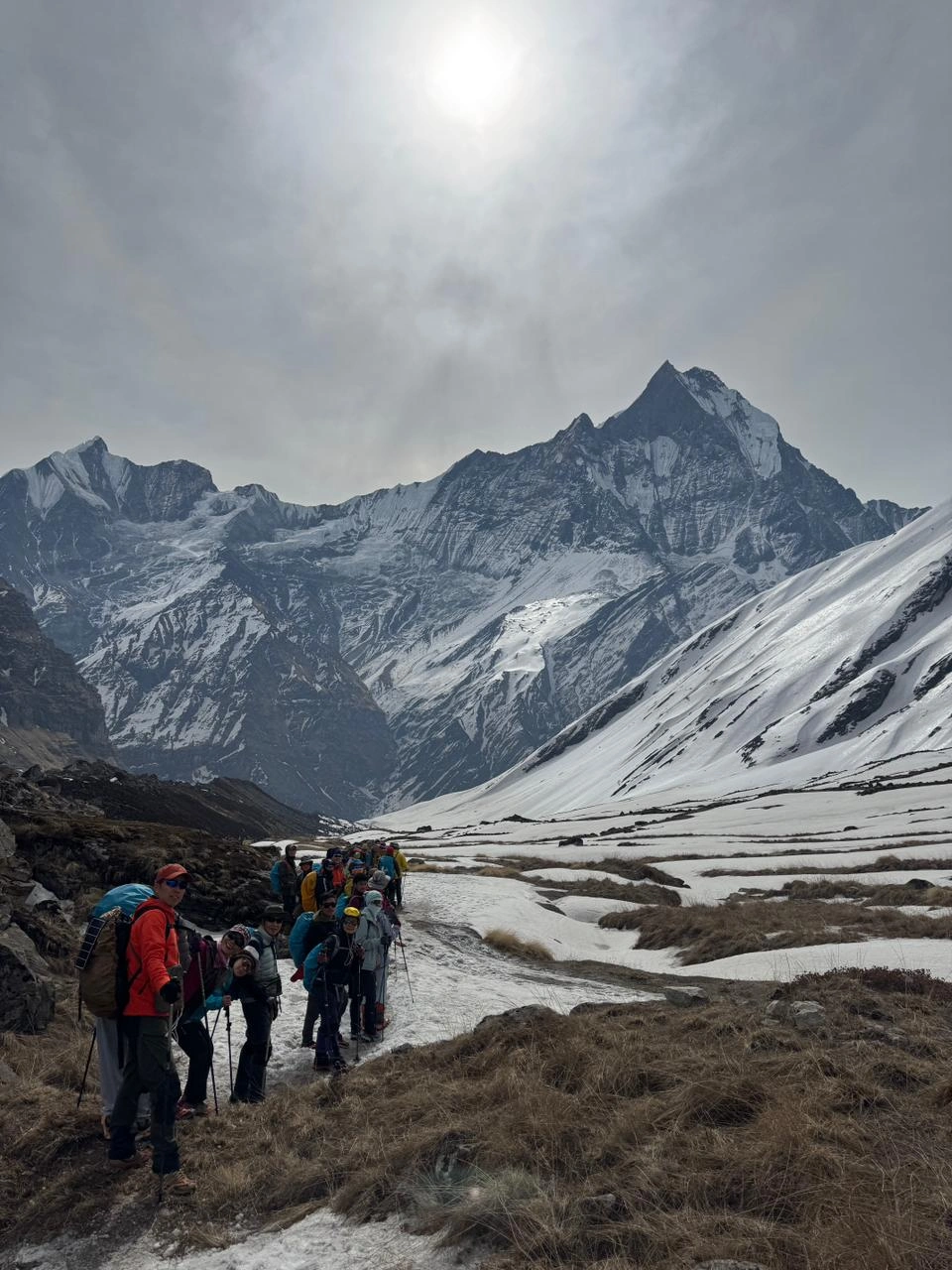
Purchasing permits at checkpoints creates 3 practical problems. First, checkpoint processing queues during peak season (March–May and October–November) extend to 1–2 hours. Second, checkpoint offices close after 17:00 NST, leaving late-arriving trekkers unable to proceed. Third, the double-charge penalty adds NPR 3,000 to the permit cost with no appeals process.
TIMS cards cannot be issued at trail checkpoints. TIMS cards are issued only at NTB offices and licensed trekking agency offices. Trekkers reaching Birethanti without TIMS must return to Pokhara for issuance.
What Documents Do You Need to Get ACAP and TIMS Permits for ABC Trek?
Getting ABC permits requires 4 documents: a valid passport original, a passport photocopy, 2 passport-size photographs, and the permit fee in Nepali Rupees (NPR). Some NTB offices also accept a completed trekking itinerary form, though this requirement is not uniformly enforced across offices.
All 4 documents are required for both the ACAP permit and the TIMS card simultaneously. Trekkers applying for both permits in one NTB office visit need 2 sets of 2 passport photos, a total of 4 photos, and 2 passport photocopies. Trekkers with a trekking agency booking may need only 1 set, as agencies sometimes consolidate applications.
Do You Need a Passport, Photos, or an ABC Itinerary for ACAP and TIMS permits?
The ACAP permit and TIMS card each require a passport original for verification, a photocopy of the bio-data page, and 2 passport-size photographs (35mm × 45mm, white background). The itinerary form is available at NTB offices and takes 5 minutes to complete, it requests the trek name, entry and exit points, trek duration, guide name (if applicable), and emergency contact details.
The passport must have a minimum of 6 months validity beyond the trek start date. Nepal Tourism Board officers compare the passport original against the photocopy and permit application form before issuing. Discrepancies in name spelling between documents cause permit issuance delays of 15–30 minutes while verification is completed.
Trekkers obtaining permits through a trekking agency send a scanned passport copy and digital photo by email. The agency submits documents to the NTB and collects printed permits on the trekker's behalf. Trekkers collect completed permits from the agency office in Kathmandu or Pokhara.
How Long Does the ACAP and TIMS Permit Process Usually Take?
The ABC permit process takes 30–60 minutes per person at NTB offices when all 4 required documents are presented together. During peak season months (March, April, October, November), queue times at Pokhara NTB extend to 90–120 minutes. Off-season processing (December–February and June–August) takes 20–30 minutes. Trekkers still weighing their travel window can read a detailed month-by-month breakdown of the best time for the ABC trek, which covers trail conditions, visibility, and crowd levels alongside permit processing considerations.
Obtaining both the ACAP and TIMS permits in a single NTB office visit is the standard procedure. NTB offices in both Kathmandu and Pokhara process both permits at the same counter. Processing through a trekking agency takes 1–2 working days from the time documents are submitted, as agencies batch applications.
What Rules Can Change Your ABC Permit Budget?
3 rules directly change the ABC permit budget: single-entry restrictions on ACAP, double-charge fines for trekking without permits, and mandatory licensed guide costs for foreign trekkers. Each rule affects the total spend before departure or on the trail. Trekkers budgeting only NPR 5,000 for permits, without accounting for guide costs, underestimate the total regulated expense by NPR 25,000–40,000.
Understanding permit validity conditions before departure prevents unplanned repeat payments. The ACAP permit's single-entry structure creates a specific constraint for trekkers combining the ABC trail with the Annapurna Circuit. According to Nepal's official 2023 tourism statistics, 107,880 foreign trekkers entered the Annapurna Conservation Area that year, and 28,691 TIMS cards were issued to trekkers nationwide, a scale of demand that underscores why ACAP and TIMS fees fund a full-time ranger and trail-maintenance operation.
Are Permits Single-Entry or Reusable on the Same ABC Trek?
The ACAP permit is a single-entry document valid for the entire duration of one continuous trek within the Annapurna Conservation Area. The permit becomes void when the trekker exits the conservation area boundary at the departure checkpoint. Re-entry after exiting requires a new permit at full cost.
A single ACAP permit covers multiple ABC sub-routes within one uninterrupted trek. Trekkers combining the ABC approach route, the Ghorepani–Poon Hill viewpoint detour, and the Chhomrong descent route do not need additional permits, as all 3 segments lie within the Annapurna Conservation Area boundary.
The TIMS card operates on the same single-entry basis. Trekkers planning a combination of ABC and Annapurna Circuit in a single expedition require 1 permit covering the full journey, as long as they do not exit and re-enter the conservation area.
What Fines or Double Charges Apply Without ACAP and TIMS Permits?
Trekking without an ACAP permit results in a double-charge fine, NPR 6,000 for foreign nationals, issued at the first checkpoint encountered on the trail. NTNC conservation staff at Birethanti, Chhomrong, and Deurali checkpoints have authority to issue on-site fines and collect payments in Nepali Rupees.
Trekking without a TIMS card does not carry a fixed penalty equivalent to the ACAP double-charge. However, trekkers without TIMS face return to Pokhara for issuance, resulting in 1–2 lost trekking days and associated costs of NPR 500–2,000 for transport back to the city and return.
Trekkers operating without a mandatory licensed guide, required for foreign nationals since April 1, 2023, face denial of entry at conservation checkpoints. Checkpoints verify guide licensing documentation alongside trekker permits.
Are Any ABC Routes Classed as Restricted Areas?
The standard Annapurna Base Camp route is not classified as a Restricted Area in 2026. The ABC trek via Nayapul–Ghorepani–Chhomrong–MBC–ABC operates under ACAP jurisdiction, which requires only the standard NPR 3,000 permit. No Restricted Area Permit (RAP) is required for the main ABC trail.
Restricted Area Permits (RAP) apply to 3 zones adjacent to Annapurna: Upper Mustang (NPR 50,000 for the first 10 days), Upper Dolpo (NPR 50,000 for the first 10 days), and the Nar–Phu Valley (NPR 10,000 for 7 days). These 3 zones share the Annapurna region's geography but operate under separate permit frameworks issued by Nepal's Department of Immigration.
Trekkers extending the ABC itinerary into the Mustang zone, accessible via the Annapurna Circuit's Thorong La route and the Kagbeni junction, require a separate Upper Mustang RAP. The ACAP permit alone does not authorise entry into Upper Mustang.
How Should You Handle ABC Permits When Booking ABC Trek?
ABC permits are most efficiently handled by booking through a licensed Nepali trekking agency that includes permit procurement as part of the package. Permits obtained through agencies use the agency TIMS rate of NPR 1,000 instead of NPR 2,000, saving NPR 1,000 per foreign trekker. Agencies familiar with 2026 NTB requirements prevent document errors that delay permit issuance.
Trekkers booking independently obtain permits directly from NTB offices in Kathmandu or Pokhara. Independent permit procurement is viable when trekkers arrive 2–3 days before the trek start date, allowing time for NTB office visits and any documentation corrections.
Can a Trekking Agency Arrange ABC Permits for You?
Yes. Any licensed trekking agency registered with the Trekking Agencies' Association of Nepal (TAAN) and Nepal Tourism Board arranges ACAP and TIMS permits on behalf of the trekker. The agency submits the trekker's passport copy, passport photos, and completed application to NTB, then delivers printed permits 1–2 working days before the trek departure date.
Agency-arranged permits use the Agency TIMS rate. For a 2-person ABC itinerary, the Agency TIMS saving is NPR 2,000 total, NPR 1,000 per person. For a 4-person group, the saving is NPR 4,000. This saving partially offsets the agency service fee, which ranges from NPR 500–1,500 per person for permit procurement.
Agencies also verify that all 4 required documents meet NTB specifications before submission. This eliminates the risk of photo dimension errors, unclear passport scans, or missing itinerary details, the 3 most common causes of same-day permit rejection at NTB counters.
What Are the Key Takeaways on ABC Permit Costs?
The 6 key facts on ABC permit costs in 2026:
Foreign trekkers pay NPR 5,000 (USD 42) in total for ACAP (NPR 3,000) and TIMS (NPR 2,000) when trekking solo.
SAARC nationals pay NPR 2,000 in total for ACAP (NPR 1,000) and TIMS (NPR 1,000) when trekking solo.
Children under 10 pay NPR 0, exempt from both ACAP and TIMS fees.
The ACAP permit is single-entry, exiting the conservation area invalidates the permit.
Trekking without an ACAP permit triggers a NPR 6,000 double-charge fine at the first trail checkpoint.
Foreign trekkers must hire a licensed guide, mandatory since April 1, 2023, at an additional NPR 2,500–4,000 per day.
Permit fees represent the smallest fixed cost in the ABC trek budget. A 10-day ABC itinerary with a licensed guide adds NPR 25,000–40,000 in guide fees on top of the NPR 5,000 permit cost. Trekkers ready to move from planning to booking can explore the complete short Annapurna Base Camp trek package, which covers the full 10-day itinerary with permit procurement included. Budgeting accurately for all 3 regulated expenses, ACAP, TIMS, and guide, prevents surprise costs at checkpoints and at NTB offices.
The Annapurna Base Camp permit cost in 2026 is NPR 5,000 for foreign trekkers, NPR 2,000 for SAARC nationals, and NPR 0 for children under 10, a fee structure unchanged from the 2023 revision and applicable to all routes within the Annapurna Conservation Area. Ready to start planning? View the full Annapurna Base Camp Trek package for itinerary options, included services, and current pricing.