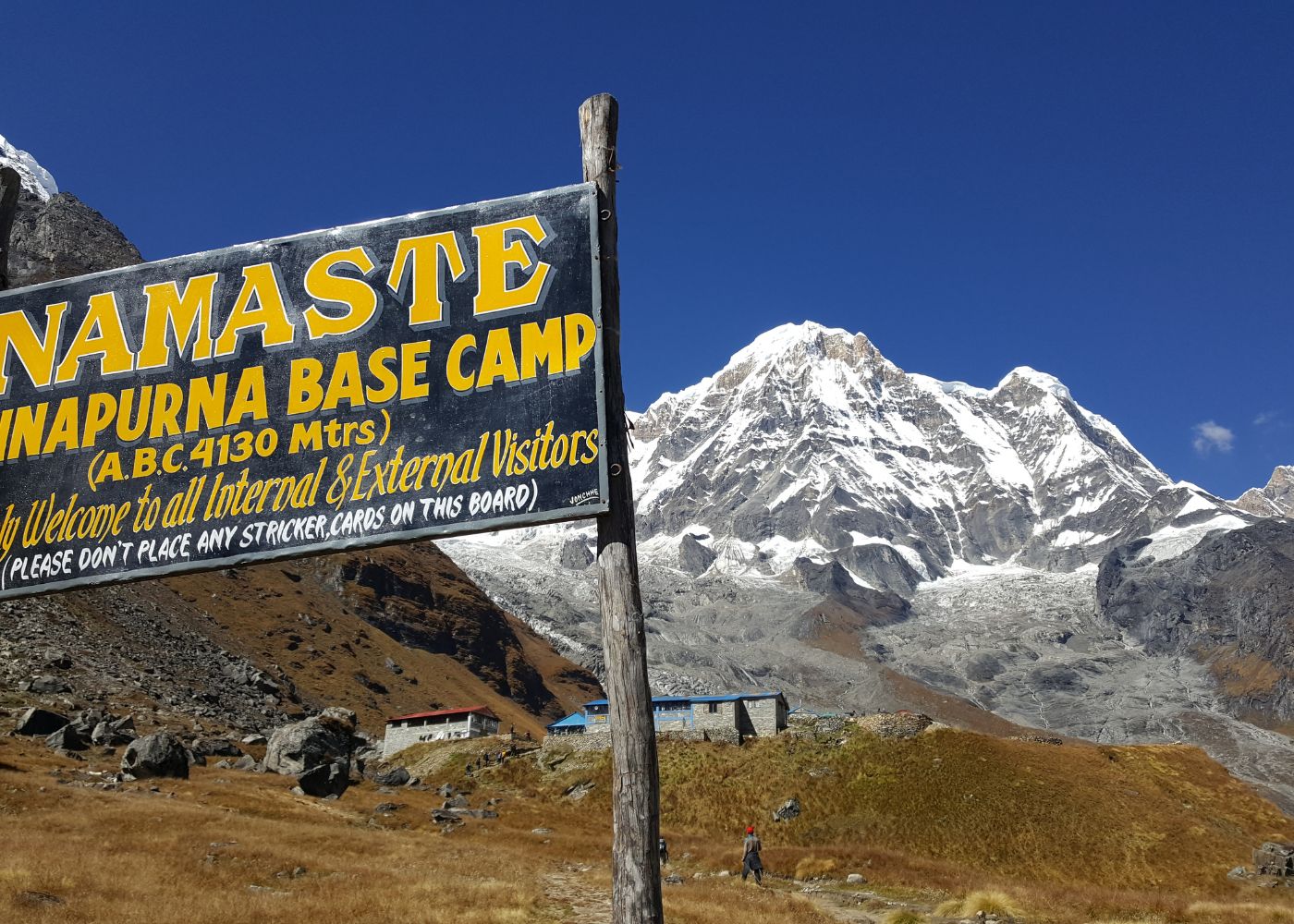
Annapurna Conservation Area hosts two of Nepal’s most popular Himalayan trekking routes: Mardi Himal Trek and Annapurna Base Camp Trek. Mardi Himal Trek is a short-duration Himalayan trek for rapid altitude exposure, ridge-line walking, and close-up views of Machhapuchhre at 4,500 m. Annapurna Base Camp Trek is a classic high-altitude expedition route with extended duration, developed teahouse infrastructure, and a 360-degree glacial amphitheater at 4,130 m surrounded by peaks including Annapurna I, Annapurna South, and Hiunchuli.
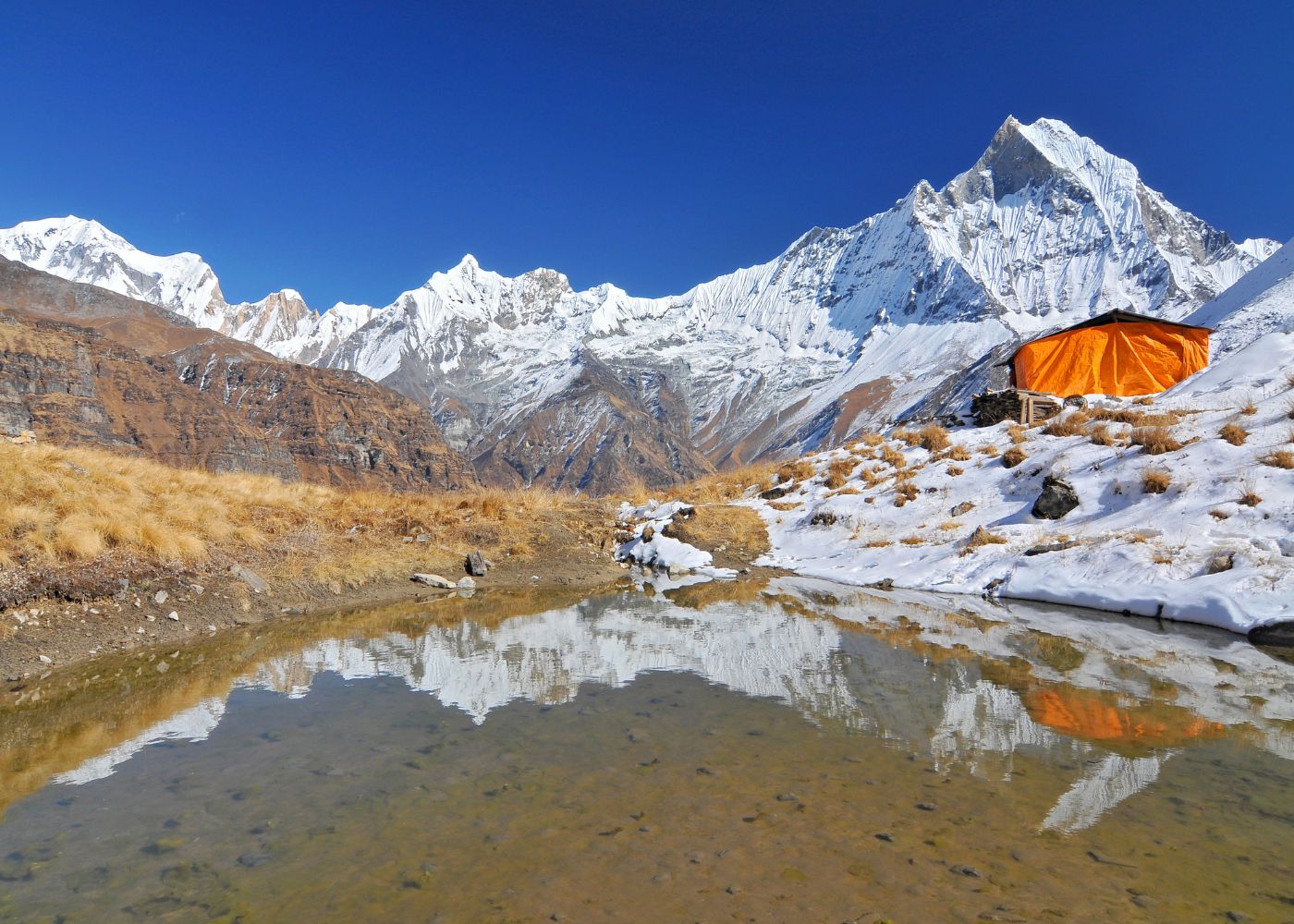
Mardi Himal offers a low-cost, low-crowd trekking experience with 5–7 day completion time and direct ridge panoramas. Annapurna Base Camp delivers a longer 7–12 day journey with higher trekking volume, hot spring access, and full immersion inside the Annapurna Sanctuary. This Mardi Himal vs Annapurna Base Camp comparison evaluates scenery, difficulty, altitude profile, duration, budget, accommodation quality, crowd density, and seasonal conditions to determine the best trek for specific travel timelines, fitness levels, and Himalayan experience goals.
How Do the Routes and Views Compare?
Mardi Himal Trek follows a narrow eastern ridge of the Annapurna massif, while Annapurna Base Camp Trek descends into the Modi Khola valley and terminates inside a glacial sanctuary. The 2 routes share the trailhead town of Pokhara but diverge entirely in terrain, vegetation zones, and summit perspectives.
What Makes Mardi Himal's Trail and Scenery Stand Out?
Mardi Himal Trail stands out for 3 defining features: unobstructed ridge-line walking above 3,000 m, direct face-on views of Machhapuchhre (6,993 m), and near-zero trekker traffic compared to all other Annapurna routes.
The trail departs from Kande (1,770 m) or Phedi and ascends through 4 distinct vegetation zones: subtropical forest, rhododendron forest, alpine scrub, and high-altitude grassland. The ridge section between Forest Camp (2,600 m) and High Camp (4,500 m) spans 22 km of exposed trail with 270-degree panoramic views.
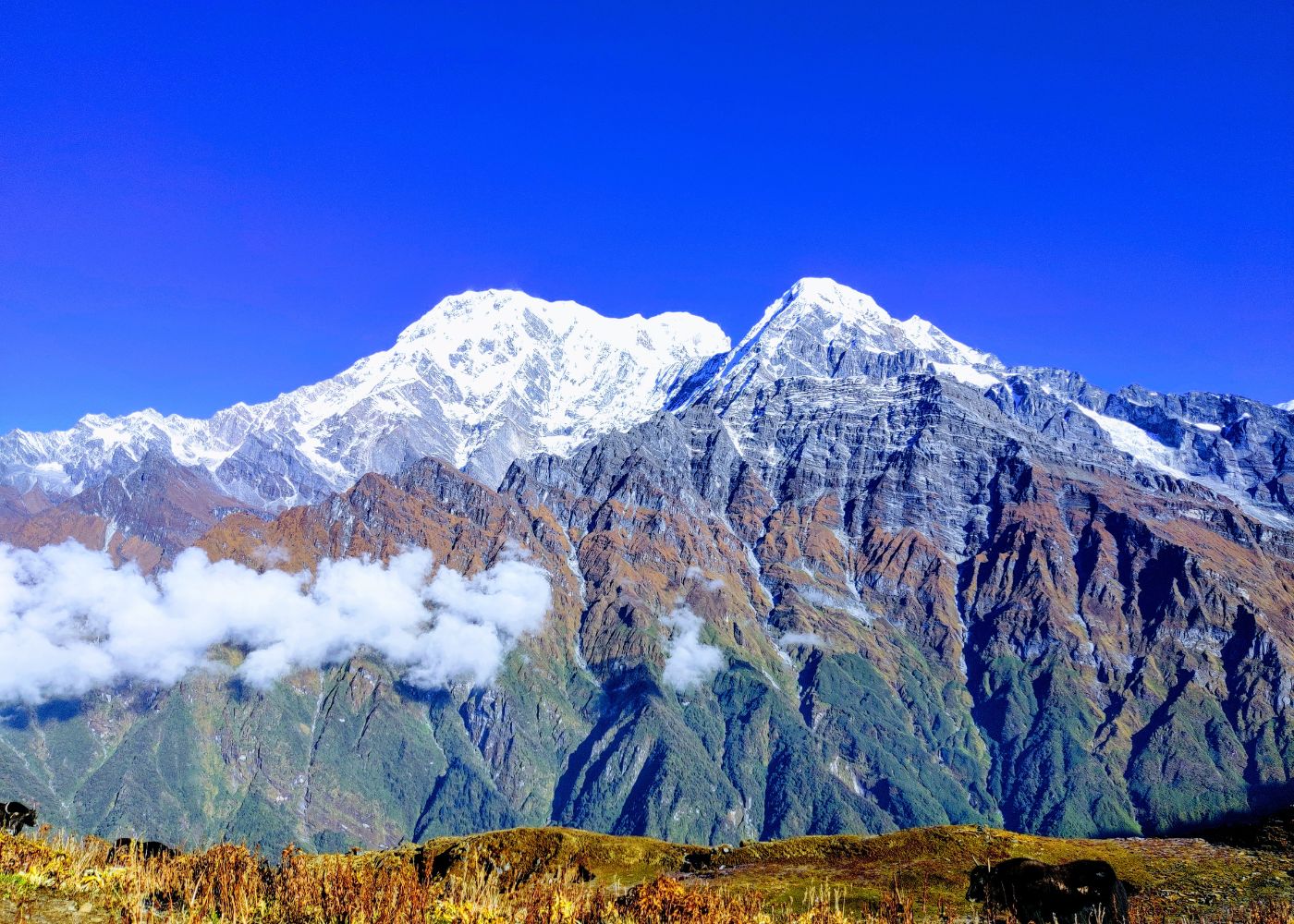
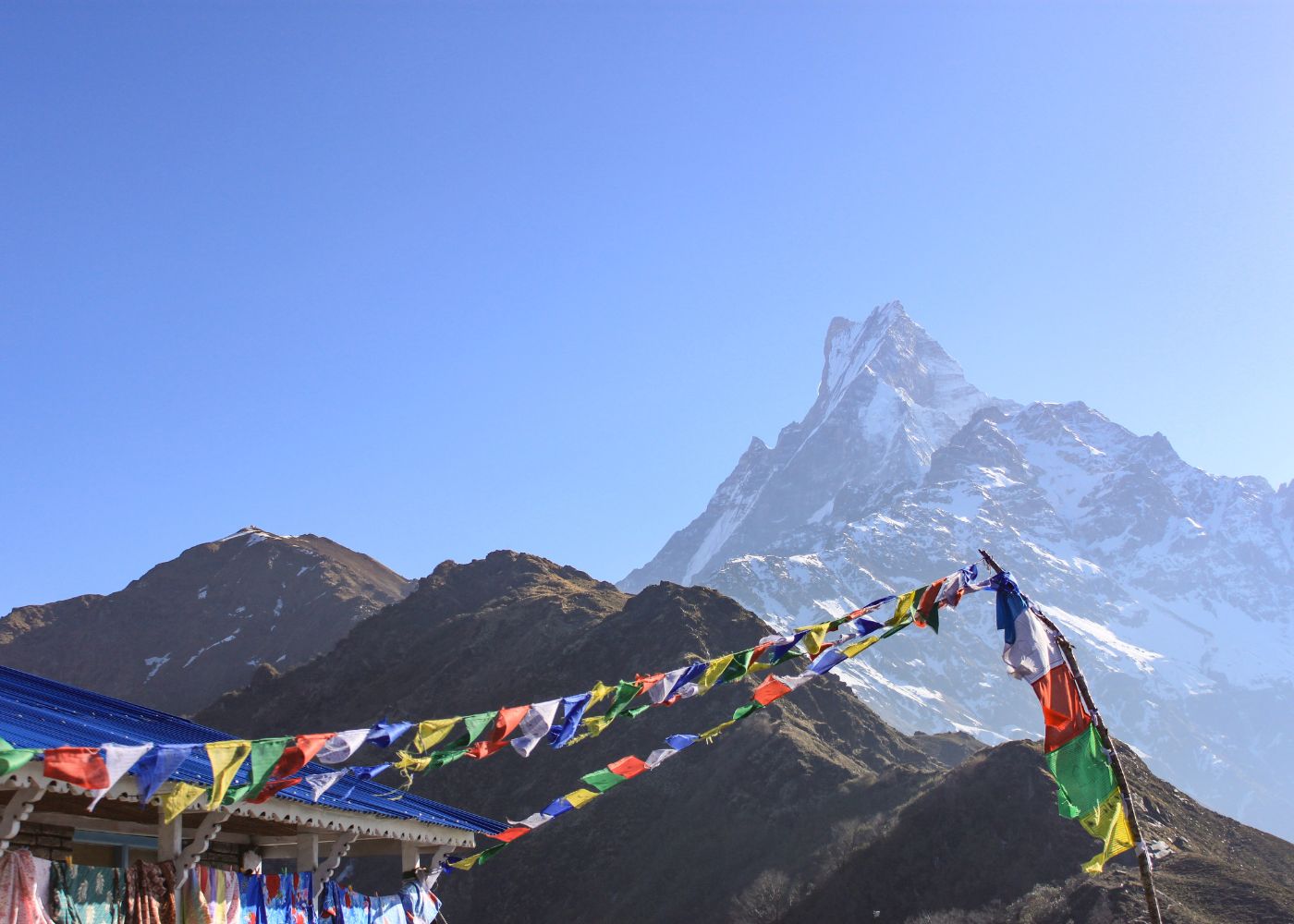
Mardi Himal peak itself stands at 5,587 m (18,330 ft). The trek does not summit the peak but reaches a viewpoint at 4,500 m, delivering eye-level sightlines to Annapurna South (7,219 m), Hiunchuli (6,441 m), and Machhapuchhre (6,993 m), the "Fishtail" mountain, which remains unclimbed by any expedition.
The trail receives fewer than 3,000 trekkers annually, compared to 60,000+ on the Annapurna Circuit. This low traffic preserves pristine trail conditions and eliminates queue times at teahouses.
What Makes Annapurna Base Camp's Trail and Scenery Stand Out?
Annapurna Base Camp Trail stands out for 4 defining features: entry into a closed glacial amphitheater at 4,130 m, 360-degree views of 7 Himalayan peaks, passage through the sacred Annapurna Sanctuary, and 2 active hot spring sites along the route.
The standard route departs from Nayapul (1,070 m) and ascends through Ghandruk (1,940 m), Chhomrong (2,170 m), Himalaya Hotel (2,920 m), and Machhapuchhre Base Camp (3,700 m) before reaching Annapurna Base Camp (4,130 m).

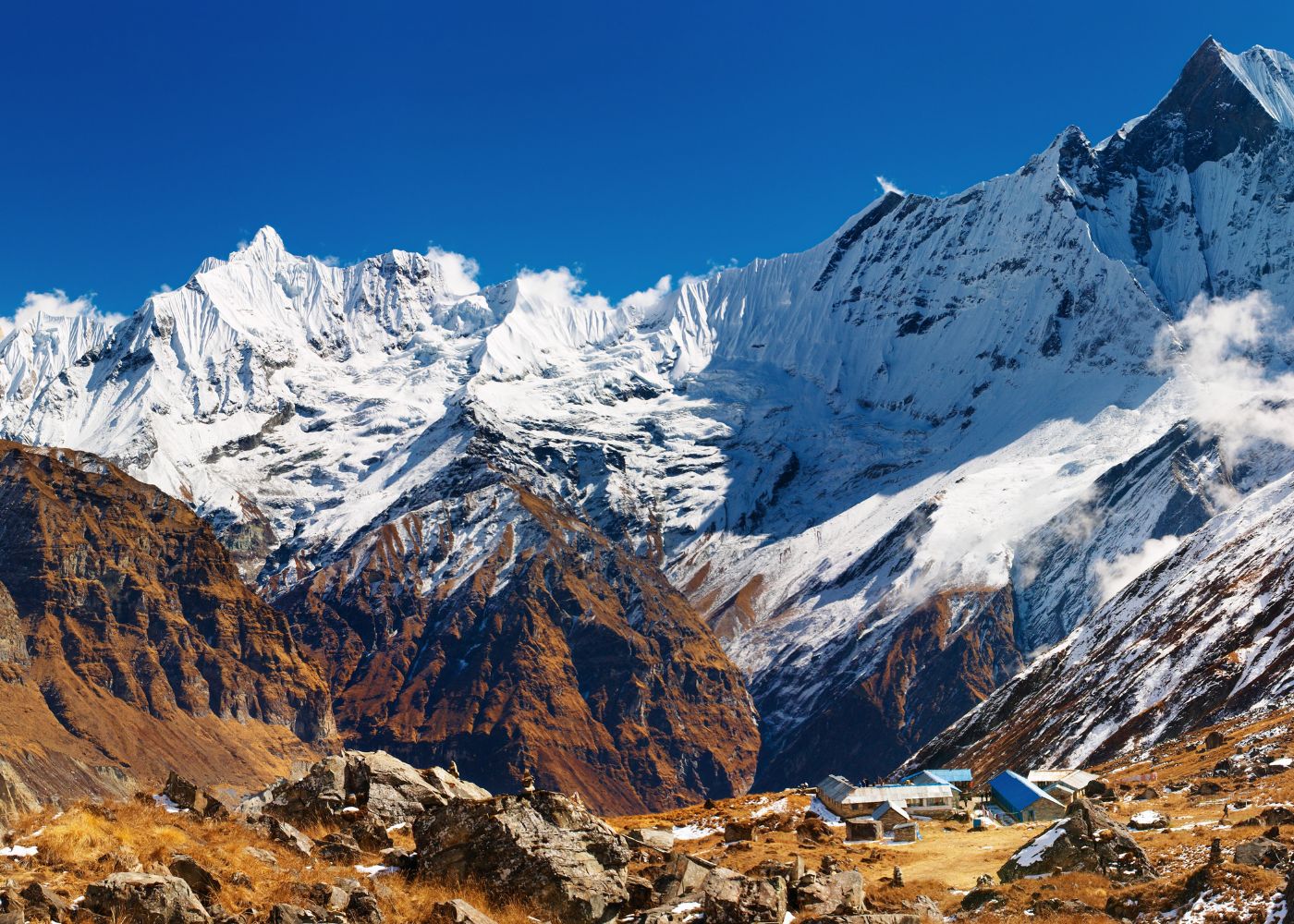
The glacial sanctuary is enclosed by 7 peaks exceeding 7,000 m: Annapurna I (8,091 m), Annapurna III (7,555 m), Annapurna IV (7,525 m), Ganggapurna (7,455 m), Annapurna South (7,219 m), Glacier Dome (7,193 m), and Hiunchuli (6,441 m). This enclosed circular panorama is unmatched by any other accessible trekking destination in the Annapurna region.
The Tatopani hot springs near Jhinu Danda (1,760 m) and the Jhinu hot springs (1,760 m) provide active thermal bathing pools used by trekkers on the descent.
Which Trek Offers the More Dramatic Mountain Experience?
Annapurna Base Camp delivers the more dramatic mountain experience because the enclosed 360-degree glacial amphitheater creates physical immersion within the Himalayan massif at 4,130 m, a geological formation Mardi Himal's ridge viewpoints cannot replicate.
Mardi Himal provides closer perceived proximity to Machhapuchhre due to direct face-on ridge positioning. Annapurna Base Camp provides a greater number of visible summits, 7 versus 4, and the unique experience of sleeping inside a glacial bowl flanked by peaks on all sides.
Trekkers prioritizing a singular, iconic mountain backdrop choose Mardi Himal. Trekkers prioritizing the sensation of entering a mountain sanctuary with full 360-degree enclosure choose Annapurna Base Camp.
How Do Difficulty and Daily Effort Compare?
Mardi Himal Trek rates as moderate difficulty with maximum daily elevation gains of 900 m, while Annapurna Base Camp Trek rates as moderate-to-strenuous with maximum daily elevation gains of 1,100 m and 2 consecutive high-altitude days above 3,500 m.
Which Trek Has the Steeper Climbs and Tougher Trail Days?
Annapurna Base Camp has the steeper cumulative climb and tougher trail days because the route covers 115 km total distance with 5,600 m total elevation gain, compared to Mardi Himal's 60 km distance and 2,730 m total gain.
The steepest section on Annapurna Base Camp occurs between Bamboo (2,310 m) and Deurali (3,230 m), gaining 920 m in 6 km. The descent from ABC to Chhomrong covers a 1,960 m drop over a single day, which causes significant knee strain on stone-stepped trail sections.
Mardi Himal's steepest section spans the 4 km between Low Camp (2,990 m) and High Camp (4,500 m), gaining 1,510 m, the single hardest stretch on the route. The gradient here reaches 35 degrees on exposed sections.
Trail surfaces also differ: ABC route uses stone stairs on 60% of the lower sections, while Mardi Himal uses natural dirt and root trails on 80% of the route below the ridge.
How Do Walking Hours and Pacing Differ on Each Trek?
Mardi Himal Trek averages 4 to 6 walking hours per day over 5 to 7 days. Annapurna Base Camp Trek averages 5 to 8 walking hours per day over 7 to 12 days, with 2 days exceeding 8 hours on the standard itinerary.
The following table compares daily walking times and distances for the 2 routes at their most demanding stages.
|
Stage |
Trek |
Distance |
Elevation Change |
Avg. Walking Time |
|
Low Camp → High Camp |
Mardi Himal |
4 km |
+1,510 m |
5–6 hrs |
|
Chhomrong → Himalaya Hotel |
ABC |
10 km |
+750 m |
6–7 hrs |
|
MBC → Annapurna Base Camp |
ABC |
4 km |
+430 m |
2–3 hrs |
|
Bamboo → Deurali |
ABC |
6 km |
+920 m |
4–5 hrs |
Mardi Himal allows rest days at High Camp without logistical pressure. ABC requires daily forward movement to maintain teahouse reservations during peak season (October–November).
Which Trek Suits Beginners Better?
Mardi Himal Trek suits beginners better because it covers 60 km total, reaches a maximum sleeping altitude of 4,500 m, requires no prior trekking experience, and completes in 5 days, reducing both physical fatigue and altitude exposure duration.
Beginners on Mardi Himal face 1 primary challenge: the steep 4-km push from Low Camp to High Camp. This section demands slow pacing and acclimatization awareness but does not require technical skills, crampons, or ropes.
Annapurna Base Camp places beginners under greater cumulative stress: 7+ continuous trekking days, stone-stair descents causing joint fatigue, and 2 nights above 3,700 m without intermediate acclimatization options between Deurali and ABC.
Trekkers with zero prior Himalayan experience and limited preparation time of 3 months select Mardi Himal as the entry-level Annapurna route.
How Do Altitude and Acclimatization Compare?
Mardi Himal Trek peaks at 4,500 m (High Camp) with 1 night at altitude above 4,000 m, while Annapurna Base Camp peaks at 4,130 m with 2 consecutive nights above 3,700 m, creating a more sustained altitude exposure window despite the lower maximum elevation.
Which Trek Reaches Higher Sleeping and Trekking Elevations?
Mardi Himal reaches a higher sleeping elevation at 4,500 m (High Camp), compared to Annapurna Base Camp's highest sleeping point at 4,130 m. The trekking viewpoint on Mardi Himal at 4,500 m also exceeds ABC's summit elevation by 370 m.
The following table compares key elevation points on both routes.
|
Elevation Point |
Mardi Himal |
Annapurna Base Camp |
|
Trek Start |
1,770 m (Kande) |
1,070 m (Nayapul) |
|
Highest Sleeping Point |
4,500 m (High Camp) |
4,130 m (ABC) |
|
Key Intermediate Camp |
2,990 m (Low Camp) |
3,700 m (MBC) |
|
Total Elevation Gain |
~2,730 m |
~3,060 m |
ABC's total elevation gain from trailhead to summit exceeds Mardi Himal's by 330 m despite having a lower peak elevation, because ABC begins at a lower starting point of 1,070 m versus Kande at 1,770 m.
Where Is Altitude Sickness Risk More Noticeable?
Altitude sickness risk is more noticeable on Mardi Himal at High Camp (4,500 m) because the ascent from 2,990 m (Low Camp) to 4,500 m occurs in a single day, a gain of 1,510 m, exceeding the medically recommended maximum daily altitude gain of 500 m above 3,000 m.
The Wilderness Medical Society defines Acute Mountain Sickness (AMS) onset above 2,500 m. High Camp on Mardi Himal at 4,500 m places trekkers 2,000 m above the AMS threshold within 48 hours of beginning the route from Kande at 1,770 m.
On Annapurna Base Camp, the ascent from Chhomrong (2,170 m) to Himalaya Hotel (2,920 m) to Deurali (3,230 m) to MBC (3,700 m) to ABC (4,130 m) spans 4 days, a more gradual gain of 1,960 m over 96 hours. This staged ascent reduces AMS probability for most trekkers.
Common AMS symptoms reported at both high camps include headache, nausea, and disrupted sleep. Descending 500 m resolves symptoms in 90% of cases within 12 hours.
How Much Acclimatization Does Each Route Usually Need?
Mardi Himal requires 1 rest day at Low Camp (2,990 m) before ascending to High Camp (4,500 m). Annapurna Base Camp requires 1 rest day at Chhomrong (2,170 m) and benefits from a slow ascent through Bamboo and Deurali before reaching ABC.
Trekkers arriving in Pokhara from sea level require 2 days of acclimatization in Pokhara (827 m) before starting either route. This pre-trek acclimatization period applies equally to both treks.
Diamox (acetazolamide) at 125–250 mg twice daily is used by 35% of trekkers on both routes as a prophylactic AMS measure, taken starting 24 hours before significant altitude gain. Consultation with a physician precedes any Diamox use.
How Long Does Each Trek Take?
Mardi Himal Trek takes 5 to 7 days for the standard itinerary. Annapurna Base Camp Trek takes 7 to 12 days depending on the chosen starting point, acclimatization stops, and exit route selected.
What Is the Typical Itinerary for Mardi Himal Trek?
The standard Mardi Himal Trek itinerary spans 6 days: Pokhara → Kande → Forest Camp → Low Camp → High Camp → Viewpoint → descent to Siding → Pokhara, covering 60 km and 2,730 m of total elevation gain.
The 6-day itinerary follows this daily structure:
-
Day 1: Pokhara (827 m) to Forest Camp (2,600 m), drive to Kande (1,770 m), then trek 4 hours
-
Day 2: Forest Camp (2,600 m) to Low Camp (2,990 m), 3 hours trekking through rhododendron forest
-
Day 3: Low Camp (2,990 m) to High Camp (4,500 m), 5–6 hours on steep ridge trail
-
Day 4: High Camp (4,500 m), rest, viewpoint hike to 4,500 m, acclimatization
-
Day 5: High Camp (4,500 m) to Sidhing (1,700 m), full descent, 6–7 hours
-
Day 6: Sidhing (1,700 m) to Pokhara (827 m), jeep transfer, 2 hours
A 5-day variant skips the Day 4 rest and descends directly on Day 4. A 7-day variant adds a night at Middle Camp (3,350 m).
What Is the Typical Itinerary for Annapurna Base Camp Trek?
The standard Annapurna Base Camp Trek itinerary spans 10 days: Pokhara → Nayapul → Ghandruk → Chhomrong → Himalaya Hotel → Deurali → MBC → ABC → Jhinu → Nayapul → Pokhara, covering 115 km and 3,060 m of total elevation gain.
The 10-day itinerary follows this daily structure:
-
Day 1: Pokhara (827 m) to Nayapul (1,070 m) by bus, trek to Ghandruk (1,940 m), 5 hours
-
Day 2: Ghandruk (1,940 m) to Chhomrong (2,170 m), 4 hours
-
Day 3: Chhomrong (2,170 m) to Bamboo (2,310 m), 4 hours (acclimatization pacing)
-
Day 4: Bamboo (2,310 m) to Himalaya Hotel (2,920 m), 5 hours
-
Day 5: Himalaya Hotel (2,920 m) to Deurali (3,230 m), 3 hours
-
Day 6: Deurali (3,230 m) to Machhapuchhre Base Camp (3,700 m), 3 hours
-
Day 7: MBC (3,700 m) to Annapurna Base Camp (4,130 m), 3 hours, overnight at ABC
-
Day 8: ABC (4,130 m) to Bamboo (2,310 m), 6 hours descent
-
Day 9: Bamboo (2,310 m) to Jhinu Danda (1,760 m), 4 hours, hot spring soak
-
Day 10: Jhinu (1,760 m) to Nayapul (1,070 m) to Pokhara (827 m), 4 hours trek plus bus
A 7-day fast variant combines Day 1–2 and Day 8–9 stages by trekking longer daily hours. A 12-day variant adds acclimatization rests at Chhomrong and Deurali.
Which Trek Fits a Shorter Travel Schedule Better?
Mardi Himal Trek fits a shorter travel schedule better because the full route completes in 5 days from Pokhara and returns to Pokhara on Day 5, requiring a total Nepal visit of 7 days including 2 travel days.
Annapurna Base Camp Trek requires a minimum of 7 trekking days plus 2 travel days to/from Pokhara, totaling 9 days minimum. The 7-day ABC fast variant demands 8 to 9 hours of walking on 3 separate days, increasing injury and fatigue risk.
Trekkers with 10 total days in Nepal choose Mardi Himal. Trekkers with 14 or more days choose Annapurna Base Camp as the primary Annapurna objective.
How Do Costs and Logistics Compare?
Mardi Himal Trek costs USD 400–650 total for an independent trekker including permits, accommodation, meals, and transport from Pokhara. Annapurna Base Camp Trek costs USD 600–1,000 total for the same trekker profile over 10 days.
Which Trek Is Usually More Budget-Friendly?
Mardi Himal Trek is the more budget-friendly option at an average total cost of USD 500 for a 6-day independent trek, compared to USD 750 average for a 10-day Annapurna Base Camp Trek, a 33% cost difference driven by fewer teahouse nights and shorter total duration.
The following table breaks down average per-day costs for both treks in 2024 USD.
|
Cost Category |
Mardi Himal (per day) |
ABC Trek (per day) |
|
Teahouse accommodation |
USD 5–12 |
USD 8–15 |
|
Meals (3 per day) |
USD 10–18 |
USD 12–22 |
|
Permits (total, divided by days) |
USD 5 |
USD 5 |
|
Transport (total, divided by days) |
USD 8 |
USD 5 |
|
Daily average total |
USD 28–43 |
USD 30–47 |
Costs increase by 25–40% on both routes when hiring a licensed guide (NPR 2,500–3,500 per day / USD 19–27) or porter (NPR 1,800–2,500 per day / USD 14–19).
How Do Permits, Transport, and Guide Needs Differ?
Mardi Himal Trek requires 2 permits: the Annapurna Conservation Area Permit (ACAP) at NPR 3,000 (USD 22) and the TIMS Card at NPR 2,000 (USD 15). Annapurna Base Camp Trek requires the same 2 permits at identical fees.
ACAP covers the entire Annapurna Conservation Area (7,629 km²), which encompasses both trekking routes. Both permits are obtained at the Nepal Tourism Board office in Pokhara or Kathmandu and require 1 passport photo and a photocopy of the passport bio page.
Transport differences:
-
Mardi Himal: Pokhara to Kande (1,770 m) by taxi costs NPR 600–800 (USD 4.50–6.00), 40-minute drive. Siding to Pokhara jeep transfer costs NPR 1,200–1,500 (USD 9–11.50).
-
Annapurna Base Camp: Pokhara to Nayapul (1,070 m) by tourist bus costs NPR 350–500 (USD 2.70–3.80), 1.5-hour drive. Nayapul to Pokhara return costs the same.
Guide requirements differ in practice: Mardi Himal's trail has fewer waymarkers and signage than ABC, making a licensed guide more valuable for navigation on the ridge sections above 3,000 m. ABC's trail has consistent NTNC signboards at all junctions.
Solo trekking is legally permitted on both routes for trekkers holding valid ACAP and TIMS permits.
Which Trek Is Easier to Plan from Pokhara or Kathmandu?
Mardi Himal Trek is easier to plan from Pokhara because the trailhead at Kande sits 40 minutes by taxi from Pokhara Lakeside, eliminating the 1.5-hour bus transfer to Nayapul required for Annapurna Base Camp.
Both treks depart from Pokhara as the primary logistics hub. Kathmandu-based planning for either route requires a 200-km road transfer to Pokhara (6–7 hours by tourist bus at NPR 800–1,200 / USD 6–9) or a 25-minute domestic flight (USD 90–130 one-way on Buddha Air or Yeti Airlines).
Accommodation booking on Mardi Himal requires advance reservation only during October and November peak season. ABC teahouses at Chhomrong, Deurali, and ABC fill by 3 pm during October–November and require same-day advance booking via phone or app.
How Do Crowds and Accommodation Compare?
Mardi Himal Trek averages fewer than 3,000 trekkers annually with maximum 15–20 trekkers per night at High Camp. Annapurna Base Camp Trek receives 40,000–60,000 trekkers annually with 80–120 trekkers per night at ABC during October–November peak season.
Which Trek Feels Quieter and Less Commercial?
Mardi Himal Trek is significantly quieter, with trail sections between Low Camp and High Camp routinely hosting fewer than 10 trekkers per day during peak season, a 95% reduction in crowd density compared to the equivalent altitude section on the ABC route.
The commercial development gap is measurable: Annapurna Base Camp has 14 operating teahouses along the route from Chhomrong to ABC. Mardi Himal has 6 teahouses between Forest Camp and High Camp. Fewer facilities mean fewer trekkers, more direct interaction with teahouse owners, and greater trail solitude.
Mardi Himal teahouse owners are predominantly local Gurung and Magar community families from Lwang village (1,750 m). This community-based ownership structure keeps commercial density low and cultural interaction high.
What Are the Teahouses Like on Each Route?
Mardi Himal teahouses offer basic twin-room accommodation with foam mattresses, blankets, and shared squat toilets at USD 5–10 per night. Annapurna Base Camp teahouses offer improved twin rooms, attached bathrooms at 3 facilities, and hot shower access at 8 of 14 locations at USD 8–15 per night.
Heating differs between the 2 routes: Mardi Himal teahouses use yak dung and firewood burners in communal dining halls. ABC teahouses use electric heating at Chhomrong and Himalaya Hotel, with solar-heated water at MBC and ABC.
WiFi availability: available at teahouses below 3,000 m on the ABC route and at Forest Camp on Mardi Himal. Above 3,000 m on both routes, cellular data (NCell or NT SIM) provides the only connectivity.
Charging facilities: solar charging available at all teahouses on both routes above 2,500 m. Cost: NPR 100–200 (USD 0.75–1.50) per device charge.
Which Trek Offers the Better Balance of Comfort and Solitude?
Mardi Himal Trek offers the better balance of comfort and solitude because it provides teahouse accommodation with all essential services, meals, blankets, charging, and basic WiFi, at trail densities of fewer than 20 trekkers per day, a combination unavailable on the commercial ABC route during October–November.
Annapurna Base Camp provides better physical comfort through superior facilities at Chhomrong and below. The trade-off is crowd exposure: ABC teahouses at Deurali and ABC operate at 90–100% capacity from October 1 to November 30.
Trekkers valuing room availability without advance booking, silence on the trail, and undisturbed sunrise views choose Mardi Himal. Trekkers valuing hot showers, attached bathrooms, and a wider food menu choose the lower sections of the ABC route.
When Is the Best Time to Do Each Trek?
The best time for both Mardi Himal Trek and Annapurna Base Camp Trek is October to November (post-monsoon) and March to May (pre-monsoon), when daily temperatures range from -5°C to 18°C and summit visibility exceeds 80 km on clear days.
Which Seasons Offer the Clearest Views on Both Routes?
October and November deliver the clearest views on both routes because post-monsoon air pressure pushes atmospheric dust south, reducing particulate matter in the Annapurna range to annual minimums and producing visibility distances of 80–100 km on cloudless days.
Temperature ranges by season for both routes above 3,500 m:
-
October–November: daytime 2°C to 12°C, nighttime -5°C to 2°C
-
March–May: daytime 5°C to 15°C, nighttime -3°C to 5°C
-
December–February: daytime -5°C to 5°C, nighttime -15°C to -8°C
-
June–September: daytime 10°C to 20°C, nighttime 5°C to 12°C with 80% rain probability
March through May produces rhododendron blooms at 2,000–3,000 m elevation on both routes. The Mardi Himal ridge and the Modi Khola valley display red and white rhododendron flowering from mid-March to late April, lasting approximately 40 days.
How Do Weather and Trail Conditions Differ by Season?
Mardi Himal's exposed ridge above 3,500 m experiences 35% stronger wind speeds than the enclosed Modi Khola valley on the ABC route during winter months (December–February), making wind exposure the primary weather risk on Mardi Himal versus snowfall accumulation on ABC.
Snowfall accumulation differences by route:
-
Mardi Himal High Camp (4,500 m): 40–80 cm snowfall December–February, trail closure probability 60% in January
-
Annapurna Base Camp (4,130 m): 20–60 cm snowfall December–February, trail closure probability 45% in January
-
Both routes: landslide risk September–October on lower sections below 2,000 m during monsoon tail
Wind speed at High Camp on Mardi Himal averages 45–65 km/h in December and January, compared to 20–35 km/h at ABC during the same period.
When Should You Avoid Each Trek?
Avoid both Mardi Himal Trek and Annapurna Base Camp Trek during June, July, and August, the core monsoon months, when daily rainfall exceeds 15 mm at elevations above 2,500 m, trail erosion increases landslide risk, and leeches are active on forest sections below 2,800 m.
Specific avoidance periods per route:
-
Mardi Himal: Avoid January–February due to wind-exposed ridge icing at High Camp (4,500 m) and trail closures averaging 18 days per month
-
Annapurna Base Camp: Avoid January for avalanche risk between Himalaya Hotel (2,920 m) and Deurali (3,230 m), where the hanging glacier above releases debris annually
-
Both routes: Avoid June 10 – September 10 for active monsoon conditions
The NTNC (National Trust for Nature Conservation) issues trail closure advisories for both routes via the Annapurna Conservation Area Project (ACAP) office in Chhomrong and Ghandruk.
Who Should Choose Mardi Himal or Annapurna Base Camp?
Trekkers with 5 to 7 available days, preference for solitude, and a USD 400–650 budget choose Mardi Himal. Trekkers with 10 to 12 available days, preference for an iconic glacial sanctuary, and a USD 600–1,000 budget choose Annapurna Base Camp.
Who Is the Ideal Trekker for Mardi Himal?
The ideal Mardi Himal trekker is a person with 5 to 7 days available, moderate fitness, no prior Himalayan experience required, and a primary objective of close-range ridge views of Machhapuchhre (6,993 m) in a low-traffic environment.
4 trekker profiles match Mardi Himal optimally:
-
First-time Nepal trekkers wanting a high-altitude experience under 7 days
-
Return Nepal visitors who completed ABC and seek a quieter, off-the-beaten-path alternative
-
Photography-focused trekkers targeting unobstructed ridge-line compositions of Machhapuchhre
-
Budget travelers keeping total trek costs under USD 500 without sacrificing Himalayan elevation
Mardi Himal does not suit trekkers requiring wheelchair accessibility, below-knee prosthetic compatibility on steep terrain, or consistent hot shower access above 2,600 m.
Who Is the Ideal Trekker for Annapurna Base Camp?
The ideal Annapurna Base Camp trekker is a person with 10 to 14 days available, good physical fitness, prior hiking experience on multi-day trails, and a primary objective of standing inside the Annapurna glacial sanctuary at 4,130 m.
4 trekker profiles match Annapurna Base Camp optimally:
-
Bucket-list Himalayan trekkers completing one of Nepal's 3 most iconic routes (alongside Everest Base Camp and Langtang)
-
Trekkers combining the route with Poon Hill (3,210 m) for a 12-day extended itinerary
-
Group trekkers preferring more developed teahouse infrastructure, including attached bathrooms and hot showers
-
Adventure travelers seeking immersion inside an active glacial environment with direct sightlines to Annapurna I (8,091 m)
Annapurna Base Camp does not suit trekkers with 7 or fewer available days without accepting elevated daily physical effort, or trekkers sensitive to crowd environments during October and November.
Which Trek Is Better for Scenery, Challenge, and Time?
Annapurna Base Camp is better for scenery and challenge. Mardi Himal is better for time efficiency and solitude. For a trekker optimizing across all 3 factors, Mardi Himal ranks higher because it delivers 90% of the scenic value of ABC in 50% of the time at 67% of the cost.
The following table summarizes the comparison across 6 key criteria.
|
Criterion |
Mardi Himal |
Annapurna Base Camp |
|
Duration |
5–7 days |
7–12 days |
|
Max Elevation |
4,500 m |
4,130 m |
|
Total Distance |
60 km |
115 km |
|
Average Cost (USD) |
400–650 |
600–1,000 |
|
Annual Trekkers |
~3,000 |
40,000–60,000 |
|
Peak Views |
4 summits |
7 summits |
Trekkers unable to decide between the 2 routes complete both as a combined 12-day itinerary departing from Pokhara, using the Mardi Himal route as the first leg and the ABC route as the second, sharing the Chhomrong junction midpoint.
How Should You Choose Between Them With a Trek Company?
A licensed Nepal trekking company matches trekkers to the correct route by assessing 5 criteria: available days, physical fitness level, altitude experience history, budget in USD, and personal scenery preference, then customizes the itinerary to include appropriate acclimatization days and teahouse reservations.
Can a Trekking Company Help Match You to the Right Trek?
A registered Nepal trekking company provides 4 concrete matching services: route selection consultation based on fitness assessment, customized itinerary planning with acclimatization days, licensed guide and porter assignment, and teahouse pre-booking for both routes during peak October–November season.
Trek companies registered with the Nepal Tourism Board (NTB) and the Trekking Agencies Association of Nepal (TAAN) provide certified guides with Wilderness First Responder (WFR) training. Guides with WFR certification carry pulse oximeters, diamox supplies, and descent protocols for altitude emergencies on both routes.
Reputable companies offer both routes as standalone packages and as combined Mardi Himal plus Annapurna Base Camp itineraries. A 12-day combined package costs USD 900–1,400 per person including guide, porter, all teahouse accommodation, permits, and transport from Pokhara.
What Are the Key Takeaways About Both Treks?
Mardi Himal Trek and Annapurna Base Camp Trek are 2 of the 4 most-trekked routes in the Annapurna Conservation Area, each serving distinct trekker objectives separated by duration, crowd density, elevation profile, and cost.
The 6 key facts defining the Mardi Himal vs Annapurna Base Camp comparison:
-
Mardi Himal reaches 4,500 m in 5–7 days at USD 400–650 with fewer than 3,000 annual trekkers
-
Annapurna Base Camp reaches 4,130 m in 7–12 days at USD 600–1,000 with 40,000–60,000 annual trekkers
-
Mardi Himal delivers 4 close-range summit views from an exposed ridge; ABC delivers 7 summits from an enclosed glacial sanctuary
-
Both routes require ACAP (NPR 3,000 / USD 22) and TIMS Card (NPR 2,000 / USD 15) permits
-
October–November and March–May are the optimal trekking windows for both routes
-
Combined 12-day Mardi Himal plus ABC itineraries depart from Pokhara and cost USD 900–1,400 per person with a licensed guide
Trekkers choosing between Mardi Himal and Annapurna Base Camp face a decision defined by time and intent: Mardi Himal rewards efficiency and solitude; Annapurna Base Camp rewards endurance and iconic destination completion. Both routes trace the same Annapurna massif, deliver genuine Himalayan altitude, and return trekkers to Pokhara with measurable mountain experience.