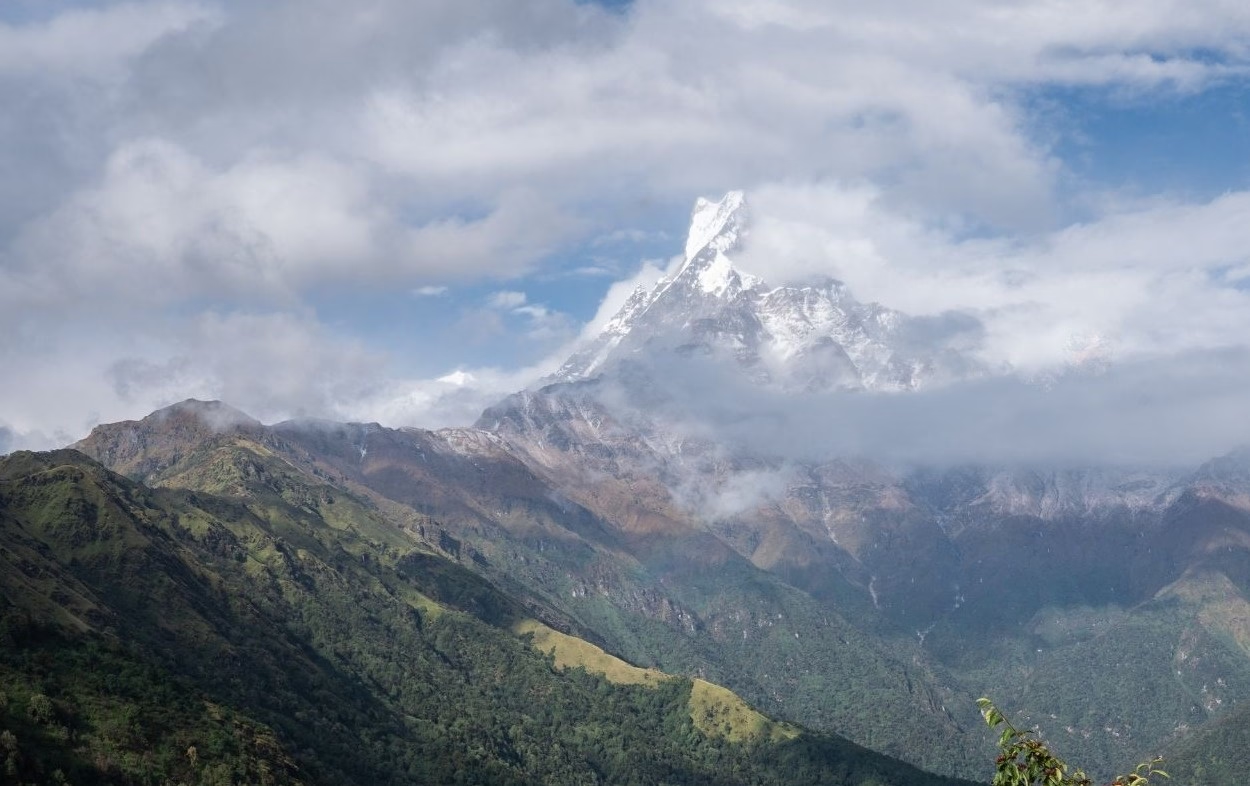
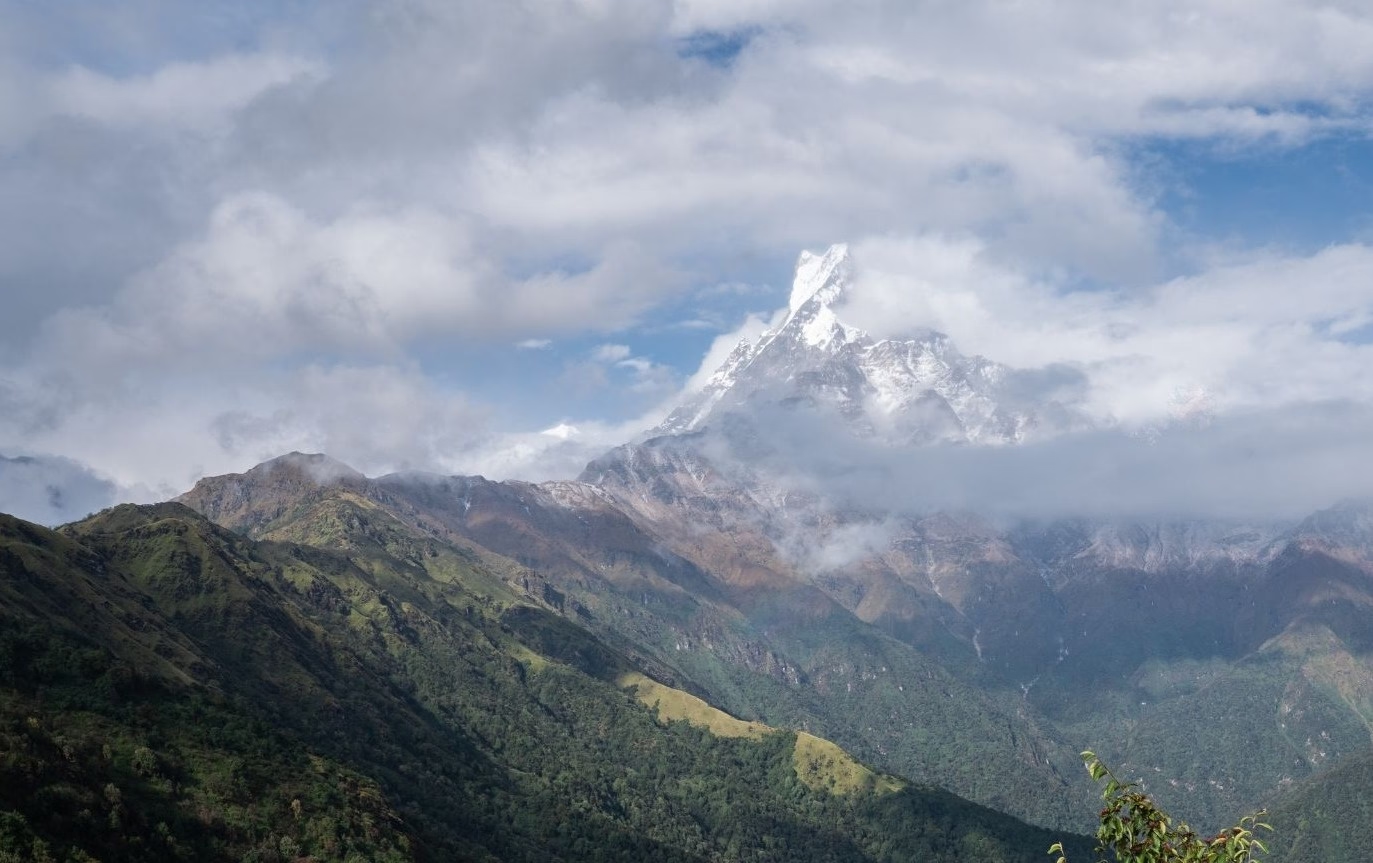
The Mardi Himal Trek cost in 2026 depends on far more than a single package price. This short trek in Nepal’s Annapurna region, usually accessed from Pokhara via Kande and often finished through Siding, can cost anywhere from $250 to $1,500 USD per person depending on trek style, season, group size, itinerary length, and whether a licensed guide or porter is included. Most trekkers compare the route because it offers a relatively short 4-to-7-day Himalayan trek with high-value mountain views from Mardi Himal Viewpoint (about 4,200 m) and routes extending toward Mardi Himal Base Camp (4,500 m).
This guide breaks down every major Mardi Himal Trek expense in 2026, including Annapurna Conservation Area Permit (ACAP) and TIMS (Trekkers' Information Management System) permits, Kathmandu-to-Pokhara transport, trailhead access, teahouse accommodation, daily meals, guide and porter wages, gear rental, tips, charging, Wi-Fi, hot showers, and emergency cash planning. It also compares budget, mid-range, premium guided, independent, and agency package costs so trekkers can build a realistic budget before departure. By the end, readers can see exactly what changes the total price of the Mardi Himal Trek and how to reduce costs without sacrificing safety, legality, or comfort.
What Is the Average Mardi Himal Trek Cost?
The average Mardi Himal Trek cost in 2026 is $450–$650 USD per person for a 5-to-7-day itinerary, covering permits, transport between Kathmandu and Pokhara, teahouse accommodation, meals, and optional guide fees. Solo budget trekkers land closer to $250–$350. Trekkers hiring a licensed guide and porter average $600–$800 total.
The 3 main cost categories on the Mardi Himal Trek are:
Fixed costs: Annapurna Conservation Area Permit (ACAP) at NPR 3,000 ($22 USD) and TIMS card at NPR 2,000 ($15 USD), totaling NPR 5,000 ($37 USD) per person regardless of itinerary length.
Variable daily costs: Teahouse accommodation at $5–$15 per night and 3 daily meals at $3–$8 each, averaging $20–$40 per day on trail.
Service costs: Licensed guide fees at $25–$35 per day and porter fees at $20–$30 per day, added when trekking with professional support.
The following table summarizes the average Mardi Himal Trek cost per category in 2026 USD:
Cost Category | Budget Range | Mid-Range | Premium Guided |
Permits (ACAP + TIMS) | $37 | $37 | $37 |
Transport (KTM–PKR–Trail) | $25–$40 | $60–$90 | $90–$120 |
Accommodation (5 nights) | $25–$50 | $50–$90 | $90–$150 |
Food (5 days × 3 meals) | $50–$90 | $90–$130 | $120–$180 |
Guide (5 days) | $0 | $125–$175 | $175–$225 |
Porter (5 days) | $0 | $100–$150 | $100–$150 |
Miscellaneous (tips, Wi-Fi, charging) | $20–$30 | $40–$60 | $70–$100 |
Total Estimate | $157–$247 | $502–$732 | $682–$962 |
Transport from Kathmandu to Pokhara by tourist bus costs $12–$20 USD. Flights between Kathmandu and Pokhara cost $80–$150 USD one way, with fares fluctuating by season and airline. From Pokhara, local bus to Kande costs $0.80–$1.10 USD per seat and private taxi costs $15–$18.50 USD for the full vehicle.
How Much Does a Budget Mardi Himal Trek Cost?
A budget Mardi Himal Trek costs $250–$400 USD for a trekker completing the route in 5 days. This total includes both required permits ($37 USD), bus transport from Kathmandu to Pokhara ($15 USD), a local bus or shared taxi to Kande ($1–$4 USD), 5 nights of basic teahouse accommodation ($25–$50), and 3 daily teahouse meals ($50–$90).
Note on guide requirement: The Nepal Tourism Board's revised provision effective March 31, 2023 lists Mardi Himal Trek as a route requiring a licensed guide and agency-issued TIMS card. Trekkers confirm current requirements with NTB or a registered agency before departure. Guide costs ($25–$35/day) add $125–$175 USD to a 5-day budget if a guide is engaged, raising the total to $375–$575 USD at the budget teahouse standard.
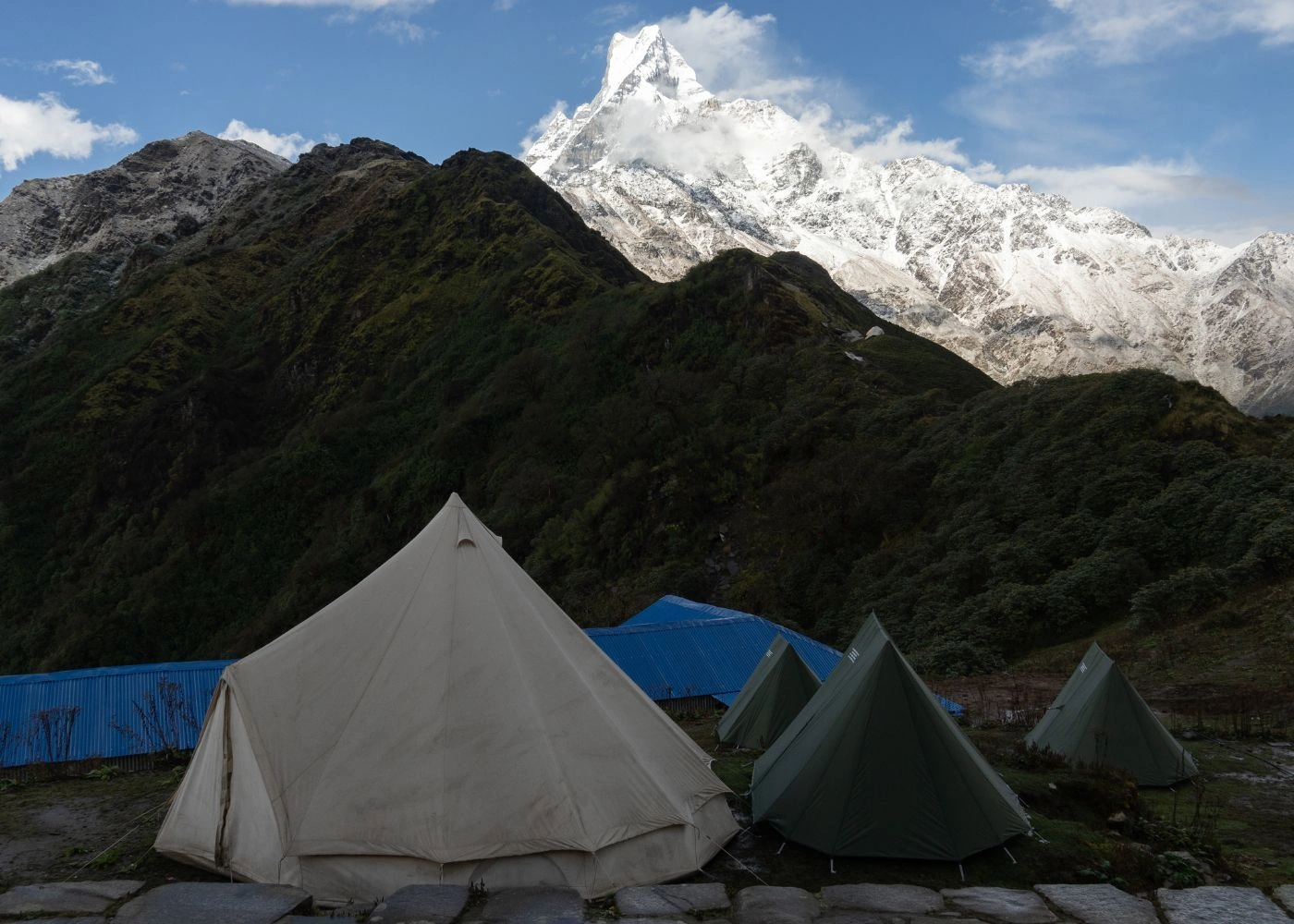
Budget trekking on the Mardi Himal route is practical because 4 established teahouse clusters exist along the route: Forest Camp (2,520 m), Low Camp (2,985 m), High Camp (3,580 m), and Mardi Himal Base Camp (4,500 m). Each cluster has 3–7 teahouses offering dal bhat (lentil rice), noodle soup, eggs, and hot drinks.
3 strategies reduce costs to the lower end of the budget range:
Travel by tourist bus from Kathmandu to Pokhara (8–9 hours, $12–$15 USD) instead of flying ($90–$120 USD)
Eat dal bhat twice daily at $4–$6 per plate, the highest caloric value for the lowest cost on the trail
Carry a 40-liter pack independently to eliminate porter costs ($20–$30/day)
A budget trekker's realistic 5-day daily spend on trail averages $35–$45 USD, excluding permits and transport already paid at the start.
How Much Does a Mid-Range Mardi Himal Trek Cost?
A mid-range Mardi Himal Trek costs $500–$800 USD per person for a 6-to-7-day itinerary including a licensed guide, 1 porter shared between 2 trekkers, bus transport, and comfortable teahouse rooms with private bathrooms where available.
Mid-range trekking adds 3 specific services not present in budget itineraries:
Licensed guide at $25–$35/day for 6 days = $150–$210 USD
Porter at $20–$30/day for 6 days = $120–$180 USD, typically shared between 2 trekkers
Private or twin-bed teahouse rooms with attached bathroom at $10–$15/night instead of $5–$8/night
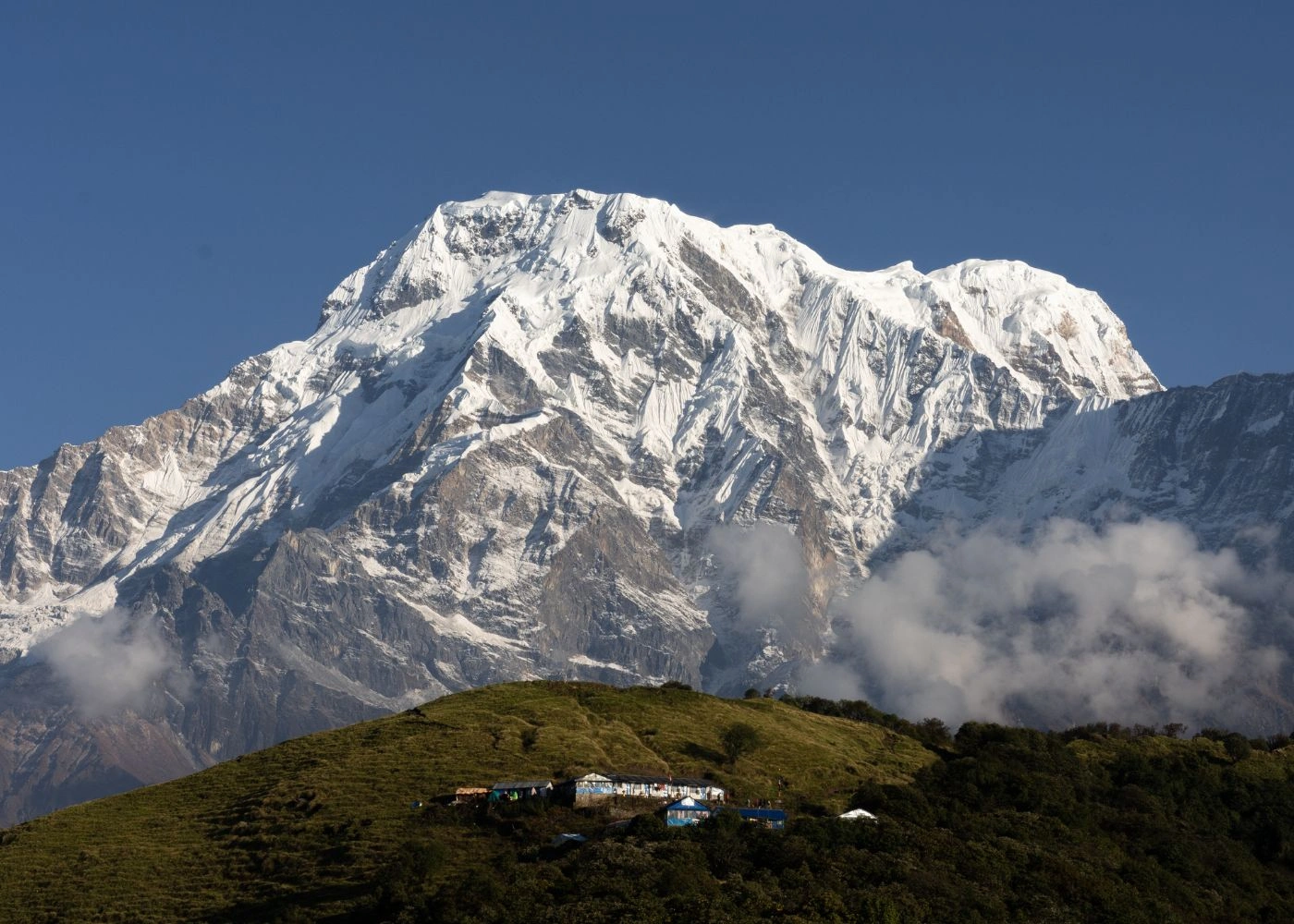
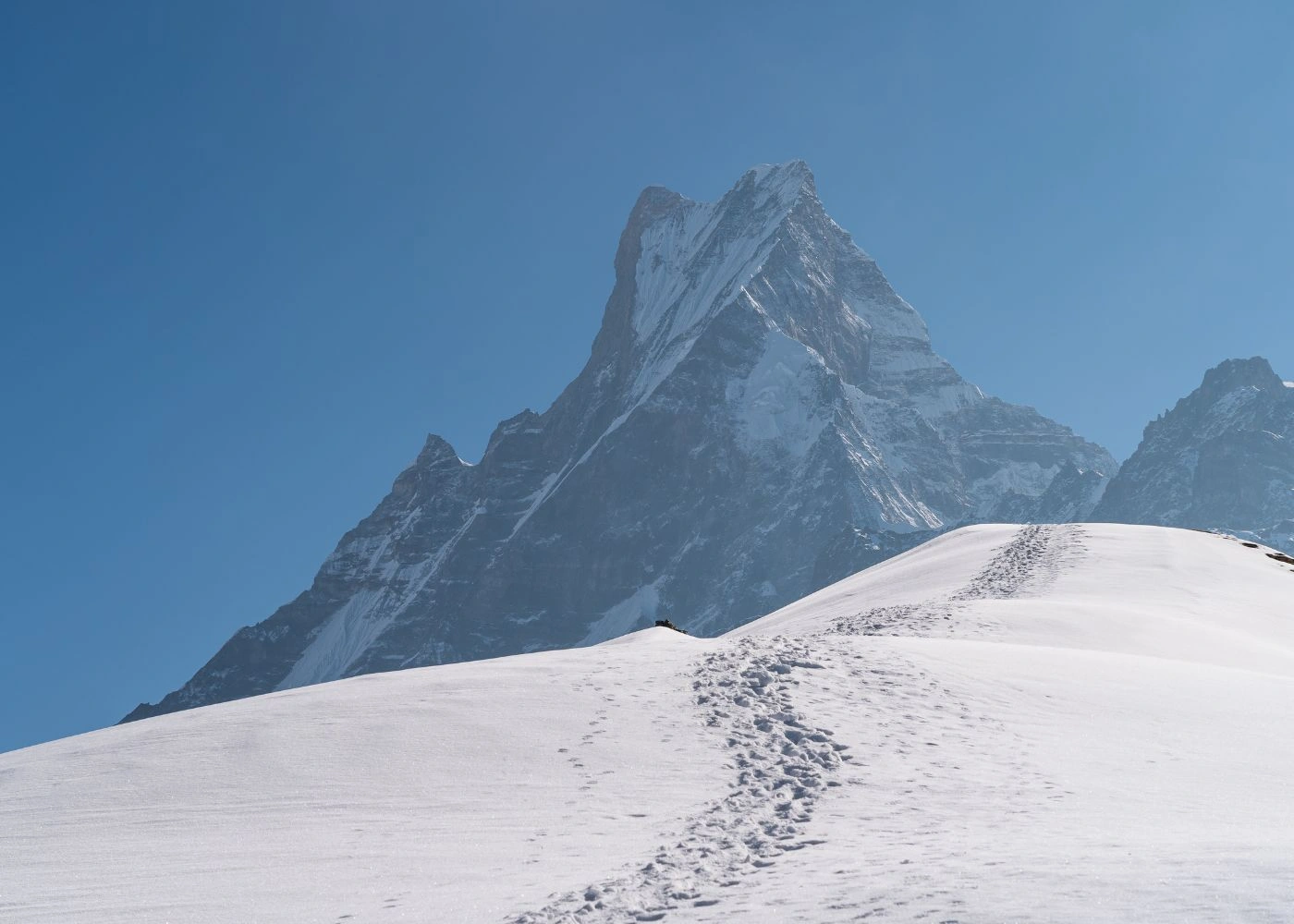
Mid-range trekkers budget $50–$70 per day on trail, including meals, accommodation, and the per-day share of guide and porter costs. The 7-day mid-range itinerary includes an acclimatization rest day at High Camp, improving safety at altitude and extending the experience at Mardi Himal Base Camp with full panoramic views of Machhapuchhre (6,993 m), Annapurna I (8,091 m), Annapurna South (7,219 m), and Hiunchuli (6,441 m).
How Much Does a Guided Premium Mardi Himal Trek Cost?
A guided premium Mardi Himal Trek costs $900–$1,500 USD per person, covering a licensed senior guide, 1 dedicated porter per trekker, flight transport between Kathmandu and Pokhara, top-tier teahouse accommodation, and full meal plans arranged by the trekking agency.
Premium packages offered by registered Nepal trekking agencies include 5 additional services not found in budget or mid-range itineraries:
Senior licensed guide with Wilderness First Responder (WFR) certification at $35–$45/day
1 dedicated porter per trekker carrying up to 25 kg at $25–$35/day
Kathmandu hotel (1–2 nights) at 3-to-4-star standard included in package pricing
Emergency rescue coordination and pre-arranged insurance documentation
Flight Kathmandu–Pokhara ($90–$120 each way) replacing 8-hour bus journeys
Premium agency packages also include predeparture briefings in Kathmandu covering altitude sickness recognition, route safety, and equipment checks. Acclimatization schedules are professionally designed into premium itineraries, with rest days at High Camp built into the standard program.
What Factors Affect Mardi Himal Trek Cost?
5 primary factors affect Mardi Himal Trek cost: season, group size, trek length, starting point, and service level (independent vs. guided). Each factor independently changes total expenditure by 15%–40%. Combined, these factors create the $250–$1,500 USD price range observed across all trekker profiles in 2025–2026.
Understanding each factor allows trekkers to calculate a precise budget before departure rather than relying on general estimates.
How Do Season and Group Size Change Mardi Himal Trek Costs?
Season affects Mardi Himal Trek cost through accommodation pricing and availability. Peak seasons, spring (March to May) and autumn (October to November), push teahouse room rates 20%–30% higher than off-peak periods. During peak season, teahouse rooms cost $10–$15/night. During winter (December to February) and monsoon (June to September), teahouse rooms cost $5–$10/night.
Group size reduces per-person costs through 3 shared-expense mechanisms:
Porter costs split across group members, a porter carrying 25 kg for 2 trekkers costs $10–$15/person/day instead of $20–$30/person/day
Private vehicle hire from Pokhara to Kande ($20–$30 total) divided by 4 trekkers costs $5–$8/person vs. $10/person by shared taxi
Guide fee distributed, 1 licensed guide at $30/day costs $10/person/day for a group of 3 vs. $30/day for a solo trekker
A group of 4 trekkers saves 25%–35% per person compared to solo trekking on the same mid-range itinerary.
How Do Mardi Himal Trek Length and Itinerary Changes Affect Price?
Mardi Himal Trek length directly determines total accommodation, meal, and guide costs because all 3 are charged per day. A 4-day express Mardi Himal Trek costs $200–$350 less than a 7-day extended itinerary with the same service level.
The 3 standard Mardi Himal Trek itinerary lengths and their cost ranges are:
Itinerary | Duration | Estimated Total Cost (Mid-Range) |
Express route (Kande or Phedi to viewpoint and back) | 4 days | $380–$520 USD |
Standard circuit (Kande ascent, Siding descent) | 5–6 days | $500–$700 USD |
Extended with rest day and Lwang Ghalel cultural descent | 7–8 days | $680–$950 USD |
The extended 7-to-8-day itinerary adds the Lwang Ghalel village descent route, requiring an extra night of accommodation and 1 additional day of guide and porter fees. The Lwang descent costs $15–$25 more per day in trail expenses but provides cultural exposure to a Gurung farming community not accessible on the standard route.
How Does Your Starting Point Affect Total Expenses of Mardi Himal Trek?
Starting the Mardi Himal Trek from Pokhara costs $5–$10 USD in transport to Kande. Starting from Kathmandu adds $15–$120 USD in overland or air transport to Pokhara before the trek begins.
Pokhara (822 m elevation) serves as the primary gateway city for Mardi Himal trekking. Pokhara is located 200 kilometers west of Kathmandu, connected by tourist bus (8–9 hours, $12–$20 USD), luxury bus (7 hours, $25–$35 USD), or domestic flight (25 minutes, $80–$150 USD one way depending on season and airline).
From Pokhara's Baglung Bus Park or Lakeside area, trekkers reach Kande village by:
Shared taxi/microbus: NPR 200–500 ($1.50–$3.75 USD) per seat, approximately 45 minutes; availability varies by day and demand
Private taxi: NPR 2,000–2,500 ($15–$18.50 USD) for the whole vehicle, 40 minutes
Local bus: NPR 110–150 ($0.80–$1.10 USD) per seat, 60–75 minutes
Trekkers flying directly into Pokhara from Kathmandu eliminate the overland journey entirely, saving 8 hours of travel time at an additional cost of $60–$130 USD over the bus fare depending on the airline and booking timing.
How Much Should You Budget for Mardi Himal Trek Permits and Transport?
Budget $37–$40 USD for Mardi Himal Trek permits and $20–$140 USD for transport depending on departure city and travel mode. Permit costs are fixed by the Nepal government and do not change by season or group size. Transport costs vary by 600% based on bus vs. flight selection.
What Do Mardi Himal Trek Permits Cost?
Mardi Himal trekking requires 2 mandatory permits: the Annapurna Conservation Area Permit (ACAP) at NPR 3,000 ($22 USD) and the TIMS (Trekkers' Information Management System) card at NPR 2,000 ($15 USD), totaling NPR 5,000 ($37 USD) per person in 2026.
The ACAP, managed by the National Trust for Nature Conservation (NTNC), covers trekking within the Annapurna Conservation Area, a protected region of 7,629 square kilometers in the Gandaki Province of Nepal. The Mardi Himal Trek route lies entirely within this protected zone.
The TIMS card, issued by the Trekking Agencies' Association of Nepal (TAAN) and the Nepal Tourism Board (NTB), records trekker movements along established routes for safety and rescue coordination purposes. Under the revised NTB provision effective March 31, 2023, Mardi Himal Trek is listed among routes requiring a licensed guide and an agency-issued TIMS card. Trekkers confirm the current TIMS issuance procedure applicable to their booking type with NTB or a registered trekking agency before departure, as official guidance on this point has undergone updates.
Both permits are obtained at the Nepal Tourism Board office in Kathmandu (Pradarshani Marg) or the TAAN office in Pokhara (Damside). Processing takes 15–30 minutes with a passport photo and passport photocopy. Children under 10 years old are exempt from ACAP fees. SAARC nation citizens pay NPR 1,000 for ACAP instead of NPR 3,000.
How Much Is Transport from Kathmandu or Pokhara?
Transport from Kathmandu to Pokhara costs $12–$150 USD depending on mode: tourist bus at $12–$20, luxury night bus at $25–$35, and domestic flight at $80–$150 (fares vary by season and carrier). Transport from Pokhara to Kande trailhead costs $0.80–$18.50 USD.
The 4 transport options between Kathmandu and Pokhara with 2026 pricing:
Transport Mode | Duration | Cost (USD) | Departs From |
Local bus | 8–10 hours | $5–$8 | Gongabu Bus Park, Kathmandu |
Tourist bus | 7–9 hours | $12–$20 | Thamel, Kathmandu |
Luxury/AC night bus | 6–8 hours | $25–$35 | Thamel or New Bus Park |
Domestic flight (Buddha Air, Yeti Airlines, Shree Airlines) | 25 minutes | $80–$150 | Tribhuvan International Airport |
The table above shows pricing from Kathmandu. Return transport costs apply symmetrically at the end of the trek.
How Much Do Guide and Porter Fees Add to Mardi Himal Trek Costs?
A licensed guide adds $25–$45 USD per day to Mardi Himal Trek costs. A porter adds $20–$30 USD per day. A 5-day trek with 1 guide and 1 porter adds $225–$375 USD to the total budget, excluding tips.
Guide and porter fees on the Mardi Himal Trek follow rates established by the Trekking Agencies' Association of Nepal (TAAN). The 3 standard hiring arrangements and their daily rates in 2026:
Licensed local guide: $25–$35/day (carries no luggage, provides navigation, altitude safety, and cultural interpretation)
Guide-porter: $28–$38/day (carries up to 15 kg of trekker gear and provides basic guidance)
Porter: $20–$30/day (carries 20–25 kg, requires trekker or agency to handle navigation)
Guides and porters are entitled to their own accommodation and meal costs covered by the trekker or agency, adding approximately $15–$20/day per staff member to total expenses. This accommodation and meal cost for staff is separate from the daily wage.
How Much Do Food and Accommodation Cost on the Mardi Himal Trek?
Food and accommodation on the Mardi Himal Trek cost $25–$55 USD per person per day, covering 1 teahouse room at $5–$15/night and 3 meals at $3–$8 each. Higher camps charge premium prices because all supplies reach those elevations by porter or mule.
What Do Teahouses on Mardi Himal Trek Usually Charge Per Night?
Teahouses on the Mardi Himal Trek charge $5–$15 USD per room per night. Forest Camp teahouses charge $5–$8 for basic dormitory-style rooms. High Camp and Mardi Himal Base Camp teahouses charge $10–$15 for private rooms due to altitude supply costs and limited capacity.
The 4 main accommodation stops and their 2026 room rate ranges:
Camp | Elevation | Room Rate (USD/night) | Room Type |
Forest Camp (also called Deurali) | 2,520 m | $5–$8 | Shared bathroom |
Low Camp | 2,985 m | $6–$10 | Shared or private |
High Camp | 3,580 m | $8–$12 | Private or dormitory |
Mardi Himal Viewpoint / Base Camp area | 4,200–4,500 m | $10–$15 | Basic dormitory |
Teahouse owners at High Camp and Base Camp expect trekkers to take at least 2 meals per day at the teahouse in exchange for low room rates. This meal obligation is a standard practice along the Annapurna Conservation Area routes and is not a formal rule but an established teahouse culture.
How Much Should You Budget for Meals and Drinks on the Mardi Himal Trek?
Budget $12–$25 USD per day for 3 meals and beverages on the Mardi Himal Trek. Breakfast costs $3–$6 USD (oatmeal, eggs, toast, or tsampa porridge). Lunch costs $4–$7 USD (dal bhat, noodle soup, or pasta). Dinner costs $4–$8 USD (dal bhat, fried rice, or noodle dishes).
Dal bhat, a traditional Nepali meal of steamed rice, lentil soup, vegetable curry, and pickled radish, costs $4–$6 USD at all camps and offers free second servings. Dal bhat provides the best caloric value per dollar on the route and is the primary meal of Nepali mountain communities.
Hot drink prices increase with altitude:
Tea (ginger, masala, black): NPR 80–150 ($0.60–$1.10 USD) at lower camps, NPR 150–250 ($1.10–$1.85 USD) at High Camp
Coffee: NPR 150–300 ($1.10–$2.20 USD)
Hot lemon with honey: NPR 100–200 ($0.75–$1.50 USD)
Bottled water (1 liter): NPR 100–300 ($0.75–$2.20 USD); carrying a water filter or purification tablets reduces this cost to zero
What Extra Charges Appear Along the Mardi Himal Trek Route?
3 extra charges appear consistently along the Mardi Himal route: local community entry fees at NPR 200–500 ($1.50–$3.70 USD), rubbish disposal fees at NPR 100–200 ($0.75–$1.50 USD), and campfire charges at some teahouses at NPR 200–400 ($1.50–$3 USD) per session.
Trekkers who do not pre-purchase a route map encounter map charges of NPR 200–300 ($1.50–$2.25 USD) at Forest Camp checkpoints. Carrying a pre-downloaded offline map via Maps.me or Gaia GPS eliminates this expense.
Should You Trek Mardi Himal Independently or With a Guide?
The Nepal Tourism Board's current official guidance lists Mardi Himal Trek as a route requiring a licensed guide and agency-issued TIMS card under the March 2023 revised provision. The cost difference between guided and unguided trekking remains 35%–50% per person. Trekkers confirm current regulatory requirements with NTB or a registered agency before finalizing their approach.
Is an Independent Mardi Himal Trek Cheaper Overall?
An independent Mardi Himal Trek costs $250–$400 USD total vs. $500–$800 USD for a guided mid-range trek, saving $250–$400 per person on a 5-day itinerary. The cost difference is significant, but the legal and regulatory context of independent trekking on this route requires attention before planning.
The Nepal Tourism Board's revised provision, effective March 31, 2023, explicitly places the Mardi Himal Trek under the Annapurna Region routes that require a licensed trekking guide and an agency-issued TIMS card. Under current official NTB guidance, trekking this route without a licensed guide is not compliant with the stated regulatory requirement. Trekkers verify the current enforcement status and applicable booking requirements directly with the Nepal Tourism Board or a Government of Nepal-registered trekking agency before departure.
The practical cost figures below reflect what trekkers spend at each tier when a licensed guide is or is not engaged, allowing for full budget comparison regardless of final decision:
4 conditions relevant to route navigation on Mardi Himal:
Established trail markers from Kande to High Camp with clear signage
Teahouse density, 3–7 teahouses at each major camp providing food and shelter
Short daily walking stages averaging 4–6 hours between camps
Mobile phone coverage available at Forest Camp and Low Camp via Ncell and Nepal Telecom networks
Above High Camp, trail markers thin and navigation requires map-reading proficiency.
When Is a Guided Mardi Himal Trek Worth the Extra Cost?
A guided Mardi Himal Trek is worth the $250–$400 extra cost for 5 specific trekker profiles: first-time Himalayan trekkers, solo female travelers, trekkers with pre-existing cardiovascular conditions, groups with members over 60 years old, and trekkers planning summit pushes to Mardi Himal Base Camp in winter conditions.
Licensed Nepali guides carry altitude sickness recognition training and coordinate descent decisions when Acute Mountain Sickness (AMS) symptoms appear. AMS onset at 3,500–4,500 meters requires immediate descent decisions. Trained guides execute those decisions faster and with clearer authority than trekkers managing the situation independently.
How Do Package Prices for Mardi Himal Trek Compare With DIY Planning?
Agency package prices for Mardi Himal Trek range from $350–$900 USD per person and include transport, permits, guide, porter, accommodation, and meals, services that cost $500–$900 USD when arranged independently for the same mid-range standard.
The cost comparison between agency packages and DIY planning on a 6-day mid-range Mardi Himal Trek:
Expense Item | Agency Package | DIY Arrangement |
Permits (ACAP + TIMS) | Included | $37 USD |
Transport (bus round trip) | Included | $24–$40 USD |
Guide (6 days) | Included | $150–$210 USD |
Porter (6 days) | Included | $120–$180 USD |
Accommodation (6 nights) | Included | $60–$90 USD |
Meals (6 days) | Included | $72–$150 USD |
Staff accommodation and meals | Included | $90–$120 USD |
Total | $350–$600 USD | $553–$827 USD |
Agency packages at the mid-range and premium tier often cost less than equivalent DIY arrangements when guide and porter wages, staff meals, and teahouse accommodation for staff are all accounted for. Budget agency packages ($299–$399 USD range) vary significantly by inclusions, and DIY arrangements remain cheaper for trekkers who already have gear, use budget transport, and share guide costs across a larger group. Comparing itemized agency quotes against a detailed DIY estimate for the same services produces the most accurate cost comparison for a specific trip profile.
What Hidden Costs Should You Expect on Mardi Himal Trek?
4 hidden cost categories consistently surprise trekkers on the Mardi Himal route: gear rental or purchase ($30–$150 USD), tips for guide and porter ($30–$80 USD), electronic charging and Wi-Fi fees ($15–$40 USD), and hot shower charges ($2–$5 per shower).
How Much Should You Budget for Gear and Rentals?
Budget $30–$150 USD for gear rental or purchase in Kathmandu or Pokhara before the Mardi Himal Trek. Down sleeping bags (rated to -10°C) rent for $1–$3/day in Pokhara's Lakeside area. Down jackets rent for $1–$2/day. Trekking poles rent for $1/day per pair.
The 6 essential gear items and their 2026 Pokhara rental or purchase costs:
Gear Item | Rental/Day | Purchase (Budget Quality) |
Down sleeping bag (-10°C rating) | $1–$3 | $30–$60 |
Down jacket | $1–$2 | $25–$60 |
Trekking poles (pair) | $1 | $15–$30 |
Trekking boots (waterproof) | $2–$3 | $40–$80 |
Woolen gloves and hat | Not available for rent | $5–$15 |
Rain poncho or Gore-Tex jacket | $1–$2 | $15–$40 |
Trekkers who already own a 3-season sleeping bag rated to -5°C or below, waterproof boots, and layered clothing systems spend $0 on gear rental.
What Do Tips, Charging, Wi-Fi, and Showers Cost on Mardi Himal Trek?
Tips, charging, Wi-Fi, and hot showers add $30–$80 USD to the total Mardi Himal Trek cost. These 4 expense types are not included in standard agency packages or per-day budget estimates but occur daily along the route.
The 4 incidental costs and their per-use charges in 2026:
Guide tip: $5–$10/day, totaling $25–$70 for a 5-to-7-day trek (industry-standard tipping rate per TAAN guidelines)
Porter tip: $3–$5/day, totaling $15–$35 for a 5-to-7-day trek
Phone and device charging: NPR 200–500 ($1.50–$3.70) per charge at teahouse solar charging points; High Camp charges NPR 400–500 ($3–$3.70)
Wi-Fi access: NPR 200–400 ($1.50–$3) per session at Forest Camp and Low Camp; High Camp charges NPR 400–600 ($3–$4.50) per session
Hot shower: NPR 300–600 ($2.25–$4.50) per shower at Forest Camp and Low Camp; unavailable at High Camp and Base Camp
Ncell and Nepal Telecom SIM cards purchased in Kathmandu or Pokhara for NPR 1,000–1,500 ($7.50–$11 USD) provide 4G data at Forest Camp and Low Camp, reducing Wi-Fi dependence at teahouses.
Should You Set Aside an Emergency Cash Buffer for the Mardi Himal Trek?
Set aside $100–$200 USD as an emergency cash buffer for the Mardi Himal Trek. This buffer covers 3 realistic emergency scenarios: flight delays requiring extra Kathmandu or Pokhara hotel nights ($30–$80/night), trail injury or illness requiring helicopter evacuation ($1,500–$5,000 USD covered by travel insurance reimbursement, not out-of-pocket), and extended teahouse stays due to weather-closed high camps ($20–$40/extra day).
Travel insurance covering helicopter rescue and medical evacuation costs $30–$80 USD for a 2-week Nepal trekking trip from providers including World Nomads, SafetyWing, and Allianz Travel. Trekkers without insurance that covers helicopter evacuation face out-of-pocket rescue costs that reach $1,500–$5,000 USD depending on altitude and helicopter operator. Confirming coverage specifics with the insurance provider before departure is the reliable approach, as terms and exclusions vary by policy.
How Can You Reduce Mardi Himal Trek Cost?
Mardi Himal Trek cost reduces by 30%–45% through 4 strategies: trekking during off-peak season, forming a group of 3 or more, arranging permits and transport independently, and carrying a water filter to eliminate bottled water costs.
When Is the Cheapest Time to Trek Mardi Himal?
The cheapest time to trek Mardi Himal is December to February (winter) and June to August (monsoon), when teahouse room rates drop 20%–30% and fewer trekkers compete for accommodation. Winter daytime temperatures at High Camp reach -5°C to -10°C, requiring proper down gear but offering clear skies between storm days. Monsoon season brings rain below 3,000 meters but clearer conditions above treeline after 10:00 AM on many days.
The 4 trekking seasons ranked by total cost in 2026:
Winter (December–February): Cheapest overall; room rates lowest; trail rarely crowded; requires cold-weather gear rental adding $5–$10/day
Monsoon (June–August): Second cheapest; leeches below 3,000 m require gaiters ($5–$10 purchase); higher trail injury risk on wet paths
Spring (March–May): Peak season pricing; rhododendron forests in bloom attract maximum trekker volume; accommodation books up 2–3 days in advance at High Camp
Autumn (October–November): Peak season pricing; clearest mountain views; highest teahouse occupancy rates
How Can You Save Money on Mardi Himal Trek Without Cutting Safety?
Trekkers save $80–$150 USD on a 5-day Mardi Himal Trek through 5 specific decisions that preserve safety standards:
Carry a SteriPen or Sawyer water filter: eliminates $0.75–$2.20/liter bottled water costs over 5 days, saving $15–$30 USD
Buy food at valley towns (Pokhara's Lakeside market): trail mix, energy bars, and electrolyte sachets cost 40%–60% less than teahouse prices
Travel by tourist bus Kathmandu to Pokhara: saves $70–$100 USD vs. flying at identical safety outcomes for healthy trekkers
Share a porter with 1–2 other trekkers: splits the $20–$30/day porter fee, saving $60–$90 USD over 5 days
Download offline maps (Maps.me or Gaia GPS): eliminates $1.50–$3 map purchase fees at trailhead checkpoints
Cutting costs on 3 items undermines trek safety: quality sleeping bag (-10°C rating), waterproof footwear, and travel insurance with helicopter evacuation coverage. These 3 items represent non-negotiable safety expenditure on any Himalayan trek above 4,000 meters.
Which Costs Are Worth Paying More For Mardi Himal Trek?
3 Mardi Himal Trek costs justify premium spending: a licensed senior guide for high-altitude navigation, quality cold-weather sleeping gear rated to -10°C, and helicopter rescue travel insurance covering Nepal.
A licensed guide with Nepal Tourism Board (NTB) certification and wilderness first aid training costs $35–$45/day vs. $20–$25/day for unlicensed informal guides. The $10–$20/day price difference provides access to certified altitude emergency response, legal responsibility in case of route accidents, and English communication fluency for non-Nepali speaking trekkers.
A sleeping bag rated to -10°C costs $30–$60 to rent or $80–$150 to purchase in Pokhara vs. $10–$20 for unrated or inadequate bags. At High Camp (3,580 m) and Base Camp (4,500 m), overnight temperatures drop to -15°C in winter and -8°C in autumn. Inadequate sleeping bags cause hypothermia exposure risk, a preventable outcome at full premium sleeping bag cost.
How Should You Plan Mardi Himal Trek Cost With Expert Help?
Trekkers plan Mardi Himal Trek costs accurately by consulting a Government of Nepal-registered trekking agency in Kathmandu or Pokhara, comparing 3 or more agency quotations, and requesting itemized cost breakdowns that separate permit fees, guide wages, porter wages, accommodation costs, and agency service margins.
Can a Trek Agency Help You Control Mardi Himal Trek Costs?
A registered Nepal trekking agency controls Mardi Himal Trek costs through 3 mechanisms: pre-negotiated teahouse rates, full-time employed guide and porter staff, and package pricing that bundles transport with trail expenses.
Government-registered trekking agencies hold a Tourism Enterprises License issued by the Department of Tourism, Government of Nepal. Licensed agencies operate under TAAN (Trekking Agencies' Association of Nepal) regulations mandating minimum daily wages for guides (NPR 3,000–4,000/day = $22–$30 USD) and porters (NPR 2,500–3,000/day = $18–$22 USD), insurance coverage for all staff, and load limits of 25 kg per porter.
Trekkers hiring unlicensed guides through informal Thamel or Lakeside street contacts pay $15–$20/day but receive no insurance guarantees, no certified altitude training, and no regulatory accountability in case of accidents or disputes.
What Are the Key Takeaways About Mardi Himal Trek Cost?
The Mardi Himal Trek costs $250–$1,500 USD per person in 2026, with budget trekkers spending $250–$400, mid-range trekkers spending $500–$800, and premium guided trekking reaching $900–$1,500. Permits cost a fixed $37 USD (ACAP + TIMS). Transport adds $20–$140 USD. Daily trail expenses average $35–$70/day including accommodation and meals. Guide fees add $25–$45/day. Porter fees add $20–$30/day.
4 decisions determine total Mardi Himal Trek cost more than any other variable:
Transport mode (bus vs. flight) changes total cost by $70–$100 USD
Guide and porter hire (yes or no) changes total cost by $225–$375 USD for a 5-day trek
Season (peak vs. off-peak) changes accommodation and meal costs by 20%–30%
Group size (solo vs. 3+) changes per-person guide and porter costs by 33%–66%
The Mardi Himal Trek offers one of the highest value-per-cost ratios among Nepal's Himalayan trekking routes in 2026, 4-to-7-day durations, $250–$800 total budget range, and base camp views of Annapurna I (8,091 m), the world's 10th-highest peak, accessible from Pokhara within 45 minutes by road.