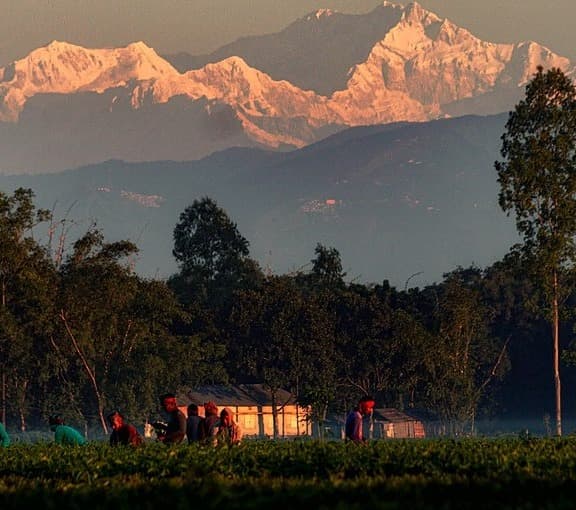
The Kanchenjunga Region is one of Nepal's most remote, pristine, and awe-inspiring trekking destinations. Located in the far northeastern corner of Nepal, bordering Tibet and Sikkim (India), this region offers an unparalleled wilderness experience, from thundering glaciers and ancient monasteries to rare wildlife and sacred high-altitude lakes. Unlike the crowded trails of Everest or Annapurna, Kanchenjunga rewards adventurous trekkers with raw, unspoiled Himalayan beauty and deep cultural immersion.
Mt Kanchenjunga: World's Third-Highest Peak
Standing at a staggering 8,586 metres (28,169 ft) above sea level, Mt Kanchenjunga is the world's third-highest peak, surpassed only by Everest and K2. Located on Nepal, this colossal massif is part of the greater Himalayan range and is visible from as far as Darjeeling on a clear day.
The name Kanchenjunga is derived from the Tibetan words meaning "Five Treasures of Snow", a reference to its five summits, each believed to hold divine riches. The mountain was first summited on May 25, 1955, by British climbers George Band and Joe Brown, who, honouring local beliefs, stopped just short of the very top.
The Kanchenjunga massif contains multiple peaks above 7,000 metres, making it one of the most technically demanding and scenically overwhelming mountains in the world. For trekkers, the approach to its base camps, both North (Pangpema) and South (Oktang), offers breathtaking close-up views of this majestic giant.
A Brief History of Kanchenjunga: From Sacred Mountain to Trekking Destination
Long before mountaineers set their eyes on Kanchenjunga, the mountain was, and still is, regarded as a sacred deity by the indigenous Limbu, Rai, and Sherpa communities of eastern Nepal. Local legends describe Kanchenjunga as the guardian spirit of the region, and its summit is believed to be the abode of gods. Even today, many local communities perform religious rituals to seek the mountain's blessing before any major expedition.
The region remained largely unexplored by outsiders until the late 19th century, when British surveyors and adventurers began mapping the Himalayan frontier. The first serious mountaineering attempts came in the early 20th century, with notable expeditions in 1905 and the 1930s drawing international attention.
Nepal officially opened the Kanchenjunga region to trekkers in 1988, and the Kanchenjunga Conservation Area was established in 1997, covering over 2,035 sq km of pristine Himalayan landscape. Today, the region is accessible via a restricted trekking permit, ensuring that its wilderness remains protected and the number of visitors stays limited, preserving the very essence that makes this destination extraordinary.
Wildlife of Kanchenjunga: Red Pandas, Snow Leopards & Rare Species
The Kanchenjunga Conservation Area is a biodiversity hotspot of extraordinary richness, sheltering some of the world's most endangered and elusive animals within its forests, alpine meadows, and glacial valleys.
Key Wildlife of the Region:
- Red Panda (Ailurus fulgens): One of the flagship species of the region, the red panda inhabits the temperate bamboo and rhododendron forests between 2,200–4,800 metres. Spotting one in the wild is considered a rare and special encounter.
- Snow Leopard: The ghost of the Himalayas, the snow leopard roams the high-altitude rocky terrain above 3,500 metres. Tracks and sightings, though infrequent, have been reported in the upper reaches of the conservation area.
- Musk Deer: A nocturnal and shy species, the Himalayan musk deer can occasionally be spotted near forested ridgelines.
- Himalayan Black Bear: Found in the mid-hill forests, these bears are most active during the warmer trekking months.
- Birds: Over 250 species of birds have been recorded, including the Impeyan pheasant (Danphe, Nepal's national bird), blood pheasant, golden eagle, and lammergeier (bearded vulture).
- Flora: The region boasts remarkable plant diversity, including over 30 species of rhododendron (Nepal's national flower), giant magnolias, orchids, and rare medicinal herbs used in traditional Ayurvedic and Tibetan medicine.
Trekking through the Kanchenjunga Conservation Area is essentially a journey through one of Asia's last great wilderness corridors.
Sacred Lakes and Viewpoints: Goecha La, Oktang & Pangpema
The Kanchenjunga region is home to some of the most spiritually significant and visually breathtaking high-altitude destinations in the entire Himalayan range. Whether you are a devout pilgrim or an adventure trekker, these sites leave a profound and lasting impression.
Pangpema (North Base Camp), 5,143 m
Pangpema serves as the North Base Camp of Kanchenjunga and offers one of the most dramatic panoramas in Nepal. From here, trekkers stand face-to-face with the colossal northern face of Kanchenjunga, along with sweeping views of Jannu (Khumbhakarna), Tent Peak, and Nepal Peak. The glacial moraine landscape and towering ice walls make Pangpema a truly humbling destination.
Oktang (South Base Camp), 4,730 m
Oktang is the South Base Camp and holds deep spiritual significance for the Limbu and Sherpa communities. A small chorten (Buddhist shrine) here marks the spot where locals make offerings to the mountain deity. The views from Oktang of Kanchenjunga's southwestern face and the surrounding glacial landscape are nothing short of spectacular.
Goecha La, 4,940 m
Though technically located on the Sikkim (Indian) side of the Kanchenjunga massif, Goecha La pass is one of the most celebrated viewpoints for the mountain. Trekkers who complete the Goecha La trek from Yuksom in Sikkim are rewarded with sunrise views of Kanchenjunga at extraordinarily close range, a near-religious experience for mountaineers and photographers alike.
Sacred Lakes of the Region
Scattered across the high-altitude terrain are several glacial and sacred lakes that hold spiritual importance in local Buddhist and Limbu traditions. These turquoise jewels, set against snow-capped backdrops, are often used as pilgrimage sites during auspicious festivals.
Kanchenjunga Region Packages
Browse our carefully curated Kanchenjunga region packages below and take the first step toward one of the most extraordinary trekking experiences in the world.