Choosing the best trekking company for the Gokyo Lake Trek means finding a registered Nepal trekking agency with proven Khumbu experience, licensed mountain guides, responsible crew management, and transparent pricing. A reliable Gokyo trekking operator provides a properly acclimatized itinerary, handles trekking permits and Lukla flights, arranges suitable accommodation, and maintains emergency evacuation support. These factors directly influence your trekking safety, overall experience, and total trip cost in the high-altitude Gokyo Valley.
Before booking a Gokyo Lake Trek package, compare trekking agencies based on their government credentials, guide qualifications, sleeping-altitude plans, porter welfare, insurance coverage, group size, and package inclusions. Understanding these essential differences helps you identify dependable operators, avoid hidden costs and inadequate safety arrangements, and choose a trekking company that delivers a well-organized Himalayan journey.
Why Is Choosing the Right Trekking Company Important for Gokyo Lake Trek?
The trekking company you choose decides your acclimatization pace, guide quality, rescue options, and final bill. On a 15-day route that climbs to 5,357 m with no road above Lukla, those four variables decide whether you stand on Gokyo Ri or turn back at Dole.
Above Namche Bazaar (3,443 m), the Gokyo valley offers one main trail, small lodges, and patchy mobile coverage. Your company is the only organization accountable for you between Lukla and the lakes. The next two sections show what that accountability covers and what happens when it fails.
How Does a Trekking Company Influence Your Gokyo Lake Trek Experience?
A trekking company controls 6 parts of your trek: itinerary pacing, guide competence, lodge selection, food hygiene, flight logistics, and emergency response. Each part shows up every day on the trail.
Pacing decides whether you sleep 2 nights in Namche or 1. Guide competence decides who notices a headache turning into altitude sickness. Lodge selection decides whether your Gokyo room sits near a heated dining area, because November nights at 4,750 m drop to around -10 °C. Food hygiene decides whether a stomach bug costs you 2 days. Flight logistics decide whether you leave Ramechhap at 3 a.m. or Kathmandu at 7 a.m. Emergency response decides how fast a helicopter reaches you.
In real-world use, two trekkers on the same 15-day itinerary often return with opposite stories. The difference is usually an assistant guide who walked with the slower trekker, a lodge booked months ahead, or a buffer day that absorbed a cancelled flight.
What Risks Can an Unreliable Trekking Agency Create?
An unreliable agency creates 5 risks: compressed acclimatization, unlicensed guides, uninsured crew, hidden charges, and staged evacuations. Each one is documented in Nepal's trekking industry.
Compressed acclimatization: skipping the Namche rest day to cut the price raises altitude-illness risk above 4,000 m.
Unlicensed guides: a guide without training misses early symptoms, and Nepal's guide policy requires licensed guides for foreign trekkers.
Uninsured crew: an injured porter without cover pays the medical bill from family savings.
Hidden charges: flights, permits, and Kathmandu meals appear as add-ons after you pay the deposit.
Staged evacuations: a guide or agency arranges a helicopter you do not medically need and bills your insurer.
In 2018, Nepal Police's Central Investigation Bureau arrested executives across multiple rescue companies in a fake-rescue insurance case, leading to stricter industry oversight today. The safety section below explains how to protect yourself.
What Should You Look for in a Gokyo Lake Trekking Company?
Look for 5 verified credentials: a Department of Tourism license, 5 or more years of Everest-region operations, licensed guides with Gokyo experience, insured and fairly paid porters, and recent reviews that name the Gokyo route. Every credential is checkable with a document, a license number, or a phone call. The next four sections show how.
How Much Himalayan Trekking Experience Should a Company Have?
A Gokyo trekking company needs at least 5 years of Everest-region operations and a guide team with 3 or more seasons on the Gokyo route. Company age tells you less than route-specific experience. An agency with 20 years in Annapurna may run only a handful of Khumbu departures each season.
Ask 3 questions. How many Gokyo departures did you run in 2025? How many Gokyo Ri summit days has my guide completed? What did you change after your last difficult trip? The third question separates operators fastest. A mature company answers with a specific change, such as adding a buffer day after a run of flight cancellations. A careless one answers with a slogan.
Should You Choose a Government-Registered Trekking Agency?
Yes. Only an agency licensed by the Department of Tourism and registered with the Office of the Company Registrar operates legally in Nepal. Registration also connects the agency to the permit system, the guide-licensing system, and legal liability for your safety.
Five registrations matter:
Company registration: the Office of the Company Registrar certificate proves the business legally exists.
Tourism license: the Department of Tourism license authorizes the company to run treks.
Tax registration: the PAN/VAT certificate from the Inland Revenue Department proves tax compliance.
Association membership: the Trekking Agencies' Association of Nepal (TAAN) is the trade body for licensed trekking operators.
Board affiliation: the Nepal Tourism Board (NTB) regulates tourism standards and lists affiliated operators.
TAAN membership signals accountability and does not guarantee quality. Nepal Mountaineering Association (NMA) membership matters only if you add a climbing peak to the trip.
Why Are Licensed Trekking Guides Important for Gokyo Lake Trek?
Licensed trekking guides hold a government-issued license earned through training at the Nepal Academy of Tourism and Hotel Management, and Nepal's guide policy makes them the standard for every foreign trekker. The Nepal Tourism Board announced the mandatory-guide policy effective April 1, 2023, citing trekker safety.
Enforcement on open routes such as Gokyo varies by season and checkpoint, but the policy stands in 2026. While the Nepal Tourism Board enforced a nationwide licensed-guide requirement for foreign trekkers on all routes, independent trekking without a guide is no longer permitted in the Khumbu region.
On the Gokyo route, a licensed guide does 5 jobs: leads you across the Ngozumpa Glacier moraine, reads the weather before the Gokyo Ri climb, checks your oxygen saturation, manages lodge bookings, and decides when to descend. Ask for the license number and a photo of the license before you book.
How Can You Verify a Company's Reputation and Credibility?
Verify reputation in 4 steps: read independent reviews from the 2026 season, match license numbers against official records, request the legal documents, and message 2 past Gokyo clients. Read reviews for detail, not stars. A useful review names the guide, describes the Gokyo section, and explains how the company handled a problem. "Great trip" tells you nothing.
Recency matters, because a 2022 guide team is not necessarily the 2026 team. More than 2,000 agencies operate from Kathmandu, according to Responsible Adventures, so sort by recent Gokyo and Khumbu reviews rather than total review count. Gokyo reviews are scarcer than Everest Base Camp reviews, which makes direct references worth requesting. Call the office, confirm the street address, and notice whether a person answers or a script does.
How Do You Compare Gokyo Lake Trek Packages and Services?
Compare Gokyo Lake Trek packages on 6 line items: itinerary length, sleeping-altitude profile, inclusions, porter ratio, group size, and rescue arrangements. Headline price comes last, because a 12-day itinerary at US$1,100 and a 15-day itinerary at US$1,460 are different products.
Request every quote in writing, in the same format. The table below defines the 6 comparison points, the question that tests each, and the red flag to watch for.
Comparison point | Question to ask | Red flag |
Itinerary length | How many nights do I sleep in Namche, Dole, and Gokyo? | One night in Namche and no rest day |
Sleeping-altitude profile | What is the sleeping elevation each night? | A gain above 500 m between nights over 3,000 m with no rest day |
Inclusions | Which flights, permits, meals, and hotel nights sit in the price? | "Flights extra" or "permits extra" with no amounts |
Porter ratio | How many trekkers share each porter? | 3 or more trekkers per porter |
Group size | How many trekkers does each guide lead? | More than 4 trekkers per guide with no assistant |
Rescue arrangements | Who calls the helicopter, and who approves it? | No written evacuation protocol |
Answers that arrive within 48 hours, in writing, with numbers, signal a company that runs this route often.
What Should a Standard Gokyo Lake Trek Package Include?
A standard Gokyo Lake Trek package includes 8 items: airport transfers, Kathmandu hotel nights, round-trip Lukla flights, 2 permits, a licensed guide, porters, full-board teahouse meals, and crew insurance. On a 15-day itinerary that means 3 hotel nights in Kathmandu and 10 teahouse nights between Phakding and Lukla.
Stronger packages add 4 items: a sleeping bag and down jacket on loan, a pulse oximeter on every trek, a written evacuation protocol, and at least 1 buffer day. Check the sleeping bag's temperature rating, because Gokyo nights in late autumn fall to -10 °C and lodge blankets do not compensate for a weak bag.
Are Accommodation, Meals, Permits, and Transportation Included in Gokyo Lake Trek Package?
Most Gokyo packages include Kathmandu hotel nights, teahouse lodging, three meals a day on the trek, both permits, and Lukla flights, but 4 details change between companies: flight origin, Kathmandu meals, drinks, and the Ramechhap transfer.
Accommodation is usually bed-and-breakfast at a 3-star Kathmandu hotel, then twin-sharing teahouse rooms with shared toilets above Namche. A private room costs extra. Trek meals run on a full-board basis with tea. Kathmandu lunches and dinners, bottled water, and soft drinks are normally excluded.
Both permits sit in a well-built quote, and the agency obtains them for you. Transportation covers airport transfers and the Lukla flights. Lukla flights depart from Kathmandu or from Ramechhap (Manthali) airport, 130 km east of Kathmandu and a 4 to 5 hour drive away. In peak months, most flights shift to Ramechhap to reduce congestion at Tribhuvan International Airport. According to Nepal Hiking, the Kathmandu to Lukla fare rose to US$237 one-way on March 1, 2026, while Ramechhap fares run lower, around US$190. Ask which airport your quote assumes and whether the road transfer is included.
How Do Private and Group Gokyo Lake Trek Packages Differ?
Private packages set dates, pace, and lodges around your party, while group packages fix the dates and itinerary and split guide and logistics costs across 4 to 12 trekkers.
Three perspectives clarify the choice:
Solo travelers: a group departure adds company and spreads the guide's cost across more people.
Couples and families: a private trek lets you add a rest day, slow the pace, or reserve a specific Gokyo lodge.
Photographers: a private trek lets you stand at the fourth lake at first light without waiting for a group.
Group departures carry one trade-off. The group moves at a fixed schedule, so a trekker who feels strong on day 5 still follows the day-5 plan.
What Is the Ideal Group Size for Gokyo Lake Trek?
The ideal group size for the Gokyo Lake Trek is 2 to 8 trekkers with one licensed lead guide, plus one assistant guide for every 4 trekkers beyond the first 4.
Altitude response varies by person. On the same route, one trekker feels fine at Gokyo while another descends from Machhermo. An assistant guide lets one person walk the sick trekker down while the lead guide continues with the group. Without an assistant, the sick trekker descends alone or the whole group stops. Groups above 12 also split at altitude and stretch the lodge logistics in a valley with limited rooms.
How Much Does It Cost to Hire a Trekking Company for Gokyo Lake Trek?
Most Kathmandu-based operators price a guided 12 to 15-day Gokyo Lake Trek between US$1,000 and US$1,700 per person in 2026, while international marketplaces list similar itineraries from US$1,280 to US$3,140. The spread comes from inclusions, margins, and how crews are paid. The next four sections break it down.
What Factors Affect Gokyo Lake Trekking Package Prices?
Eight factors set the price: flight origin, itinerary length, Kathmandu hotel category, group size, guide language, porter ratio, season, and insurance and rescue coverage.
According to Himalayan Hero's 2026 Gokyo cost guide, licensed guides earn US$25 to US$35 per day, porters US$15 to US$20, teahouse rooms cost US$5 to US$15 per night, and meals add US$25 to US$35 per day. Other Nepali operators quote porter pay up to US$30 per day. The table below builds an illustrative cost floor for 2 trekkers sharing 1 guide and 1 porter on a 15-day itinerary, using those published ranges.
Cost item | Basis | Per-person range (US$) |
Round-trip Lukla flights | 2 flights at US$190 to US$237 | 380 to 474 |
Park and municipal permits | NPR 6,390 combined | about 47 |
Guide share | 11 days at US$25 to US$35, split by 2 | 138 to 193 |
Porter share | 11 days at US$15 to US$30, split by 2 | 83 to 165 |
Trek meals | 11 days at US$25 to US$35 | 275 to 385 |
Teahouse rooms | 10 nights at US$5 to US$15 | 50 to 150 |
Kathmandu hotel | 3 nights at US$25 to US$40 | 75 to 120 |
Total before margin, VAT, and crew costs | 1,048 to 1,534 |
The floor excludes office costs, 13% VAT, crew insurance, crew food and lodging, ground transfers, and profit. A guided price below US$1,050 cannot cover these items at all.
Why Do Gokyo Lake Trek Prices Vary Between Agencies?
Prices vary between agencies because of 4 differences: what the quote includes, how much overhead and tax the agency adds, whether the agency operates the trek or resells it, and how it pays its crew.
Group size alone moves one operator's price by 28%: its Gokyo page lists US$1,690 for a single traveler and US$1,210 per person for groups of 13 to 20. Resale adds a second layer. Many foreign-based sellers subcontract the trek to a Nepali operator and add a margin, so ask which company runs your trek on the ground and request its license number. Crew pay is the third layer. A low price often reflects low wages or missing insurance, and the trekker never sees the cost until something goes wrong.
Are There Hidden Costs to Consider Before Booking?
Yes. 7 costs commonly sit outside a Gokyo quote: Nepal visa, travel insurance, tips, trail extras, Kathmandu meals, delay expenses, and personal gear.
Nepal visa: US$50 for 30 days on arrival, plus your international flights.
Travel insurance: a policy covering trekking to 6,000 m with helicopter evacuation.
Tips: US$10 to US$15 per day for the guide and US$5 to US$8 per day for each porter, a range Nepali operators commonly suggest.
Trail extras: hot showers (about US$4 to US$8), device charging (about US$3 to US$5), Wi-Fi cards, and boiled or bottled water at altitude.
Kathmandu meals: lunch and dinner outside the package, roughly US$10 to US$20 per meal.
Delay expenses: about US$55 per extra day for a room and meals, or a shared helicopter seat to or from Lukla at US$500 to US$600 per person.
Personal gear: boots, poles, gloves, and a rated sleeping bag if the company does not loan one.
Budget US$250 to US$400 for these items, and plan 2 buffer days for weather.
Is the Cheapest Gokyo Lake Trek Package Worth Choosing?
No. A guided Gokyo package priced below roughly US$1,050 sits under the 2026 cost floor, so the missing money comes from skipped inclusions, underpaid crew, or reduced safety margins.
A worked example shows the gap. Take a US$900 quote and subtract US$380 for Ramechhap flights. That leaves US$520 for permits, 3 hotel nights, a guide, a porter share, meals, and teahouse rooms, whose combined low-end cost is US$668. The quote loses money on paper, so something else gives: the flights are excluded, the crew is underpaid, or the service is thinner than advertised.
Three patterns appear repeatedly. Flights get excluded and show up as a US$380 to US$474 surprise. Crews get squeezed, with porters carrying 3 trekkers' bags or guides leading 8 people alone. Safety gets trimmed: no oximeter, no assistant guide, no buffer day.
Budget travelers have better levers than the cheapest quote. Join a group departure of 4 or more, fly from Ramechhap instead of Kathmandu, choose a 2-star Kathmandu hotel, and skip the private room at Namche. Those choices cut cost without cutting acclimatization days, crew insurance, or rescue arrangements.
How Important Are Safety Standards and Altitude Acclimatization?
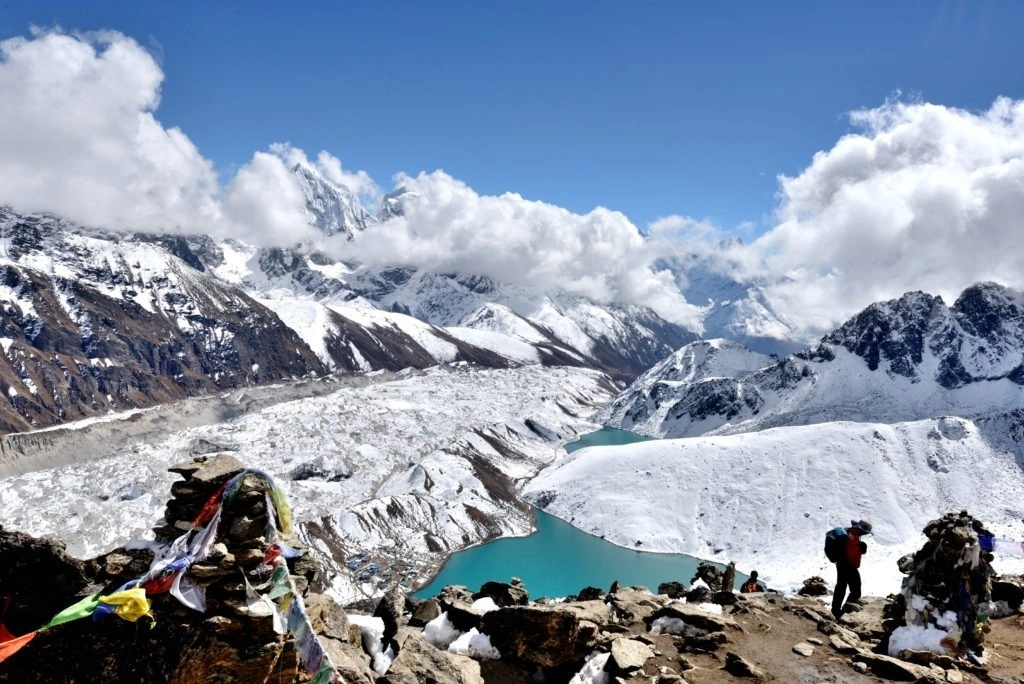
Safety standards and altitude acclimatization rank first among selection criteria, because Gokyo village sleeps at 4,790 m and Gokyo Ri reaches 5,357 m, far above the 2,500 m where the Wilderness Medical Society places the start of acute altitude-illness risk. Four areas decide how a company performs when something goes wrong: rescue systems, altitude management, equipment, and insurance.
What Emergency Rescue and Evacuation Services Should Be Available?
A Gokyo trekking company needs 4 rescue assets: a 24-hour operations contact in Kathmandu, a helicopter partner with a written dispatch protocol, a guide-held communication device, and an insurer-approval step for non-emergency flights.
The fourth asset exists because of fraud. According to Nepal Police's Central Investigation Bureau, six executives of rescue companies were arrested in 2018 for staging evacuations to claim insurance payouts. Investigators recommended prosecution of 33 people across rescue firms, helicopter operators, hospitals, and trekking agencies, and OCCRP put the alleged fraud near US$20 million. Police later called reports of deliberate guide poisoning baseless. The fake rescues themselves remain the core of the case.
Put 5 questions to any company before booking:
Ask who decides on a helicopter evacuation and on what medical criteria.
Confirm that your insurer's assistance line is called before any non-emergency flight.
Request the names of the helicopter and rescue partners.
Check that the guide carries a charged phone with a Nepali SIM and a backup communicator.
Keep copies of every medical and flight record.
In a genuine emergency, descent and evacuation come first and paperwork second. In a mild case, you hold the right to a second opinion and a call to your insurer.
How Does a Trekking Company Manage Altitude Sickness?
A competent company manages altitude sickness through 5 measures: a sleeping-altitude profile that follows the 500 m rule, scheduled rest days, twice-daily oximeter and symptom checks, a descent-first policy, and guides trained to recognize AMS, HAPE, and HACE.
AMS (acute mountain sickness) is a headache plus nausea, dizziness, fatigue, or poor sleep. HAPE (high-altitude pulmonary edema) is fluid in the lungs, marked by breathlessness at rest and a wet cough. HACE (high-altitude cerebral edema) is brain swelling, marked by confusion and loss of coordination. According to the Wilderness Medical Society's 2019 clinical practice guidelines, travelers above 3,000 m do not increase sleeping elevation by more than 500 m per day and include a rest day every 3 to 4 days.
The table below tests a benchmark 15-day Gokyo itinerary against that rule, using sleeping elevations.
Night | Sleeping elevation (m) | Gain from previous night (m) |
Phakding | 2,650 | Start (Lukla flight lands at 2,850) |
Namche Bazaar | 3,443 | +793 (443 m above 3,000 m) |
Namche Bazaar, rest day | 3,443 | 0 |
Dole | 4,038 | +595 |
Machhermo | 4,447 | +409 |
Gokyo | 4,750 | +303 |
Gokyo, Gokyo Ri day | 4,750 | 0 |
From Namche to Gokyo, sleeping elevation rises 1,307 m over 3 ascent nights, an average of 436 m per night. The one step above 500 m, Namche to Dole at 595 m, follows a rest day. An itinerary that skips the Namche rest day, or runs Namche to Machhermo in one move (1,004 m), fails the check.
Descent is the definitive treatment for altitude illness. Bottled oxygen and medication buy time and never replace going down. Ask the company for its descent trigger in writing: which symptoms end the ascent, and who walks you down.
Does the Company Provide First Aid and Safety Equipment?
A reliable Gokyo company carries 6 items on every trek: a first aid kit, a pulse oximeter, a thermometer, an altitude medication kit, a charged communication device, and bottled oxygen on request. The guide carries the kit, and you hold the right to see its contents list and expiry dates before booking.
A pulse oximeter reading works as a trend tool. A falling reading combined with symptoms matters more than any single number, and a guide trained in wilderness first aid reads that combination correctly. No hospital operates in the Gokyo valley, so serious cases leave on foot with the guide or by helicopter.
Personal safety gear matters too. Confirm whether the company loans a sleeping bag and down jacket, and compare your own kit against the Equipment Checklist. A common mistake is arriving with a 0 °C sleeping bag for a route that reaches -10 °C at night.
What Insurance Should Your Trekking Guide and Porters Have?
Guides and porters need accident and medical insurance that covers high-altitude helicopter evacuation, issued by the agency, with a policy certificate available on request. Responsible operators insure their crew. Cheaper ones skip it, because porter insurance costs the agency money and the trekker rarely asks.
Your own policy matters just as much. It must cover trekking to 6,000 m with helicopter evacuation, because Gokyo Ri reaches 5,357 m and many standard plans cap trekking at 4,500 m or 5,000 m. Read the altitude clause before you pay the trek deposit, and carry the insurer's 24-hour assistance number on paper.
How Can You Evaluate Trekking Guides and Porter Services?
Evaluate guides and porters on 3 measures: documented qualifications, fair pay and treatment, and local knowledge of the Gokyo valley. The same 3 measures predict how a crew behaves when weather, flights, or health turn.
What Qualifications and Experience Should Gokyo Lake Trek Guides Have?
Gokyo Lake Trek guides need a government trekking guide license, first aid and altitude-illness training, working English, and at least 3 seasons in the Khumbu region.
Request a one-page guide profile before booking:
License number, with the training institute and year of issue.
First aid certificate, with the issuing body and expiry date.
Khumbu seasons, with the number of Gokyo departures led.
Languages spoken, with the working level in each.
Salary model, either fixed pay or commission.
The last item matters more than most trekkers realize. Guides paid on commission have a financial reason to steer you toward particular lodges and gear shops. A licensed English-speaking guide earns US25 to US35 per day, so a package that pays less than that squeezes the person responsible for your safety.
How Does a Responsible Trekking Company Treat Its Porters?
A responsible trekking company assigns 1 porter to 2 trekkers, keeps loads well under the 30 kg ceiling the International Porter Protection Group (IPPG) sets for Nepal, supplies cold-weather clothing, covers insurance, and pays above the TAAN minimum.
Lukla flights limit trekker baggage to 10 kg checked plus 5 kg hand carry, so a shared porter carries about 20 kg of client gear plus personal items. Loads far above 25 kg signal overpacking or a short-staffed crew. IPPG guidance also expects shelter, food, and medical care equal to the clients', and it expects a sick porter to descend with an escort rather than stay behind.
Ask 4 questions: What does each porter earn per day? What clothing does the company issue above 4,000 m? Where do porters sleep in Gokyo village? What happens when a porter falls ill? Companies affiliated with the Kathmandu Environmental Education Project (KEEP) answer these questions routinely, because KEEP promotes porter welfare standards among operators.
Why Is Local Knowledge Important for Gokyo Valley Trekking?
Local knowledge turns a map route into a safe route: guides raised in Solukhumbu read the Ngozumpa Glacier moraine, forecast afternoon cloud, time Gokyo Ri for sunrise, and know which lodges hold heated dining rooms.
The Ngozumpa Glacier is Nepal's longest, about 36 km, and the path across its moraine shifts each season. A guide who walked it in October finds the current line in minutes. Afternoon cloud climbs the valley by late morning, so strong guides start the Gokyo Ri climb around 5 a.m. and reach the summit for first light, when Everest, Lhotse, Makalu, and Cho Oyu stand clear.
Local guides also know the alternatives. The fifth lake and the viewpoint above Dudh Pokhari reward a second Gokyo night, and the Cho La pass links Gokyo to the Everest Base Camp trail for trekkers who want both. A guide who knows lodge owners by name also secures rooms in October when beds are scarce.
What Permits and Regulations Must a Gokyo Lake Trekking Company Handle?
A Gokyo trekking company handles 2 trekking permits, your Lukla flight booking, guide registration, and crew insurance, and the agency carries legal responsibility if any item is missing. You supply a passport copy and arrival dates. The agency does the rest.
Which Trekking Permits Are Required for Gokyo Lake Trek?
The Gokyo Lake Trek requires 2 permits: the Sagarmatha National Park entry permit (NPR 3,000 plus 13% VAT) and the Khumbu Pasang Lhamu Rural Municipality entry permit (NPR 3,000), about US$47 combined in 2026.
The municipality permit rose from NPR 2,000 to NPR 3,000 in 2026, according to Everest Trekking Routes. It replaced the TIMS card in the Khumbu region in 2018, so a TIMS card is no longer part of a Gokyo quote. Gokyo lies outside Nepal's restricted areas, so no special permit applies.
The park permit is issued at the Department of National Parks and Wildlife Conservation counter in Kathmandu (Bhrikuti Mandap) or at the Monjo checkpoint. The municipality permit is issued at the Lukla counter or at Monjo. Both counters require a passport, and the municipality counter accepts Nepali rupees only. Checkpoint staff at Monjo and Namche inspect both permits, so your guide keeps them together with a passport copy in a waterproof sleeve. Fees change, so confirm the figures with your agency at booking.
How Can You Confirm That Your Trekking Company Follows Nepal's Regulations?
Confirm compliance with 5 documents: the Department of Tourism license, company registration certificate, PAN/VAT certificate, TAAN membership certificate, and your guide's license number. A legitimate company shares all five without hesitation, and many publish them on a legal documents page.
Then check 3 behaviors. Ask to see the permit receipts at Lukla or Monjo. Request a written contract that lists inclusions, exclusions, and the cancellation policy. Pay by bank transfer or card to a company account, never to a personal wallet. These 3 checks take minutes and filter out most informal operators.
When Is the Best Time to Book a Gokyo Lake Trekking Company?
Book 4 to 6 months ahead for October and November, 2 to 3 months ahead for March to May, and 4 to 6 weeks ahead for the winter months. Season drives availability more than any other variable.
How Does Trekking Season Affect Availability and Gokyo Lake Trek Package Prices?
Peak seasons, late September to November and March to May, fill Lukla flights, lodges, and guide calendars, and they push costs up through Ramechhap transfers, tighter flight inventory, and early lodge sell-outs.
The contrast in numbers is large. According to the Sagarmatha National Park office, 8,902 trekkers entered the Khumbu from mid-September to mid-October 2024, against 125 from mid-July to mid-August, a ratio above 70 to 1. On April 21, 2025, the park recorded 694 entries in a single day. Monsoon months (June to August) bring cancelled flights and slippery trails. December to February brings extreme cold, and the upper lakes freeze.
Weather risk also shows up in spring. A trekker who completed the route between March 28 and April 15, 2026 reported light snow on the Gokyo section and slick descents as snow melted. Some operators add peak-season supplements, so ask whether your quote is a fixed price or a seasonal rate.
How Far in Advance Should You Book Your Trekking Agency?
Book 4 to 6 months ahead for October and November departures, because Lukla seats, Gokyo village rooms, and experienced guides sell out first. Spring departures need 2 to 3 months, and winter departures need 4 to 6 weeks.
A common mistake is booking the international flight before confirming the trek date and agency. Confirm the agency, the dates, and the deposit terms first. Then book flights with 2 buffer days at the end, because Lukla flights cancel in poor weather.
How Can Nepal Intrepid Treks Make Your Gokyo Lake Trek More Enjoyable?
Nepal Intrepid Treks runs the Gokyo Lake Trek as a 15-day, private-capable itinerary with a Namche rest day, permits included, one porter per 2 trekkers, and a Kathmandu team reachable by WhatsApp. The route follows the sleeping-altitude profile tested earlier in this guide.
The itinerary flies you to Lukla, spends 2 nights in Namche with a hike to the Everest View Hotel (3,880 m) on the rest day, then climbs through Dole and Machhermo to Gokyo, with a separate day for Gokyo Ri. Three Kathmandu hotel nights, private vehicle transfers, full-board meals on the trek, a sleeping bag, a down jacket, and a trekking map come in the price. The guide, porters, and their insurance, plus the park and municipality permits, are also included. Oxygen cylinders and masks are available on request for an extra charge. Flights run from Kathmandu or Ramechhap, depending on the season.
Plan your Gokyo Lake Trek with Nepal Intrepid Treks. Review the full Gokyo Lake Trek itinerary, then message the Kathmandu team on WhatsApp at +977 9849009919 for dates and a written quote.
Why Choose Nepal Intrepid Treks for Your Gokyo Lake Trek?
Choose Nepal Intrepid Treks if you want a Kathmandu-based operator with 12+ years of experience, affiliations with the Nepal Tourism Board, TAAN, NMA, and KEEP, and a 5.0 TripAdvisor rating from 165 reviews.
Pricing follows group size: US$1,690 for 1 traveler, US$1,460 per person for 2 to 4, US$1,410 for 5 to 8, US$1,310 for 9 to 12, and US$1,210 for 13 to 20. All five prices sit above the US$1,050 line where a guided package stops covering its own costs. Trekkers who want a longer loop extend through the Cho La pass with the Everest Base Camp with Chola Pass Trek at US$1,860 for 19 days, or the Everest Three High Passes Trek at US$2,075 for 21 days.
What Should You Remember When Choosing the Best Gokyo Lake Trekking Company?
The best trekking company for the Gokyo Lake Trek proves its license, its guides, its acclimatization plan, its crew welfare, and its price in writing. Seven actions cover the decision:
Verify the Department of Tourism license, company registration, PAN/VAT, and TAAN membership.
Request the guide's license number, first aid certificate, and Khumbu seasons.
Test the itinerary against the 500 m sleeping-altitude rule and confirm a Namche rest day.
Compare quotes line by line against the US$1,048 to US$1,534 cost floor.
Confirm crew insurance, porter loads, and a written evacuation protocol with insurer approval.
Check your own insurance covers trekking to 6,000 m with helicopter evacuation.
Book 4 to 6 months ahead for October and November, with 2 buffer days at the end.
A company that passes all seven checks delivers the Gokyo Lake Trek you planned: 6 turquoise lakes, one sunrise from Gokyo Ri, and a safe walk back to Lukla.