An Annapurna Conservation Area Project (ACAP) permit is the official entry permit for trekking in Nepal’s Annapurna Conservation Area, issued by the National Trust for Nature Conservation (NTNC). Trekkers need this permit for major routes such as Annapurna Base Camp, Annapurna Circuit, Ghorepani Poon Hill, Mardi Himal, Tilicho Lake, Nar Phu Valley, and Khopra Ridge, with fees of NPR 3,000 for foreign nationals, NPR 200 for SAARC nationals, and free entry for Nepali citizens.
This guide explains how to buy an Annapurna Conservation Area Project (ACAP) permit in Nepal online, in Kathmandu, in Pokhara, or at selected checkpoints, along with the exact documents, passport photo rules, payment methods, and printing requirements. The page also shows when TIMS is needed, what mistakes can cause permit rejection, and how to complete the permit process before your trek starts.
What Is an ACAP Permit, and Who Needs One?
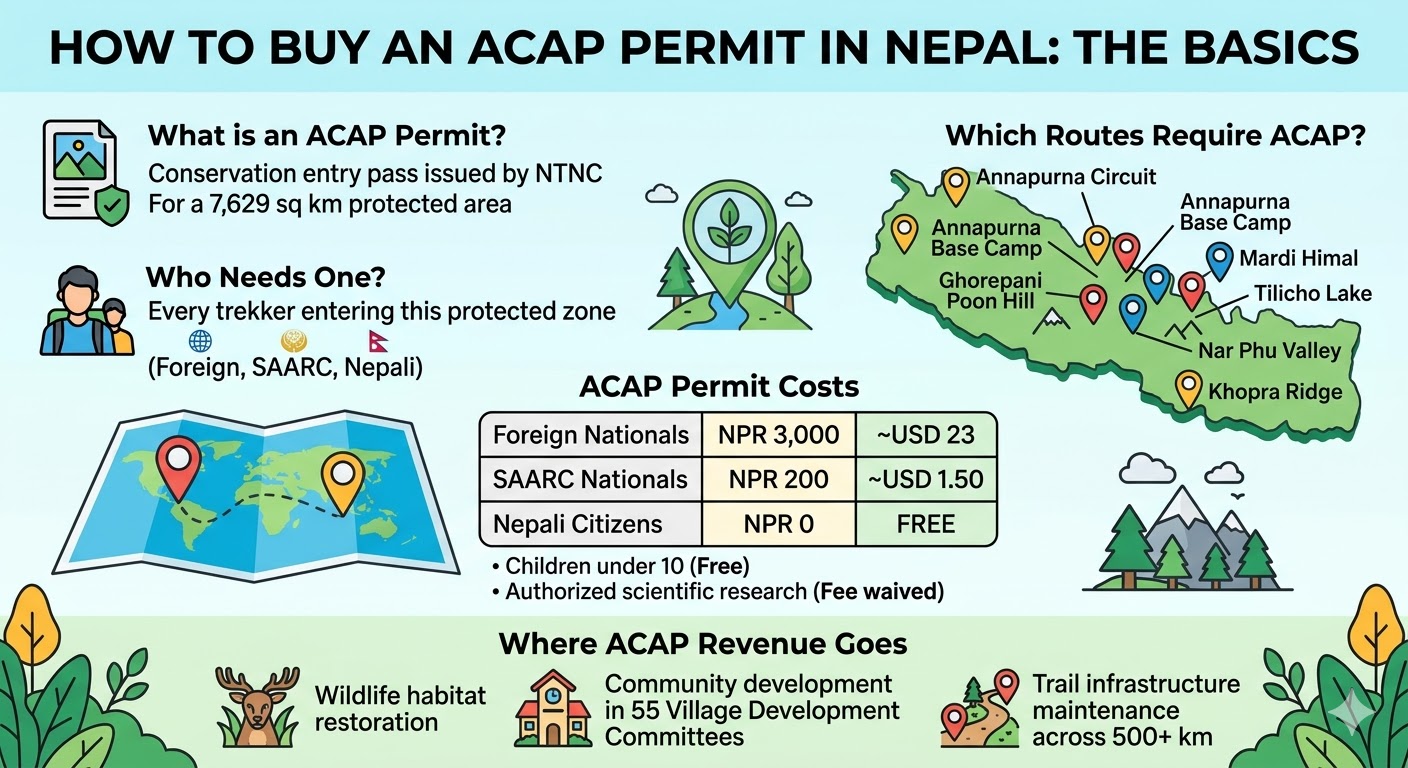
The Annapurna Conservation Area Project (ACAP) permit is a conservation entry pass issued by NTNC that grants legal access to the 7,629 sq km Annapurna Conservation Area in Nepal's Gandaki Province. Every trekker entering this protected zone requires a valid ACAP permit, foreign nationals, SAARC nationals, and Nepali citizens alike, with differentiated fee structures for each category.
What Does ACAP Stand for in Nepal Trekking?
ACAP stands for Annapurna Conservation Area Project, the protected-area management program administered by NTNC since 1986. NTNC (National Trust for Nature Conservation) is a semi-government body established under the National Trust for Nature Conservation Act of 1982 in Nepal. The ACAP permit is the official document issued under this program to regulate and fund conservation inside Nepal's largest protected area.
NTNC uses ACAP permit revenue, collected from over 100,000 annual visitors, to fund 3 core programs: wildlife habitat restoration, community development in 55 Village Development Committees, and trail infrastructure maintenance across 500+ km of trekking routes.
Which Annapurna Routes Usually Require an ACAP Permit?
7 major trekking routes inside the Annapurna Conservation Area require an ACAP permit:
-
Annapurna Circuit Trek (15–20 days, 160–230 km)
-
Annapurna Base Camp Trek (10–13 days, 110 km)
-
Ghorepani Poon Hill Trek (4–5 days, 45 km)
-
Mardi Himal Trek (5–9 days, 57 km)
-
Tilicho Lake Trek (12–15 days, 130 km)
-
Nar Phu Valley Trek (14–18 days, 150 km)
-
Khopra Ridge Trek (7–10 days, 75 km)
Every route listed above requires permit verification at entry checkpoints. Rangers at 12 designated checkpoints scan QR codes on permits and cross-check passport details.
Who Is Exempt from Paying for an ACAP Permit?
Nepali citizens pay NPR 0, they enter the Annapurna Conservation Area free of charge. Children under the age of 10 are exempt from ACAP permit fees regardless of nationality. Trekkers conducting authorized scientific research under NTNC-approved projects also receive fee waivers, verified with official documentation from NTNC headquarters in Jawalakhel, Lalitpur.
How Much Does an ACAP Permit Cost?
The ACAP permit costs NPR 3,000 (USD 23) for foreign nationals and NPR 200 for SAARC nationals. Nepali citizens pay no fee. These 3 fee tiers, foreign, SAARC, and domestic, apply uniformly across all entry points: online portal, Kathmandu counter, Pokhara counter, and entry checkpoints. Fee rates are set by NTNC and remain fixed regardless of trek duration.
What Does the ACAP Permit Cost for Foreign Trekkers?
Foreign trekkers pay NPR 3,000 per person for one ACAP permit entry. At the current exchange rate of approximately NPR 133 per USD 1, this equals approximately USD 23. The permit covers a single entry into the conservation area with no duration limit, it remains valid for the entirety of one trek regardless of whether the trek takes 5 days or 25 days.
The following table shows ACAP permit costs by nationality category with NPR and approximate USD equivalents.
|
Trekker Category |
ACAP Permit Cost (NPR) |
Approximate Cost (USD) |
|
Foreign nationals |
NPR 3,000 |
~USD 23 |
|
SAARC nationals |
NPR 200 |
~USD 1.50 |
|
Nepali citizens |
NPR 0 |
Free |
Exchange rates fluctuate daily. Confirm the exact USD equivalent on the date of payment at the official NTNC portal or your bank.
What Does the ACAP Permit Cost for SAARC Nationals?
SAARC nationals pay NPR 200 per person for one ACAP permit entry. SAARC (South Asian Association for Regional Cooperation) includes 8 member states: Afghanistan, Bangladesh, Bhutan, India, Maldives, Nepal, Pakistan, and Sri Lanka. Trekkers from these 7 non-Nepali SAARC member states qualify for the NPR 200 discounted rate. Proof of SAARC nationality, a valid passport, is required at the time of application.
Are There Extra Fees for Online Payment or Checkpoint Purchase?
Online payment carries an additional service charge of NPR 50–100 depending on the payment gateway used. Counter payments at Kathmandu and Pokhara offices carry no additional service fee, the base fee applies directly. Checkpoint purchases do not include extra fees, but rangers at checkpoints accept only Nepali Rupees cash, with no card or digital wallet options available. Total cost differences between online and counter channels remain under NPR 100 per permit.
What Do You Need Before Applying for an ACAP Permit?
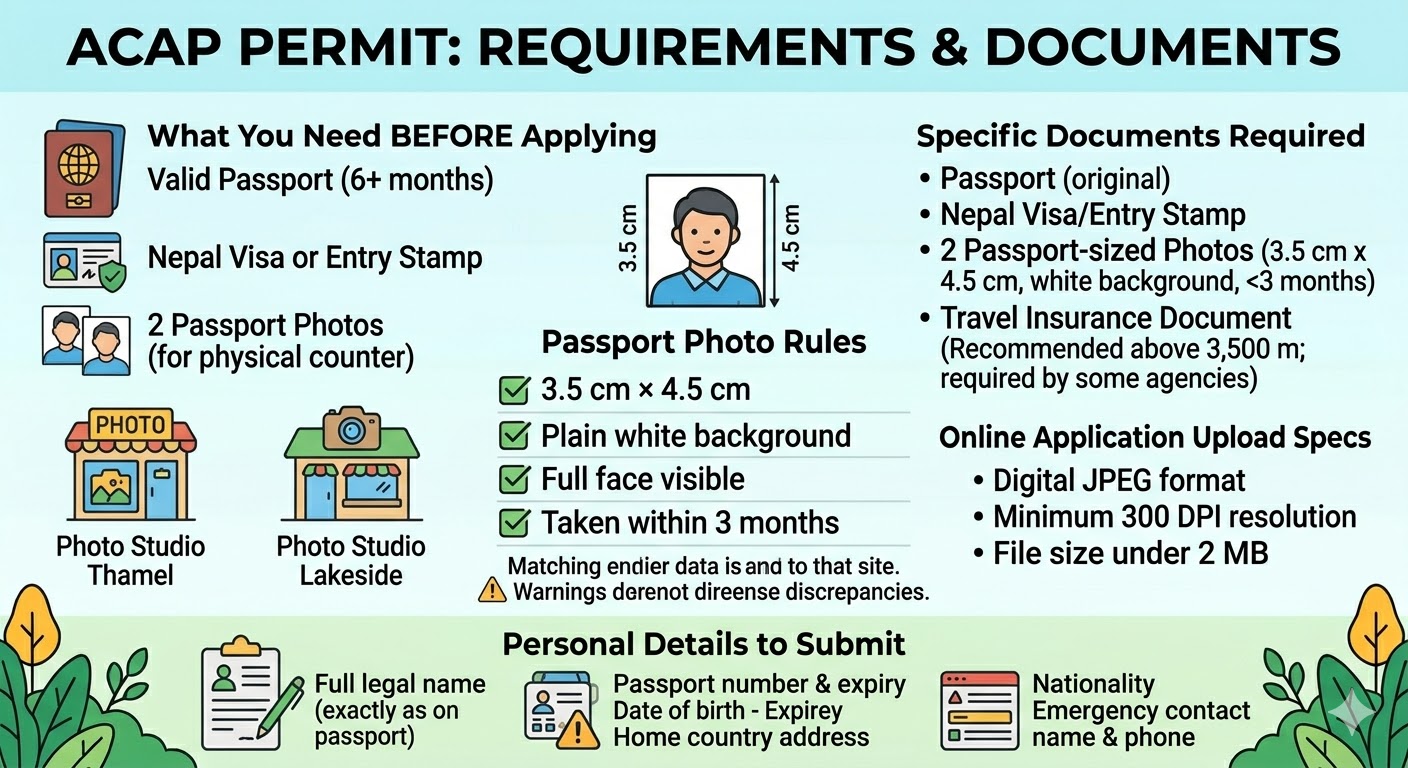
3 items are required before applying for an ACAP permit: a valid passport with at least 6 months of remaining validity, 2 passport-sized photographs (3.5 cm × 4.5 cm, white background), and your Nepal visa or entry stamp confirming legal entry into Nepal. Online applications additionally require a scanned copy or clear photograph of the passport bio-data page and a registered email address for permit delivery.
Which Documents Are Required to Get an ACAP Permit?
4 documents are required to get an ACAP permit:
-
Passport (original, valid for minimum 6 months from trek start date)
-
Nepal visa or entry stamp (confirmed legal entry into Nepal)
-
2 passport-sized photographs (3.5 cm × 4.5 cm, white background, taken within 3 months)
-
Travel insurance document (recommended for trek areas above 3,500 m; required by some registered trekking agencies)
Online applications substitute physical photographs with a digital JPEG upload under 2 MB. Counter applications require 2 printed photographs submitted in person.
What Personal Details Do You Need to Submit?
6 personal details are required in the ACAP permit application form:
-
Full legal name (exactly as printed on passport)
-
Passport number and expiry date
-
Date of birth
-
Nationality
-
Home country address
-
Emergency contact name and phone number
The name and passport number fields are cross-verified against passport scans at NTNC processing centers. Discrepancies between submitted details and passport data trigger application rejection.
Do You Need a Passport Photo for an ACAP Permit?
Yes, 2 passport-sized photographs are required for ACAP permit applications at physical counters. Photo specifications: 3.5 cm × 4.5 cm dimensions, plain white background, full face visible, taken within 3 months of application. Online applicants upload a digital photograph in JPEG format, minimum resolution 300 DPI, file size under 2 MB. Photo studios in Thamel (Kathmandu) and Lakeside (Pokhara) produce compliant passport photos for NPR 100–200 per set.
How Do You Apply for an ACAP Permit Online?
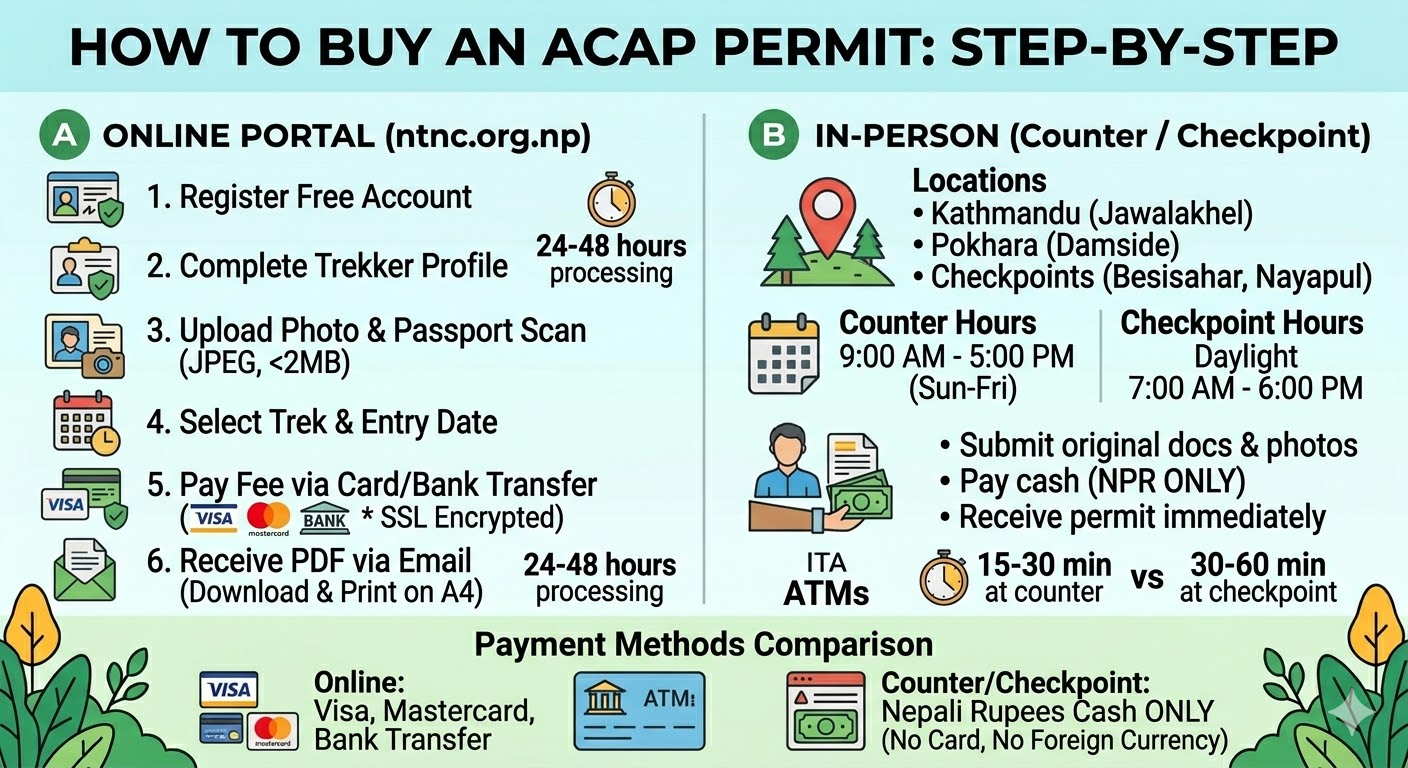
To apply online, visit the official NTNC portal at ntnc.org.np/acap, create a free user account, complete the trekker profile form with passport details, upload a passport photograph and passport bio-data scan, select your entry point and trek start date, and complete payment via bank transfer, debit card, or credit card. The system generates and emails a PDF permit within 24–48 hours of payment confirmation.
Which Official Portal Is Used for ACAP Permit Applications?
The official online portal for ACAP permit applications is ntnc.org.np, maintained by NTNC's IT division in Jawalakhel, Lalitpur. An alternative government portal, nepaltourism.gov.np, redirects ACAP permit applications to the NTNC portal. No third-party website holds authority to issue official ACAP permits. Permits purchased through unofficial travel agency websites are not recognized at checkpoints unless the agency processes through the NTNC system directly.
How Does the Online ACAP Permit Process Work Step by Step?
The online ACAP permit process completes in 6 steps:
-
Register a free account at ntnc.org.np using a valid email address
-
Complete the trekker profile with full name, passport number, nationality, and date of birth
-
Upload a passport photograph (JPEG, under 2 MB) and passport bio-data page scan
-
Select trek type, intended entry point, and trek start date
-
Pay NPR 3,000 (foreign national) or NPR 200 (SAARC national) via credit card, debit card, or bank transfer
-
Download and print the PDF permit after payment confirmation (delivered to registered email within 24–48 hours)
Processing time from completed application to permit delivery: 24 hours for card payments, 48 hours for bank transfer payments.
How Do You Receive and Print Your Permit After Payment?
The ACAP permit arrives as a PDF file sent to the registered email address within 24–48 hours of confirmed payment. Print the permit on A4 paper in black-and-white or color, both formats are accepted at checkpoints. The permit contains a QR code that rangers scan at entry checkpoints; carry a laminated printed copy throughout the trek. A screenshot of the PDF on a mobile device serves as a backup but not a replacement for the printed permit at all checkpoint types.
Where Can You Buy an ACAP Permit in Person?
4 physical locations sell ACAP permits in person: the NTNC-ACAP office in Kathmandu (Jawalakhel, Lalitpur), the ACAP permit counter in Pokhara (Damside area), entry checkpoints at Besisahar (Annapurna Circuit), and the Nayapul checkpoint (Annapurna Base Camp and Ghorepani routes). Counter operating hours run 9:00 AM to 5:00 PM Sunday through Friday; counters close on Saturdays and public holidays.
Can You Buy an ACAP Permit in Kathmandu?
Yes, the NTNC headquarters office in Jawalakhel, Lalitpur (Kathmandu Valley) sells ACAP permits directly. The office address is NTNC, Post Box 3712, Jawalakhel, Lalitpur, Nepal. Office hours: Sunday to Friday, 9:00 AM to 5:00 PM. The Kathmandu counter accepts Nepali Rupees cash and local debit/credit cards. Processing time at the counter: 15–30 minutes with complete documents.
Can You Buy an ACAP Permit in Pokhara?
Yes, the ACAP permit counter in Pokhara operates at the Damside (Pame) area, adjacent to the Nepal Tourism Board regional office. This is the most common purchase location for trekkers starting from Pokhara directly. The Pokhara counter accepts Nepali Rupees cash. Operating hours match Kathmandu: Sunday to Friday, 9:00 AM to 5:00 PM. Trekking agencies in Lakeside (Pokhara) process ACAP permits on behalf of clients for a service fee of NPR 200–500 per permit.
Can You Buy an ACAP Permit at Entry Checkpoints?
Yes, ACAP permits are available at entry checkpoints, with 1 critical limitation: checkpoint counters accept only Nepali Rupees cash, with no card or digital payment options. The 2 primary checkpoint purchase locations are Besisahar (Annapurna Circuit start point) and Nayapul (Annapurna Base Camp and Ghorepani route start point). Checkpoint counters operate during daylight hours, typically 7:00 AM to 6:00 PM. Purchasing at a checkpoint adds 30–60 minutes to the trek start, as queue times at peak season (October–November, March–April) reach 45 minutes.
Which Payment Methods Can You Use to Buy an ACAP Permit?
3 payment methods are accepted across ACAP permit purchase channels: digital card payment (Visa, Mastercard) for online portal applications, Nepali Rupees cash for all counter and checkpoint purchases, and local bank transfers for online portal applications. Foreign currency cash (USD, EUR, GBP) is not accepted at counters or checkpoints. International cards are accepted only through the NTNC online portal, not at physical counters.
Can You Pay for an ACAP Permit by Card Online?
Yes, Visa and Mastercard are accepted on the NTNC online portal at ntnc.org.np. The payment gateway charges a processing fee of NPR 50–100 per transaction, added automatically at checkout. American Express cards are not currently accepted. The portal uses SSL encryption for card data transmission. Card payments confirm within 30 minutes and trigger permit PDF generation within 24 hours.
Do You Need Cash for Counter Payment?
Yes, Nepali Rupees cash is the only accepted payment method at all ACAP permit counters and checkpoints. ATMs dispensing Nepali Rupees are available in Thamel (Kathmandu), Lakeside (Pokhara), and Besisahar town, all within 500 m of permit counters. Carry NPR 3,000 per foreign national permit or NPR 200 per SAARC national permit in exact change to reduce counter processing time.
When Does Online Payment Cost More Than Counter Payment?
Online payment costs NPR 50–100 more than counter payment due to the payment gateway service charge added during online checkout. The base permit fee (NPR 3,000 for foreign nationals) remains identical across channels. The NPR 50–100 difference applies only when paying by card through the NTNC portal. Bank transfer payments through the portal carry a flat NPR 50 bank processing fee. Counter payments in cash carry zero additional fees.
Is TIMS Also Required with an ACAP Permit?
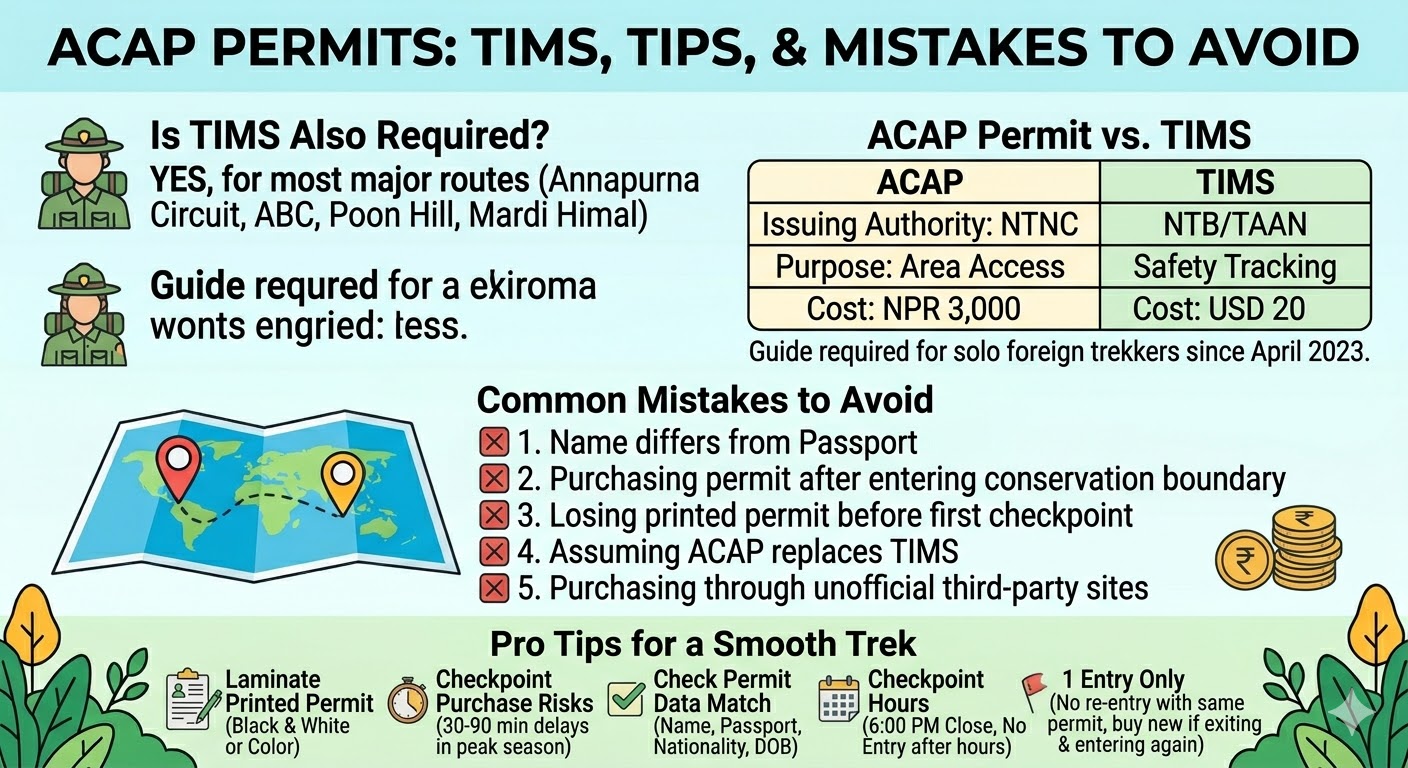
TIMS (Trekkers' Information Management System) is required separately from the ACAP permit for most Annapurna routes. TIMS is a trekker registration card issued by the Nepal Tourism Board (NTB) and Trekking Agencies' Association of Nepal (TAAN). The ACAP permit grants area access; TIMS registers the trekker's identity and itinerary for safety tracking. Both documents are checked at the same entry checkpoints.
Which Annapurna Treks Currently Require a TIMS Card?
4 Annapurna region routes currently require both an ACAP permit and a TIMS card:
-
Annapurna Circuit Trek
-
Annapurna Base Camp Trek
-
Ghorepani Poon Hill Trek
-
Mardi Himal Trek
Trekkers on the Nar Phu Valley route require a Restricted Area Permit (RAP) instead of TIMS. RAP costs USD 90 per person for the first 7 days and USD 15 per person per additional day, issued through the Department of Immigration in Kathmandu.
When Do You Need a Licensed Guide to Get TIMS?
Independent trekkers obtain TIMS directly from Nepal Tourism Board offices without a guide requirement. Trekkers booking through a registered Nepal trekking agency receive TIMS through the agency, which requires a licensed guide assignment for group tours. Since April 2023, Nepal's Ministry of Tourism mandates licensed guides for solo foreign trekkers on designated routes, including the Annapurna Circuit and Annapurna Base Camp. This guide requirement affects TIMS issuance: agencies process TIMS only with a guide assigned to the itinerary.
How Is TIMS Different from the ACAP Permit?
TIMS and the ACAP permit differ in 3 fundamental ways:
-
Issuing authority: TIMS is issued by Nepal Tourism Board (NTB) and TAAN; the ACAP permit is issued by NTNC
-
Purpose: TIMS registers trekker identity and emergency contacts for safety tracking; the ACAP permit grants legal entry into the conservation area
-
Cost: TIMS costs USD 20 per person for individual trekkers (NPR 2,670 equivalent) and USD 10 for organized group trekkers; the ACAP permit costs NPR 3,000 (USD 23) for foreign nationals
Both documents require the same passport data. Both are checked at the same checkpoints. Carry both simultaneously throughout the trek.
What Mistakes Should You Avoid When Getting an ACAP Permit?
5 common mistakes invalidate or delay ACAP permits:
-
Entering a name that differs from the passport (even by 1 character)
-
Purchasing the permit after entering the conservation area boundary
-
Losing the printed permit before reaching the first checkpoint
-
Assuming the ACAP permit replaces the TIMS card
-
Purchasing through unofficial third-party websites not connected to the NTNC system
Rangers at all 12 checkpoints verify permit data against the original passport. Any discrepancy results in permit rejection at the checkpoint.
What Happens If Your Permit Details Do Not Match Your Passport?
Permit details that do not match passport data result in checkpoint entry refusal. Rangers run a QR code scan that retrieves the trekker's NTNC database record, then physically compare name, passport number, and nationality against the original passport. A single-character name discrepancy, for example, "Johnathan" instead of "Jonathan", triggers rejection. The trekker returns to the nearest permit counter (Besisahar or Pokhara) to obtain a corrected permit. Correction processing takes 1–2 working days and requires submitting the original incorrect permit.
Can You Re-Enter with the Same ACAP Permit?
No, the ACAP permit is valid for 1 entry only. Re-entering the conservation area after exiting requires purchasing a new permit at the same current fee. Trekkers combining 2 separate itineraries, for example, Poon Hill followed by Annapurna Base Camp, purchase 2 separate permits. The permit has no printed expiry date but remains valid only for the continuous trek it covers, beginning at the first checkpoint entry scan.
What Happens If You Buy the Permit at a Checkpoint Instead?
Buying the permit at a checkpoint is valid but adds 30–90 minutes to the trek start. Peak season queues (October–November, March–April) at Besisahar and Nayapul checkpoints reach 45–90 minutes. The checkpoint permit is identical to counter and online permits in legal validity and ranger acceptance. The 1 operational risk: checkpoint counters close at 6:00 PM. Trekkers arriving after 6:00 PM cannot purchase or continue without a pre-purchased permit.
How Should You Choose the Best Way to Buy an ACAP Permit?
Choose the online portal when the trek starts within 48 hours and card payment is available. Choose the Pokhara counter when starting the trek from Pokhara and the office is open (Sunday–Friday, 9 AM–5 PM). Choose the Kathmandu counter when in Kathmandu before traveling to the trailhead. Use checkpoint purchase only as a last-resort option due to queue times and cash-only restrictions. Pre-purchasing through any channel other than the checkpoint reduces trek-day delays by 30–90 minutes.
Can an Authorized Permit Service Help You Buy an ACAP Permit?
Yes, registered Nepal trekking agencies listed on the Nepal Tourism Board (NTB) database process ACAP permits on behalf of clients. The agency submits the trekker's passport copy and photographs to the NTNC counter or online portal, pays the fee, and delivers the permit before the trek start. Agency service charges for permit processing range from NPR 200 to NPR 500 per permit, in addition to the base ACAP permit fee. Verify agency NTB registration at tourism.gov.np before authorizing any agency to handle permit documentation.
What Are the Key Takeaways About ACAP Permits?
The ACAP permit is a mandatory, non-transferable entry document for 7 Annapurna region trekking routes, issued by NTNC at NPR 3,000 for foreign nationals, NPR 200 for SAARC nationals, and free for Nepali citizens. Purchase through 4 channels: NTNC online portal (ntnc.org.np), Kathmandu counter (Jawalakhel), Pokhara counter (Damside), or entry checkpoints.
4 facts every trekker confirms before entering the Annapurna Conservation Area:
-
Permit data matches passport exactly; name, passport number, nationality, and date of birth
-
TIMS card is obtained separately from Nepal Tourism Board or a registered agency
-
Printed permit is carried throughout the trek: rangers at all 12 checkpoints require physical inspection
-
Checkpoint purchase requires Nepali Rupees cash only, no card or digital wallet options are available at trail entry points
ACAP permit fees fund 3 core NTNC conservation programs in the Annapurna Conservation Area: wildlife habitat protection, community development across 55 Village Development Committees, and infrastructure maintenance on 500+ km of trekking trails.