Mardi Himal Trek is a short Himalayan teahouse trek in Nepal’s Annapurna Conservation Area, known for its ridge trail, moderate difficulty, and close views of Mardi Himal, Machapuchare, and Annapurna South. The route starts near Pokhara and climbs through Dhampus, Forest Camp, Low Camp, and High Camp before reaching the 4,500-meter Mardi Himal Base Camp viewpoint.
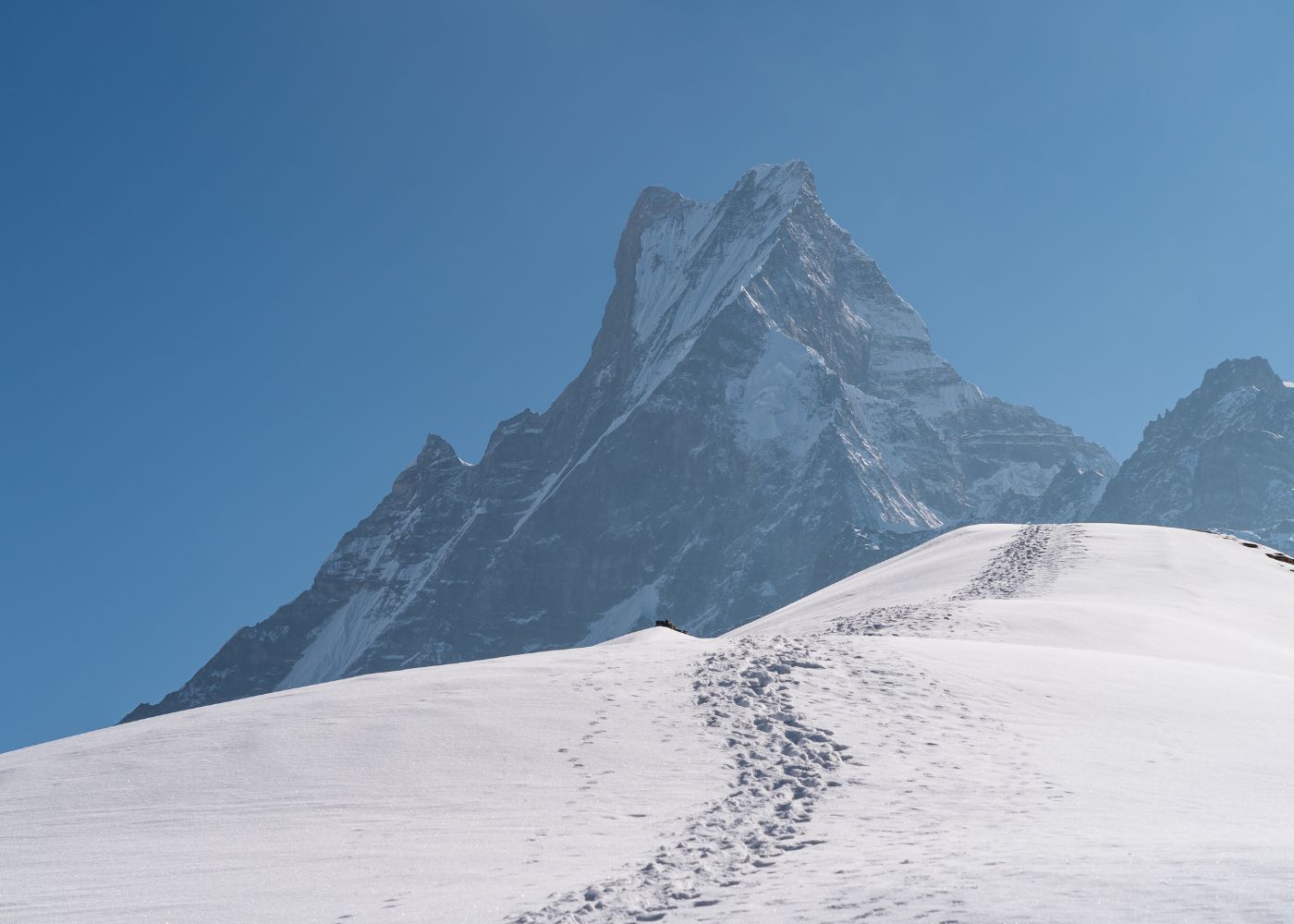
Planning the Mardi Himal Trek step by step means choosing the right season, deciding on a 4-to-7-day itinerary, arranging permits, budgeting for transport and teahouses, and preparing for altitude, weather, and trail conditions. This guide brings together everything needed to organize the trek well, including route options, costs, fitness, packing, food, water, connectivity, and the return from Siding to Pokhara.
Is the Mardi Himal Trek the Right Trek for You?
The Mardi Himal Trek suits beginners and intermediate trekkers who want 4–7 days of mountain immersion without the crowd density of the Annapurna Circuit or ABC routes. The trek reaches 4,500 meters at High Camp, offers direct views of Mardi Himal, Machapuchare (6,993m), and Annapurna South (7,219m), and operates on a well-maintained teahouse trail.
How Difficult Is the Mardi Himal Trek for Beginners?
The Mardi Himal Trek rates as moderate difficulty. A trekker with 4 weeks of consistent cardio training, running, stair climbing, or hiking, completes the route without technical challenge.
The steepest section runs between Low Camp (2,985m) and High Camp (3,580m), gaining 595 meters over 4 kilometers. The trail surface is forested, then rocky above the treeline. No fixed ropes, ladders, or glacier crossings exist on the standard route.
3 physical benchmarks indicate readiness:
- Completing a 15-kilometer walk with a 7-kilogram pack without joint pain
- Climbing 400 meters of elevation in under 90 minutes at low altitude
- Recovering normal breathing within 5 minutes after steep ascents
Altitude affects performance above 3,000 meters regardless of fitness level. The acclimatization strategy, not physical conditioning alone, determines summit-day comfort at 4,500 meters.
What Makes Mardi Himal Different from Other Annapurna Treks?
Mardi Himal Trek separates itself from other Annapurna treks through 3 distinct characteristics: a single-ridge trail with no circuit loop, lower permit fees than the Annapurna Circuit, and 40–60% fewer daily trekkers compared to the ABC route.
The Annapurna Circuit Trek covers 160–230 kilometers over 12–21 days and crosses Thorong La Pass at 5,416 meters. The Annapurna Base Camp (ABC) Trek covers 65 kilometers over 7–12 days and reaches 4,130 meters. The Mardi Himal Trek covers 40–50 kilometers over 4–7 days and reaches 4,500 meters.
The Mardi Himal ridge trail runs directly above the Modi Khola valley. This linear geometry delivers close-range views of the Annapurna Sanctuary walls from a high ridge without crossing a pass.
Teahouse density on the Mardi Himal route remains lower than ABC. High Camp has 5–8 teahouses. Forest Camp has 4–6. The reduced infrastructure keeps the trail quieter, especially outside peak season.
How Many Days Do You Need for the Full Experience?
A complete Mardi Himal Trek experience requires 5 days minimum, 2 days ascending to High Camp, 1 morning at Base Camp or the viewpoint at 4,500 meters, and 2 days descending via Siding.
A 4-day itinerary reaches High Camp and returns without a Base Camp morning, cutting the summit-day experience. A 6-day or 7-day itinerary adds a rest day at Low Camp or Forest Camp, which improves acclimatization and reduces altitude-related discomfort at High Camp.
The 5-day structure balances time efficiency with altitude safety for trekkers arriving from Pokhara at 822 meters.
When Is the Best Time to Do the Mardi Himal Trek?
The best time to trek Mardi Himal is October–November (autumn) and March–May (spring). These 2 seasons deliver the highest trail visibility, dry paths, and stable daytime temperatures between 5°C and 18°C at High Camp. Autumn and spring account for 75% of annual trek permit sales on this route.
What Is Mardi Himal Like in Spring?
Spring on the Mardi Himal Trek runs from March 1 to May 31. Daytime temperatures at High Camp average 8°C–16°C. Night temperatures drop to -2°C–4°C in March and warm to 2°C–8°C by May.
Rhododendron forests between Dhampus (1,650m) and Forest Camp (2,550m) bloom from mid-March through April, covering the trail in red, pink, and white flowers. This visual density is specific to the Annapurna foothills and peaks at the third week of March.
Morning visibility is clear in March and April. Late April and May bring afternoon cloud build-up from the pre-monsoon moisture, obscuring Machapuchare and Annapurna South by 1:00–2:00 PM. Trekkers targeting summit-day photographs reach the 4,500-meter viewpoint before 9:00 AM.
What Is Mardi Himal Like in Autumn?
Autumn on the Mardi Himal Trek runs from October 1 to November 30. Daytime temperatures at High Camp average 5°C–12°C in October and drop to 0°C–8°C in November. Night temperatures at High Camp fall to -5°C–0°C in November.
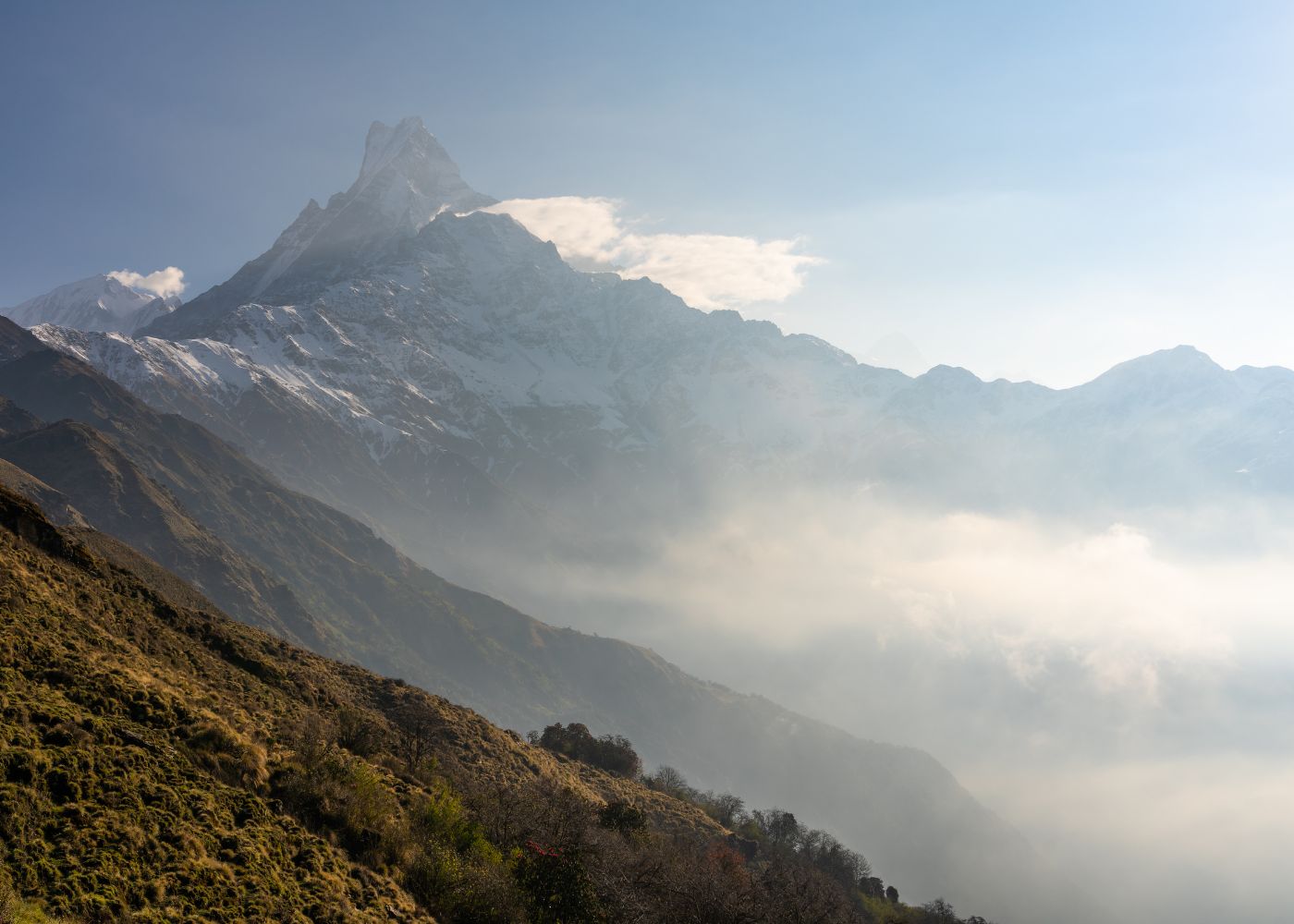
Post-monsoon air clarity produces the sharpest mountain views of the year. October delivers stable skies, dry trails, and full panoramic visibility of Mardi Himal (5,587m), Machapuchare (6,993m), Hiunchuli (6,441m), and Annapurna South (7,219m) from High Camp.
November is colder and quieter. Snow reaches High Camp in late November, requiring insulated sleeping equipment and microspikes on frozen morning sections above Low Camp.
Should You Avoid Monsoon or Winter for This Trek?
Monsoon (June–September) and winter (December–February) each create distinct hazards that reduce trail safety and summit-day visibility on the Mardi Himal route.
Monsoon brings 250–400mm of monthly rainfall to the Pokhara region from June through September. The section between Forest Camp and Low Camp becomes a mudslide risk zone. Leeches are active on the lower trail from Kande to Dhampus. Visibility at High Camp drops to 200–500 meters on 60–70% of monsoon days.
Winter from December through February freezes the trail above Low Camp. Snow accumulation at High Camp (3,580m) reaches 30–80cm in January. Teahouses at High Camp close from December 15 to February 15 in most years. Trekkers attempting winter routes require crampons, ice axes, and cold-weather shelter above 3,000 meters.
Which Route and Itinerary Should You Choose?
The standard Mardi Himal Trek route ascends via Kande–Dhampus–Forest Camp–Low Camp–High Camp and descends via Siding village. This linear route covers 42–48 kilometers total. The alternative is retracing the same path back to Kande, which reduces logistics but repeats 3 identical trail days.
Where Does the Mardi Himal Trek Start and End?
The Mardi Himal Trek starts at Kande (1,770m) or Dhampus (1,650m) and ends at Siding village (1,700m) on the standard itinerary. Both start points sit 25–28 kilometers from Pokhara Lakeside and are accessible by jeep, taxi, or local bus.
Kande is the most common starting point. The Kande trailhead sits at the roadhead on the Pokhara–Nayapul highway, 28 kilometers from Pokhara. The Dhampus start adds 1.5–2 hours of flat walking before the main climb begins.
Siding village is the standard endpoint for trekkers finishing the one-way route. Siding sits in the Seti River valley south of the Mardi Himal ridge. A 45-minute jeep ride from Siding reaches Pokhara.
4 named camps define the ascent route:
- Dhampus (1,650m): first overnight, 2–3 hours from Kande
- Forest Camp (2,550m): second overnight, 3–4 hours from Dhampus
- Low Camp (2,985m): third overnight, 2–3 hours from Forest Camp
- High Camp (3,580m): fourth overnight, 2.5–3.5 hours from Low Camp
- Mardi Himal Base Camp / Viewpoint (4,500m), day-trip summit from High Camp, 2–3 hours one-way
What Does a 4-Day Mardi Himal Itinerary Look Like?
A 4-day Mardi Himal itinerary covers Kande–High Camp in 3 ascending days and descends to Siding on day 4, skipping an overnight stay at Dhampus.
The following table shows the 4-day camp sequence, elevation gain, and walking time per day.
|
Day |
Route |
Elevation |
Walking Time |
|
1 |
Kande → Forest Camp |
780m gain |
5–6 hours |
|
2 |
Forest Camp → High Camp |
1,030m gain |
5–6 hours |
|
3 |
High Camp → Base Camp (morning) → Low Camp |
920m descent |
6–7 hours |
|
4 |
Low Camp → Siding → Pokhara |
1,285m descent |
5–6 hours |
The 4-day structure pushes 780 meters of elevation gain on Day 1 by combining Kande–Dhampus and Dhampus–Forest Camp into one long day. This schedule suits physically conditioned trekkers with prior altitude experience. First-time high-altitude trekkers experience more pronounced headache and fatigue at High Camp on this compressed schedule.
What Does a 5-Day or 6-Day Itinerary Look Like?
A 5-day Mardi Himal itinerary separates each camp section into individual days, adds a summit morning at 4,500 meters, and descends fully to Siding on the final day. A 6-day itinerary inserts a rest or acclimatization day at Low Camp or High Camp.
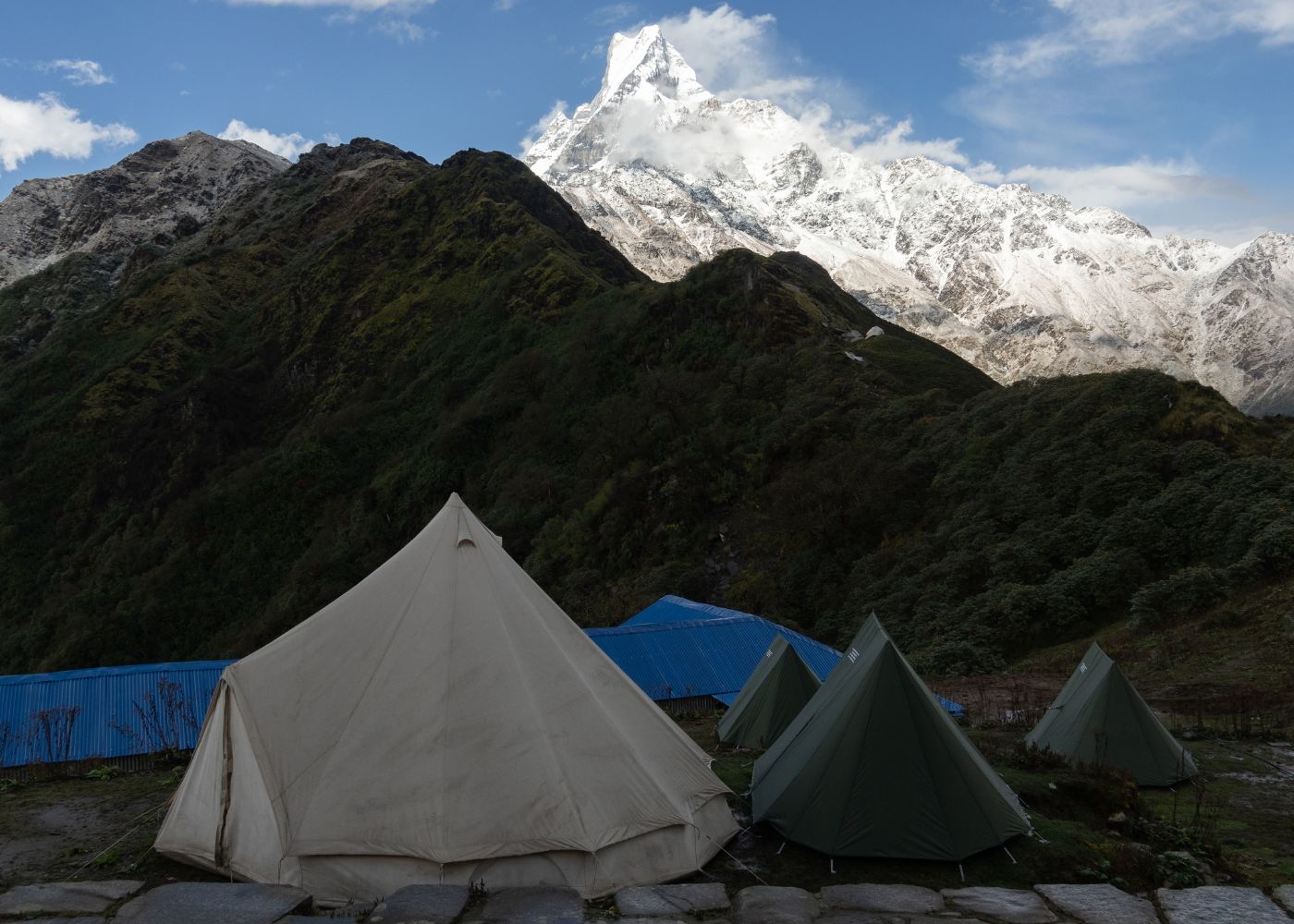
The following table shows the 5-day sequence with elevation and time data.
|
Day |
Route |
Elevation |
Walking Time |
|
1 |
Kande → Dhampus |
120m gain |
2–3 hours |
|
2 |
Dhampus → Forest Camp |
900m gain |
3–4 hours |
|
3 |
Forest Camp → High Camp |
1,030m gain |
5–6 hours |
|
4 |
High Camp → Base Camp (sunrise) → High Camp → Low Camp |
920m net descent |
6–7 hours |
|
5 |
Low Camp → Siding → Pokhara |
1,285m descent |
5–6 hours |
The 6-day version adds a full rest day at Low Camp between Day 2 and Day 3. This rest day reduces headache incidence at High Camp by allowing the body to produce additional red blood cells at 2,985 meters before ascending to 3,580 meters.
Should You Finish in Siding or Return the Same Way?
Finishing at Siding village is the recommended exit route. Siding offers direct jeep transport to Pokhara and avoids repeating 3 days of identical uphill-then-downhill trail through Forest Camp and Dhampus.
Returning via the same Kande path is a valid option only when a trekker has pre-booked transport at Kande or travels as part of a Pokhara loop with a vehicle waiting. The Siding descent path is steeper than the Kande ascent path but shorter by 8–10 kilometers.
Which Permits and Documents Do You Need?
The Mardi Himal Trek requires 2 permits: the Annapurna Conservation Area Permit (ACAP) priced at NPR 3,000 ($22 USD) and the TIMS Card priced at NPR 2,000 ($15 USD) for individual trekkers. Both are obtained in Pokhara before the trek begins.
What Permit Is Required for the Mardi Himal Trek?
The Annapurna Conservation Area Permit (ACAP) is the primary permit for the Mardi Himal Trek. ACAP is issued by the Nepal Tourism Board and the National Trust for Nature Conservation. It is mandatory for all foreign nationals entering the Annapurna Conservation Area.
ACAP fee structure as of 2024:
- Foreign nationals (SAARC countries): NPR 1,000 (~$7.50 USD)
- Foreign nationals (all other countries): NPR 3,000 (~$22 USD)
- Nepalese citizens: NPR 100
ACAP is obtained at the Nepal Tourism Board office in Pokhara (Damside area) or at the ACAP counter in Lakeside. Processing takes 15–30 minutes with a valid passport and 1 passport-sized photo. The permit is checked at checkpoints in Kande and at the Forest Camp junction.
Do You Need a Guide, Porter, or TIMS Card?
A guide is not legally mandatory for the Mardi Himal Trek as of 2024. The TIMS Card (Trekkers' Information Management System) costs NPR 2,000 ($15 USD) for individual trekkers and NPR 1,000 ($7.50 USD) for trekkers booked through a registered agency.
The Nepal government's 2023 policy mandated guides for 28 specific trekking routes in Nepal. The Mardi Himal Trek was not included in the mandatory-guide list. Trekkers complete the route independently with map, compass, or GPS.
A porter is optional but recommended for loads over 8 kilograms. Porters on the Mardi Himal route charge NPR 1,500–2,500 ($11–$18.50 USD) per day and carry 20–25 kilograms maximum.
TIMS is obtained at the Nepal Tourism Board in Pokhara or at the Trekking Agencies' Association of Nepal (TAAN) office. A valid passport, 2 passport photos, and travel insurance details are required.
What Documents Should You Carry on the Trail?
5 documents are required on the Mardi Himal Trail:
- Original passport (or certified copy accepted at most checkpoints)
- ACAP permit (original, with entry date stamped)
- TIMS card (original)
- Travel insurance certificate with emergency helicopter evacuation coverage
- Emergency contact card with local guide or agency contact, insurance hotline, and nearest hospital number (Pokhara's Manipal Teaching Hospital, +977-61-526416)
Checkpoint officers record trekker details at Kande and Forest Camp. Permit inspections also occur at High Camp. Carrying digital copies on a phone as backup is acceptable but not sufficient as a primary document.
How Should You Budget for the Mardi Himal Trek?
A 5-day Mardi Himal Trek costs NPR 15,000–35,000 ($110–$260 USD) per person for an independent trekker, excluding flights to Pokhara. This range covers 2 permits, teahouse accommodation, all meals on the trail, and local transport from Pokhara to Kande and from Siding back to Pokhara.
How Much Does Transport, Food, and Lodging Cost?
Daily teahouse accommodation costs NPR 300–800 ($2.20–$6 USD) per night when a trekker orders meals from the same teahouse. Rooms are often provided free or at a nominal fee when breakfast, lunch, and dinner are booked in-house.
The following table shows average costs per category on the Mardi Himal route in 2024.
|
Category |
Low Range (NPR) |
High Range (NPR) |
USD Equivalent |
|
Accommodation per night |
300 |
800 |
$2.20–$6 |
|
Breakfast |
300 |
600 |
$2.20–$4.50 |
|
Lunch |
400 |
700 |
$3–$5.20 |
|
Dinner |
400 |
800 |
$3–$6 |
|
Bottled water (1L) |
80 |
200 |
$0.60–$1.50 |
|
Hot tea or coffee |
100 |
250 |
$0.75–$1.85 |
Prices increase with altitude. A meal at High Camp costs 30–50% more than the same dish at Forest Camp. Meals at Dhampus sit closest to Pokhara-level pricing.
Transport from Pokhara to Kande costs NPR 400–600 ($3–$4.50 USD) per seat in a shared jeep. A private jeep from Pokhara to Kande costs NPR 2,500–3,500 ($18.50–$26 USD) for the full vehicle. Transport from Siding to Pokhara costs NPR 500–800 ($3.70–$6 USD) per seat in a shared jeep.
How Much Should You Budget for a Guide or Porter?
A licensed trekking guide charges NPR 2,500–4,000 ($18.50–$30 USD) per day on the Mardi Himal route. A porter charges NPR 1,500–2,500 ($11–$18.50 USD) per day.
Guide-and-porter rates include the individual's food, accommodation, and permit fees. A trekker hiring both a guide and a porter for a 5-day trek budgets an additional NPR 20,000–32,500 ($148–$241 USD) for staff costs.
Hiring through a Pokhara-based registered trekking agency adds NPR 3,000–8,000 ($22–$60 USD) for agency service fees but provides staff with verified training certificates and insurance coverage.
How Much Cash Should You Carry for the Trek?
A solo trekker on a 5-day Mardi Himal Trek carries a minimum of NPR 20,000 ($148 USD) in cash. No ATMs exist between Kande and Siding. The last ATM is at Pokhara Lakeside or Damside before departure.
The NPR 20,000 budget breaks down as follows: NPR 5,000 for permits, NPR 7,500 for 5 nights accommodation and meals, NPR 2,000 for transport, NPR 2,000 for water and hot drinks, and NPR 3,500 as emergency and contingency reserve.
Teahouses accept Nepalese rupees only. No teahouse on the Mardi Himal route accepts credit cards, digital payment (eSewa or Khalti), or foreign currency as of 2024.
How Should You Prepare for Altitude and Fitness?
Mardi Himal Trek preparation requires 4 weeks of dedicated physical training and a 2-day Pokhara acclimatization stop before trek day 1. The trek gains 2,730 meters from Kande (1,770m) to High Camp (4,500m) over 3–4 days. This rate of ascent averages 680–910 meters per day, above the recommended 300–500 meter daily limit above 3,000 meters.
How Fit Do You Need to Be for Mardi Himal?
A trekker fit enough to walk 18–22 kilometers with 600–800 meters of elevation gain in a single day handles the Mardi Himal trail without distress. This fitness level corresponds to 4–6 weeks of structured training.
A recommended 4-week training plan includes:
- Week 1–2: 30-minute walks daily, increasing to 60 minutes by Day 10
- Week 2–3: Stair climbing for 45 minutes, 4 times per week, targeting 40+ floor equivalents per session
- Week 3–4: 2 long hikes per week of 15+ kilometers each with a 6–8 kilogram pack
- Week 4: 1 full-day trail hike of 20+ kilometers to simulate a trail day
Strength training for quads, hamstrings, and calves reduces knee strain on the Siding descent, which drops 1,285 meters in 4–6 hours.
How Can You Reduce Altitude Sickness Risk?
4 altitude sickness reduction strategies apply directly to the Mardi Himal Trek:
- Ascend gradually: Spend a night at Dhampus (1,650m) even on a 4-day itinerary instead of combining Kande–Dhampus–Forest Camp into one day
- Hydrate consistently: Drink 3–4 liters of water per day above 2,000 meters; urine color is the reliable hydration indicator, pale yellow signals adequate intake
- Avoid alcohol above 2,500 meters: Alcohol inhibits oxygen saturation and accelerates fluid loss at altitude
- Descend 300–500 meters on symptom onset: Headache persisting more than 4 hours above 3,000 meters requires immediate descent to the previous camp
Acute Mountain Sickness (AMS) is defined by the Lake Louise Score. A score of 3 or above, combining headache with at least 1 of the following: nausea, dizziness, fatigue, or difficulty sleeping, requires descent. Diamox (acetazolamide) at 125–250mg twice daily reduces AMS incidence when started 24 hours before ascent above 3,000 meters. Consult a physician before use.
What Pace Helps You Trek Safely and Comfortably?
The Sherpa pace, slow, steady, and continuous, is the most effective movement strategy for high-altitude trekking. The Sherpa pace maintains 2–3 kilometers per hour on flat terrain and 1.5–2 kilometers per hour on steep ascent. It eliminates the stop-sprint-stop pattern that spikes heart rate and causes faster glycogen depletion.
The rest-step technique, pausing the back leg straight at full extension after each uphill step for 1 second, distributes load to the skeletal system, reducing muscular fatigue on the High Camp ascent.
Starting each day before 7:00 AM provides 4–5 hours of stable morning weather before afternoon cloud formation. Weather at High Camp deteriorates between 1:00 PM and 3:00 PM on 70% of days in both spring and autumn.
What Should You Pack for the Mardi Himal Trek?
The Mardi Himal Trek packing list centers on a 3-layer clothing system, a 40–50 liter daypack, and 7 essential gear items for teahouse trekking. The total pack weight stays between 6 and 10 kilograms for a 5-day trek without a porter.
Which Clothing Layers Work Best on This Route?
A 3-layer clothing system covers the full temperature range from Dhampus (1,650m, average 12°C–22°C) to High Camp (3,580m, average -2°C–10°C):
- Base layer: Moisture-wicking merino wool or synthetic top and bottom, regulates temperature from 5°C to 22°C, worn daily
- Mid layer: 200–300 weight fleece jacket, insulates from 5°C down to -5°C, worn above Forest Camp
- Outer layer: Waterproof and windproof hardshell jacket, blocks wind chill at High Camp and precipitation above Low Camp
Additional clothing items required:
- Down jacket (600–800 fill power) for High Camp evenings (-5°C to -10°C)
- Trekking pants: 2 pairs, 1 lightweight and 1 insulated
- Thermal base layer bottoms for sleeping above 3,000 meters
- Gaiters for snow crossing in November, March, and post-snowfall in peak months
- Sun hat, wool or fleece hat, balaclava for High Camp wind
- 3 pairs of moisture-wicking trekking socks
Which Gear Is Essential for Teahouse Trekking?
8 gear items are essential for the Mardi Himal teahouse route:
- Trekking boots: Waterproof, ankle-supporting boots broken in over 20+ kilometers before the trek; avoid new boots
- Trekking poles: 2 collapsible poles, reduce knee impact by 22% on descent (Siding descent covers 1,285 meters)
- Headlamp: 200–400 lumen headlamp with 2 spare AAA batteries; power cuts occur in teahouses above Forest Camp
- Sleeping bag: Rated to -10°C for High Camp; most teahouses provide blankets but do not guarantee warmth above 3,000 meters
- Daypack: 20–30 liter summit pack for the High Camp–Base Camp day, separate from the main 40-liter pack left at teahouse
- Sunglasses: UV400 or polarized lenses; UV radiation increases 4% per 300 meters of elevation
- Sunscreen: SPF 50+ for face, neck, and hands above 2,500 meters
- Trekking gaiters: Low gaiters block trail debris; high gaiters required in snow above Low Camp from November to March
What Health, Water, and Power Items Should You Bring?
6 health, water, and power items complete the Mardi Himal packing list:
- Water purification: SteriPen UV purifier or chlorine tablets purify stream and tap water at teahouses; 2-liter capacity water bottles reduce bottled water purchases and cost
- First aid kit: Blister pads, ibuprofen, oral rehydration salts, altitude sickness medication (Diamox), antihistamine, and antiseptic wipes as minimum contents
- Personal medications: 7-day supply in original packaging, stored in a waterproof case
- Power bank: 20,000mAh capacity; teahouses at High Camp charge NPR 200–400 ($1.50–$3 USD) per device charge; charging is unavailable at Base Camp
- Universal adapter plug: Nepal uses Type C and Type D plugs; Type C adapters work in all Mardi Himal teahouses
- Satellite communicator or emergency beacon: Garmin inReach or SPOT device recommended above High Camp for solo trekkers; mobile networks are absent above Forest Camp on most carriers
How Do You Handle Food, Stay, and Daily Logistics?
Teahouses on the Mardi Himal route provide bed, blanket, and a menu of 15–25 Nepali and international dishes at each camp. Advance booking is not required outside peak season (October and April). The 5 main camps, Dhampus, Forest Camp, Low Camp, High Camp, and Base Camp area, all have functioning teahouses open from March through November.
What Are the Teahouses Like on the Mardi Himal Route?
Mardi Himal teahouses are family-run lodges offering dormitory beds (NPR 200–500 per night) and private double rooms (NPR 400–1,000 per night). Room quality varies between camps.
Dhampus teahouses are the largest and most developed. They offer attached bathrooms, hot showers (NPR 200–400 extra), and reliable electricity in 90% of lodges.
Forest Camp teahouses offer shared bathrooms and intermittent solar-powered electricity. Hot showers are available at 70% of Forest Camp lodges.
Low Camp teahouses are smaller. Shared squat toilets, solar-powered charging, and cold-water taps are standard. Hot showers exist at 50% of Low Camp lodges.
High Camp teahouses are the most basic. Squat outdoor toilets, shared dormitory beds with 3–6 berths, solar or kerosene lighting, and no shower facilities define the standard. The wind chill at High Camp drops the perceived temperature to -15°C–-20°C on clear nights, making an insulated sleeping bag essential rather than optional.
What Food and Water Options Are Available Each Day?
Dal bhat, lentil soup, steamed rice, vegetable curry, and pickle, is the staple meal available at all 5 camps and costs NPR 400–700 ($3–$5.20 USD). Trekking menus at all camps include dal bhat, noodle soup, fried rice, pasta, momo (Nepali dumplings), porridge, pancakes, chapati, and egg dishes.
Protein options above Low Camp shrink to eggs, cheese, and lentils. Fresh meat is not served above Low Camp on the Mardi Himal route. Vegetarian meals are available at every teahouse.
Water is available from 3 sources along the route:
- Tap water: Available at Dhampus, Forest Camp, and Low Camp from natural springs; requires purification
- Boiled water: Sold at teahouses for NPR 100–150 per liter; safe to drink without further treatment
- Bottled water: Sold at NPR 80–200 depending on altitude; produces plastic waste and increases cost
Using a SteriPen or purification tablets reduces water costs by 60–80% over a 5-day trek.
How Should You Plan Charging, Toilets, and Connectivity?
Charging is available at all teahouses below High Camp using solar power. Teahouses at High Camp offer solar-charged sockets on clear days only. Charging cost averages NPR 200–400 ($1.50–$3 USD) per device per charge.
Mobile network coverage follows this pattern:
- Dhampus: NTC (Nepal Telecom) and Ncell signals are strong, 3G or 4G available
- Forest Camp: NTC signal is available; Ncell signal is intermittent
- Low Camp: NTC signal is weak; Ncell is absent
- High Camp and Base Camp: No mobile network on any carrier; satellite communicators are the only connectivity option
Toilet facilities at Dhampus and Forest Camp include Western flush toilets in most lodges. Low Camp, High Camp, and Base Camp use squat-style pit toilets. Trekkers carry toilet paper and hand sanitizer. Wet wipes substitute for showering above Low Camp when hot water is unavailable.
How Do You Reach the Trailhead and Return to Pokhara?
The Mardi Himal trailhead at Kande is 28 kilometers northeast of Pokhara Lakeside and is reached by jeep, taxi, or local minibus in 45–75 minutes. Return transport from Siding village to Pokhara operates on the same route via Lwang, taking 45–60 minutes.
How Do You Get from Pokhara to Kande or Dhampus?
3 transport options connect Pokhara to Kande:
- Shared jeep from Pokhara Bus Park (Baglung Bus Park): NPR 400–600 per seat ($3–$4.50 USD); departs 7:00 AM–10:00 AM; travel time 60–75 minutes
- Private jeep or taxi: NPR 2,500–3,500 ($18.50–$26 USD) for full vehicle; direct door-to-trailhead; departs at preferred time
- Local minibus via Phedi: NPR 150–200 per seat; connects Pokhara to Phedi (22km), then requires 45-minute walk to Kande; slower but lowest-cost option
Trekkers arriving late in the day take a private taxi to avoid the midday heat on the Kande–Dhampus first-day climb. Pokhara Lakeside taxi drivers charge NPR 2,000–2,800 for the Lakeside–Kande route.
How Do You Get Back from Siding to Pokhara?
Siding village connects to Pokhara via jeep along a rough unpaved road through Lwang village. The road distance from Siding to Pokhara is 32 kilometers. Travel time is 50–70 minutes.
Shared jeeps from Siding to Pokhara depart between 7:00 AM and 11:00 AM and cost NPR 500–800 ($3.70–$6 USD) per seat. Private jeep hire costs NPR 3,000–4,000 ($22–$30 USD) for the full vehicle.
Teahouse owners at Low Camp arrange Siding jeep pickup for guests who book the night before. Confirming pickup at Low Camp avoids a long wait at Siding.
Should You Arrange Transport in Advance or on Arrival?
Advance transport arrangement is recommended for departure from Pokhara during peak season (October and April) and for return from Siding on any day of the year. Off-season trekkers (March, May, November) find on-arrival taxis and jeeps available without reservation.
Shared jeeps from Baglung Bus Park to Kande fill and depart without fixed timetables. Arrival before 8:00 AM guarantees departure by 9:00 AM. Trekkers arriving after 10:00 AM on busy October days wait 1–2 hours for the next available vehicle.
A trekking agency in Pokhara arranges return jeep from Siding with 24 hours' notice. The agency contacts the driver by radio or satellite phone from High Camp the evening before descent.
When Should You Book a Guide or Trek Package?
Book a guide or trek package 2–4 weeks before departure during peak season (October and April) and 48–72 hours before departure during off-peak months. Pokhara has 250+ registered trekking agencies as of 2024. Agency concentration is highest in Lakeside (Baidam) and Damside neighborhoods.
Can a Local Trek Agency Help You Plan Mardi Himal?
A registered Pokhara trekking agency handles 7 logistics at once: ACAP and TIMS permits, guide and porter hiring, transport to Kande and from Siding, teahouse booking, emergency insurance verification, and equipment rental for items like sleeping bags, poles, and boots.
Package trek costs from Pokhara agencies range from NPR 25,000–65,000 ($185–$480 USD) per person for a 5-day Mardi Himal trek. Package pricing includes all permits, guide salary, porter salary, all meals, all accommodation, and transport. It excludes international flights, travel insurance, and personal gear.
Solo budget trekkers save NPR 8,000–15,000 ($60–$110 USD) by booking permits, accommodation, and transport independently. The savings trade off against the convenience of having a Nepali-speaking guide manage teahouse negotiations, weather calls, and medical emergencies above 3,000 meters.
Agencies registered with TAAN (Trekking Agencies' Association of Nepal) and NMA (Nepal Mountaineering Association) provide guides with verified Wilderness First Responder or Nepal Guide License certification.
What Are the Key Takeaways for Planning Mardi Himal?
Planning the Mardi Himal Trek requires 8 sequential actions:
- Choose the season, October–November or March–May for optimal visibility
- Select a 5-day itinerary for the best balance of acclimatization and summit access
- Book flights to Pokhara (Tribhuvan International Airport to Pokhara Regional Airport, 25 minutes; or Kathmandu to Pokhara by bus, 7–8 hours)
- Obtain ACAP (NPR 3,000) and TIMS (NPR 2,000) in Pokhara before departure
- Arrange transport to Kande, shared jeep (NPR 400–600) or private vehicle (NPR 2,500–3,500)
- Pack a 3-layer clothing system, -10°C sleeping bag, water purifier, 20,000mAh power bank, and 7 essential gear items
- Ascend at Sherpa pace, start each day before 7:00 AM, drink 3–4 liters of water daily, and descend immediately on AMS symptom onset
- Return from Siding to Pokhara by shared or private jeep, pre-book with Low Camp teahouse owner the evening before descent
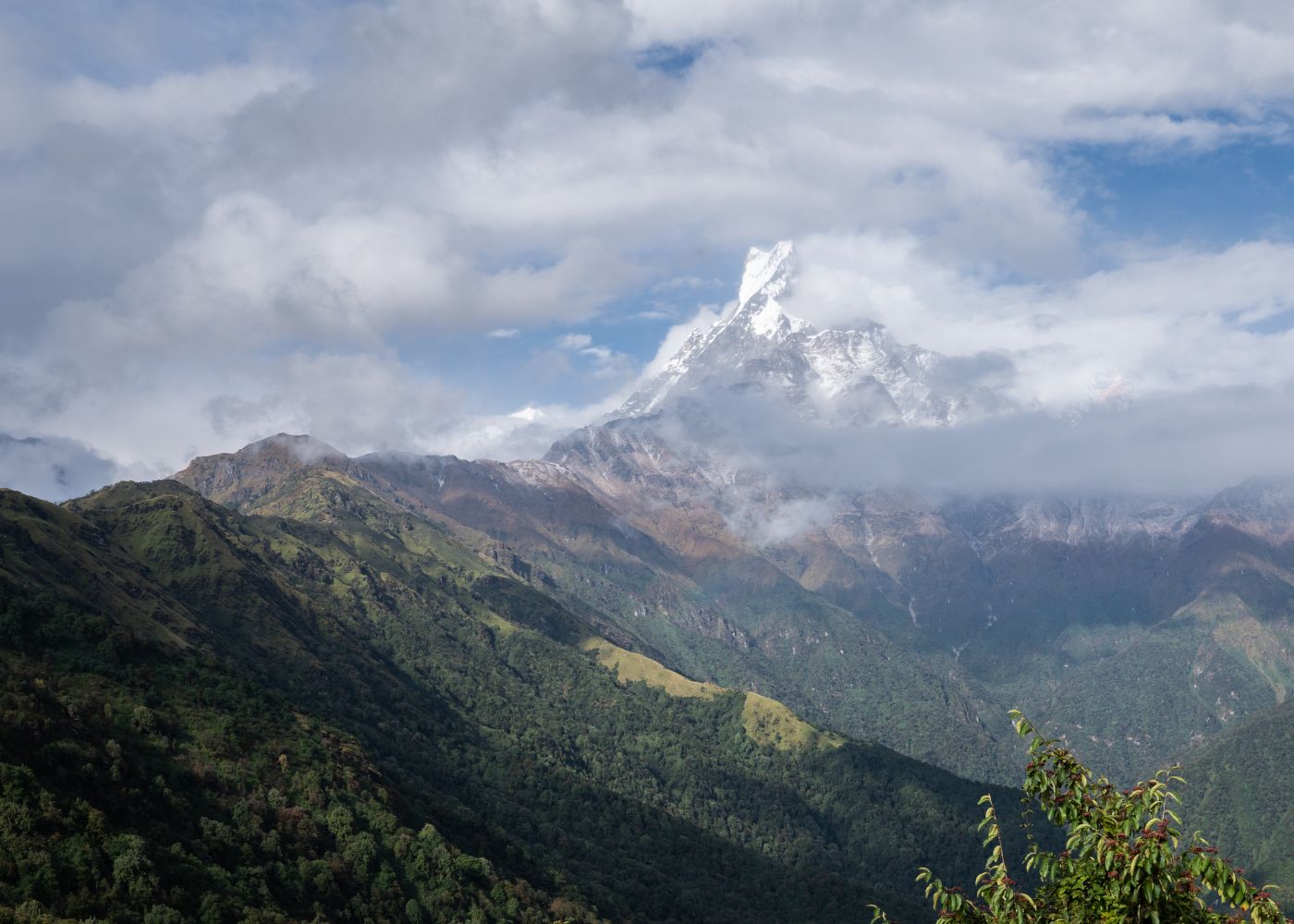
The Mardi Himal Trek delivers 3 assets unavailable on the busier Annapurna routes: direct ridge-line exposure to Mardi Himal (5,587m) and Machapuchare (6,993m), teahouse density low enough for genuine mountain solitude, and a 4-to-7-day format that integrates into a standard 9-to-14-day Nepal itinerary. Planning the Mardi Himal Trek step by step, from permit acquisition to altitude strategy to Siding exit logistics, transforms a moderate Himalayan trek into a fully controlled and deeply rewarding mountain experience.