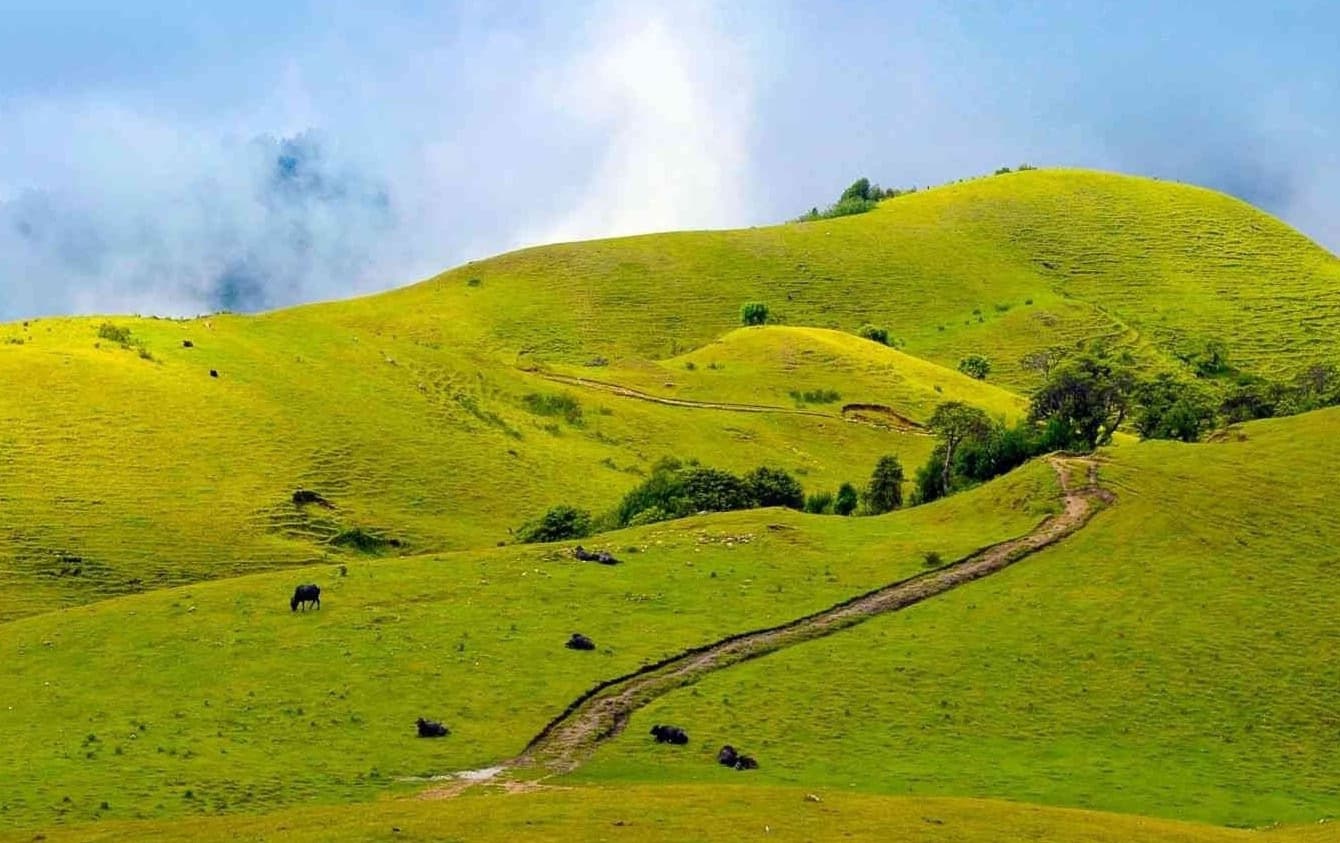
The Ghorepani Poon Hill Trek is a beginner-friendly Himalayan trekking route in Nepal that combines manageable mountain walking with exceptional views of the Annapurna and Dhaulagiri ranges. The trek reaches Poon Hill at 3,210 meters (10,531 feet) and normally takes 4–5 days, with daily walking of around 4–6 hours through stone-paved mountain trails, rhododendron forests, terraced farmland, and traditional Gurung and Magar villages. Its moderate elevation, established trekking paths, gradual ascent, and lack of technical climbing make Poon Hill an accessible introduction to Himalayan trekking for travelers with basic walking fitness. The route also provides a concentrated mountain experience from Pokhara, without the long approach journeys, extreme elevations, or extended acclimatization schedules required by higher-altitude treks such as Everest Base Camp, the Annapurna Circuit, or the Langtang Valley Trek.
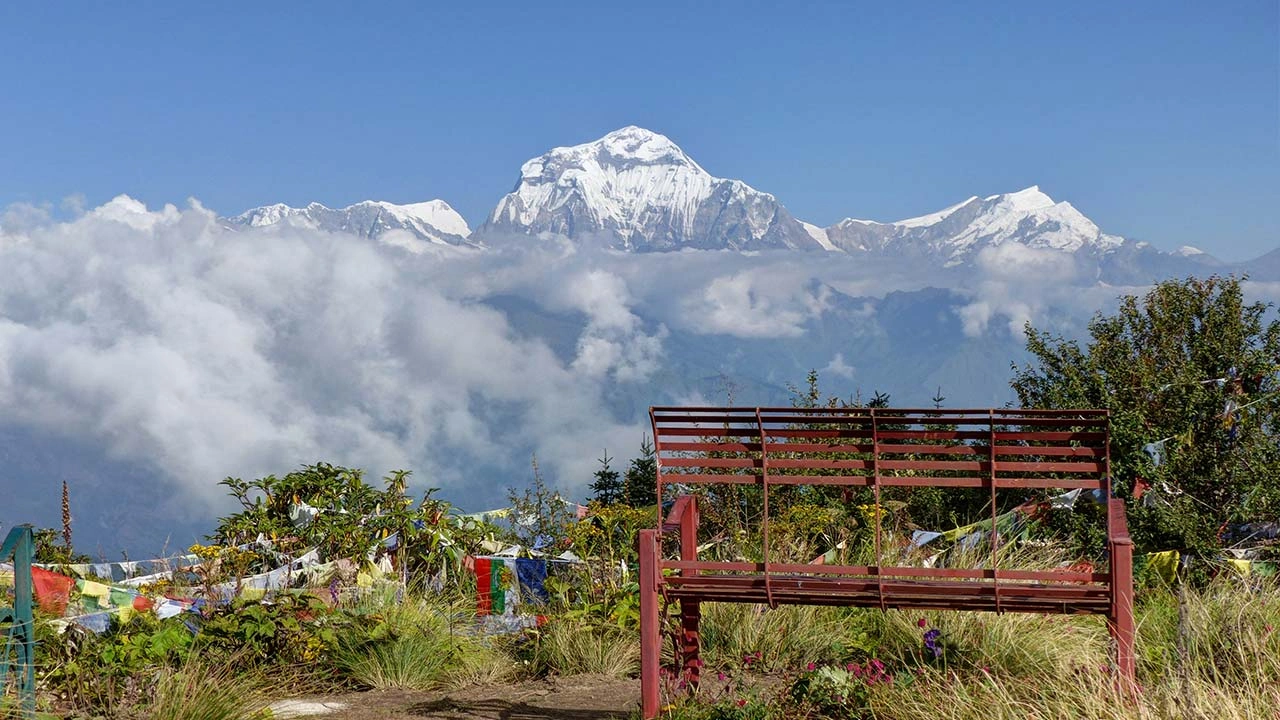
The appeal of the Ghorepani Poon Hill Trek for beginners extends beyond its manageable physical demands. A well-developed teahouse network provides accommodation, meals, hot drinks, charging facilities, and regular rest points along the route, while road access from Pokhara simplifies transportation to the trailhead. The trek combines cultural encounters in villages such as Ulleri, Ghorepani, Tadapani, and Ghandruk with the signature Poon Hill sunrise, where trekkers can view Dhaulagiri I (8,167 m), Annapurna I (8,091 m), Annapurna South, Hiunchuli, Machhapuchhre, and other Himalayan peaks from a single viewpoint. This guide covers the trek's difficulty, daily walking distances, highest altitude, itinerary, route, transportation, accommodation, food, scenery, fitness preparation, essential gear, permits, weather, trekking seasons, and guided trekking options, giving first-time trekkers a complete understanding of what makes Ghorepani Poon Hill one of Nepal's most accessible Himalayan experiences.
How Easy Is the Ghorepani Poon Hill Trek for First-Time Trekkers?
The Ghorepani Poon Hill Trek rates as easy to moderate on the Nepal trekking difficulty scale. First-time trekkers with basic walking fitness complete the route without prior mountaineering experience. Daily walking time averages 4–6 hours on well-marked trails with regular teahouse stops along every section.
The trail follows established footpaths through Magar and Gurung villages, two indigenous Himalayan ethnic groups whose communities have maintained these routes for centuries. Every section carries clear directional markers. Porters and teahouse owners know the trail intimately, so trekkers are never isolated. The elevation gain is gradual enough that acclimatization remains manageable without medical intervention for most healthy adults.
What Is the Ghorepani Poon Hill Trek Difficulty and Typical Daily Walking Time?
The Ghorepani Poon Hill Trek rates easy to moderate in difficulty. Daily walking distances range from 8 to 14 kilometers, with walking times between 4 and 6 hours per day. The trail involves stone staircases, forest paths, and ridge walks, no technical climbing, rope sections, or glacier crossings of any kind.
The 4 most physically demanding sections are:
Tikhedhunga to Ulleri: A steep stone staircase climb of approximately 3,000 consecutive steps, taking 1.5–2 hours at a moderate pace
Ulleri to Ghorepani: A steady forest ascent through rhododendron forest, covering 9 kilometers in 4–5 hours
Ghorepani to Poon Hill: An early morning ascent of 45 minutes, covering 1.5 kilometers with 350 meters of elevation gain
Ghorepani to Tadapani: A ridge walk with moderate elevation changes, covering 11 kilometers in 5–6 hours
The Poon Hill summit ascent at 04:30 AM is the most demanding single section, but its brevity, 45 minutes at a steady pace, makes it achievable for all fitness levels, including trekkers over 60 years of age.
How Does the Trekking Altitude of Ghorepani Poon Hill Trek Compare With Other Nepal Treks?
The Ghorepani Poon Hill Trek reaches a maximum altitude of 3,210 meters, which is significantly lower than Nepal's other popular trekking circuits. The Everest Base Camp Trek reaches 5,364 meters. The Annapurna Circuit peaks at Thorong La Pass at 5,416 meters. The Langtang Valley Trek tops out at Kyanjin Ri at 4,773 meters.
At 3,210 meters, the risk of Acute Mountain Sickness (AMS) is minimal for healthy adults on a gradual ascent profile. Rapid ascents to 3,500 meters or higher carry a 70–100% incidence of AMS according to the U.S. Department of Defense Joint Trauma System altitude-illness guideline, underscoring why the Ghorepani route’s gradual elevation gain keeps risk low even though trekkers still reach a genuine high-altitude viewpoint. The Poon Hill altitude keeps trekkers comfortably below this threshold while still delivering a genuine high-altitude panoramic experience.
This altitude comparison defines the trek's beginner suitability more than any other single factor. Trekkers experience the physical sensation and visual scale of high-mountain environments without the physiological risks that accompany extended time above 4,000 meters.
What Is the Highest Point on the Ghorepani Poon Hill Trek?
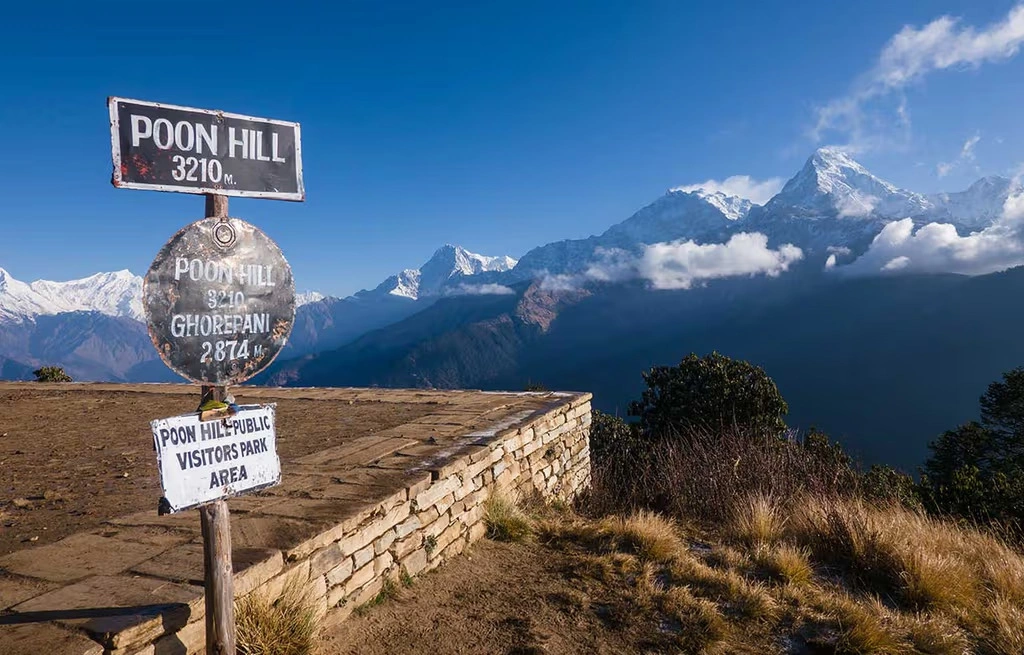
The highest point on the Ghorepani Poon Hill Trek is Poon Hill viewpoint at 3,210 meters (10,531 feet) above sea level. The village of Ghorepani, where trekkers stay the night before the summit ascent, sits at 2,860 meters. The ascent from Ghorepani to Poon Hill covers 350 meters of elevation gain across 1.5 kilometers of trail.
Trekkers depart Ghorepani at 04:30 AM to reach Poon Hill by 05:15–05:30 AM, arriving 15–20 minutes before sunrise. The trail to the viewpoint is clear, well-trodden, and marked throughout. A headlamp with fresh batteries covers the pre-dawn ascent without difficulty.
Why Is Ghorepani Poon Hill Suitable for Short Trekking Holidays?
The Ghorepani Poon Hill Trek fits into 4 to 5 days of trekking time, making it the optimal Nepal trek for travelers with limited vacation windows. The full loop from Nayapul to Nayapul delivers complete mountain immersion without requiring the 12 or more days that other Himalayan circuits demand.
Most trekking destinations in Nepal require 12–21 days for a complete experience. The Ghorepani route delivers the full Annapurna panorama, authentic Gurung village culture, rhododendron forest trails, and the Poon Hill sunrise within 4–5 trekking days. This compression of peak-level experience into a short timeframe drives the route's consistent global popularity.
How Many Days Does the Ghorepani Poon Hill Trek Usually Take?
The standard Ghorepani Poon Hill Trek takes 4 to 5 days for most beginners. The standard 4-day itinerary covers these daily stages:
Day 1: Pokhara to Nayapul by vehicle, then trek to Tikhedhunga (1,540m), walking 2–3 hours
Day 2: Tikhedhunga to Ghorepani (2,860m), walking 5–6 hours including the Ulleri staircase ascent
Day 3: Pre-dawn ascent to Poon Hill (3,210m) for sunrise, then trek to Tadapani (2,590m), walking 6–7 hours total
Day 4: Tadapani to Ghandruk to Nayapul, then drive back to Pokhara, walking 4–5 hours
A 5-day version adds a rest morning at Ghorepani or extends the route through Ghandruk village for additional cultural immersion and time at the Gurung Cultural Museum. Extended 6–7-day versions incorporate side trips to Khopra Danda (3,660m) or approach segments of the Annapurna Base Camp trail.
What Can Beginners Expect From the Typical Trekking Route?
The standard trekking route follows a loop circuit starting and ending near Nayapul (1,070 meters), 42 kilometers west of Pokhara by road. The trail passes through 6 main villages: Tikhedhunga, Ulleri, Banthanti, Ghorepani, Tadapani, and Ghandruk.
Each village carries distinct character and experience value:
Ulleri is a traditional Magar village with stone-paved streets and terraced agricultural fields at 1,960 meters
Ghorepani is the highest overnight stop, perched on a ridge with direct unobstructed views of Dhaulagiri (8,167m) to the north
Tadapani is a forested ridge settlement offering Annapurna South (7,219m) views on clear mornings from its teahouse terraces
Ghandruk is a large Gurung village with a cultural museum, traditional slate-roofed architecture, and panoramic views across the entire Annapurna massif
The trail connects these villages through subtropical forest at lower elevations, mixed broadleaf forest at mid-elevation, and dense rhododendron forest above 2,500 meters, a complete cross-section of Himalayan vegetation zones.
Can Beginners Customize the Trek Duration and Itinerary?
Yes. Beginners customize the Ghorepani Poon Hill Trek in 3 practical directions:
Extend to 6–7 days by adding Khopra Danda Ridge (3,660m) for more dramatic altitude, solitude, and direct Dhaulagiri views
Shorten to 3 days by using a jeep track to Tikhedhunga and bypassing the lower trail sections below Ulleri
Reverse the direction by starting from Ghandruk and ending at Nayapul, which distributes elevation gain differently and suits trekkers who prefer front-loading the cultural villages
Nepal Intrepid Treks designs custom Ghorepani itineraries based on individual fitness levels, available trekking days, and seasonal conditions. Beginners with specific time constraints or physical considerations receive adjusted day-by-day plans before departure day.
What Makes the Ghorepani Poon Hill Trek Easy to Access?
The Ghorepani Poon Hill Trek starts 42 kilometers from Pokhara, reachable by a 1.5-hour vehicle drive. The trailhead at Nayapul connects directly to Pokhara by public bus, shared jeep, or private car, making it the most accessible beginner trek in the entire Annapurna region.
No domestic flights, multi-day approach roads, or complex permits limit trailhead access. Trekkers arriving at Pokhara International Airport step onto the trail within hours of landing. This immediacy is a defining advantage over circuits like Manaslu or Dolpo, which add 2–3 travel days before trekking begins.
How Do You Reach the Trek Starting Point From Pokhara?
The trek starting point at Nayapul (1,070 meters) is 42 kilometers from Pokhara city center. Travel time by road is 1.5 hours in dry season conditions and up to 2 hours during monsoon season (June–September) when road surfaces degrade on the Pokhara-Baglung Highway.
The standard route from Pokhara to the trailhead:
From Pokhara Lakeside: 42 kilometers northwest along the Pokhara-Baglung Highway to Nayapul junction.
Alternative trailhead at Tikhedhunga: 3 kilometers beyond Nayapul by jeep track, saving 1.5 hours of walking on Day 1
What Are the Main Transportation Options for the Trek?
3 transportation options connect Pokhara to the Ghorepani trailhead, each with distinct advantages:
Private car or jeep: Door-to-door service from Pokhara hotel to Nayapul, cost NPR 4,000–6,000 (approximately USD 30–45 in 2026 rates), travel time 1.5 hours; recommended for organized groups
Shared jeep from Baglung Bus Terminal: Departs Pokhara's Baglung Bus Terminal from 06:30 AM, cost NPR 400–600 (approximately USD 3–4), travel time 2 hours
Public local bus: Slowest and cheapest option, cost NPR 200–300, travel time 2.5–3 hours with multiple village stops en route
Private transport is the most practical option for organized trekking groups because it allows flexible departure timing, direct trailhead drop-off, and eliminates the Pokhara bus terminal navigation that first-time visitors find confusing.
Why Is the Trek Convenient for Travelers With Limited Time?
The Ghorepani Poon Hill Trek delivers a complete Nepal mountain experience without the logistical complexity that extends other trekking circuits by days. The 3 convenience factors that matter most to time-limited travelers are:
No domestic flight dependency: Circuits like Upper Mustang or Dolpo require domestic flights from Kathmandu or Pokhara that are vulnerable to weather delays of 1–3 days in any season
Daily road access to the trailhead: Trekkers alter departure day without rescheduling flights or internal transfers
Teahouse infrastructure every 2–3 hours: Trekkers carry no tents, cooking gear, or food supplies, keeping pack weights below 8 kilograms and daily pace consistent
What Can Beginners Expect From the Ghorepani Poon Hill Scenery?
Beginners encounter 5 distinct landscape types on the Ghorepani Poon Hill Trek: subtropical forests, rhododendron forests, cultivated terraced fields, traditional stone villages, and high-ridge panoramas. The trek delivers views of 10 Himalayan peaks above 6,000 meters from a single viewpoint at 3,210 meters.
The scenery transforms at every elevation band. Below 2,000 meters, the trail passes through banana groves, terraced rice fields, and farmhouses. Between 2,000 and 2,800 meters, vegetation shifts to oak, maple, and mixed broadleaf forest. Above 2,800 meters, Nepal's national flower, the rhododendron, dominates the entire trail corridor.
What Himalayan Mountains Can You See From Poon Hill?
From the Poon Hill viewpoint at 3,210 meters, trekkers see 10 Himalayan peaks on clear mornings. The most prominent peaks visible include:
Dhaulagiri I (8,167m): The world's 7th highest mountain, rising directly north of Poon Hill
Annapurna I (8,091m): The world's 10th highest mountain, the centerpiece of the western massif
Annapurna South (7,219m): The sharp triangular peak that dominates the view directly above Ghorepani
Hiunchuli (6,441m): Positioned immediately east of Annapurna South along the ridge
Machhapuchhre (6,993m): The iconic "Fish Tail" peak, sacred to Hindus and permanently closed to climbing
Annapurna II (7,937m), Annapurna III (7,555m), Annapurna IV (7,525m): The eastern Annapurna chain
Nilgiri South (6,839m): The southern pillar of the Nilgiri massif, west of the main Annapurna group
Tukuche Peak (6,920m): The prominent triangular peak positioned between the Dhaulagiri and Annapurna ranges
This 180-degree panorama from Poon Hill represents the most accessible simultaneous view of both the Annapurna and Dhaulagiri massifs from a single vantage point in Nepal below 4,000 meters.
Why Are the Annapurna and Dhaulagiri Views Special?
The Poon Hill viewpoint sits precisely between two of the world's highest mountain ranges, the Annapurna massif to the east and the Dhaulagiri massif to the northwest. The horizontal separation between Annapurna I and Dhaulagiri I at this latitude measures 34 kilometers, among the shortest separations between any two 8,000-meter peaks globally.
From Poon Hill, trekkers simultaneously observe 3 unique geographical phenomena:
The Kali Gandaki Gorge, the world's deepest river gorge at 5,571 meters depth, cutting between the two massifs at the valley floor
Dhaulagiri's southwest face, illuminated in orange by the first light of sunrise on clear mornings
Annapurna's northern face, with permanent glacial ice fields reflecting dawn colors across a 30-kilometer wide panorama
No other viewpoint in Nepal under 4,000 meters provides simultaneous first-light views of two 8,000-meter massifs with a gorge of this scale between them.
What Forests, Villages, and Landscapes Are Along the Trail?
The Ghorepani Poon Hill trail traverses 4 vegetation zones across 1,000 meters of elevation change:
Subtropical mixed forest (1,000–2,000m): Sal trees, bamboo groves, ferns, and cultivated cardamom gardens lining the lower trail sections
Mixed broadleaf forest (2,000–2,500m): Oak, rhododendron, and mossy boulders with dense canopy blocking direct sun
Rhododendron forest (2,500–3,000m): Pure rhododendron stands reaching 8 meters in height, blooming red, pink, and white from February through April
Sub-alpine scrub (3,000–3,210m): Low ground-cover vegetation near the Poon Hill summit with fully unobstructed Himalayan views
The route passes through Gurung and Magar communities. Gurung houses in Ghandruk feature traditional flat-stone slate roofs, carved wooden windows, and open courtyards used for grain threshing. Trekkers observe village life at close range, women carrying water in copper vessels, farmers tending potato and millet fields, and children walking along the same trail to reach their schools.
Why Is Poon Hill Sunrise a Highlight for First-Time Trekkers?
The Poon Hill sunrise is the most photographed single trekking moment in the Annapurna region. At approximately 05:30 AM, the rising sun illuminates Dhaulagiri's snow face in orange light before sweeping across the full Annapurna panorama, a spectacle witnessed from a compact viewing platform at 3,210 meters, reached by a 45-minute walk from Ghorepani.
This concentrated visual experience, lasting approximately 30 minutes from first light to full peak illumination, defines the Ghorepani Poon Hill Trek for first-time trekkers more decisively than any other single moment on the route. The Annapurna region drew 107,880 foreign visitors in 2023 alone, according to the Government of Nepal's official Tourism Statistics 2023 report, making it one of Nepal's most-visited conservation areas and explaining why the teahouse network along the Ghorepani route is so well developed.
What Makes the Poon Hill Sunrise Viewpoint Special?
Poon Hill viewpoint is a purpose-built observation area at the summit of a 3,210-meter ridge directly above Ghorepani village. The platform features a watchtower, a teahouse serving hot beverages from 04:30 AM, and open ground with 360-degree horizontal visibility.
The viewpoint combines 3 factors that make it uniquely compelling for beginners:
Accessibility: 45-minute ascent from Ghorepani on a clear, marked trail with no technical sections
360-degree visibility: Unobstructed panorama from the Kali Gandaki Valley floor to the full Himalayan chain, without tree cover or ridge obstruction at the summit
Crowd tolerance: Despite peak-season popularity, the platform accommodates hundreds of trekkers simultaneously without blocking sightlines
The Nepal Tourism Board identifies Poon Hill as one of Nepal's 10 Priority Trekking Destinations specifically because of its sunrise viewpoint quality relative to access difficulty.
When Should Beginners Reach Poon Hill for Sunrise?
Beginners depart Ghorepani at 04:30 AM to reach Poon Hill by 05:15–05:30 AM, arriving 10–15 minutes before sunrise begins. Sunrise time varies by season across the year:
October to November: Sunrise at approximately 06:00 AM, depart Ghorepani at 05:00 AM
December to February: Sunrise at approximately 06:30 AM, depart Ghorepani at 05:30 AM
March to May: Sunrise at approximately 05:45 AM, depart Ghorepani at 04:45 AM
A headlamp with fresh batteries covers the 1.5-kilometer pre-dawn ascent without difficulty. Hot tea and beverages are available at the summit teahouse from 04:30 AM onward on every day of the season.
What Can Trekkers See From Poon Hill at Sunrise?
At sunrise, trekkers at Poon Hill observe 3 distinct lighting phases across a 30-minute window:
Phase 1 (T-15 minutes): Alpenglow, pink and purple light appears on the upper summits of Dhaulagiri and Annapurna before the sun clears the eastern horizon
Phase 2 (T-0 minutes): Sunrise, the sun crests the eastern ridge, casting orange light across Dhaulagiri's southwest face first, then sweeping progressively across Annapurna I, Annapurna South, Hiunchuli, and Machhapuchhre
Phase 3 (T+15 minutes): Full illumination, all 10 visible peaks in clear daylight, with Kali Gandaki Valley mist beginning to burn off from the gorge floor below
Most trekkers remain on the Poon Hill platform for 60–90 minutes after sunrise to photograph the full lighting transition from alpenglow through complete peak illumination.
What Is Accommodation Like on the Ghorepani Poon Hill Trek?
Teahouses along the Ghorepani Poon Hill Trek provide private or dormitory rooms, hot meals, and basic facilities at every major village stop. Accommodation costs range from NPR 500 to 2,000 per room per night in 2026, with all meals priced separately from room charges.
The teahouse system, Nepal's network of family-run mountain lodges that function simultaneously as accommodation and restaurants, is the defining infrastructure of the Ghorepani route. It removes the need for camping equipment, cooking gear, and food supplies, reducing pack weight and logistical complexity for every beginner on the trail.
What Are Teahouses Like Along the Trekking Route?
Teahouses on the Ghorepani trail range from basic village lodges to well-equipped multi-story mountain hotels. The 4 main teahouse hubs along the standard route each offer distinct accommodation quality:
Tikhedhunga (1,540m): 8–10 teahouses with private twin rooms, squat and Western-style toilets, cold-water shower facilities
Ghorepani (2,860m): 15+ teahouses including multi-story lodges with solar-heated water and dining rooms facing the Dhaulagiri range directly
Tadapani (2,590m): 6–8 smaller teahouses with simpler room configurations and fewer private bathroom options
Ghandruk (1,940m): 12+ teahouses ranging from basic guesthouses to boutique lodges with modern private bathrooms and terrace views
Room types across all teahouses follow a standard structure: twin beds with foam mattresses, wool blankets, and a bedside table. Higher-grade rooms in Ghorepani and Ghandruk add electric blankets and ensuite bathrooms with heated water access.
What Food and Facilities Can Beginners Expect?
Teahouse menus along the Ghorepani route carry 25–35 standard items at every stop. Breakfast options include eggs (fried, boiled, or scrambled), porridge, toast with honey, pancakes, and muesli with milk. Lunch and dinner menus feature dal bhat (rice with lentil soup and vegetable curry), Tibetan bread, noodle soups, pasta, fried rice, and seasonal vegetable dishes.
Dal bhat, Nepal's national dish and the primary daily fuel for trekking guides and porters, is available at all meal hours and commonly served with unlimited refills at a fixed price. A standard dal bhat plate costs NPR 400–700 (USD 3–5) across all teahouses in 2026.
Teahouse facilities along the route:
Electricity: Available at all teahouses in Ghorepani and Ghandruk; intermittent solar power at Tadapani and Tikhedhunga
Wi-Fi: Available in Ghorepani and Ghandruk teahouses at NPR 200–500 per day; not available at Tadapani and Banthanti
Device charging: Phone and camera charging available in dining rooms at all teahouses with electricity
Hot showers: Solar-heated water at Ghorepani lodges; bucket hot water at smaller stops on request
How Comfortable Are the Trekking Lodges?
Lodge comfort on the Ghorepani route corresponds directly to village size and elevation. Ghorepani lodges at 2,860 meters invest heavily in room insulation and blanket provision because temperatures regularly drop to -5°C to -10°C on winter nights at this altitude. Ghandruk lodges at 1,940 meters maintain warmer nighttime temperatures and offer the most modern bathroom facilities on the entire circuit.
The most consistent comfort challenge beginners encounter is cold nights at Ghorepani. Standard teahouse rooms are not internally heated, warmth comes from blankets and personal sleeping bags. A sleeping bag rated to 0°C or below, thermal base layers, and wool sleeping socks resolve this completely. Nepal Intrepid Treks provides a pre-departure gear checklist specifying sleeping bag temperature ratings by season of travel.
How Can Beginners Prepare for the Ghorepani Poon Hill Trek?
Beginners prepare for the Ghorepani Poon Hill Trek with 4–6 weeks of cardiovascular fitness training, a gear list covering 15 essential items, and 2 permit applications completed in Pokhara before the trail begins. Physical preparation is the single most impactful investment a first-time trekker makes before departure.
The Ulleri staircase, a consecutive stone step ascent of approximately 1,000 vertical meters across 3,000 steps, surprises trekkers who underestimate the cumulative leg and cardiovascular demand of steep terrain. A structured 4-week pre-trek walking program eliminates this surprise entirely.
What Fitness Level Is Needed for the Trek?
The Ghorepani Poon Hill Trek requires a baseline fitness level equivalent to walking 10–12 kilometers per day on hilly terrain for 4 consecutive days. Trekkers with no current exercise routine reach this level within 4–6 weeks of targeted walking training.
Trekkers who complete the route most comfortably share 3 preparation patterns:
Walk or hike 3–4 times per week for 4 weeks before departure date
Include at least 1 weekly session with 500 meters of cumulative elevation gain on stairs, hills, or inclined treadmill
Complete 1 full-day practice walk of 12–15 kilometers in the 2 weeks immediately before departure
No swimming, cycling, or gym training transfers directly to trail performance on mountain terrain. Walking on inclines, stairs, and uneven surfaces is the highest-value preparation activity for the Ghorepani route.
What Should Beginners Pack for Ghorepani Poon Hill?
The 15 essential items for the Ghorepani Poon Hill Trek are:
Trekking boots (waterproof, ankle-support, broken-in before the trek, not new on departure day)
Trekking poles (a 2024 lower-limb loading study hosted by the U.S. National Library of Medicine found that correctly timed pole strikes, not pole use alone, are what meaningfully reduce knee loading on descents, plant the tip just before your leading foot lands for the full benefit).
Daypack (20–25 liters for the pre-dawn Poon Hill summit ascent)
Sleeping bag (rated to 0°C minimum; -5°C recommended for November and December)
Down jacket (600-fill minimum for Ghorepani cold nights)
Waterproof jacket (hardshell with hood for afternoon rain in spring and autumn)
Thermal base layers (top and bottom, merino wool or synthetic quick-dry material)
Trekking pants (1 pair waterproof, 1 pair lightweight)
Warm hat and gloves (essential for the 04:30 AM Poon Hill pre-dawn ascent)
Headlamp (with fresh batteries loaded and one backup set packed)
Sunscreen SPF 50+ (per the WHO/WMO/UNEP/ICNIRP Global Solar UV Index guide, UV intensity increases 10–12% with every 1,000 meters of altitude gain, and reflection off snow-covered terrain near Poon Hill’s sub-alpine summit can double total UV exposure).
Water purification (tablets or filter for filling bottles from teahouse taps and trail streams)
First aid kit (blister plasters, ibuprofen, oral rehydration salts, altitude sickness awareness medication)
Trail snacks (energy bars, nuts, and dried fruit for segments between teahouses)
Camera or smartphone (with a fully charged portable battery bank, power outlets are limited above Ulleri)
Porters on the Ghorepani route carry loads up to 20 kilograms at a daily rate of NPR 1,200–1,800 (USD 9–13 in 2026). Hiring a porter reduces pack weight to a 5-kilogram daypack, transforming the trekking experience for first-time hikers.
What Training Can Help First-Time Trekkers Prepare?
A 4-week progressive training plan builds the endurance needed for 5 consecutive days of Himalayan trail walking:
Week 1: 3 walks per week, 45–60 minutes each, flat terrain, build the walking habit
Week 2: 3 walks per week, 60–75 minutes each, include staircase or uphill sections
Week 3: 4 walks per week, 75–90 minutes each, add 1 longer 3-hour session on hilly terrain
Week 4: 4 walks per week, include 1 full-day hike of 5–6 hours on the final weekend before departure
Stair training is the highest-value specific preparation for the Ulleri section. Urban trekkers without access to hills use building stairwells or stadium steps: 30 minutes of consecutive stair climbing 3 times per week in Weeks 3 and 4 directly replicates the muscular demand of the Tikhedhunga to Ghorepani ascent.
What Trekking Permits Are Required for Ghorepani Poon Hill?
The Ghorepani Poon Hill Trek requires 2 permits: the Annapurna Conservation Area Permit (ACAP) and the Trekkers' Information Management System card (TIMS). Both are obtained in Kathmandu or Pokhara before trekking begins, checkpoint officers verify both documents at multiple points on the trail.
The Annapurna Conservation Area Permit (ACAP), issued by the National Trust for Nature Conservation (NTNC), authorizes entry into the Annapurna Conservation Area, Nepal’s largest protected area at 7,629 square kilometers and home to more than 100,000 residents from diverse cultural and linguistic communities, according to NTNC’s 2024 Annual Report. The TIMS card, managed jointly by the Trekking Agencies' Association of Nepal (TAAN) and the Nepal Tourism Board, functions as a trekker registration and emergency safety identification document.
2026 permit costs for the Ghorepani Poon Hill Trek:
Permit | Foreign Nationals | SAARC Nationals | Issuing Authority |
ACAP | NPR 3,000 (USD 22) | NPR 1,000 (USD 7.50) | NTNC offices, Kathmandu or Pokhara |
TIMS Card (All Trekkers) | NPR 2,000 (USD 15) | NPR 1,000 (USD 7.50) | Issued via Authorized Trekking Agencies |
Both permits require 2 passport-sized photographs and a photocopy of the photo page of your passport. Nepal Intrepid Treks handles permit acquisition as part of all organized trekking packages, eliminating queuing and paperwork for group trekkers entirely.
What Is the Best Season for a Beginner-Friendly Ghorepani Poon Hill Trek?
The best seasons for the Ghorepani Poon Hill Trek are spring (March to May) and autumn (September to November). These 2 seasons deliver stable weather, clear Himalayan visibility, and comfortable daytime temperatures of 10°C to 18°C on the trail, making them the primary recommendation for all first-time trekkers.
Nepal's trekking seasons divide into 4 distinct periods, each with specific weather patterns, trail conditions, visibility outcomes, and comfort levels for overnight stops at Ghorepani.
Which Months Offer the Best Mountain Views?
October and November deliver the clearest mountain visibility from Poon Hill in any given year. Post-monsoon atmospheric clarity removes the haze and cloud cover that accumulates through summer. October mornings at Poon Hill record clear mountain visibility on more than 85% of days based on Nepal Meteorological Forecasting Division data for the Annapurna region.
March and April rank second for visibility, with the additional spectacle of rhododendron peak bloom, the red, pink, and white flowers transforming the forest trail between Ulleri and Ghorepani into one of Nepal's most photographed seasonal landscapes. Visibility in spring is slightly lower than October due to pre-monsoon dust accumulation and occasional afternoon cloud development.
The month-by-month Poon Hill visibility guide:
October: Excellent, post-monsoon clarity, minimal precipitation risk
November: Excellent, clearest skies of the year, cooler nights at Ghorepani
December: Good, clear days, cold nights (-5°C to -10°C at Ghorepani)
March: Good, rhododendron peak bloom, moderate afternoon cloud
April: Good, warm temperatures, late rhododendron season, increasing afternoon cloud
May: Fair, pre-monsoon heat haze, risk of early monsoon onset in late May
June to August: Poor, monsoon cloud cover, precipitation, leeches below 2,000m
How Does Weather Affect Trekking Conditions?
Weather at Poon Hill follows a predictable daily pattern in both spring and autumn: clear mornings with optimal summit viewing conditions, gradual cloud build-up through the afternoon, and clearing again by early evening. Trekkers who reach Poon Hill before 08:00 AM consistently catch clear Himalayan views before afternoon cumulus clouds develop at lower elevations.
Temperature ranges by season across the standard trekking route:
Spring (March–May): Daytime 12°C–18°C on trail, nights 2°C–8°C at Ghorepani altitude
Autumn (October–November): Daytime 10°C–16°C on trail, nights -2°C–5°C at Ghorepani altitude
Winter (December–February): Daytime 5°C–12°C on trail, nights -5°C–-10°C at Ghorepani altitude
Monsoon (June–September): Daytime 18°C–25°C with high humidity, trail surfaces wet and slippery, leeches active on the lower trail below 2,000 meters
Can Beginners Trek Ghorepani Poon Hill During Winter or Monsoon?
Winter trekking (December to February) on the Ghorepani route is viable for well-equipped beginners for 4 specific reasons:
Snow covers the trail above 2,800 meters but crampons are not required on the standard route under normal conditions
Teahouses remain open in Ghorepani and Ghandruk throughout the winter season
Trekker numbers drop by 60–70% compared to October, delivering a quieter and more intimate mountain experience
Clear winter skies produce exceptional visibility on days without precipitation, often the clearest Himalayan views of the entire year
Additional winter gear requirements: boots insulated to -10°C, microspikes for icy sections near Poon Hill summit, hand warmer packets, and a sleeping bag rated to -10°C minimum.
Monsoon trekking (June to August) carries 4 challenges that make it the least recommended season for beginners: trail surfaces become slippery clay and wet stone on the approach, leeches are active below 2,000 meters on the lower sections, Poon Hill morning visibility drops below 30% of days, and teahouse availability in peak monsoon is inconsistent. The trail remains technically passable but delivers a fundamentally different beginner experience.
How Can Beginners Trek Ghorepani Poon Hill With Nepal Intrepid Treks?
Nepal Intrepid Treks offers fully guided Ghorepani Poon Hill Trek packages starting from USD 450 per person for 5 days, including a NTB-licensed guide, porter service, pre-booked teahouse accommodation, permit acquisition, and Pokhara airport-to-trailhead transfers.
Nepal Intrepid Treks is a Nepal Tourism Board-registered trekking company based in Pokhara, specializing in Annapurna region treks and Himalayan trekking experiences for international visitors. Guides hold NMA or NTB trekking guide licenses and carry wilderness first aid certifications. Every guided group receives a pre-departure briefing in Pokhara covering gear review, daily itinerary structure, altitude management protocols, and emergency contact procedures.
Can Nepal Intrepid Treks Make the Ghorepani Poon Hill Trek Easier for Beginners?
Yes, in 5 direct and measurable ways. Nepal Intrepid Treks removes the 5 most common friction points for first-time trekkers:
Permit handling: Both ACAP and TIMS permits are secured before departure day, eliminating permit office queuing time in Pokhara for every group member
Porter allocation: Every group trek includes porter service for bags above 5 kilograms, keeping individual daypack weights below 6 kilograms throughout the route
Teahouse pre-booking: Accommodation is confirmed in advance during peak seasons (October, November, March, April), guaranteeing rooms in Ghorepani on nights when walk-in availability reaches zero
Daily pacing: Licensed guides set a walking pace calibrated to the group's slowest and least-experienced walker, a critical safety and comfort factor on the Ulleri staircase ascent
Emergency readiness: Guides carry satellite communication devices and maintain direct contacts with Pokhara hospital evacuation services and the Himalayan Rescue Association
Since independent trekking is no longer permitted in Nepal, all foreign beginners must hire a licensed guide, transferring logistical responsibilities like permit handling, navigation, and emergency planning entirely to experienced professionals. Guided trekking transfers these responsibilities to experienced professionals, allowing first-time trekkers to focus entirely on the trail experience, the scenery, and the people they meet along the way.
Contact Nepal Intrepid Treks to discuss your Ghorepani Poon Hill Trek dates, group size, and any specific fitness levels or dietary requirements. Custom itineraries are available for groups of 2 or more trekkers.
What Are the Key Takeaways About Why Ghorepani Poon Hill Is Best for Beginners?
The Ghorepani Poon Hill Trek earns its position as Nepal's premier beginner trek through a convergence of 7 defining advantages that no other Nepal circuit delivers at the same time:
Manageable difficulty: Easy to moderate rating with 4–6 hours of daily walking and zero technical terrain requirements
Safe altitude: Maximum elevation of 3,210 meters, comfortably below the 3,500-meter AMS risk threshold
Short duration: 4–5 days complete the full circuit, fitting vacation windows as short as 1 week including travel days
Direct access: 1.5-hour drive from Pokhara removes complex approach logistics and domestic flight dependency
World-class scenery: 10 Himalayan peaks visible from Poon Hill, including 2 mountains above 8,000 meters, viewed from a single accessible platform
Complete teahouse infrastructure: Private rooms, hot meals, electricity, and device charging at every overnight stop, no camping equipment required
Year-round feasibility: 2 primary seasons (spring and autumn), viable winter trekking for well-prepared beginners, and a passable monsoon season for those with specific reasons to go
The trek functions as the ideal introduction to Himalayan trekking. First-time trekkers who complete Ghorepani Poon Hill gain the fitness benchmark, trail terrain familiarity, and altitude acclimatization experience to progress toward the Annapurna Base Camp Trek (4,130m), the Everest Three Passes Trek, or the Manaslu Circuit on future Nepal visits.
Nepal Intrepid Treks guides beginners through the Ghorepani Poon Hill route across spring, autumn, and winter departures every year. The Ghorepani Poon Hill Trek is where Nepal's Himalayan trekking journey begins, and for most first-time trekkers, it is the experience that brings them back.