Selecting the best EBC trek tour operator in Nepal is one of the most important decisions for anyone planning the Everest Base Camp Trek. A reliable trekking company provides far more than transportation and accommodation; it delivers experienced licensed guides, acclimatization-focused itineraries, emergency preparedness, and logistical support throughout the Khumbu region. From permit management and domestic flights to altitude sickness protocols and teahouse reservations, the quality of the operator directly affects safety, comfort, and the overall trekking experience.
Everest Base Camp remains one of the world's most sought-after trekking destinations, attracting thousands of trekkers each year to the trails between Lukla, Namche Bazaar, Dingboche, Gorak Shep, and Kala Patthar. With hundreds of trekking agencies operating in Nepal, comparing companies based on guide credentials, safety standards, group size, package inclusions, customer reviews, and pricing transparency becomes essential. This guide explains the key factors that distinguish the best Everest Base Camp trek operators in Nepal and helps trekkers make an informed decision before embarking on this iconic Himalayan journey.
Why Does Choosing the Right EBC Trek Operator Matter?
The right EBC trek operator directly controls 7 critical variables: guide qualification, acclimatization scheduling, permit management, emergency response speed, accommodation quality, group size, and transparent pricing. A poorly chosen operator creates measurable risks, including premature descent due to altitude sickness, permit complications at national park checkpoints, and inadequate emergency coordination at elevations where helicopter rescue costs between $3,000 and $5,000 USD.
Nepal's Department of Tourism and the Trekking Agencies' Association of Nepal (TAAN) register all legitimate trek operators. TAAN's current roster of 2,100+ registered agencies, makes it the largest umbrella body for mountain tourism in Nepal. Among these, only a fraction hold additional certifications from the Nepal Mountaineering Association (NMA) and operate with wilderness first responders on staff.
Trekkers who book with unregistered or underqualified operators report 3 common outcomes: guides with no formal altitude medicine training, itineraries that skip mandatory acclimatization days at Namche Bazaar (3,440m) and Dingboche (4,410m), and zero emergency evacuation plans for HACE (High Altitude Cerebral Edema) or HAPE (High Altitude Pulmonary Edema), both life-threatening conditions above 4,000m.
The decision made before you fly into Tribhuvan International Airport in Kathmandu determines the quality, safety, and value of every day that follows.
What Makes a Reliable Everest Base Camp Trek Company?
A reliable Everest Base Camp trek company holds active registration with Nepal's Department of Tourism, employs government-licensed guides, maintains a documented emergency evacuation protocol, and provides written itineraries with clear day-by-day acclimatization schedules.
Why Is Local Expertise Important for the EBC Trek?
Local expertise on the EBC Trek means direct, practical knowledge of the Khumbu region's terrain, weather patterns, teahouse conditions, and altitude-related medical risks. A Kathmandu-based operator with Sherpa-origin staff or long-term field experience in the Solu-Khumbu district brings 4 concrete advantages:
Route-level knowledge: familiarity with trail conditions between Phakding (2,652m), Namche Bazaar, Tengboche (3,867m), Lobuche (4,940m), and Gorak Shep (5,164m)
Teahouse relationships: pre-established booking partnerships that secure beds during peak season (April and October) when lodges reach 100% occupancy
Weather reading: experience interpreting Khumbu-specific storm patterns that arrive without warning above Dingboche
Medical network access: direct contact with the Himalayan Rescue Association (HRA) clinic at Pheriche (4,371m) and Khunde Hospital
An operator based outside Nepal or lacking Khumbu field presence cannot replicate this operational depth.
How Can the Right Operator Improve Your Experience?
The right operator improves your EBC trek experience across 5 measurable dimensions: safety management, comfort at altitude, time efficiency, cultural context, and post-trek support. Specifically:
Safety management: guides trained in Wilderness First Aid administer pulse oximetry checks twice daily, monitoring SpO₂ (blood oxygen saturation) levels and making evidence-based ascent or descent decisions
Comfort at altitude: pre-booked private or semi-private teahouse rooms prevent sleeping in dining halls during peak season, which disrupts the rest critical for acclimatization
Time efficiency: an operator familiar with the Tenzing-Hillary Airport (Lukla) flight system manages rebooking quickly during weather cancellations, a common occurrence that delays unprepared trekkers by 2 to 4 days
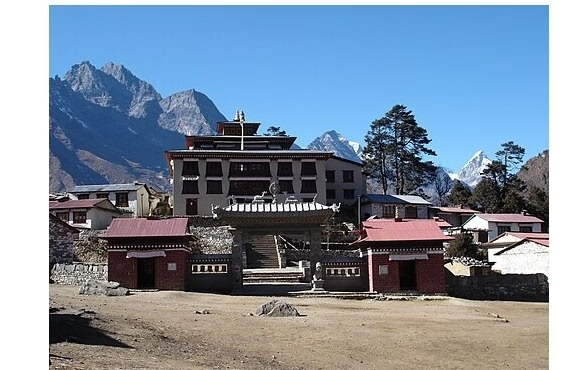
Cultural context: Sherpa guides explain Khumbu's Buddhist heritage, including Tengboche Monastery (3,867m) and Mani walls along the route, which transforms a physical challenge into a culturally meaningful journey
Post-trek support: reliable operators arrange Kathmandu hotel transfers, gear storage, and debrief calls, reducing the logistical burden after 2 weeks at altitude
What Qualities Should the Best EBC Trek Operator Have?
The best EBC trek operator demonstrates 6 non-negotiable qualities: government registration, certified guide staff, documented safety protocols, verified client reviews, appropriate group-size limits, and comprehensive service packages with no hidden fees.
How Important Are Experienced Guides and Porters?
Experienced guides and porters are the single most important human factor on the EBC trek. Nepal's government issues 2 categories of trekking staff licenses:
Trekking Guide License: requires completing the Nepal Tourism Board's 45-day guide training and passing written and field examinations
Senior Trekking Guide License: requires a minimum of 250 days of verified trekking experience and advanced altitude medicine training
The best EBC trek operators assign Senior Licensed Guides or government-certified High Altitude Guides to all Everest region routes. Guides in this category recognize the 4 primary symptoms of Acute Mountain Sickness (AMS), headache, nausea, dizziness, and fatigue, and apply the Lake Louise Score to determine whether a trekker ascends, rests, or descends.
Porters carry loads capped at 30 kg per standard Nepalese and International Porter Protection Group (IPPG) welfare guidelines, though premium ethical operators voluntarily limit this to 20–25 kg. Operators aligned with the International Porter Protection Group (IPPG) also supply porters with appropriate clothing, footwear, and insurance, a distinction that separates ethical operators from cost-cutting ones.
What Safety Standards Should an EBC Trek Company Follow?
An EBC trek company follows 5 core safety standards that protect trekkers between Lukla and Kala Patthar (5,545m):
Mandatory rest days: 2 structured acclimatization days, one at Namche Bazaar and one at Dingboche, included in every standard itinerary
Pulse oximetry monitoring: daily SpO₂ and heart rate checks using calibrated devices, with documented thresholds for descent decisions
Emergency medication carriage: guides carry Diamox (Acetazolamide), Dexamethasone, and Nifedipine in field medical kits
Gamow Bag availability: portable hyperbaric chambers available with team leads for severe AMS emergencies above 4,000m
24/7 Kathmandu base camp contact: a dedicated operations contact reachable at all hours to coordinate helicopter evacuation from Lukla, Namche Bazaar, or Pheriche
Why Do Customer Reviews Matter When Choosing a Trek Operator?
Customer reviews on platforms such as TripAdvisor, Google Reviews, and Trustpilot provide 3 categories of verified operator intelligence: guide competence ratings, itinerary accuracy scores, and emergency response evaluations. An operator with 500+ verified reviews averaging 4.6 stars or above over 3 consecutive years demonstrates consistent operational reliability.
Reviews also reveal patterns invisible in marketing materials, specifically, whether guides enforced acclimatization protocols when trekkers felt pressured to push ahead, and whether the operator fulfilled written inclusions such as breakfast, accommodation, and domestic flights without dispute.
How Does Group Size Affect the Trek Experience?
Group size directly impacts trek safety and pacing. Peer-reviewed wilderness-medicine research on staffing ratios at altitude links smaller supervised groups to faster recognition of AMS symptoms and better outcomes. The following table defines the relationship between group size and trek experience quality:
Group Size | Guide Ratio | Impact on Experience |
1–4 trekkers | 1 guide | Maximum personalisation, flexible pacing |
5–8 trekkers | 1 guide + 1 assistant | Balanced attention, standard pacing |
9–12 trekkers | 2 guides | Reduced individual attention |
13+ trekkers | 3+ guides required | Teahouse booking stress, trail congestion |
The best EBC trek operators cap private group sizes at 12 and tailor guide ratios to group fitness levels. Solo trekkers joining shared departures access groups of 6 to 10 participants, the ideal range for both cost efficiency and trek quality.
What Services Should an Everest Base Camp Trek Operator Provide?
A full-service Everest Base Camp trek operator provides airport transfers, Kathmandu accommodation, domestic flights, all trek permits, teahouse lodging, 3 daily meals during the trek, licensed guiding, porter service, and documented emergency support.
What Accommodation and Meal Arrangements Are Included?
Standard EBC trek accommodation uses teahouses (locally operated lodges) along the Namche-to-EBC trail. A quality operator pre-books accommodation at each overnight stop, including Phakding, Namche Bazaar, Tengboche, Dingboche, Lobuche, and Gorak Shep. Teahouse rooms range from basic twin-bed rooms with shared facilities to superior rooms with attached bathrooms, a distinction that operators clearly specify in written package terms.
Meals during the trek include breakfast, lunch, and dinner at teahouses. Standard menu items include Dal Bhat (lentil soup with rice and vegetables), pasta, soups, eggs, porridge, and tea. The best operators include all 3 daily meals in the trek cost rather than issuing a daily food allowance, which reduces uncertainty for trekkers managing altitude-related appetite changes.
How Are Transportation and Domestic Flights Managed?
Transportation on the EBC trek involves flights to Lukla (VNLK). During peak trekking seasons (March–May and September–November), these flights are diverted to Manthali Airport in Ramechhap, requiring a 4 to 5-hour drive from Kathmandu followed by a 20-minute flight. Both routes operate on 20-minute mountain flights aboard Tara Air or Summit Air Twin Otter aircraft. Reliable operators include return domestic flight tickets in the package cost, book seats 4 to 6 months in advance for spring season, and manage rebooking without additional charges during weather-related cancellations.
Ground transportation in Kathmandu, airport pickup, hotel transfer, and pre-departure hotel check-out transfer, is arranged and included by full-service operators.
What Permits Are Required for the Everest Base Camp Trek?
The Everest Base Camp Trek requires 2 mandatory permits:
Khumbu Pasang Lhamu Rural Municipality Permit: This local entry permit replaces the TIMS card in the Everest region. The fee is NPR 2,000 (approximately USD 15) for all foreign trekkers and is typically obtained upon arrival in Lukla or at the Monjo checkpoint.
Sagarmatha National Park Entry Permit: required at the Monjo checkpoint (2,835m). The fee is NPR 3,000 (approximately USD 22) for international trekkers
The best operators manage both permits before departure and include the fees within the stated package price, eliminating permit queues and cost surprises on the trail.
What Support Is Available During Emergencies?
Emergency support on the EBC trek involves 3 active response channels: the operator's 24-hour Kathmandu operations team, the Himalayan Rescue Association (HRA) clinic at Pheriche (open October through May), and helicopter rescue coordination through certified insurance providers. Operators with established relationships with air rescue companies, such as Simrik Air, Fishtail Air, and Air Dynasty, activate helicopter evacuation within 1 to 3 hours of a medical emergency, weather permitting.
The operator's emergency plan documents the nearest helicopter landing points at Gorak Shep (5,164m), Lobuche, Pheriche, and Namche Bazaar, each with GPS coordinates confirmed with the operator's ground team.
How Can You Compare Everest Base Camp Trek Companies?
To compare Everest Base Camp trek companies, evaluate 4 parallel criteria: registration status with Nepal's Department of Tourism, transparency of written itineraries including acclimatization days, completeness of service inclusions vs. exclusions, and documented emergency protocols.
What Questions Should You Ask Before Booking?
Ask these 7 specific questions before committing to an EBC trek operator:
Is your company registered with Nepal's Department of Tourism, and can you provide your registration number?
Do your assigned guides hold a Senior Trekking Guide License from the Nepal Tourism Board?
Does your standard itinerary include 2 mandatory acclimatization days at Namche Bazaar and Dingboche?
Are domestic Lukla flights included in the stated package price?
What is your documented protocol for managing HACE and HAPE above 4,000m?
Which helicopter rescue companies are you contracted with for emergency evacuations?
Does your written contract list all inclusions and exclusions with no additional service charges?
A credible operator answers each question with specific, verifiable information, not generalities.
How Can You Evaluate Trek Packages and Itineraries?
Evaluate EBC trek packages by cross-referencing 3 itinerary elements against established altitude medicine guidelines. The benchmark itinerary, recommended by the Wilderness Medical Society, places trekkers at the following overnight stops:
Day 1: Fly Kathmandu to Lukla (2,860m), trek to Phakding (2,652m)
Day 2: Trek to Namche Bazaar (3,440m)
Day 3: Acclimatization day at Namche Bazaar, hike to Everest View Hotel (3,880m) and return
Day 4: Trek to Tengboche (3,867m)
Day 5: Trek to Dingboche (4,410m)
Day 6: Acclimatization day at Dingboche, hike to Nangkartshang Peak (5,083m)
Day 7: Trek to Lobuche (4,940m)
Day 8: Trek to Gorak Shep (5,164m), visit Everest Base Camp (5,364m)
Day 9: Hike Kala Patthar (5,545m), trek to Pheriche (4,371m)
Any itinerary compressing this schedule into fewer than 10 active trekking days eliminates critical acclimatization time and increases AMS risk measurably.
Why Should You Check Inclusions and Exclusions Carefully in EBC Trek Contracts?
Inclusions and exclusions in EBC trek contracts determine your total out-of-pocket cost. A well-structured package explicitly includes: airport transfers, Kathmandu accommodation (pre and post trek), domestic flights, all trek permits, teahouse accommodation (twin-sharing), 3 daily meals during the trek, guide fee, porter fee (1 porter per 2 trekkers), and staff insurance.
Exclusions typically include: personal travel insurance, visa fee (USD 50 for 30-day Nepal visa), tips for guides and porters (customary: USD 10–15 per day for guides, USD 5–8 per day for porters), personal gear, beverages beyond water, hot showers, and WiFi charges at teahouses.
Reading both lists prevents the most common trekker frustration: arriving on the trail expecting inclusions that were never part of the signed contract.
How Can You Identify Hidden Costs in EBC Trek Packages?
Hidden costs appear in 4 common patterns across EBC trek packages:
"Flights on request": some operators state flight costs separately, adding $350 to $500 USD per person after booking
"Accommodation not included on Day 1 and Day 12": pre- and post-trek hotel nights excluded from stated price
"Permits at actual cost": operators charge current permit fees on top of quoted price rather than absorbing them
"Tips not included": while tips are genuinely discretionary, the lack of guidance in contract documentation creates awkward on-trail situations
Request a complete itemized cost sheet before signing any contract. Any operator unwilling to provide this document warrants caution.
What Safety Measures Are Essential on the Everest Base Camp Trek?
The 3 essential safety measures on the Everest Base Camp Trek are daily altitude acclimatization monitoring, guide-administered emergency medical protocols, and pre-arranged helicopter evacuation agreements with air rescue operators in Kathmandu.
How Do EBC Trek Operators Handle Altitude Sickness?
Trek operators handle altitude sickness through a 3-tier response framework tied to the Lake Louise AMS Score:
Mild AMS (score 3–4): guide halts ascent, provides hydration, administers Diamox 250mg, and monitors SpO₂ for 4 hours before making a continue-or-descend decision
Moderate AMS (score 5–7): immediate descent of 500 to 1,000m below symptom onset altitude, with Dexamethasone 8mg administered and HRA clinic consultation initiated
Severe HACE/HAPE: Gamow Bag deployment at the nearest point, oxygen administration if available, and emergency helicopter evacuation coordination within 60 minutes
Under the Wilderness Medical Society's 2024-updated altitude illness guidelines, immediate descent remains the only evidence-based response to severe HACE or HAPE, alongside refined thresholds for oxygen and dexamethasone use introduced in the 2024 revision. The best operators train all field staff in this protocol and rehearse scenarios annually.
What Emergency Evacuation Support Should Be Available?
Emergency evacuation support covers 3 operational components: pre-identified helicopter landing zones, active insurance verification, and real-time communication with the Kathmandu operations team. Helicopter landing zones on the EBC route include:
Gorak Shep (5,164m): weather-dependent, usable in calm morning conditions
Lobuche (4,940m): standard evacuation point for upper Khumbu emergencies
Pheriche (4,371m): primary HRA clinic and helicopter evacuation hub
Namche Bazaar (3,440m): reliable year-round evacuation point
A prepared operator confirms the trekker's travel insurance policy covers helicopter evacuation up to $100,000 USD before departure, a non-negotiable requirement in high-altitude rescue contexts.
Why Is Travel Insurance Important for the EBC Trek?
Travel insurance with high-altitude evacuation coverage is essential for the EBC Trek because helicopter rescue from Gorak Shep to Kathmandu costs between $3,000 and $5,000 USD, and rescue coordination without pre-approved insurance delays medical response by 30 to 90 minutes. Insurance policies covering the EBC Trek must explicitly include:
Helicopter evacuation from altitudes above 5,000m
Trip cancellation due to flight delays (Lukla weather cancellations affect 30% of spring departures)
Medical treatment costs at HRA clinics
Trek abandonment due to injury or illness
World Nomads, IMG Global, and Battleface all offer EBC-compatible high-altitude trekking insurance policies with evacuation coverage above 5,000m.
When Is the Best Time to Trek to Everest Base Camp?
The best time to trek to Everest Base Camp is during 2 primary seasons: spring (March to May) and autumn (September to November). These windows deliver the clearest skies, most stable weather, and the highest trail safety conditions on the Khumbu route.
Which Seasons Offer the Best Trekking Conditions?
Spring and autumn provide the 4 optimal trekking conditions: stable daytime temperatures, low precipitation, clear visibility of Everest (8,848.86m) and surrounding peaks, and open teahouse availability across all overnight stops.
Spring (March–May): daytime temperatures at Namche Bazaar average 8°C to 12°C; temperatures at Gorak Shep range from -5°C to 5°C. April represents the peak Everest climbing season, filling the trail with both trekkers and expedition teams.
Autumn (September–November): post-monsoon clarity delivers the sharpest mountain views. Daytime temperatures at Gorak Shep average -3°C to 3°C. October is the busiest month on the EBC trail.
How Does Weather Affect the Trek Experience?
Weather affects the EBC Trek experience across 3 variables: trail safety, flight operability at Lukla, and mountain visibility. The monsoon season (June to August) brings 80% of Nepal's annual rainfall to the Khumbu region, creating leeches on lower trails, waterlogged paths above Namche, and near-zero visibility from Tengboche upward. The winter season (December to February) drops temperatures at Gorak Shep to -20°C at night, closes most teahouses above Dingboche, and creates dangerous icy conditions above 4,500m.
Weather also disrupts domestic flights into Lukla. The Tenzing-Hillary Airport operates under VFR (Visual Flight Rules), making it non-operational during cloud cover, snowfall, or strong winds. Spring season sees approximately 25 to 35 flight cancellation days; autumn sees 15 to 25 days. Reliable operators plan for 1 to 2 buffer days in Kathmandu pre-departure to absorb flight delays.
What Should You Expect During Peak Trekking Seasons?
During peak trekking seasons, expect 3 specific trail realities: high teahouse occupancy, crowded trail sections between Namche and Tengboche, and permit queue waits at the Sagarmatha National Park entrance checkpoint. April and October each see over 8,000 trekkers on the EBC route simultaneously.
Pre-booked accommodation with a registered operator eliminates the risk of arriving at Lobuche or Gorak Shep without a confirmed bed, a situation that forces trekkers to sleep in dining rooms at altitudes where rest quality directly determines acclimatization success.
How Much Does an Everest Base Camp Trek Cost?
An Everest Base Camp trek costs between $1,200 and $6,500 USD per person depending on package tier, group size, season, service inclusions, and operator quality. The 3 primary price tiers, budget, standard, and luxury, cover measurably different service levels.
What Factors Influence EBC Trek Prices?
EBC trek prices are shaped by 6 primary cost drivers:
Guide and porter wages: government-set minimum daily wages for licensed guides (NPR 3,100–4,000) and porters (NPR 2,400–3,500) contribute 20–30% of package costs
Domestic flight tickets: round-trip Lukla flights cost $350–$450 USD per person at 2026 rates
Teahouse accommodation: ranges from NPR 300–800 per night for budget rooms to NPR 2,000–5,000 for superior rooms at lodge brands in Namche
Permit fees: The Khumbu local permit and Sagarmatha National Park Entry Permit together total NPR 5,000 per trekker
Season: spring packages cost 10–15% more than autumn due to higher operator demand
Service inclusions: packages including pre- and post-trek Kathmandu hotel nights, airport transfers, and all meals cost $300–$600 more than basic packages excluding these items
Are Budget and Luxury Trek Packages Available?
Budget and luxury trek packages both exist across Nepal's EBC operator market, covering 3 distinct experience tiers:
Budget packages ($1,200–$2,200 USD): include licensed guide and porter, standard teahouse accommodation (twin-sharing), daily breakfast, domestic flights, and permits. Meals beyond breakfast are self-funded. Groups of 6–10 share departure slots.
Standard packages ($2,200–$3,800 USD): add 3 daily meals, pre-/post-trek Kathmandu accommodation (3-star hotel), airport transfers, and group medical kit. Recommended for first-time Himalayan trekkers.
Luxury packages ($4,000–$6,500 USD): include private teahouse rooms at premium lodge properties (Yeti Mountain Home, EcoHimal Summit Lodges), satellite communication devices, personal oxygen canisters, and 1:1 guide-to-trekker ratios. Used by corporate groups and trekkers prioritising maximum comfort.
How Can You Get the Best Value for Your Money?
Getting the best value on an EBC trek package requires comparing 3 specific factors beyond the headline price: the inclusions-to-exclusions ratio, guide qualification level, and operator emergency protocol documentation. A $2,500 package from a registered operator with Senior-licensed guides and a written emergency protocol delivers more measurable value than a $1,800 package with unlicensed guides and no documented safety procedures.
Book early, 4 to 6 months in advance for spring season, to lock current pricing before operators apply seasonal demand surcharges of 12–18%.
What Should You Know Before Booking an EBC Trek?
Before booking an EBC trek, trekkers confirm 3 readiness factors: physical fitness level appropriate for sustained trekking at 4,000–5,400m altitude, possession of appropriate cold-weather gear, and a booking timeline allowing adequate acclimatization and preparation.
What Fitness Level Is Required for the Trek?
The EBC trek requires an aerobic fitness level sufficient to sustain 5 to 7 hours of uphill walking at altitude on consecutive days. Trekkers with no pre-existing cardiac or pulmonary conditions complete this trek. No technical climbing skills are required. The 3 physical markers that predict EBC trek completion:
Ability to hike continuously for 5 hours with a 6–8 kg daypack at sea level
Resting heart rate below 70 BPM (indicating good cardiovascular baseline)
8 to 12 weeks of preparatory hiking with elevation gain, completed before departure
Trekkers above 60 years of age complete the EBC trek regularly. Age is not a disqualifying factor; cardiovascular health and prior high-altitude experience are the relevant variables.
What Equipment and Gear Should You Bring?
The EBC trek requires 18 essential gear items across 4 categories:
Layering and warmth: down jacket (rated to -20°C), fleece mid-layer, moisture-wicking base layers (3 sets), trekking pants (2 pairs), thermal underwear, warm hat, balaclava, and waterproof shell jacket
Footwear: waterproof trekking boots (broken in before the trek), gaiters, trekking sock liners, camp shoes
Accessories: trekking poles (reduces knee strain by 25% on descent), UV-protective sunglasses (CE Category 4), SPF 50+ sunscreen, and a 40–50L trekking backpack
Health and safety: pulse oximeter (personal), water purification tablets, Diamox prescription (if advised by a travel medicine physician), blister kit, and rehydration sachets
Operators confirm that rental sleeping bags and trekking poles are available in Kathmandu's Thamel district at NPR 300–600 per day, a practical option for trekkers unable to transport bulky gear internationally.
How Far in Advance Should You Reserve Your Trek?
Reserve your EBC trek 4 to 6 months in advance for spring departures (March–May) and 3 to 4 months in advance for autumn departures (September–November). Early reservations secure domestic flight bookings to Lukla, a bottleneck during peak season when airlines release limited seat inventories.
Operators require a booking deposit of 20–30% upon reservation confirmation, with the balance payable 30 days before departure. Cancellation policies typically allow full refunds 60 days before departure and 50% refunds 30 to 59 days before departure.
How Should You Choose an EBC Trek Operator in Nepal?
Choosing an EBC trek operator in Nepal follows a 5-step evaluation process:
Verify registration: confirm the operator holds a current license from Nepal's Department of Tourism (DoT) and TAAN membership. Both registrations are publicly searchable on Nepal's DoT online portal.
Assess guide credentials: request the names and license numbers of the assigned guides. Verify these against the NTB's guide registry before payment.
Review the written itinerary: confirm 2 acclimatization days, an appropriate daily elevation gain schedule not exceeding 500m above 3,500m, and all overnight stops named.
Request the full inclusions and exclusions list: any operator unable to provide this document within 24 hours of inquiry warrants removal from your shortlist.
Read minimum 50 verified reviews: focus on reviews from the past 18 months. Prioritise reviews that specifically discuss guide performance, emergency response, and itinerary adherence, not only general satisfaction.
Operators who satisfy all 5 criteria and provide written contracts covering the agreed terms represent the standard you deserve on a 130-km round-trip high-altitude journey to the world's most famous base camp.
Can Nepal Intrepid Treks Help You Experience the Everest Base Camp Trek?
Nepal Intrepid Treks is a Kathmandu-based trekking and expedition company with deep-rooted operational experience across the Khumbu, Langtang, Annapurna, and Manaslu trekking regions of Nepal. The team includes government-licensed Senior Trekking Guides with Khumbu field experience, TAAN registration, and a documented safety framework aligned with Nepal Tourism Board standards.
Nepal Intrepid Treks structures its Everest Base Camp Trek packages around 3 core commitments: acclimatization-first itineraries, verified guide and porter credentials, and fully transparent pricing with itemised inclusions and exclusions. The company manages the complete trek logistics, permits, domestic flights, Kathmandu accommodation, and teahouse bookings, so trekkers focus entirely on the experience rather than the administration.
Whether you pursue the standard 14-day EBC itinerary, the extended route through Gokyo Lakes and the Cho La Pass, or a private departure with a custom pacing schedule, Nepal Intrepid Treks builds the operational structure around your goals.
Reach out to the Nepal Intrepid Treks team to review current departure dates, package options, and itinerary details. Their advisors answer the 7 pre-booking questions listed in this guide, clearly, completely, and in writing.
What Are the Key Takeaways About Choosing the Best EBC Trek Tour Operator in Nepal?
The best EBC Trek tour operator in Nepal delivers these 8 verified outcomes:
DoT and TAAN registration: confirmed before any payment is made
Senior-licensed guides: verified through the NTB's public guide registry
Acclimatization-first itinerary: 2 mandatory rest days at Namche Bazaar (3,440m) and Dingboche (4,410m) built into every standard schedule
Complete permit management: Khumbu Pasang Lhamu Rural Municipality Permit and Sagarmatha National Park Entry Permit included in the stated package price
Transparent pricing: full inclusions and exclusions list provided in writing before deposit payment
Emergency protocol documentation: written procedures for AMS, HACE, and HAPE covering descent thresholds, medication use, and helicopter evacuation coordination
Travel insurance guidance: specific advice on obtaining policies covering helicopter rescue above 5,000m
Verified reviews: 50 or more recent client reviews averaging 4.5 stars or above across Google, TripAdvisor, or Trustpilot
Trekking to Everest Base Camp is a 12 to 17-day commitment at altitudes that demand both physical resilience and operational support. The operator you choose provides, or fails to provide, the infrastructure that makes the difference between a successful summit of Kala Patthar (5,545m) and an emergency evacuation from Pheriche.
Choose an operator who treats your safety as a non-negotiable standard. The Everest Base Camp trek rewards meticulous preparation with one of the most profound mountain experiences on earth, and you deserve every advantage that the right operator makes possible.