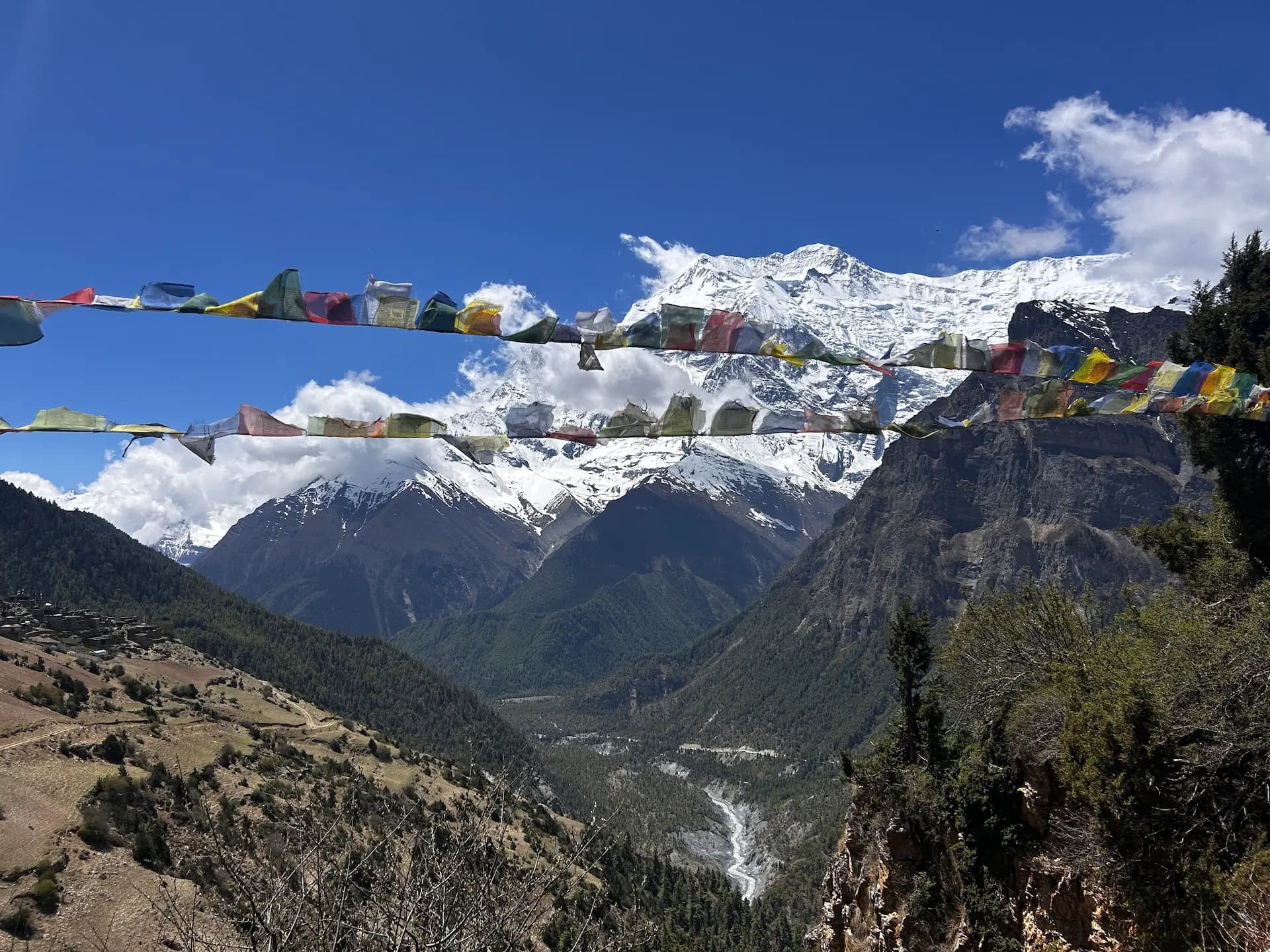
The Annapurna Base Camp Trek in October is a high-altitude Himalayan trekking route that leads through the Annapurna Conservation Area and Modi Khola valley to Annapurna Base Camp at 4,130 m (13,550 ft). October brings the post-monsoon transition that makes the route particularly suited to trekking, with generally dry trails, clearer mountain views, green forests, harvested terraces, and relatively stable daytime conditions. The trail passes through Ghandruk, Chhomrong, Bamboo, Deurali, Machhapuchhre Base Camp (MBC), and the Annapurna Sanctuary, with views of Annapurna I, Annapurna South, Machhapuchhre, Hiunchuli, and Gangapurna. Temperatures change sharply with elevation, from warm conditions around Pokhara to freezing nights above 3,200 m and approximately −4 to −8 °C at ABC.
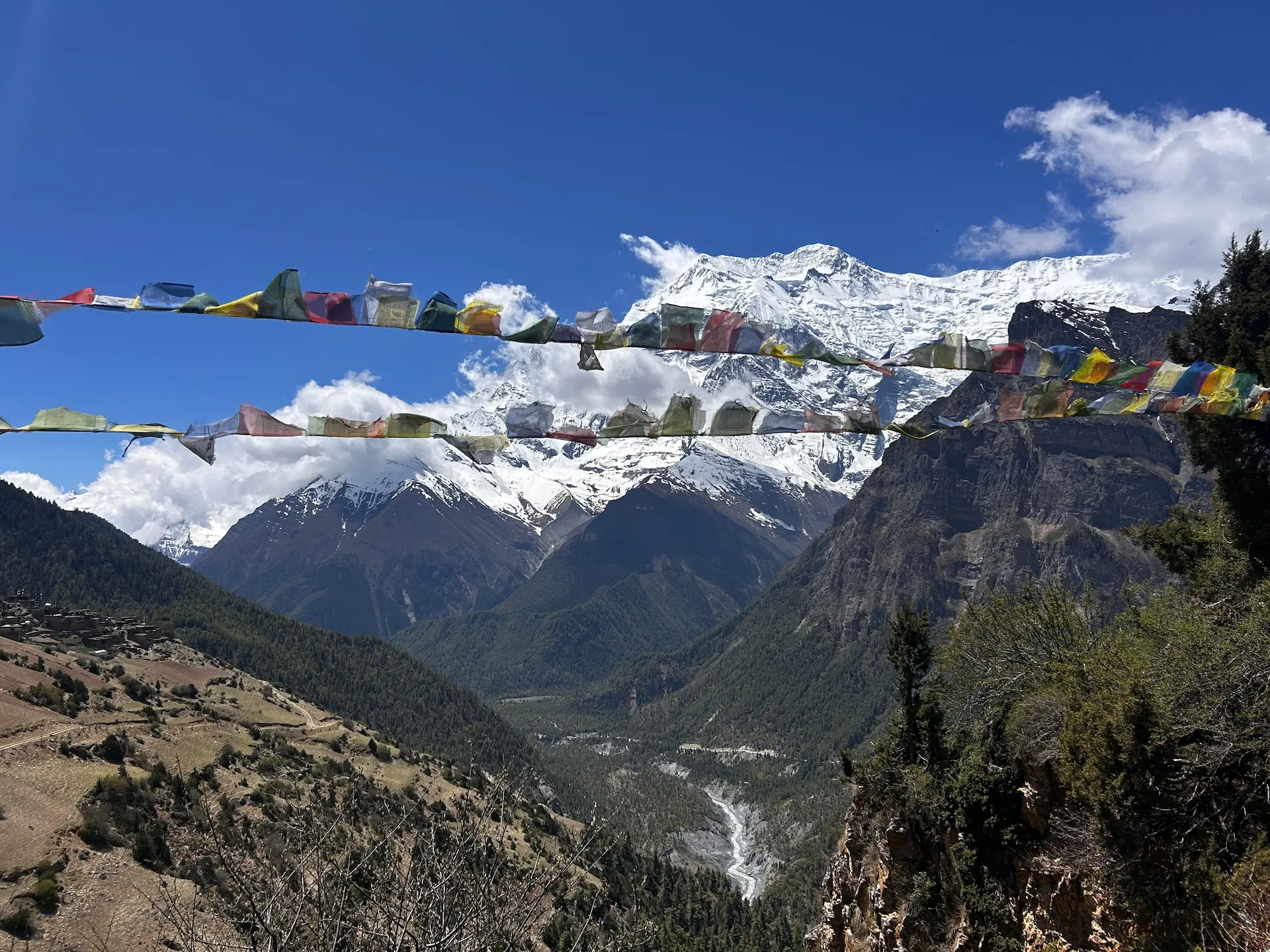
October also places the Annapurna Base Camp trek at the centre of Nepal’s autumn trekking season, making crowds, accommodation, weather changes, snowfall, and transport planning important parts of the experience. The Dashain period from 11–25 October 2026 can increase demand for transport and lodge beds, while late October can bring a higher risk of snow and weather-related disruption at higher elevations. The 2026 monsoon floods and landslides also affected roads, bridges, and lower-route access around Ghandruk, Birethanti, and the Kimrong Khola. This guide covers the October ABC trek from trail conditions and weather by altitude to route options, daily distances, difficulty, acclimatization, packing, training, permits, insurance, accommodation, and trekking-agency planning.
Why Is October Considered a Popular Month for the Annapurna Base Camp Trek?
October is popular because the monsoon has ended, trails are dry, and the Annapurna Sanctuary shows its widest mountain views. Late September to November forms Nepal's autumn peak season, and October sits at its centre with the most stable weather of the year.
Annapurna Base Camp (ABC) sits at 4,130 m (13,550 ft) inside the Annapurna Sanctuary, a glacial basin ringed by Annapurna I (8,091 m), Machhapuchhre (6,993 m), and Hiunchuli (6,441 m). The Annapurna Conservation Area covers 7,629 square kilometres and ranks as Nepal's largest protected area. October gives trekkers 3 advantages there: dry stone steps, cloudless mornings, and lodges running at full capacity with hot meals and fixed routines.
What Makes October Part of Nepal’s Peak Trekking Season?
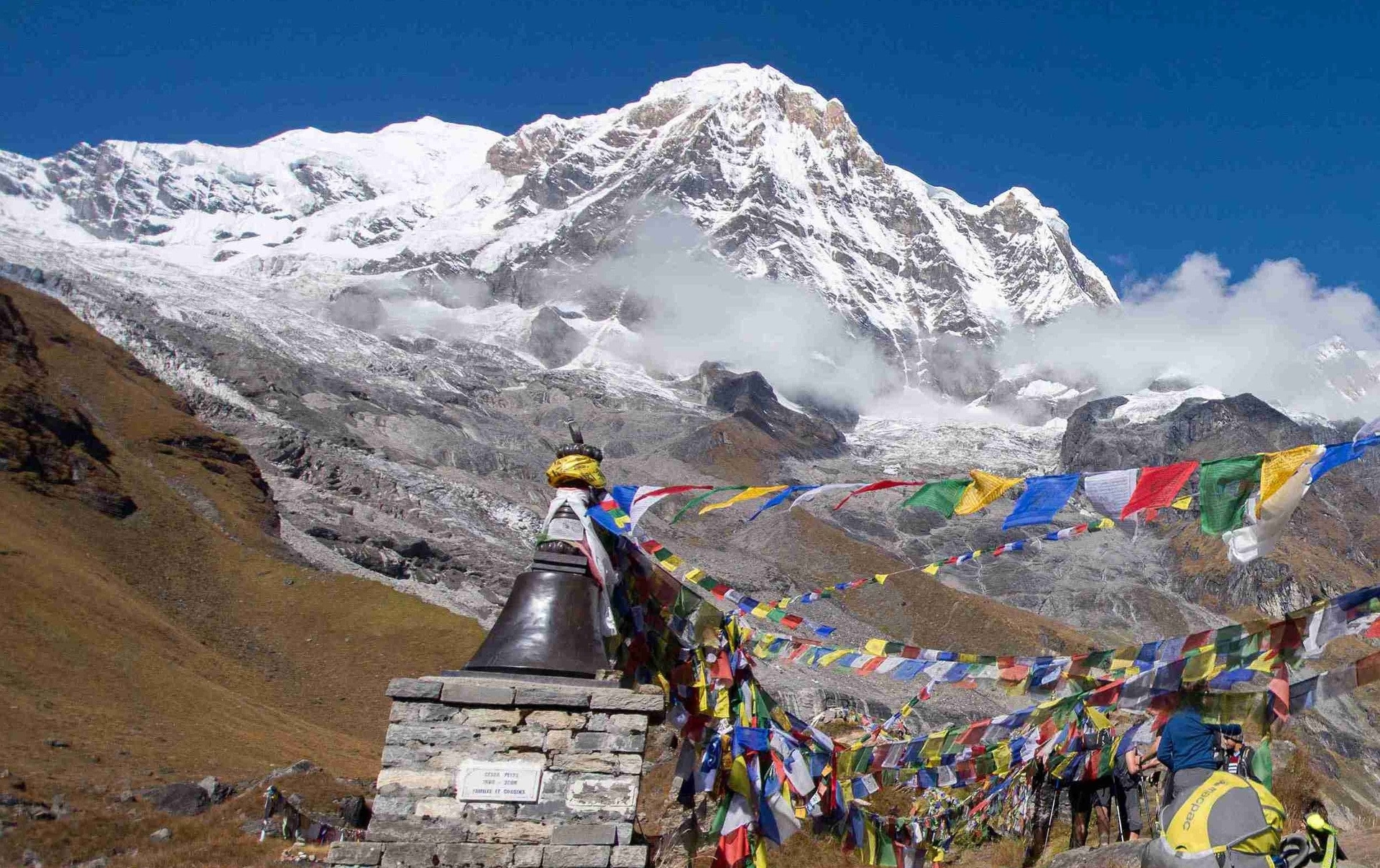
October belongs to Nepal's peak season because the summer monsoon withdraws from the western Himalaya by late September, humidity drops, and stable high pressure settles over the range. Nepal has 2 peak trekking windows: late September to November, and March to May.
Arrival data shows the shift. According to the Nepal Tourism Board, arrivals rose from 78,711 in September 2025 to 128,443 in October 2025, a 63% jump in one month. October alone produced 11% of Nepal's 1,158,459 international arrivals in 2025. The Annapurna region absorbs a large share. The Annapurna Conservation Area Project (ACAP), the body that manages the conservation area, reported over 48,500 foreign visitors in March 2026. Its chief, Dr Rabin Kadariya, stated that 40% of tourists arriving in Nepal visit the region.
November brings colder nights and marginally clearer air. October brings warmer nights, festivals, and larger crowds.
What Can Trekkers Expect From October ABC Trail Conditions?
Trekkers can expect dry stone steps, firm forest paths, and clear skies from Nayapul to Machhapuchhre Base Camp (MBC), with morning frost above Deurali after mid-October. The 2026 monsoon damaged bridges and roads near Ghandruk, so current trail status matters more than usual.
The 2026 monsoon reshaped the lower trail. The Kathmandu Post, OnlineKhabar, and the Gandaki chapter of the Trekking Agencies' Association of Nepal (TAAN) reported 3 events:
12–13 July 2026: A landslide dammed the Kimrong Khola, the burst flood swept away the suspension bridge at Ghurjung, and the vehicle road to Ghandruk closed.
18 August 2026: A Modi Khola flood damaged the road near Birethanti, and the road had not fully reopened by 8 September.
8 September 2026: A second landslide blocked the Kimrong Khola for about 6 hours, police asked residents of Nayapul and Birethanti to move to safe ground, and the river returned to normal flow overnight.
Agency reports from July and August describe the trail as walkable through rerouted sections. Ask your operator for a written trail-status update 72 hours before departure, and add 1 buffer day between Pokhara and the trailhead.
What Is the Weather Like on the Annapurna Base Camp Trek in October?
October weather on the ABC trek is dry and stable: sunny days of 12–20 °C at lower altitudes, freezing nights above 3,200 m, and −4 to −8 °C at ABC. Rain is uncommon, snow is unlikely before 20 October, and morning visibility reaches 100 km.
Temperature falls 6.5 °C for every 1,000 m of altitude gain, a rate meteorologists call the lapse rate. The trail climbs 3,060 m from Nayapul to ABC, so trekkers cross a 20 °C temperature gradient in 5–6 walking days. The narrow Modi Khola valley funnels wind and cloud toward the sanctuary, which explains why the Pokhara forecast rarely matches conditions at ABC. Read a mountain-specific forecast each evening and check conditions with the ACAP checkpost and lodges at Chhomrong.
What Temperatures in October Can You Expect at Different Altitudes?
Expect 20–27 °C in Pokhara, 12–18 °C by day at Chhomrong and Bamboo, 8–12 °C at Deurali, and 5–10 °C at ABC. Night temperatures fall to 0 °C near Deurali, −3 °C at MBC, and −4 to −8 °C at ABC.
The table below lists typical October daytime and night-time ranges for 7 stops, based on trekking-season observations and the 6.5 °C lapse rate.
Stop | Altitude | Daytime (°C) | Night (°C) |
Pokhara | 822 m | 22–27 | 15–18 |
Ghandruk | 1,940 m | 15–20 | 8–11 |
Chhomrong | 2,170 m | 12–18 | 5–8 |
Bamboo | 2,310 m | 12–18 | 4–7 |
Deurali | 3,230 m | 8–12 | −2 to 0 |
MBC | 3,700 m | 6–10 | −6 to −3 |
ABC | 4,130 m | 5–10 | −8 to −4 |
Nights above 3,200 m decide your comfort. Lodge rooms are unheated, and a room at ABC holds air near −5 °C on a clear night. A sleeping bag with a −10 °C comfort rating turns that cold into usable sleep.
How Much Rainfall Can Occur During October?
October rainfall along the lower ABC trail averages about 60 mm, falling as short afternoon showers below 2,500 m, mostly in the first half of the month. Above Deurali, October is largely dry.
Climate model data for the Sinuwa–Dovan corridor puts October precipitation near 60 mm. The monsoon delivers 80–90% of the region's annual rainfall between June and September, so October marks a sharp drop. Early October remains the exception. Heavy rain in early October 2025 triggered deadly landslides in Ilam district in eastern Nepal, and saturated slopes stay unstable for weeks after the rain stops. The Bamboo–Deurali gorge carries the highest landslide risk on the ABC route in the first days of the month. Leeches, a monsoon feature below 2,500 m, are largely absent in October. Carry a rain shell and a pack cover for the showers that remain.
What Are the Chances of Snow Around Annapurna Base Camp in October?
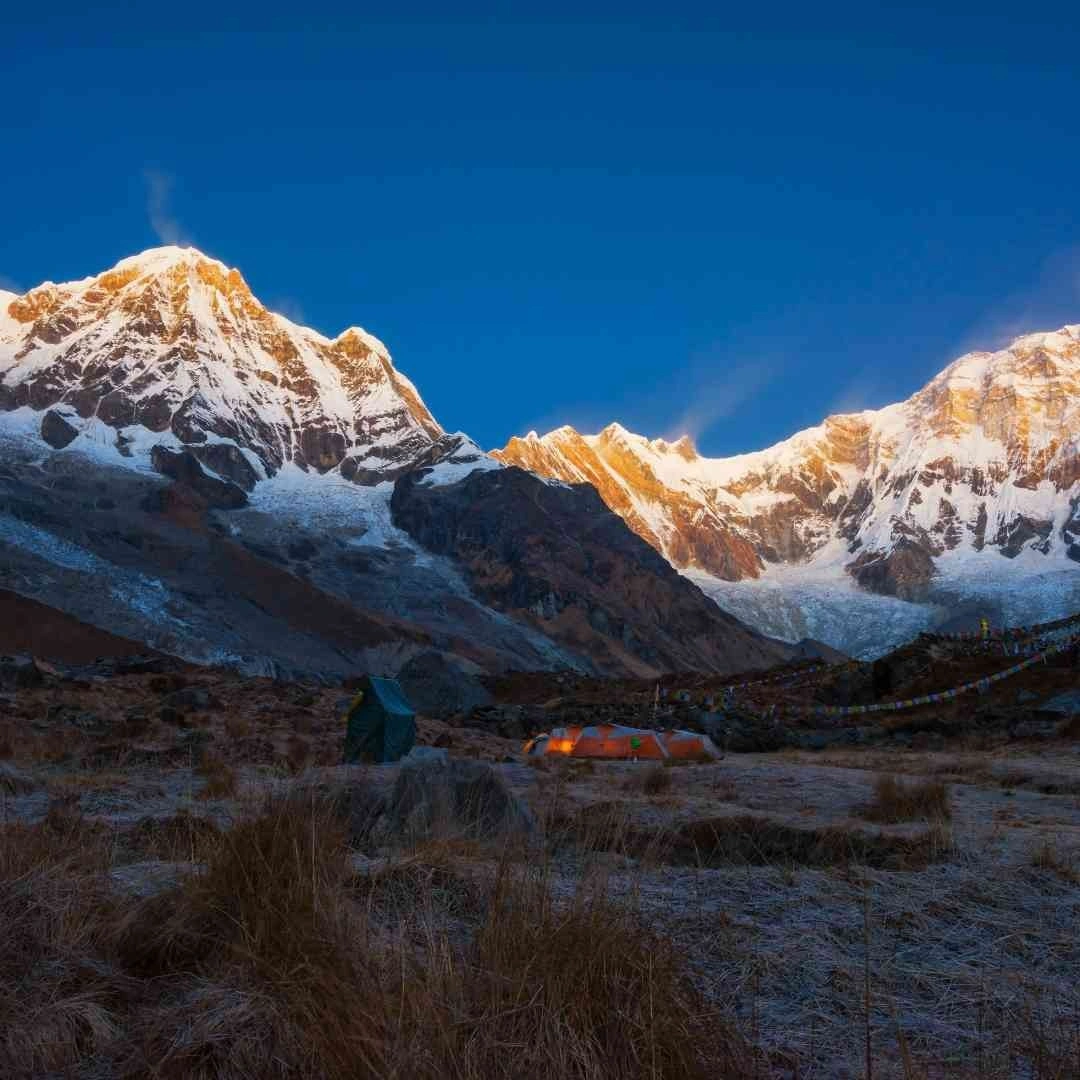
Snow at ABC is uncommon before 20 October and becomes a real possibility in the last 10 days of the month, when Bay of Bengal cyclone remnants and western disturbances reach the range. Cyclone Hudhud in 2014 and Cyclone Montha in 2025 show what those systems do to the Annapurna region.
Bay of Bengal cyclone activity peaks in October and November. Remnants push moisture west, where it meets cold air over the Himalaya and falls as snow. According to AFP, the October 2014 Hudhud blizzard killed 43 people in what it described as Nepal's worst trekking disaster.
In 2025, the Department of Hydrology and Meteorology tied heavy snow to Cyclone Montha and a western disturbance. Snowfall began around 27 October, peaked between 31 October and 1 November, and cleared by 2 November. Kaski's district administration barred trekking to ABC from 27 to 31 October. Security forces rescued 72 tourists, including 17 foreigners, stranded by snowfall in the district on 30 October.
Four steps manage the risk:
Schedule your ABC night before 25 October.
Check the 3-day forecast from Nepal's Department of Hydrology and Meteorology each evening.
Agree a turnaround rule with your guide: descend when snow starts falling above MBC.
Carry lightweight microspikes for any departure after 22 October.
How Do Daytime and Nighttime Temperatures Differ on Annapurna Trail in October?
Day-to-night swings on the ABC trail reach 15 °C in October. A 14 °C afternoon at Deurali drops to −1 °C by 5 a.m. because clear, dry air releases heat quickly after sunset.
The daily rhythm stays consistent. Frost forms overnight above 3,000 m. Direct sun reaches most of the trail between 7:00 and 8:30 a.m. Wind and cloud climb the Modi Khola valley after 1 p.m., and fog settles over Deurali around 5 p.m. Start walking at 6:30 a.m. and reach the night stop by 2 p.m.
Wear a base layer and fleece at dawn, strip to a T-shirt by 10 a.m. below Chhomrong, and put the down jacket on at every stop above MBC. Ultraviolet radiation at 4,000 m burns exposed skin even at 8 °C, so apply SPF 50 before the sun clears the ridge.
How Crowded Is the Annapurna Base Camp Trek in October?
The ABC trek is crowded in October, especially from Ghorepani to MBC. Crowds peak during Dashain (11–25 October 2026), when international trekkers share the trail with Nepali and Indian holidaymakers, and lodges above Deurali fill by mid-afternoon.
According to the Nepal Tourism Board, October 2025 arrivals included 17,298 Indian visitors (13.5%), 13,286 Americans, 8,718 Britons, 6,755 Chinese, and 6,366 Germans. Those 5 markets produced over 40% of the month's arrivals. Vijayadashami, the main Dashain day, falls on 20 October in India and 21 October in Nepal in 2026, so Indian and Nepali holiday travel overlaps the international peak. Nepal's official Dashain holidays run through 23 October. Domestic visitors add to the count during long holidays, a pattern ACAP also noted for the Nepali New Year in April 2026.
Which Sections of the ABC Trek in October Tend to Be the Busiest?
The busiest sections are the Ghorepani–Poon Hill sunrise route, the Chhomrong staircase, the Bamboo–Dovan corridor, and the final 2 hours to ABC. MBC and ABC fill first because both offer limited beds above 3,700 m.
Four pinch points explain the pattern:
Poon Hill (3,210 m): Trekkers from every Ghorepani lodge climb at 4:30 a.m., and the viewpoint fills by 5:30 a.m.
Chhomrong (2,170 m): Groups from Poon Hill, Ghandruk, and Jhinu converge here, and the ACAP checkpoint adds a queue at peak hours.
Bamboo–Dovan (2,310–2,600 m): Mule trains use the narrow gorge path up to Dovan, where animals turn back. Step to the uphill side and let them pass.
MBC to ABC (3,700–4,130 m): A single line of trekkers covers the last 2 hours, and the ABC sunrise draws every lodge outside at once.
Common mistake we see: reaching MBC after 3 p.m. in peak weeks, when the dining-hall floor is the only bed left.
How Can You Avoid the Largest Crowds in Annapurna Trail in October?
Avoid the largest crowds by trekking in the 1–9 October or 26–31 October windows, leaving at 6:00 a.m., skipping Poon Hill on peak days, and choosing itineraries that bypass Ghorepani. Each quiet window trades crowds for a different risk.
The table below compares 3 windows of the 2026 October calendar by crowd level, weather, and main trade-off.
Window | Crowd level | Weather | Main trade-off |
1–9 October | Moderate | Leftover showers, damp forest | Landslide risk in the Bamboo–Deurali gorge |
10–25 October (Dashain 11–25) | Highest | Most stable, clearest skies | Full lodges, sold-out transport |
26–31 October | Lower after Dashain | Colder nights | Cyclone and snow risk, as in 2025 |
The middle window offers the most reliable weather and the most competition for beds. The outer windows offer space and carry more weather risk.
Direct itineraries from Nayapul or Jhinu through Chhomrong skip Ghorepani and remove the 2 busiest days. Khopra Danda, a ridge trek reaching 3,660 m, draws far fewer trekkers than Chhomrong or Ghandruk and suits a second Annapurna trip.
Should You Book Accommodation in Advance for ABC Trek in October?
Yes. Book Kathmandu and Pokhara hotels and Kathmandu–Pokhara flights 4–6 weeks ahead for October, and reserve MBC and ABC beds through your guide. Lodges below Chhomrong seldom fill, but the 2 upper stops fill by mid-afternoon in peak weeks.
The Kathmandu–Pokhara flight takes 25 minutes, and the tourist bus takes 6–7 hours over roughly 200 km. Both sell out around Dashain, and weather delays hit flights.
Lodge rooms are twin-share with foam mattresses and blankets, and dormitory beds appear at ABC in busy weeks. Guides phone ahead from Bamboo or Deurali to hold upper beds. Nepali citizens can trek without a guide, and independent Nepali trekkers who arrive unbooked between 11 and 25 October often sleep in dining halls.
What Is the Annapurna Base Camp Trek Route Like in October?
The ABC route climbs 3,060 m from Nayapul (1,070 m) to Annapurna Base Camp (4,130 m) through terraced Gurung villages, rhododendron and bamboo forest, and the Modi Khola gorge before opening into the Annapurna Sanctuary. In October, paddy terraces below Ghandruk turn gold at harvest, forests stay green, and stone staircases run dry.
Where Does the Annapurna Base Camp Trek Usually Start?
The ABC trek usually starts at Nayapul (1,070 m), a 90-minute drive from Pokhara. Poon Hill itineraries start at Banthanti (2,210 m), a 3-hour drive from Pokhara, and Ghandruk starts depend on road status after the 2026 floods.
Pokhara (822 m) is the gateway city. Trekkers reach it from Kathmandu (1,355 m) by a 25-minute flight or a 6–7 hour bus ride. Birethanti (1,025 m), a short walk from Nayapul, hosts the first ACAP checkpoint, and rangers verify permits there and again at Chhomrong. Confirm road status before choosing the start point, because the July and August 2026 floods cut vehicle access to Ghandruk and damaged the Birethanti road.
How Many Days Does the October ABC Trek Typically Take?
The October ABC trek typically takes 7–9 days from Pokhara on the direct route and 10–12 days from Kathmandu with Poon Hill. A representative 12-day itinerary covers 76 km over 8 walking days, an average of 9.5 km per day.
The table below lists daily distance, walking time, and sleeping altitude for the 8 walking days of a 12-day itinerary that includes Poon Hill and ends at Jhinu Danda.
Day | Route | Distance | Time | Sleep altitude |
2 | Banthanti → Ghorepani | 6.3 km | 3–4 h | 2,880 m |
3 | Poon Hill → Tadapani | 11.1 km | 5–6 h | 2,630 m |
4 | Tadapani → Chhomrong | 8.6 km | 5 h | 2,170 m |
5 | Chhomrong → Bamboo | 7.6 km | 5 h | 2,317 m |
6 | Bamboo → Deurali | 7.1 km | 5 h | 3,200 m |
7 | Deurali → ABC | 9.3 km | 5 h | 4,130 m |
8 | ABC → Bamboo | 16.4 km | 6–7 h | 2,317 m |
9 | Bamboo → Jhinu Danda, drive to Pokhara | 9.6 km | 5 h | 822 m |
Days 1, 10, 11, and 12 cover arrival, the flight to Kathmandu, a rest day, and departure. Add 1 weather buffer day in October, since the 2025 closures lasted 5 days (27–31 October).
What Are the Main Villages and Stops Along the Annapurna Route?
The route passes 11 main stops before ABC: Nayapul, Birethanti, Ghorepani or Ghandruk, Tadapani, Chhomrong, Sinuwa, Bamboo, Dovan, Himalaya, Deurali, and MBC.
The table below lists altitude and role for the stops trekkers use most.
Stop | Altitude | Role on the route |
Birethanti | 1,025 m | First ACAP checkpoint |
Ghorepani | 2,880 m | Base for Poon Hill sunrise (3,210 m) |
Tadapani | 2,630 m | Rhododendron forest, views of Machhapuchhre and Annapurna South |
Chhomrong | 2,170 m | Largest Gurung village, permit check |
Bamboo | 2,310 m | Bamboo forest, gorge entry |
Dovan | 2,600 m | Mule limit, first alpine air |
Himalaya | 2,920 m | Avalanche-prone approach begins |
Deurali | 3,230 m | Treeline stop, freezing nights |
MBC | 3,700 m | Machhapuchhre Base Camp, 2 hours below ABC |
ABC | 4,130 m | Sanctuary floor, sunrise viewing |
Jhinu Danda | 1,780 m | Hot springs on the descent |
Chhomrong is the last stop where a rest day costs little. Above Bamboo, lodges shrink and beds get scarce.
What Is the Highest Point of the Annapurna Base Camp Trek?
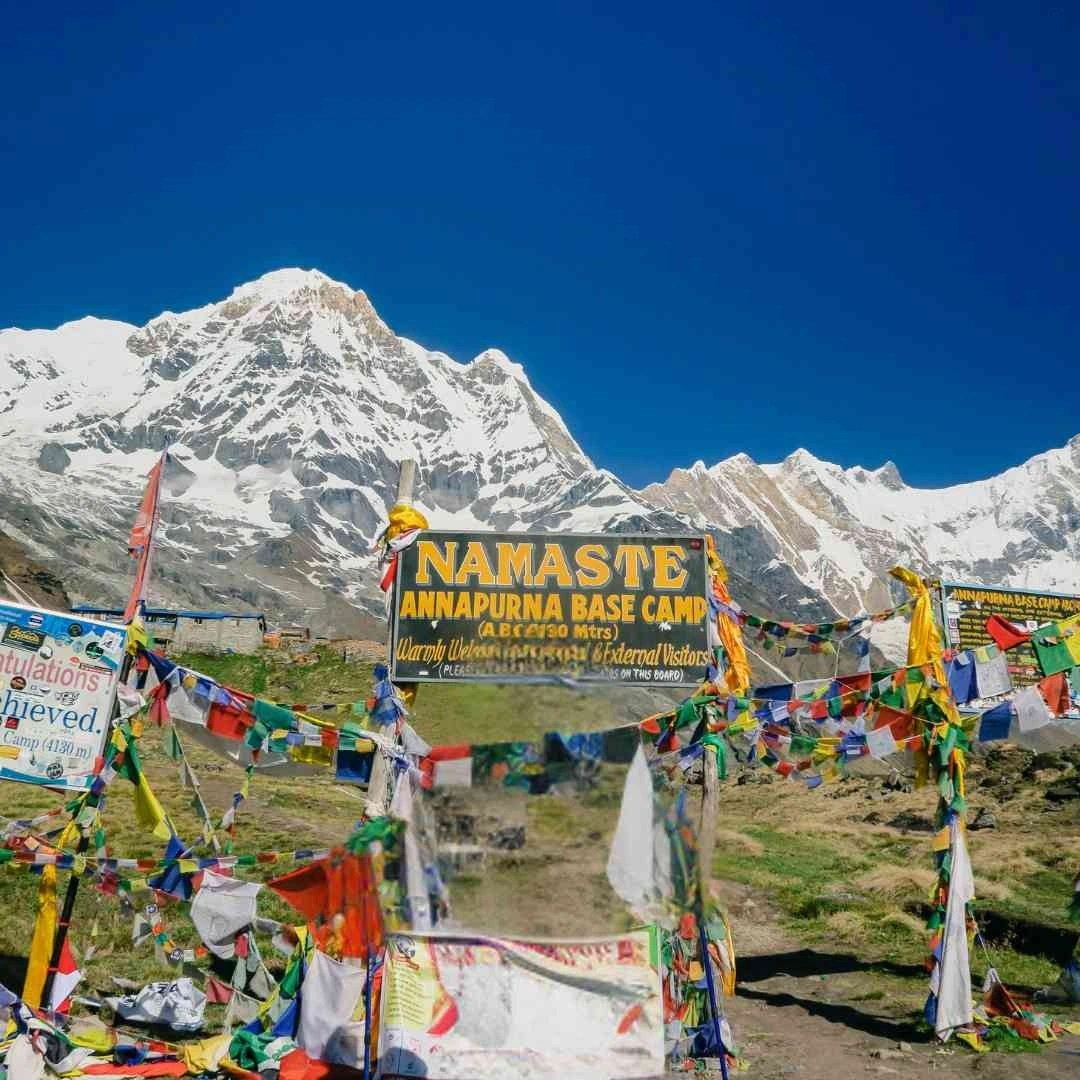
The highest point is Annapurna Base Camp at 4,130 m (13,550 ft). Poon Hill (3,210 m) is the highest point on the Ghorepani approach, and Machhapuchhre Base Camp (3,700 m) is the last major stop before ABC.
Annapurna I (8,091 m) is the world's 10th-highest mountain and the first 8,000 m peak ever climbed, by Maurice Herzog and Louis Lachenal's French expedition in 1950. The sanctuary's rim peaks stand 1–2 km from the lodges: Annapurna South (7,219 m), Gangapurna (7,455 m), Annapurna III (7,555 m), Machhapuchhre (6,993 m), and Hiunchuli (6,441 m). Sunrise around 6:00 a.m. in mid-October lights Annapurna I first.
What Is the October Annapurna Base Camp Trek Difficulty?
The October ABC trek is moderately difficult. It demands 5–7 hours of daily walking, thousands of stone steps, and a night at 4,130 m, but no technical climbing skills. Altitude and stairs decide the difficulty, not distance. Dry October trails remove the monsoon's mud and leeches, which leaves cold and crowds as the main challenges.
How Challenging Are the Daily Walking Distances of ABC Trek?
Daily distances range from 6.3 km to 16.4 km, with walking times of 3–7 hours. The hardest days are Tadapani to Chhomrong (stairs), Deurali to ABC (altitude gain), and ABC to Bamboo (16.4 km, 1,813 m descent).
The route averages 9.5 km per walking day, but the staircases around Chhomrong add thousands of steps in both directions. The descent from ABC to Bamboo drops 1,813 m in 6–7 hours and loads the quadriceps and knees harder than any ascent day. Trekking poles cut that load.
Common mistake we see: sprinting through days 2 and 3, then arriving at Chhomrong with blisters and sore knees before the hard section starts. Hold a pace of 2 km per hour, which matches the timings in the itinerary above.
How Does Altitude Affect Trekkers in October?
Above 3,000 m, each breath delivers about 30% less oxygen than at sea level, and at ABC (4,130 m) the gap reaches about 39%. The body responds with faster breathing, a higher heart rate, and disturbed sleep, and acute mountain sickness (AMS) affects some trekkers.
AMS is a hypoxia-related illness that presents as headache plus nausea, fatigue, dizziness, or poor sleep, typically 6–12 hours after arrival at a new sleeping altitude. Its severe forms, high-altitude pulmonary edema (HAPE) and high-altitude cerebral edema (HACE), are life-threatening and require immediate descent. October adds 2 stressors: freezing nights that fragment sleep and dry air that accelerates dehydration.
Fitness and nationality do not predict AMS. A Nepali trekker from Biratnagar (80 m) faces the same risk as a visitor from Berlin, and a Kathmandu resident (1,355 m) gains little.
How Can You Reduce the Risk of Altitude Sickness?
Reduce AMS risk by limiting sleeping-altitude gain to 500 m per night above 3,000 m, drinking 3–4 litres of water daily, avoiding alcohol, and descending when symptoms worsen. Acetazolamide (Diamox) at 125 mg twice daily is an option after a doctor's consultation.
According to the Wilderness Medical Society's altitude illness guidelines, trekkers above 3,000 m limit sleeping-altitude gain to 500 m per day and take a rest day every 3–4 days. Most direct ABC itineraries sleep at Deurali (3,200 m) and then ABC, a gain of 930 m. A night at MBC (3,700 m) splits that gain into +500 m and +430 m. Request the MBC night when booking.
Six habits keep the risk low:
Ascend gradually, and add a rest day at Chhomrong or Deurali when symptoms start.
Drink 3–4 litres of water daily.
Eat carbohydrate-rich meals such as dal bhat, which fuel high-altitude climbs.
Avoid alcohol and sleeping pills.
Track pulse oximeter readings each evening, since resting oxygen saturation typically falls to 80–90% at 4,000 m.
Descend 300–500 m when headache, vomiting, or unsteady walking appears.
What Should You Pack for the Annapurna Base Camp Trek in October?
Pack a five-layer clothing system, a down jacket, broken-in boots, trekking poles, a −10 °C sleeping bag, a rain shell, sun protection, and a headlamp. October demands 2 packing modes: T-shirt weather below Chhomrong and sub-zero gear above Deurali.
Standard porter loads cap at 10 kg per trekker when 1 porter carries for 2, so limit the duffel to 10 kg and the daypack to 5–6 kg. The Equipment Checklist lists the full gear set.
Which Clothing Layers Are Essential for October?
Five layers cover October: a moisture-wicking base layer, an insulating fleece, a down jacket rated to −10 °C, a waterproof shell, and quick-dry trekking trousers. Add thermal bottoms, a warm hat, insulated gloves, and 4 pairs of socks.
Pack 2 synthetic or merino T-shirts, 1 long-sleeve thermal top, 1 thermal bottom, 2 pairs of trekking trousers, 4 pairs of merino socks, a sun hat, a wool beanie, a neck buff, and liner gloves plus insulated gloves. Avoid cotton, which stays wet and chills fast at 4,000 m. What most trekkers overlook: a warm hat and insulated gloves for the pre-dawn wait before the 6:00 a.m. sunrise at ABC, when the air sits near −5 °C.
What Footwear and Trekking Gear Should You Bring?
Bring waterproof mid-cut boots broken in over at least 50 km, camp shoes, 2 trekking poles, a 30–35 L daypack, a 1-litre insulated bottle, a headlamp, and water purification tablets. Poles cut knee load on the 1,813 m descent from ABC to Bamboo.
Add sunglasses with category 3–4 lenses, SPF 50 sunscreen, and SPF lip balm, because ultraviolet exposure at 4,130 m runs high and snow glare returns in late October. Lodges sell boiled or filtered water, and purification tablets provide the backup. Lightweight microspikes suit departures after 22 October.
What Rain and Cold-Weather Essentials Are Useful?
A waterproof jacket, rain trousers, a 30-litre pack cover, a down jacket, insulated gloves, a beanie, and a sleeping bag liner handle October's 2 risks: leftover showers below 2,500 m and freezing nights above 3,200 m.
A 1-litre bottle filled with hot water and placed inside the sleeping bag warms the bed through the night. A dry bag protects electronics from showers. Keep the phone and power bank inside the sleeping bag overnight, because cold drains batteries fast. Hand warmers help during the pre-dawn wait for the ABC sunrise.
What Documents and Personal Items Should You Carry?
Carry your passport (valid 6 months), Nepal visa, printed ACAP permit, 4 passport photos, insurance details, and Nepali rupees. Nepali trekkers carry a citizenship certificate or national ID card, and Indian nationals carry a passport or voter ID card.
The 2026 rules break down as follows:
ACAP permit: NPR 3,000 (about US$23) for foreign nationals, NPR 1,000 for SAARC nationals, and free for children under 10. Nepal Tourism Board counters in Kathmandu and Pokhara issue it, and the trail sells none. Carry printed copies, since phone photos fail at checkpoints.
TIMS card: Enforcement varies by checkpoint in 2026. Where checkpoints ask, the TIMS card costs NPR 2,000 for foreign nationals and NPR 1,000 for SAARC nationals, which your trekking agency organizes.
Licensed guide: Since 1 April 2023, foreign trekkers in Annapurna trek with a licensed guide booked through a registered agency.
Visa: US$30 for 15 days, US$50 for 30 days, and US$125 for 90 days, paid in cash on arrival. Nepal Visa explains entry steps, and Indian citizens enter visa-free.
Carry Nepali rupees for drinks, showers, phone charging, and tips, because card payments do not work on the trail.
How Should You Prepare for the Annapurna Base Camp Trek in October?
Prepare over 8–12 weeks with cardio, stair climbing, loaded hikes, and leg strength work, then secure insurance covering 4,500 m and helicopter evacuation. October's crowds make early bookings part of preparation.
How Can You Train for the ABC Trek Before Departure?
Train for 8–12 weeks with 3 aerobic sessions, 2 strength sessions, and 1 long hike per week. Build the long hike from 2 hours with a 4 kg pack to 6 hours with an 8 kg pack, and add 500 vertical metres of stairs or hill repeats twice weekly.
Four training blocks cover the demands of the route:
Run, cycle, or brisk-walk for 45–60 minutes at a conversational pace.
Climb stairs or hill repeats for 500 vertical metres.
Squat, lunge, and step down with control to condition knees for the 1,813 m descent.
Hike with a loaded 8 kg pack once weekly.
Kathmandu trekkers train on Shivapuri (2,732 m) and Champadevi (2,278 m), and Pokhara trekkers train on Sarangkot (1,592 m). International trekkers replicate the load with stair machines and treadmills set to a 10–15% incline. Wear the boots and socks you will use on the trail.
What Fitness Level Is Recommended for the October ABC Trek?
The recommended fitness level is walking 5–6 hours with a 5 kg daypack over 600–800 m of elevation gain, and repeating that effort on 6 consecutive days. Aerobic base matters more than age.
Test yourself 3 weeks before departure: hike uphill for 90 minutes with 5 kg without stopping, then repeat the next day. Trekkers who finish comfortably match the demand of the Deurali day. Book a medical check before paying a deposit when you are over 50 or have a heart, lung, or blood-pressure condition.
What Travel Insurance Coverage Should You Have?
Choose travel insurance covering trekking to at least 4,500 m, emergency helicopter evacuation, medical treatment, trip cancellation, and flight delays. Many standard policies stop at 3,000 m, below ABC's 4,130 m.
Check 5 items in the policy:
Altitude limit: 4,500 m or higher.
Evacuation: helicopter rescue from ABC, which costs US$3,000 or more, billed to the insurer directly.
Medical: hospital treatment in Pokhara or Kathmandu.
Cancellation: weather closures such as Myagdi's 27–31 October 2025 ban, and river blockages such as the September 2026 Kimrong Khola event.
Delays: missed connections after Pokhara flight cancellations.
Save the policy number and the insurer's 24-hour emergency line in your guide's phone. Nepali trekkers verify whether their domestic health cover includes helicopter rescue.
How Can You Plan the Annapurna Base Camp Trek in October With a Trekking Agency?
Plan the trek with a licensed agency registered with the Trekking Agencies' Association of Nepal (TAAN). The agency arranges the ACAP permit, licensed guide, porters, lodge beds, transport, and daily weather monitoring, tasks that carry extra weight in October's crowds.
Foreign trekkers already need a registered agency for the guide requirement. Verify 5 items before paying a deposit:
Registration: company registration and TAAN membership.
Licences: guide licence numbers.
Itinerary: sleeping altitudes, including an MBC night.
Policies: weather-closure, refund, and rebooking terms.
Support: staff insurance, oximeter, and first-aid kit.
Ask how the agency handled the 27–31 October 2025 closures. The answer reveals its weather protocol.
Can Nepal Intrepid Treks Help You Plan an Annapurna Base Camp Trek in October?
Yes. Nepal Intrepid Treks & Expedition Pvt. Ltd., based in Nayabazar, Kathmandu, runs a 12-day Annapurna Base Camp Trek with licensed guides, porters, permits, a sleeping bag, and a down jacket included.
Annapurna Base Camp Trek: 12 days, maximum altitude 4,130 m
Route: Kathmandu → Pokhara → Ghorepani and Poon Hill → Chhomrong → ABC → Jhinu Danda → Pokhara → Kathmandu
Included: airport transfers, Kathmandu–Pokhara flights, 3 nights in Kathmandu and 1 night in Pokhara (3-star, breakfast), lodge stays on the trail, 3 meals daily on trek, ACAP and TIMS permits, English-speaking guide, 1 porter per 2 trekkers, oximeter, first-aid kit, sleeping bag, down jacket
Not included: international flights, Nepal visa, travel insurance, tips, drinks
Group pricing per person: US$1,120 solo; US$920 for 2–4 trekkers; US$875 for 5–8; US$815 for 9–12; US$765 for 13–20
Contact: WhatsApp or Viber +977 9851002409 (Santa) and +977 9849009919 (Lal)
According to its TripAdvisor listing, Nepal Intrepid Treks holds a 5.0 rating from 156 reviews, and its website reports over 12 years of operation. Affiliations listed on the site include TAAN, the Nepal Mountaineering Association (NMA), and the Nepal Tourism Board. For October, the team customises itineraries: adding an MBC night, choosing the 1–9 October or 26–31 October window, or planning around Dashain transport. Send your preferred dates and questions by WhatsApp to receive itinerary options. Prices and inclusions update on the website, so confirm current terms at booking.
What Are the Key Takeaways About the Annapurna Base Camp Trek in October?
The Annapurna Base Camp trek in October offers dry trails, clear views, and Nepal's most stable weather, with 3 trade-offs: peak crowds, freezing nights above 3,200 m, and late-month cyclone risk.
Weather: Days run 12–20 °C at lower altitudes, nights fall to −4 to −8 °C at ABC, and rain averages about 60 mm.
Snow risk: Cyclone remnants brought snow in October 2014 and from 27 October to 2 November 2025, so reach ABC before 25 October.
Crowds: Dashain (11–25 October 2026) produces the busiest trail, and 1–9 and 26–31 October are the quieter windows.
Trail status: The July–September 2026 floods damaged bridges and roads near Ghandruk and Birethanti, so confirm status 72 hours before departure.
Route: The trek covers 76 km over 8 walking days and peaks at 4,130 m.
Difficulty: The grade is moderate, and stairs plus the 1,813 m descent test knees more than distance.
Altitude: Limit sleeping-altitude gain to 500 m per night above 3,000 m, and add an MBC night.
Paperwork: ACAP costs NPR 3,000 (about US$23), foreign trekkers need a licensed guide, and insurance must cover 4,500 m with helicopter evacuation.
Plan the Annapurna Base Camp trek in October around 3 decisions: the window (early, Dashain, or late), the sleeping profile (with an MBC night), and the operator (registered, weather-aware, and clear on refunds). Trekkers who settle those 3 decisions early arrive at ABC ready for sunrise over Annapurna I.