Lukla flights for Everest Base Camp connect Kathmandu or Ramechhap (Manthali) Airport with Tenzing–Hillary Airport (LUA), the main air gateway to Nepal's Khumbu region. During spring and autumn, scheduled flights operate primarily from Ramechhap, requiring a 4–5-hour drive from Kathmandu and 15–20 minutes of flying time. In winter and the monsoon, flights generally depart directly from Kathmandu, with an average flight duration of 30–35 minutes.
Lukla flight schedules depend on seasonal weather, mountain visibility, and early-morning flying conditions, making delays and cancellations an important part of Everest Base Camp planning. Trekkers should allow 3 buffer days around their round trip during peak seasons and winter (1 before and 2 after), and 5 days during the monsoon (2 before and 3 after). Understanding departure airports, flight timings, road transfers, and weather-related disruptions helps protect trekking itineraries and international return connections.
Why Do Everest Base Camp Trekkers Fly to Lukla?
Everest Base Camp trekkers fly to Lukla because a 15–35 minute flight replaces days of driving over rough roads or walking from road-heads such as Tham Danda, Phaplu, or Jiri, placing the trek directly on the Khumbu trail at 2,845 meters. Lukla is the closest operational STOL airstrip to Everest Base Camp (5,364 m), as higher airstrips like Syangboche (3,780 m) are not used for commercial fixed-wing passenger services, and no direct motorable road reaches Lukla itself.
Before the airstrip opened in 1964, expedition members and porters walked in from Jiri (roughly 1,900 m) or from the Kathmandu valley. Today, while dirt roads have extended closer to the region (such as roads reaching Tham Danda or Paiya), nearly every standard guided EBC itinerary begins with the flight to Lukla. The sections below cover where the airport sits, why no practical alternative replaces it, and how long the flight lasts.
Where Is Lukla Airport Located?
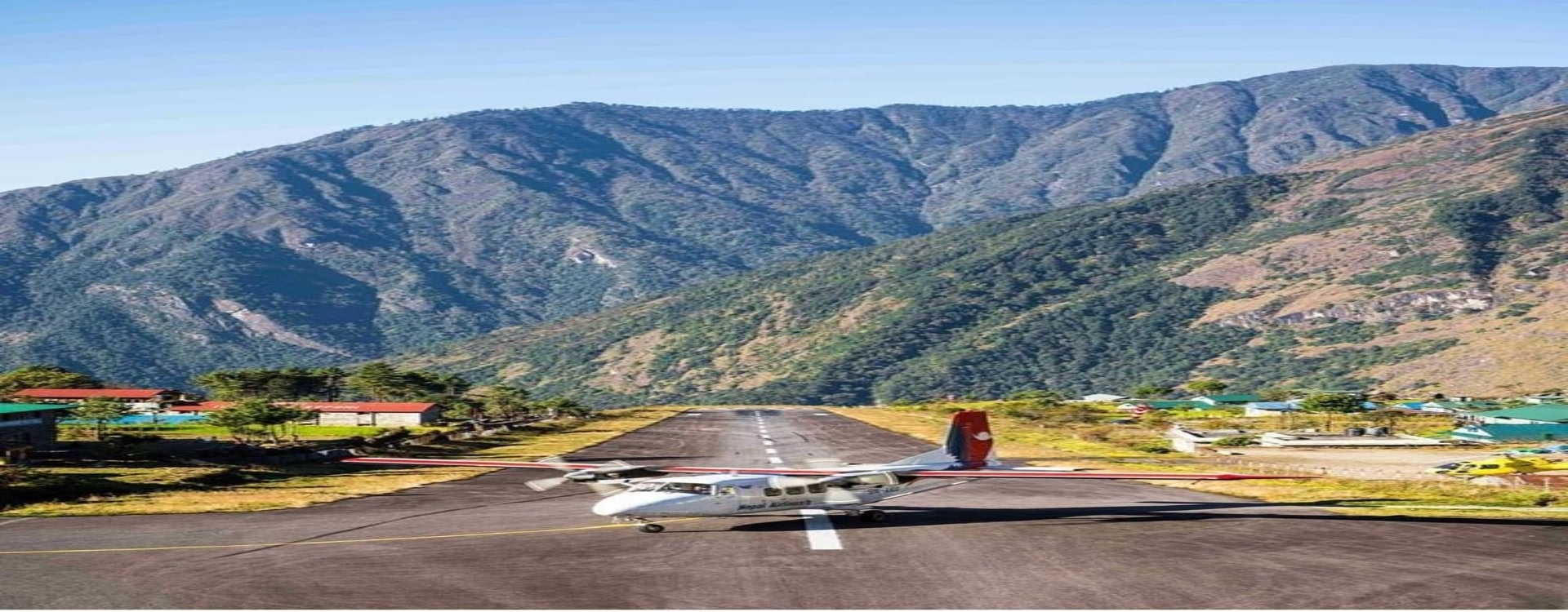
Lukla Airport, officially Tenzing–Hillary Airport (IATA code LUA), sits at about 2,845 meters in Solukhumbu District, Koshi Province, on a ledge above the Dudh Kosi valley. The village of Lukla spreads around the runway, and the Everest Base Camp trail starts a few minutes' walk from the terminal.
The airstrip is roughly 527 meters long, about 30 meters wide, and slopes at an incline to assist deceleration. A mountain wall closes the upper end and a steep drop opens at the lower end. Aircraft land uphill, which slows them down, and take off downhill, which gives them speed. Once pilots commit to the final approach, no go-around is possible.
Sir Edmund Hillary arranged construction of the strip in 1964 to move supplies for the schools and hospitals of his Himalayan Trust. By widely told accounts, local Sherpas packed the first surface down by stamping it with their feet. The runway was paved in 2001, and Nepal renamed the airport in 2008 for Tenzing Norgay and Edmund Hillary, the first two climbers to summit Everest in 1953.
Why Are Lukla Flights Essential for Everest Base Camp Treks?
Lukla flights are essential because no direct road reaches Lukla, and overland alternatives involve lengthy off-road driving followed by additional days of walking. Three main options exist for reaching the Khumbu region:
Fly a fixed-wing aircraft from Kathmandu or Ramechhap (15–35 minutes, about $210–255 one way in 2026)
Ride a shared helicopter from Kathmandu (about $500–800 per seat, based on 2026 operator quotes)
Drive to roadheads such as Tham Danda (1 day walk to Lukla/Surke), Phaplu/Salleri (2–3 days), or Jiri (6–8 days)
One point most guides skip: walking in from lower elevations (like Jiri at ~1,900 m or Phaplu) is better for acclimatization. Climbing in small daily steps gives the body more time to adapt than a 20-minute jump to 2,845 meters. Most trekkers lack a spare week, so the flight dominates. Trekkers who do have the time and want a gentler altitude profile get a real physiological benefit from the long walk.
The most common mistake we see is treating the Lukla flight like a commuter hop. It is a weather-dependent mountain flight, and the rest of this guide shows how to plan around that fact.
How Long Does the Flight From Kathmandu to Lukla Take?
The flight from Kathmandu to Lukla takes 30–35 minutes, and the flight from Ramechhap to Lukla takes 15–20 minutes. The straight-line distance is about 135 km from Kathmandu and about 75 km from Ramechhap, which explains the gap.
Both routes use short take-off and landing (STOL) aircraft, which are planes built to operate from very short runways. The airlines fly STOL aircraft such as the de Havilland Twin Otter and Dornier 228 (typically configured for up to 18–19 passenger seats, though high-altitude payload limits often restrict total weight and payload). The aircraft crosses the foothills, enters the Dudh Kosi valley, and makes a straight-in approach to the uphill runway. Airtime is only part of the picture. Door-to-door journey time differs far more between the two airports, and later sections break that down.
Do Lukla Flights Operate From Kathmandu or Ramechhap?
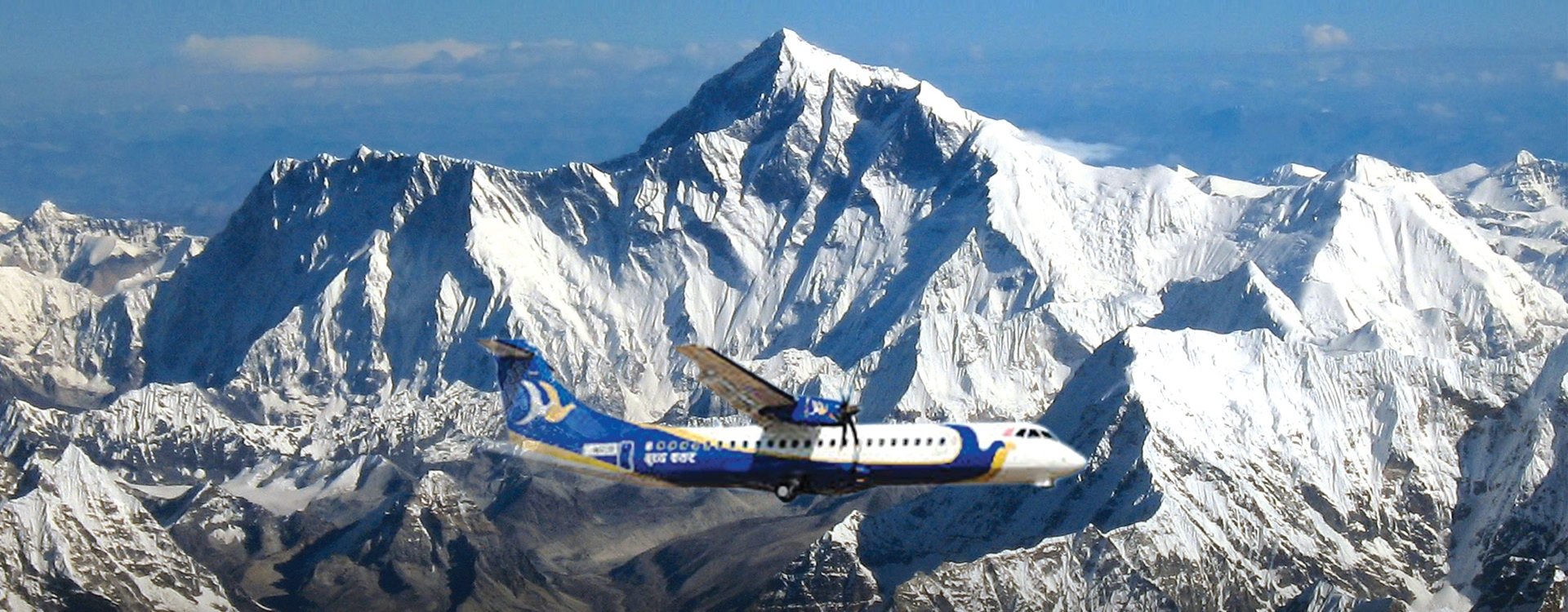
Lukla flights operate from both airports, split by season. Ramechhap (Manthali) Airport handles scheduled flights during spring (mid-March to mid-May) and autumn (late September to November). Kathmandu's Tribhuvan International Airport handles them in winter and during the monsoon.
The Civil Aviation Authority of Nepal (CAAN), the national aviation regulator, coordinates these seasonal flight shifts. Operators publish working seasonal windows of roughly 15 March–15 May and 25 September–30 November, and the airlines confirm them at ticketing based on regulatory directives. For autumn 2026, the Ramechhap window runs from 25 September to 30 November.
When Do Flights Operate Directly From Kathmandu to Lukla?
Flights operate directly from Kathmandu to Lukla in the off-peak months: roughly December to mid-March and mid-May to late September. Air traffic at Tribhuvan International Airport (TIA) is lighter in those months, so Lukla flights fit into the schedule.
Peak-season exceptions exist. A small number of Kathmandu–Lukla movements continue for aircraft repositioning and charters. CAAN has also moved flights back to Kathmandu at short notice when road closures cut off Manthali, according to operator reports.
Direct Kathmandu flights carry a higher fare, about $253–255 one way for foreign trekkers in 2026, compared with about $210 from Ramechhap. Winter flights suffer fewer cloud problems but face early-morning fog. Monsoon flights suffer the opposite: poor visibility closes the airstrip frequently during the monsoon, leading to widespread flight cancellations.
Why Are Lukla Flights Often Rerouted to Ramechhap?
Lukla flights are rerouted to Ramechhap because Kathmandu's single runway cannot absorb international arrivals, domestic departures, and a full Lukla schedule inside the narrow morning weather window. Ramechhap has no international traffic, so Lukla aircraft move without queueing.
According to Republica, CAAN first diverted Lukla flights to Manthali during runway rehabilitation at Tribhuvan, and the same newspaper reported in September 2022 that CAAN had directed airlines to resume operating Lukla flights from Manthali, citing infrastructure upgrades at the Ramechhap airfield. Operators report that the arrangement has repeated in every peak season since. Two mechanics explain why it persists. First, a Kathmandu departure delayed by 90 minutes loses its place in the Lukla weather window and often cancels. Second, the shorter Ramechhap flight lets each aircraft fly more rotations before clouds close the strip. Operators who initially opposed the shift later told Republica that flights take off on time.
Where Is Manthali Airport Located?
Manthali Airport, also called Ramechhap Airport, sits at the town of Manthali, the district headquarters of Ramechhap in Bagmati Province, roughly 132 km by road east of Kathmandu. The town lies on the Tamakoshi River valley at an elevation of about 470–500 meters above sea level.
The airport is small. The apron parks only a few STOL aircraft at once, and the terminal offers basic facilities: a waiting area, tea stalls, and limited seating. Expect no commercial airline lounges. Manthali is a domestic airfield with no international service, and its lower elevation makes early mornings milder than in Kathmandu.
How Far Is Ramechhap From Kathmandu?
Ramechhap is 132 km from Kathmandu by road, a drive of 4–5 hours in normal conditions. The straight-line distance is only about 78 km, so the road runs roughly 1.7 times longer than the crow flies because it winds through ridges and river valleys.
Conditions change the number. Operators report 6–7 hour drives on bad days, particularly where repairs followed the 2024 monsoon floods, and monsoon landslides stretch the time further. Early-morning traffic is light, which keeps the 1:00–2:00 AM departures near the 4–4.5 hour end of the range. Later sections explain how to build the drive into your schedule.
What Is the Difference Between Kathmandu and Ramechhap Lukla Flights?
The difference is the drive versus the flight. Kathmandu flights skip the 4–5 hour road transfer but spend 30–35 minutes in the air. Ramechhap flights require the drive but take only 15–20 minutes and complete more rotations before the weather closes.
The following table compares the two routes across the attributes that affect an EBC itinerary: operating window, distance, transfer, flight time, fare, and best use. Every figure reflects 2026 airline and operator data.
Attribute | Kathmandu → Lukla | Ramechhap (Manthali) → Lukla |
Operating window | Winter and monsoon (roughly Dec–mid-Mar, mid-May–late Sep) | Spring and autumn peaks (roughly 15 Mar–15 May, 25 Sep–30 Nov) |
Road transfer | None (airport is 20–30 minutes from Thamel) | 132 km, 4–5 hours |
Flight time | 30–35 minutes | 15–20 minutes |
Straight-line distance | About 135 km | About 75 km |
Typical hotel pickup | 5:00–6:00 AM | 1:00–2:00 AM |
One-way fare, foreign trekker (2026) | About $253–255 | About $210 |
Airlines | Tara Air, Summit Air, Sita Air | Tara Air, Summit Air, Sita Air |
Weather-window efficiency | Lower (longer rotations, TIA congestion) | Higher (short rotations, no international traffic) |
Best use | Off-peak departures | All peak-season departures |
The table shows a trade-off rather than a winner. Kathmandu saves your sleep. Ramechhap saves your flight.
Which Airport Offers the More Convenient Lukla Flight?
Kathmandu offers the more comfortable Lukla flight, and Ramechhap offers the more reliable one. Convenience means two different things here, and trekkers weigh them differently.
Kathmandu wins on comfort: you wake at a normal hour, check in at a full domestic terminal, and skip 8–10 hours of round-trip driving. Ramechhap wins on outcome: its shorter rotations push more passengers into Lukla during each weather opening. In a short clear window, a passenger at Manthali has a better chance of landing than one at Kathmandu.
Fares narrow the gap too. A Ramechhap ticket costs about $45 less, and a shared Kathmandu–Ramechhap vehicle seat costs about $30 per person based on operator pricing, so the shared-transfer total lands near $240 against $255. Private vehicles cost more.
How Do Flight Durations Compare Between the Two Airports?
Flights from Ramechhap last 15–20 minutes against 30–35 minutes from Kathmandu, so a Ramechhap aircraft completes roughly 3 round trips in the time a Kathmandu aircraft completes 2. That arithmetic is our estimate, not a published schedule, but it shows why CAAN favors Manthali in peak months.
The estimate uses simple numbers. A Ramechhap round trip takes about 65 minutes (20 minutes out, 10 on the ground, 20 back, 15 for turnaround). A Kathmandu round trip takes about 95 minutes (35, 10, 30, 20). Across a four-hour window from 6:00 to 10:00 AM, one aircraft completes about 3.7 Ramechhap rotations or 2.5 Kathmandu rotations. Three airlines multiply that gap across a whole fleet.
How Do Airport Transfers Affect the Overall Journey?
Airport transfers decide the real length of the journey: a Ramechhap departure takes 5.5–7 hours from Kathmandu hotel pickup to Lukla touchdown, while a Kathmandu departure takes 2–3 hours total. The drive adds one long, early-morning departure to the front of the trek.
The first trekking day softens that cost. Lukla to Phakding is a short, mostly downhill walk of 3–4 hours, so tired legs recover on gentle terrain. The return journey carries the heavier burden. Flights from Lukla land at Manthali around mid-morning, and the drive back reaches Kathmandu between 1:00 and 3:00 PM on a clear day. Trekkers who book an international departure the same evening take a real risk.
Two transfer styles exist. Most groups leave Kathmandu at 1:00–2:00 AM and drive straight through. A smaller number drive to Manthali the afternoon before and spend the night in a basic guesthouse, waking around 4:30–5:00 AM to head to the terminal. The overnight option avoids the 1:00 AM wake-up drive but requires an extra travel day on the front end, and guesthouse rooms in Manthali are limited in peak weeks.
Which Route Is Better During Peak Everest Trekking Seasons?
Ramechhap is the better route during peak Everest trekking seasons because it is the route the airlines actually fly. Between mid-March and mid-May and between late September and November, Kathmandu offers almost no scheduled Lukla departures.
Your travel date picks the airport, so the question turns into planning rather than choosing. The table below links each part of the year to its airport and its main risk.
Period | Lukla departure airport | Main risk |
Mid-March to mid-May | Ramechhap (Manthali) | Pre-monsoon haze and afternoon cloud build |
Mid-May to late September | Kathmandu | Monsoon cloud, with visibility closing the strip about 50% of the time |
Late September to November | Ramechhap (Manthali) | Festival-week crowding (Dashain and Tihar), seat shortages |
December to mid-March | Kathmandu | Early-morning fog at Kathmandu, cold-weather delays |
October and early November produce the most reliable morning windows of the year, but they also produce the heaviest demand. Festival weeks tighten both seat supply and vehicle supply for the Manthali drive, so book both early.
What Are the Lukla Flight Timings From Kathmandu and Ramechhap?
Lukla flights depart between roughly 6:00 AM and 10:30 AM from both airports. Ramechhap's first flight operations begin around 6:00 AM as weather permits, so overland transfers leave Kathmandu around 1:00–2:00 AM. Kathmandu departures use the same early window, starting with first light.
The table below shows a typical peak-season Ramechhap morning, from hotel pickup to the first steps on the trail. Times are indicative, and your airline sets the final departure slot.
Clock time | Event |
1:00–2:00 AM | Hotel pickup in Kathmandu |
5:30–6:00 AM | Arrival at Manthali Airport and check-in |
6:00–7:00 AM | First departures begin |
6:30–7:30 AM | Flight to Lukla (15–20 minutes in the air) |
6:50–8:00 AM | Landing, bag collection, and first tea in Lukla |
8:00–9:00 AM | Walk to Phakding begins |
The schedule slides when weather holds aircraft on the ground. A table slot is a position in a queue, not a promise.
What Time Do Morning Flights to Lukla Depart?
Morning flights to Lukla depart from about 6:00 AM, with most scheduled departures running until about 10:30 AM. Some days stretch later when clear weather holds, but clouds usually decide what leaves after 10:30.
Your ticket shows a time, and the time is a slot. Airlines fly in rotation, and departures follow aircraft availability and weather more than the printed order. A 6:30 AM ticket can leave at 6:45 or 9:15. Real-world advice follows from this. Arrive at the airport when your agent tells you, stay near the gate, and pack a warm layer for the wait. Return flights from Lukla follow the same morning pattern, and the earliest departures fill first.
Why Do Ramechhap to Lukla Flights Start Early?
Ramechhap to Lukla flights start early because the mountain weather window at Lukla closes by mid-morning. After sunrise, warm air rises through the Dudh Kosi valley, moisture climbs from the lowlands, and clouds and winds build around the airstrip.
Pilots fly under visual flight rules, so they need clear visual visibility of the terrain. The calm, clear hours between first light and about 10:00 AM give the best odds. A 6:00 AM departure window from Manthali is what makes the 1:00–2:00 AM wake-up necessary: a 4–5 hour drive arriving by 5:30–6:00 AM puts passengers at the gate for the first flight rotations. Everyone depends on the weather window.
How Many Lukla Flights Operate Daily?
Dozens of flights (sometimes 50+ total movements across airlines) operate from Manthali on peak clear mornings, moving hundreds of trekkers in multi-aircraft shuttles. Three main airlines operate the route: Tara Air, Summit Air, and Sita Air.
The daily count changes with weather, aircraft availability, and the length of the clear window. A long clear morning produces a full schedule. A fog hold at 6:00 AM erases several rotations. After a cancellation day, airlines add rotations and helicopters carry overflow, but the backlog still takes a day or two to clear. Lukla's apron is small, so aircraft land, unload, reload, and leave within minutes. One stalled aircraft slows everyone behind it.
How Do Weather Conditions Affect Lukla Flight Schedules?
Weather decides every Lukla departure because flights run under visual flight rules (VFR), which require pilots to see terrain from takeoff to landing. Cloud, fog, or crosswind at Lukla closes the airstrip, and delays or cancellations follow within minutes.
Lukla has no instrument landing system (ILS) or automated approach, so the pilot's visual contact with the runway and surrounding terrain is mandatory. That single fact explains why a flight can be cancelled on a day when the sun shines at your departure airport. Rain or clouds often sit over Lukla while Ramechhap or Kathmandu stays sunny. The next five sections cover why flights get delayed or cancelled, how weather works at the strip, what visibility and wind do, how congestion adds delay, and what happens after a cancellation.
Why Are Lukla Flights Delayed or Cancelled?
Lukla flights are delayed or cancelled for three reasons: weather at Lukla, air traffic and operational limits at the departure airport, and aircraft or runway problems. Weather causes by far the largest share.
Seasonal patterns follow the weather. Our Flight Delays and Cancellation in Nepal guide notes that delays cluster in January–February, when fog thickens, and in June–August, during the monsoon. Disruptions drop in March–May and September–November, when skies are dry and clear, but they do not vanish. On 25 September 2026, the Kathmandu Post reported that poor visibility closed five airports, Lukla among them. Peak season lowers the odds. It never removes them.
Aircraft and runway issues cause the smallest share, and they cause the longest outages. A single runway incident can shut the strip for several days, because Lukla has no second runway and no road for recovery equipment.
How Does Weather Affect Flights at Lukla Airport?
Weather affects flights at Lukla Airport through four channels: visibility, wind, rain, and air density. Each one removes a margin the pilots need on a 527-meter runway.
Visibility: Cloud sitting in the valley hides the approach path, and pilots cannot land on a strip they cannot see.
Wind: Gusts and crosswinds push a light aircraft off the narrow runway centerline.
Rain: Showers cut visibility and wet the sloping surface.
Air density: At 2,845 meters, thin and warm air reduces engine and wing performance, which is why airlines cap baggage at 15 kg.
Pilots make the call in real time. A Lukla radio report decides whether a flight continues. Occasionally an aircraft departs, reaches the valley, finds the strip closed, and returns to Ramechhap after 15 minutes in the air. Trekkers who land back where they started are not unlucky; they are seeing the safety system work.
Why Do Visibility and Strong Winds Disrupt Lukla Flights?
Visibility and strong winds disrupt Lukla flights because the airstrip leaves no margin for error: it is short, steeply sloped, and backed by a mountain on one end and a drop on the other. A pilot who cannot see the runway cannot land, and a pilot who meets a gust at the wrong moment cannot abort.
The approach follows the Dudh Kosi valley, and clouds fill that valley first. After sunrise, warm air rises along the slopes and pulls moisture up from the lowlands. By mid-morning the gap between ridge and cloud base shrinks, and the strip closes. Wind builds on the same schedule. Gusts and crosswinds in the valley change within minutes.
CAAN sets minimum visibility and cloud-base limits for Lukla, and airlines apply them strictly. The rules explain why the system cancels so many flights and why the airport has a long safety record by Himalayan standards. The strictness is the safety margin, not a flaw.
How Do Air Traffic Congestion and Operational Restrictions Cause Delays?
Air traffic congestion and operational restrictions cause delays because Lukla flights share a short morning window and a limited number of runways, aprons, and daylight hours. A delay at one end pushes every later flight back.
At Kathmandu, a single runway serves international arrivals, international departures, and domestic flights. During peak months, Lukla departures compete with that traffic, which is the reason CAAN moved them to Manthali. At Lukla, the apron holds only a few aircraft, and operations run in one direction at a time. Aircraft cannot depart until the previous one clears. Flights operate by daylight only, and pilots must hold CAAN mountain-flying certification.
These limits create a chain reaction. A fog hold of 90 minutes at Manthali at 6:00 AM pushes every aircraft's first rotation back by 90 minutes, and the afternoon cloud closes the strip before the last passengers leave. Real-world delays often come from the first hour of the morning, not from Lukla itself.
What Happens When Lukla Flights Are Cancelled?
When Lukla flights are cancelled, the airline rebooks passengers onto the next available flight, usually the next morning, and your trek start or finish slides by one day. Weather cancellations carry no airline penalty in standard practice, but accommodation and meals during the wait fall to you or your trekking agency.
The table below defines an escalation ladder for a cancelled outbound flight. Each step triggers when the previous one fails and your buffer shrinks.
Day of delay | Standard response | Cost impact |
Day 1 | Wait and take the next morning's rebooked flight | Hotel night and meals in Kathmandu |
Day 2 | Hold for rebooking and price a shared helicopter in parallel | Helicopter seat about $500–800 |
Day 3 and beyond | Book the helicopter, or drive to Tham Danda/Salleri/Jiri and walk | Helicopter fare, or extra driving and walking days |
Three details matter on a cancellation morning. First, Manthali has few guesthouses, so vehicles usually drive passengers back to Kathmandu, which adds another 4–5 hours to a bad day. Second, a backlog builds: when flying resumes, passengers from the cancelled day fly first. Third, helicopters can fly under cloud layers that ground fixed-wing aircraft, but they carry about 5 passengers and enforce strict 10–15 kg baggage limits. Heli seats go quickly on bad days. Decide early.
How Much Delay Buffer Should You Plan for Lukla Flights?
Build 3 buffer days around a Lukla round trip in peak season or winter (1 before the trek, 2 after) and 5 in the monsoon (2 before, 3 after). Buffers turn a cancelled flight from a crisis into a rescheduled morning.
The same guide gives the core advice: add at least one extra day beyond the planned schedule, and carry travel insurance that covers disruption. This section turns that rule into a day-by-day plan.
How Many Extra Days Should You Allow Before Your EBC Trek?
Allow 1 extra day before your EBC trek: arrive in Kathmandu at least 1 full day before your planned Lukla flight, and 2 days in the monsoon. The buffer absorbs jet lag, permit and gear checks, and a first-day cancellation.
Outbound delays are cheaper than return delays. A cancelled outbound flight shifts the entire itinerary by one day, but you are still in Kathmandu with a comfortable bed, and your international flight is weeks away. A trek booked with no spare day on the front end turns one lost morning into one lost day on the back end, and that is where the real damage lands.
Treat the pre-trek day as a working day. Check your Everest Base Camp Trek permit documents, test your boots, and weigh your duffel with a luggage scale. The Everest Base Camp Trek Permit Cost 2026 guide on our site lists the current fees and the documents agents collect.
How Much Time Should You Allow for Kathmandu to Ramechhap Transfers?
Allow 6 hours for the Kathmandu to Ramechhap transfer, even though the drive takes 4–5 hours in normal conditions. The extra hour covers road repairs, a slow truck, a toilet stop, and an arrival margin before check-in.
Departure times follow from the first flight. Most operators schedule hotel pickup between 1:00 and 2:00 AM to reach Manthali by 5:30–6:00 AM. Three habits make the transfer smoother:
Choose a private jeep over a shared bus when the budget allows, because it offers more legroom and flexible stops
Sleep early the previous evening, with dinner finished by 6:30 PM
Confirm the pickup point and driver's phone number the night before
Monsoon landslides and flood repairs lengthen the drive further. Trekkers who travel in September should add an hour to every estimate.
Should You Add Buffer Days After Returning From Everest Base Camp?
Yes, add 2 buffer days after returning from Everest Base Camp in peak season and winter, and 3 in the monsoon. Return flights carry more risk than outbound flights, because every trekker in the valley needs the same morning aircraft and the weather window is short.
Return risk compounds. Cancelled flights from the previous day stack up in front of you, and Lukla's apron has no spare capacity. A trekker who arrives at the airstrip on day 14 of a 16-day itinerary and finds a 2-day backlog needs 2 extra days to clear it. The table below links each season to a recommended buffer.
Season | Buffer before trek | Buffer after return | Total |
Spring peak (mid-March to mid-May) | 1 day | 2 days | 3 days |
Autumn peak (late Sept to Nov) | 1 day | 2 days | 3 days |
Winter (Dec to mid-March) | 1 day | 2 days | 3 days |
Monsoon (mid-May to Sept) | 2 days | 3 days | 5 days |
The return leg carries the larger share of every row, because the return flight is where a delay does the most damage.
What Happens If Flight Delays Affect Your International Departure?
If flight delays affect your international departure, the international airline does not compensate you, because your domestic Lukla ticket and your international ticket are separate bookings. A missed connection costs a rebooking fee or a new fare.
Prevention beats recovery. Schedule your international departure at least 2 days after your planned return from Lukla. Choose a flexible or changeable international fare when one is available. Buy travel insurance that covers trip interruption, missed connections, and emergency helicopter evacuation up to 6,000 meters. Keep the airline's cancellation message, because insurers require proof of the delay.
When a delay hits, call your trekking agent first. The agent can rebook the domestic flight, price a helicopter, and alert your international airline early. Notify the international carrier the same day: airlines give more help to passengers who call before the flight than to those who arrive after it. The helicopter fare of about $500–800 per seat can cost less than rebuying a long-haul ticket.
How Can You Prepare for a Smooth Lukla Flight Experience?
Prepare for a smooth Lukla flight by booking early, keeping baggage under 15 kg, packing for a 1:00 AM drive, and carrying essentials in your hand luggage. Flexible dates and travel insurance cover the rest.
Four preparation areas matter most: booking time, drive packing, baggage, and contingency planning. Each is covered below.
When Should You Book Kathmandu or Ramechhap to Lukla Flights?
Book Lukla flights 3–6 months ahead for October and April, and at least 6–8 weeks ahead for other months. Seats on Tara Air, Summit Air, and Sita Air fill quickly in peak weeks, particularly during Dashain and Tihar.
Trekking agencies hold working relationships with all three airlines and handle ticketing with your passport details, which keeps names accurate. Independent trekkers book online or through authorized agents. Seating on STOL aircraft is open unassigned seating (first-come, first-served upon boarding), so move promptly when your boarding group is called. Flight tickets can be paid via standard credit cards, online bank transfer, or agency payment methods depending on the booking platform. Weather rebookings carry no airline penalty fee in standard practice, while voluntary changes follow the airline's fare rules. Keep the e-ticket on your phone and in print.
What Should You Pack for the Kathmandu to Ramechhap Drive?
Pack warm layers, motion-sickness tablets, snacks, water, and your documents for the Kathmandu to Ramechhap drive. Pre-dawn temperatures in Kathmandu fall to roughly 5–12 °C in October and November, and the van is rarely heated.
Keep these items in your daypack, not in the checked duffel:
Passport and printed permits, together with a photocopy of each
Down jacket or fleece, plus a hat and gloves for the airport wait
Motion-sickness tablets, since the road is winding
Water (1 liter) and light snacks such as nuts, bars, or fruit
Head torch for dark terminals and rest stops
Power bank for phone and camera
Cash in Nepali rupees for tea, tips, and Lukla purchases
Neck pillow and earplugs for sleeping on the road
Wear your heaviest items, including trekking boots, onto the plane, so they stay out of the weight count. For gear lists beyond the drive, our Equipment Checklist covers the full trek.
What Are the Baggage Allowances for Lukla Flights?
The baggage allowance for Lukla flights is 15 kg per passenger: 10 kg of checked baggage plus 5 kg of hand luggage. All three airlines apply the same limit from both Kathmandu and Ramechhap.
Airlines charge excess weight per kilogram at the check-in counter, subject to available aircraft payload space, with typical rates running around $1 to $2+ per extra kilogram depending on the route and operator. Domestic carriers generally do not sell prepaid excess baggage online. Overweight bags can be offloaded onto a later flight, which means your gear arrives hours or a day behind you.
Strict weighing has a safety reason. High altitude, short runways, and warm air temperatures severely limit aircraft weight capacity. Weight limits matter far more at 2,845 meters than at sea level.
Three habits keep you inside the limit:
Weigh your duffel and daypack separately on a luggage scale in Kathmandu
Store non-trek items at your Kathmandu hotel, since most hotels hold luggage free
Move heavy, compact items such as camera gear and a power bank into the 5 kg hand allowance
Soft duffels work better than hard suitcases, because aircraft holds are small and porters tie duffels onto carry frames.
How Can You Prepare for Unexpected Flight Changes?
Prepare for unexpected flight changes by holding buffer days, carrying contingency cash, buying insurance, and staying in contact with your trekking agent. A prepared trekker treats a cancellation as a rescheduled morning.
Five practical steps cover most situations:
Hold the buffer days from the section above: 1 before the trek and 2 after in peak season
Carry $300–800 in cash or card access for hotels, meals, or a helicopter seat
Keep a clean change of clothes and essential medication in your hand luggage, in case your duffel flies later
Buy insurance that covers delay, trip interruption, and helicopter evacuation, and save the policy number on your phone
Share your itinerary and your agent's phone number with family
Prepared trekkers also check the weather forecast the evening before and accept the morning's decision calmly. The most common mistake we see is the opposite: a trekker with a tight schedule who argues with ground staff, burns the morning, and still waits for the same aircraft.
How Can Nepal Intrepid Treks Help You Plan Lukla Flights for Everest Base Camp?
Nepal Intrepid Treks is a Kathmandu-based trekking company with more than 10 years of experience operating Everest region itineraries. We book the Lukla flights, arrange Ramechhap transfers, and build buffer days into every Everest Base Camp plan, so a weather delay changes your day rather than your trip.
Our office sits at Nayabazar-16, Kathmandu, and our team monitors airline notices and weather updates throughout the season. Our Everest Base Camp Trek runs 16 days and 15 nights, listed from US $1,485. Our Everest Region page lists every itinerary that begins with the Lukla flight.
Can Nepal Intrepid Treks Arrange Lukla Flights and Ramechhap Transfers?
Yes, Nepal Intrepid Treks arranges Lukla flights from Kathmandu or Ramechhap and the Kathmandu–Ramechhap road transfers as part of Everest Base Camp itineraries. We match the departure airport to your travel dates and handle the logistics on both legs.
Here is what we handle:
Book domestic tickets with Tara Air, Summit Air, or Sita Air
Arrange early-morning hotel pickups and vehicles to Manthali
Monitor weather and airline notices from the night before
Rebook cancelled flights and coordinate with airlines
Provide alternative road transport or accommodation when a flight is cancelled
Advise on helicopter options and insurance requirements
What Are the Key Takeaways About Lukla Flights, Timings, and Delay Buffers?
The key takeaways about Lukla flights are: Ramechhap handles peak-season departures, Kathmandu handles off-peak ones, flights leave between 6:00 and 10:30 AM, weather causes most delays, and 3–5 buffer days protect your trek depending on the season. The checklist below summarizes the numbers worth remembering.
Airport by season: Ramechhap (Manthali) from roughly 15 March–15 May and 25 September–30 November; Kathmandu in the remaining months
Flight time: 15–20 minutes from Ramechhap, 30–35 minutes from Kathmandu
Road transfer: 132 km, 4–5 hours, with 6 hours allowed in the schedule
First departure: around 6:00 AM from Ramechhap, with hotel pickup between 1:00 and 2:00 AM
2026 fares: about $210 one way from Ramechhap and $253–255 from Kathmandu for foreign trekkers
Baggage: 15 kg total, split into 10 kg checked and 5 kg hand luggage
Delay cause: visibility and wind at Lukla, plus congestion and operating limits at the departure airport
Buffer: 1 day before the trek and 2 days after it in peak season and winter, and 2 before and 3 after in the monsoon
International flight: schedule it at least 2 days after your planned return from Lukla
Lukla flights for Everest Base Camp reward the trekker who plans around the weather instead of against it. Choose the airport your travel date dictates, leave early, pack light, and hold your buffer days. The flight into the Khumbu is short, and the preparation behind it is what makes it uneventful.

